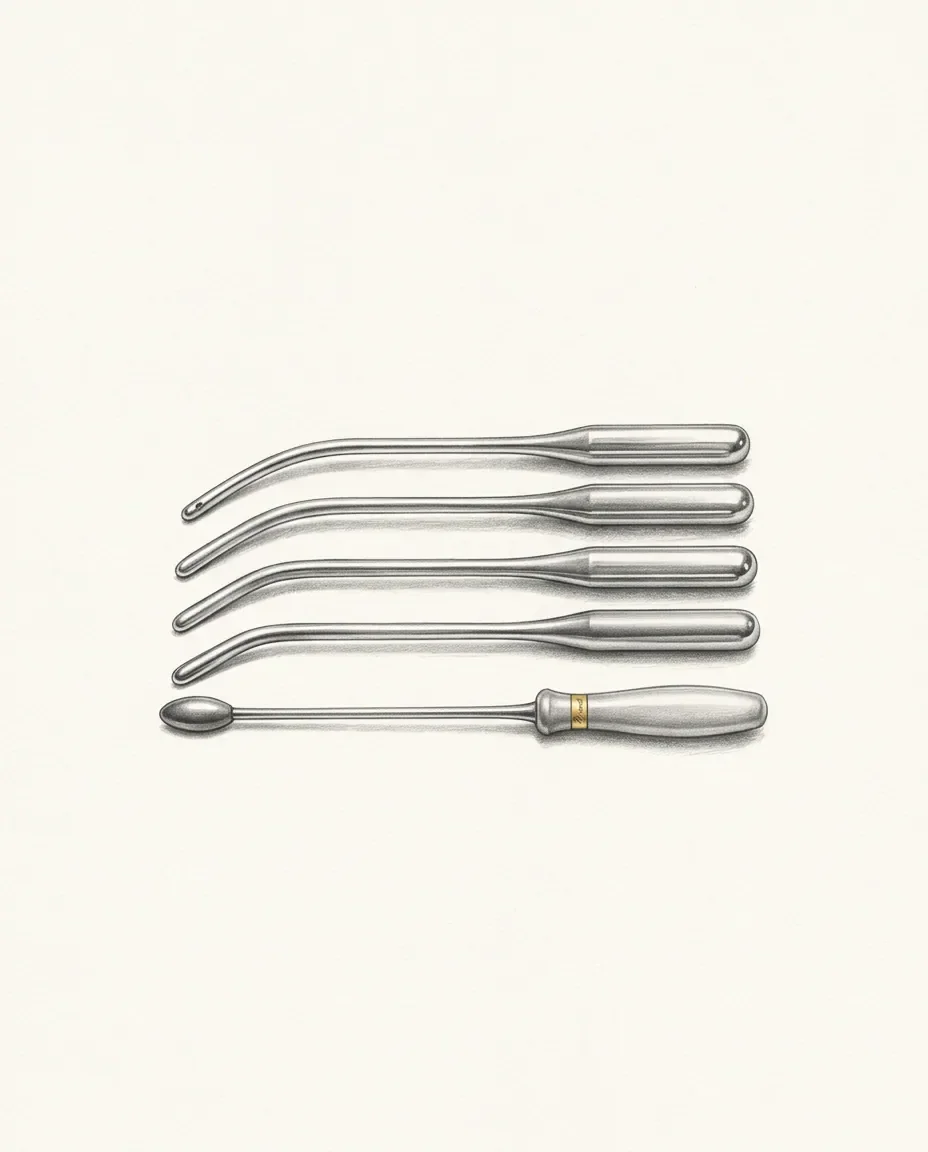
Sounding
Added 22 Jun 2026 · Updated 22 Aug 2026
Consensual insertion of a smooth rod or dilator into the urethra for erotic sensation. A niche, higher-risk form of penetration play named after the medical instruments (urethral sounds) repurposed for it.
- Prevalence
- Rare
- Category
- Sensation & Pain
- Domain
- Sexual interest
- Confidence
- Low confidence
- Status
- Not a recognised paraphilia or disorder; a niche consensual variation of penetration play. Not classified in DSM-5-TR or ICD-11 as a distinct condition.
- Also known as
- urethral sounding, urethral play, sounds, cock stuffing, urethral stimulation, urethral insertion
- Added
- 22 Jun 2026
- Updated
- 22 Aug 2026
Featured in
Overview
Sounding is a form of erotic urethral play in which a smooth, rounded rod or dilator is slowly introduced into the urethra to produce a distinctive internal sensation. It takes its name from the sound, a slender medical probe long used in urology to explore and dilate the urethra. Practised mostly by people with a penis but also possible with a vulva, it sits at the specialist, higher-risk edge of kink and is widely classified within communities as edge play. This article traces the instrument and the practice, how it is expressed, its psychology, and, above all, the medical risks that make it genuinely hazardous.
Examples
What the term covers. The slow introduction of a smooth, rounded rod into the urethra (most often a purpose-made stainless sound from a graduated set, sometimes a silicone dilator) for the internal sensation it produces. It is practised mainly by people with a penis and, less often, by people with a vulva, whose much shorter urethra makes the same act mechanically different. It frequently arrives inside a wider frame: a medical setting kink or doctor and nurse role-play scene, a chastity play arrangement, or a bondage and power-exchange dynamic.
What the term does not cover. It is not urethral dilation performed by a urologist, which uses the same family of instruments on a diagnosed stricture, under sterile conditions, for a clinical reason. It is not electro play, which stimulates with current rather than insertion, nor cock and ball torture, which is externally directed and pain-focused, nor anal play, the other and far more common route to indirect prostate stimulation. Nor has it anything to do with an interest in urine: sounding treats the urethra as a passage, not as a source.
How the word is used. In kink spaces the bare word "sounding" means the erotic practice; in urology a sound is the instrument and sounding the procedure, and the two senses sit uncomfortably close together. It is community vernacular with no clinical -philia coinage attached, and it appears as a named condition in neither DSM-5-TR nor ICD-11; almost everything published about it is urological case literature describing what went wrong. Communities conventionally file it under edge play, the label reserved for practices whose risk cannot be negotiated away.
History & origins
The instrument and its name
The tool long predates the erotic practice. Urological sounds, curved or straight metal probes, were used to locate bladder stones, detect strictures, and atraumatically widen a narrowed urethra. The word itself comes not from any audible note but from nautical depth sounding: the process of determining water depth by lowering a weighted lead line. Both sound and the French sonde share Germanic roots and entered modern English via French, as the Wikipedia instrument article sets out; the popular folk etymology that ties the name to the ring of a probe striking a stone is the weaker account.
- 1842: the Parisian instrument-maker Joseph-Frédéric-Benoît Charrière (1803–1876) introduced the French (Charrière) gauge still used to size catheters, probes and dilators today, as reviewed in the Journal of Pediatric Urology.
- 1875: the American genito-urinary surgeon William Holme Van Buren published A Practical Treatise on the Surgical Diseases of the Genito-Urinary Organs; the solid metal Van Buren sound, still sold in graduated French sizes, carries his name.
- Other 19th- and early-20th-century patterns (Dittel, Pratt, Bakes, and the gynaecological Hegar dilators) gave the instrument family its enduring named designs.
From clinic to kink
Over the 20th century, surplus and purpose-made sounds migrated from the operating theatre into kink subcultures, where sounding became the common name for their erotic use. The medical procedure and the recreational practice differ sharply: as clinicians note, sexual sounding "is not carried out for medical reasons, nor typically with the same level of safety and hygienic precautions." There is no single coined clinical term for the interest, and it is not classified as a distinct condition in the DSM-5-TR or ICD-11. It is documented chiefly through urological case reports rather than the sexology literature.
In practice
A sterilised, well-lubricated rod is introduced slowly and never forced. Practitioners favour smooth, dedicated toys in graduated sizes, typically starting at a thin gauge. The reported appeal is an unusual deep internal sensation, with possible indirect prostate stimulation in people with a penis and clitoral stimulation in people with a vulva. Some pair it with chastity play, medical role-play, or bondage and power exchange; it is sometimes practised alongside interest in the penis itself.
Psychology
The interest is usually understood as a benign variation of penetration play rather than a disorder. Its draw can include the novelty of an otherwise inaccessible internal sensation, the vulnerability and surrender of opening a normally private channel, a taboo charge, and, for some, a medical-play or control fantasy. The evidence base specific to sounding is thin: there is little formal sexological research, and most published material is clinical case literature documenting harm rather than studies of motivation.
Prevalence & culture
Sounding is rare relative to mainstream kinks and seldom appears in population surveys, so firm prevalence figures are scarce. It maintains a visible niche through dedicated toy retailers, BDSM spaces and online communities, while most mainstream visibility comes from cautionary medical writing such as Medical News Today and WebMD. The recurring theme of that literature is risk, not popularity.
Safety, consent & law
This is genuinely higher-risk activity. Documented complications include urinary-tract infection, urethral tearing, false passages, bleeding, scarring and stricture, and foreign bodies becoming lodged, sometimes requiring endoscopic or open surgical removal. A 2020 Cureus case report described a retained silicone object that calcified over months and seeded recurrent UTIs, Staphylococcus epidermidis bacteremia, spinal osteomyelitis and a psoas abscess, ultimately needing spinal fusion. More rarely still, bladder perforation can occur: a 2023 case report documented an intraperitoneal bladder rupture from a blunt object. Many urologists discourage the practice outright. Risk-aware practitioners stress sterilisation, sterile lubrication, smooth purpose-made instruments, never forcing past resistance, and urinating afterward; persistent pain, bleeding or fever warrants prompt medical care. Between consenting adults it is generally lawful, but it is a medical-risk activity rather than a how-to, and any non-consensual urethral penetration is a serious sexual offence.
Common questions
Is urethral sounding safe?
No, and the risk is intrinsic rather than a matter of technique. The urethra is a narrow, delicate passage opening directly onto the bladder and kidneys, so tearing, false passages, bleeding, infection and long-term scarring or stricture are all documented outcomes, as is an object becoming lodged and needing surgical removal. Many urologists discourage the practice outright. Sterile equipment, dedicated smooth instruments and patience lower the odds of harm; nothing removes them.
What does sounding feel like?
Practitioners describe an unusual deep internal pressure with no everyday equivalent, quite unlike external stimulation, sometimes with indirect prostate involvement in people with a penis or clitoral involvement in people with a vulva. Part of the reported appeal is precisely that novelty; part is the vulnerability of opening a normally private channel. There is almost no formal research on the experience, so these descriptions come from community accounts rather than from measurement.
Why is it called sounding?
After the instrument. A urological sound is a slender probe used to explore or widen the urethra, and its name comes from nautical depth sounding (measuring water depth by lowering a weighted line), sharing Germanic roots with the French sonde and reaching English through French. A popular alternative story traces the name to the audible note a probe makes on striking a bladder stone, but that account is the weaker one.
Can people with a vulva do sounding?
Yes, though the anatomy changes the picture considerably. The female urethra is much shorter and sits far closer to the bladder, which compresses the margin for error and makes it easier to carry bacteria straight into the urinary tract. The sensation reported differs accordingly, with more indirect clitoral involvement. Nearly all published case reports and most community material concern people with a penis, so the specific evidence base here is thinner still.
Is sounding illegal?
Between consenting adults it is generally lawful. No jurisdiction singles out consensual urethral play as an offence, and it is reached, if at all, only by general law on sexual assault and bodily harm. Urethral penetration of someone who has not agreed to it is a serious sexual offence everywhere. The meaningful constraint on this practice is medical rather than legal, which is the opposite of the usual pattern in this catalog.
When should someone see a doctor after sounding?
Promptly, if anything is wrong. Bleeding that does not stop quickly, pain that persists, fever or chills, cloudy or foul-smelling urine, difficulty or inability to urinate, or any suspicion that an object has been retained all warrant medical attention rather than waiting it out. Retained foreign bodies in particular do not resolve on their own: a 2020 case report documented one that calcified over months and seeded infection reaching the spine.
Is sounding a paraphilia?
No. It appears in neither DSM-5-TR nor ICD-11 as a distinct condition, and sexology treats it as a niche variation of penetration play rather than as a disorder. The general threshold applies: an interest becomes clinically relevant only when it causes the person marked distress or impairment, or involves someone who has not consented. Its risk profile is a medical question, not a diagnostic one.
- Chastity Play54/100Power, Roles & ScenariosChastity play is a consensual power-exchange practice in which one partner surrenders control over their own sexual release, often via a wearable device. That control passes to a partner ('key-holder') who governs if and when orgasm is permitted. A form of orgasm control, not a paraphilia.54
- Bondage86/100Acts & ActivitiesConsensual binding or restraint of a partner with rope, cuffs, tape or other materials for erotic, aesthetic or sensory pleasure. It is the "B" of BDSM and one of the most widely fantasised-about kinks.86
- Penis Fetish59/100Phallophilia · Body Parts & PartialismA pronounced sexual attraction centred on the penis: its appearance, size, shape, or symbolism. Because attraction to the penis is so widespread, it is generally an ordinary preference rather than a disorder.59
- Predicament Play28/100Sensation & PainA consensual BDSM practice in which a restrained or instructed partner is held in a sustained, awkward position. The position is engineered so that relieving one discomfort introduces another. The appeal lies in endurance, surrender, and slowly building muscular sensation rather than acute pain.28
- Fire Play27/100Pyrophilia · Sensation & PainPyrophilia is a rare paraphilia in which fire, flame, or the imagery of burning is a focus of sexual arousal. The related consensual "fire play" is a BDSM sensation technique using brief, controlled flame on skin. Both are distinct from arson, a crime.27
- Sensory Overload Play29/100Sensation & PainA consensual sensation-play practice of deliberately flooding the senses with intense, layered, or competing input. Overlapping touch, temperature, sound, and light produce an overwhelming, disorienting state. It is the mirror image of sensory deprivation.29
Named after the urological instrument called a "sound." The instrument name derives from nautical "depth sounding", determining water depth with a weighted lead line, sharing Germanic roots with the French "sonde" and entering modern English via French; a popular but weaker folk account traces it to the audible note a probe makes when striking a bladder stone.
urethral play · internal sensation · penetration play · medical play
Prevalence is computed from the entry's cited population estimate. Rows marked ESTare indicative editorial estimates scored against a fixed anchor rubric, not measured quantities. Method & anchors: methodology.
Rare · ≈ 1 in 1,000
- 01Urethral sounding, Wikipediadefinition of sounding as erotic urethral insertion, repurposing of medical sounds, edge-play classification, and core complications (UTI, urethral tearing, infection spreading to bladder/kidneys)
- 02Sound (medical instrument), Wikipediaetymology from nautical depth sounding via Old French 'sonde', use to probe and dilate passages, and named instrument types (Van Buren, Dittel, Pratt, Bakes, Hegar)
- 03Urethral sounding: Risks, safety, precautions, Medical News Todaydocumented risks (bleeding, UTI, urethral trauma, scarring/stricture, lodged foreign bodies, dysuria) and risk-aware precautions (sterilisation, lubrication, dedicated smooth toys, not forcing, urinating afterward)
- 04What Is Urethral Sounding and What Are the Health Risks, WebMDlay-medical framing of sounding and its health risks; that many clinicians discourage the practice
- 05Bladder perforation as a rare complication of urethra sounding with a blunt marking pen, PMC case report (2023)rare but serious complication, an intraperitoneal bladder rupture from a blunt object, documented in the urological literature in 2023
- 06Chronic Infectious Complications of Recreational Urethral Sounding With Retained Foreign Body, Cureus case report (2020)retained foreign body from sounding seeding recurrent UTI, S. epidermidis bacteremia, spinal osteomyelitis and psoas abscess requiring surgery; authors note retained foreign bodies are a rare occurrence
- 07Sounds and Charrière: the rest of the story, Journal of Pediatric Urologyhistory of the urethral sound and the French (Charrière) gauge introduced by Joseph-Frédéric-Benoît Charrière (1803–1876) in 1842
- 08DSM-5-TR, Paraphilic Disorders (American Psychiatric Association, 2022)sounding is not classified as a distinct paraphilic disorder in the DSM-5-TR
- 09ICD-11, Paraphilic disorders (World Health Organization)sounding is not classified as a distinct condition in the ICD-11