Gender Swap Fetish
Added 21 Jun 2026 · Updated 22 Aug 2026
An erotic or imaginative interest in fantasy scenarios where a character changes sex or swaps bodies, rather than any real-world act. It is expressed mainly through fiction, art, captions, games, and role-play. A media-driven theme distinct from real gender identity.
- Prevalence
- Rare
- Category
- Identity & Transformation
- Domain
- Sexual interest
- Confidence
- Low confidence
- Status
- Media-driven fantasy interest, not a clinical paraphilia; generally benign and distinct from real-world gender identity.
- Also known as
- Gender-transformation play, Body-swap / TG fantasy, gender bender, TG fiction interest, body swap fetish, genderswap, transformation fetish
- Added
- 21 Jun 2026
- Updated
- 22 Aug 2026
Featured in
Overview
Gender-swap interest is an erotic or imaginative attraction to scenarios in which a character changes sex or swaps bodies. Often abbreviated TG (for transgender or transformation fiction) and also called gender-bender or body-swap, it lives primarily in fiction, comics, animation, captioned images, interactive fiction, and games, where a magical or technological premise drives the change. It is a media-centred fantasy theme, distinct from a person's real-world gender identity, and this article covers its long narrative lineage, how it is expressed, why it appeals, and how it sits relative to clinical categories.
Examples
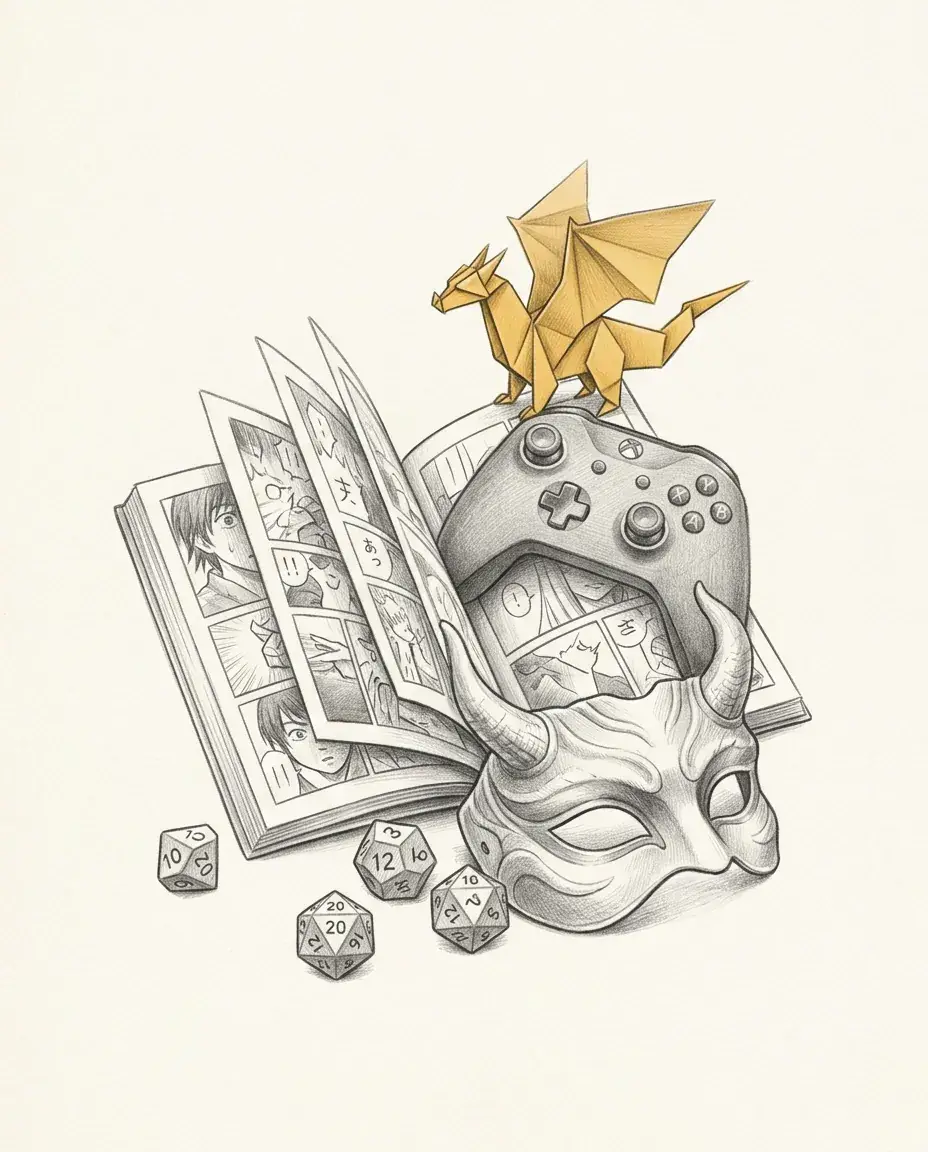
What the term covers. Reading and writing "TG" or "TSF" fiction in which a character is changed from one sex to another by magic, technology or accident; TG captions, an image paired with a short narrative of the change; manga, anime and webcomics built on the premise; body-swap comedies, where two characters exchange bodies rather than one being transformed; interactive fiction and games whose central mechanic is the change; and collaborative role-play written between consenting adults. The change event and the character's reaction to it is usually where the interest sits, which is why many readers drift away once a story settles into a new status quo.
What the term does not cover. Being transgender is not a fetish and bears no relation to it: gender identity is who a person is, while this is a fiction genre about an event that cannot happen. Cross-dressing and sissification involve real clothes and real people rather than depictions. Female masking and kigurumi masking physically approximate a changed body with silicone and latex. Transformation fetish is the wider family this belongs to, taking in changes into animals, objects and other kinds of being. Futanari and monster girl are drawn genres defined by what a character permanently is rather than by a change undergone. Autogynephilia and its counterpart autoandrophilia are contested research constructs about arousal to oneself as another sex, not descriptions of a media genre.
How the word is used. The vocabulary is fan-community jargon with no clinical standing. "Genderswap", "gender-bender", "TG" and "TSF" work as archive and board tags rather than as labels anyone claims as an identity, and none appears in DSM-5-TR or ICD-11. Outside any erotic context "gender-bender" is also an ordinary reviewer's word for a mainstream body-swap film, which is part of why the term is easy to misread.
History & origins
Mythic and literary roots
The motif of changing sex is ancient, and the fan interest inherits a deep narrative tradition rather than a clinical one.
- c. 8 CE: Ovid's Metamorphoses supplies the canonical templates: the seer Tiresias, transformed into a woman for seven years and uniquely able to judge which sex enjoys love more; and Iphis, a girl raised as a boy whom the goddess Isis transforms into a man so the wedding can proceed. These stories made bodily sex-change a durable storytelling device millennia before any erotic subculture existed.
- 1928: Virginia Woolf's Orlando gave the theme a landmark literary treatment, its protagonist changing from man to woman and living across centuries, an early exploration of gender as fluid and performed.
Modern media and the fan genre
- 1959–1994: Mainstream cinema kept the comic gender-bender alive, from Some Like It Hot (1959) through body-swap comedies, popularising the trope for wide audiences.
- 1987: Ranma ½, Rumiko Takahashi's manga (serialised in Weekly Shōnen Sunday from 1987), became a defining gender-swap work: its hero is cursed to turn into a girl in cold water and back in hot. Takahashi described wanting something "gender-free"; the anime became one of the first of its kind popular in the United States and is widely credited with shaping a Western fan appetite for the premise.
- 1990s–2000s: As personal computing and the early internet enabled niche fiction archives, mailing lists, and image-captioning communities, the labels "TG," "TSF" (transformation), and "genderswap" coalesced as recognised tags and genres. The precise coinage of these community labels is not well documented; they emerged organically online rather than from any clinical source.
Relationship to clinical categories
Gender-swap interest is not a recognised diagnosis. It appears in neither the DSM-5-TR nor the ICD-11 as a disorder, and reputable references treat transformation and gender-play fantasy as imaginative themes rather than paraphilias. It is conceptually adjacent to, but distinct from, clinically discussed phenomena such as autogynephilia, and entirely separate from real gender identity and transition, which it should never be conflated with.
In practice
The interest is typically expressed through consuming and creating media rather than physical practice: reading and writing fiction, drawing or commissioning art, making "TG captions" (an image paired with a short transformation narrative), and playing interactive fiction or games built on a magical or technological change premise. Some explore it further in collaborative writing and online role-play. The appeal often lies in the transformation itself, its novelty and the imaginative perspective-taking, more than in any specific final presentation.
Psychology
Proposed drivers include curiosity about embodying another sex, the narrative tension of involuntary change as a fantasy device, escapism, and identity exploration in a low-stakes imaginative space. For most enthusiasts it is a fictional theme held quite separately from their lived gender identity; for some it overlaps with cross-dressing, sissification, and self-image interests. The evidence base is thin: the topic has attracted little dedicated empirical study, so psychological accounts remain largely qualitative and provisional.
Prevalence & culture
The interest has a dedicated but niche following spread across fiction archives, forums, image-board threads, subreddits, and art communities, with limited mainstream recognition beyond the occasional body-swap trope in popular film and television. Because dedicated study is minimal and the theme rarely appears as a discrete item in the major fantasy surveys (such as Joyal, Cossette & Lapierre, 2015), any prevalence estimate is proxy-based, inferred from search interest and community size rather than measured directly, and should be read as a rough indication of rarity.
Safety, consent & law
Because it is fantasy and media-centred, the interest is generally harmless and raises no real-world consent issues between people. The relevant considerations attach to the media involved: that it is age-appropriate, consensually produced, and posted in line with platform rules. As with all fictional erotica, the fantasy of involuntary transformation is understood within the community as a narrative device, not an endorsement of real-world coercion.
Common questions
Is a gender swap fetish the same as being transgender?
No, and the two should not be run together. Being transgender is a matter of identity: who a person actually is, lived out over time and unrelated to arousal. A gender-swap interest is an attraction to a storytelling device in which a fictional character's body changes. One describes a real life, the other describes fiction, and most people with this interest hold it entirely apart from their own gender.
Does enjoying gender-swap fiction mean I have gender dysphoria?
Not by itself. Imagining a different body is a common thing for readers to enjoy, and finding a transformation story compelling is not diagnostic of anything. Gender dysphoria is defined by persistent distress about one's own sex characteristics or social role, not by what fiction someone reads. Where that distress is present it deserves to be taken seriously on its own terms, and discussed with a clinician, separately from any interest in the genre.
What is the difference between gender swap and body swap?
A gender swap changes one character's sex while leaving them otherwise themselves. A body swap exchanges two characters' bodies, and often involves no change of sex at all: the mainstream comedies built on the device frequently swap a parent and child of the same sex. The two overlap only when a body swap happens to be between a man and a woman, which is the version that draws this audience.
Is a gender swap fetish a paraphilia or a disorder?
No. It is listed in neither DSM-5-TR nor ICD-11, and reputable references treat transformation and gender-play fantasy as imaginative themes rather than clinical categories. It has attracted almost no dedicated research, so what exists is descriptive rather than diagnostic. As with any interest, a clinical question would arise only if it caused a person real distress or impairment.
Why are the transformations in these stories almost always involuntary?
Because the loss of control is the engine of the story. A curse, a spell or a machine gone wrong creates stakes, resistance and a reaction worth writing about, which a freely chosen change does not. Within the community this is understood as a narrative device rather than an endorsement of real-world coercion, in much the way that thriller readers do not endorse the crimes their plots require.
Is there anything harmful about a gender swap fetish?
Not in itself. It involves fiction rather than other people, so no question of real-world consent arises between participants. The considerations that do apply are the ordinary ones for erotic media: that it depicts adults, that anything commissioned or shared is consensually produced, and that it is posted where the platform's rules allow. Conflating the genre with real transgender people is the more common harm.
- Sissification43/100Identity & TransformationA consensual power-exchange role-play in which one adult partner directs another, usually a cisgender man, to adopt feminine presentation. It is often combined with submission or humiliation themes. The word "forced" denotes a negotiated fantasy, not actual coercion.43
- Self-As-Female Arousal32/100Autogynephilia · Identity & TransformationAutogynephilia is a contested research construct describing sexual arousal at the thought or image of oneself as female. The proposed pattern concerns people assigned male. It appears in the DSM-5 only as a specifier for transvestic disorder, not as a stand-alone diagnosis.32
- Cross-Dressing60/100Transvestism · Identity & TransformationWearing clothing associated with another gender, sometimes for erotic arousal and sometimes for comfort, self-expression, or relaxation. When arousal is persistent and causes distress it is diagnosed clinically as transvestic disorder; the interest itself is benign and distinct from transgender identity.60
- Human Furniture27/100Forniphilia · Identity & TransformationA consensual power-exchange role-play in which a submissive adult takes the role of an object, such as a piece of furniture. A dominant partner then treats them as such. It is a negotiated dehumanization fantasy among consenting adults.27
- Breast Expansion Fetish29/100Identity & TransformationAn erotic and imaginative fascination with the fantasy of breasts rapidly, often dramatically, enlarging. Almost entirely expressed through drawn art, animation, comics, and fiction rather than any real physiological event.29
- Giantess Fetish31/100Macrophilia · Identity & TransformationMacrophilia is an erotic or romantic fascination with giant or vastly oversized beings, most commonly a giant woman (giantess). The appeal centers on extreme size difference and the fantasy of being tiny in relation to a much larger figure.31
A plain-English compound: "gender" (via Old French gendre from Latin genus, "kind" or "type") plus "swap" (an English word meaning to exchange). The community shorthands "TG" (transgender / transformation fiction) and "TSF" (transformation) arose online and have no classical clinical root.
fantasy transformation · gender play · media-driven
Prevalence is computed from the entry's cited population estimate. Rows marked ESTare indicative editorial estimates scored against a fixed anchor rubric, not measured quantities. Method & anchors: methodology.
Rare · ≈ 1 in 1,000
- 01List of paraphilias, Wikipediaexistence/definition of transformation and gender-play fantasy interests
- 02Google Trends, relative search interest (search-interest proxy)search-interest proxy for genderswap / TG transformation fiction
- 03FetLife, kink community group sizes (community-size proxy)community-size proxy for transformation/gender-play interest groups
- 04Gender bender, Wikipediahistory and cultural lineage of gender-swap and body-swap motifs in mythology, literature, and media
- 05Metamorphoses (Ovid), Wikipediaclassical sex-change templates Tiresias and Iphis (c. 8 CE) as the narrative roots of the gender-swap motif
- 06Orlando: A Biography (Virginia Woolf, 1928), Wikipedialandmark 1928 literary treatment of a protagonist who changes sex across centuries
- 07Ranma ½, Wikipediadefining 1987 gender-swap manga/anime by Rumiko Takahashi and its role in popularising the premise in the West
- 08DSM-5-TR, Paraphilic Disorders (American Psychiatric Association, 2022)gender-swap fantasy is not listed as a paraphilic disorder
- 09ICD-11, Paraphilic disorders (World Health Organization)gender-swap fantasy is not recognised as a disorder in the ICD-11 framework
- 10Joyal, Cossette & Lapierre (2015), What Exactly Is an Unusual Sexual Fantasy?, J. Sexual Medicine 12(2):328-340major general-population fantasy survey in which transformation/gender-swap themes do not appear as a distinct, commonly reported item