Heartbeat Fetish
Cardiophilia
Added 22 Jun 2026 · Updated 22 Aug 2026
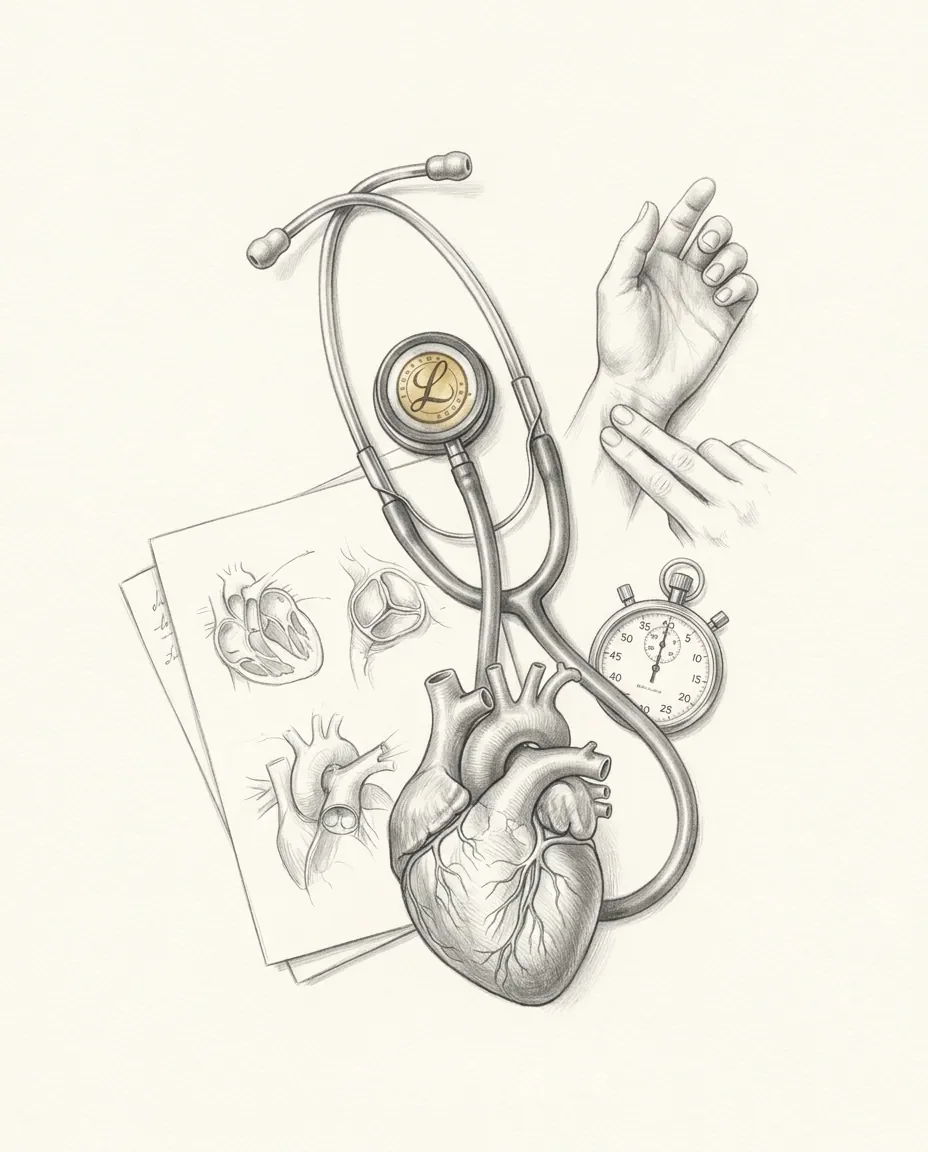
An erotic or sensual interest in the heart and heartbeat, its sound through a stethoscope or an ear pressed to the chest. The pulse felt at the wrist or neck counts too, as does how it quickens with emotion and exertion. A rare interest with a small, durable online community.
- Prevalence
- Rare
- Category
- Body Functions & Fluids
- Clinical term
- Cardiophilia
- Domain
- Sexual interest
- Confidence
- Low confidence
- Status
- Rare benign variation; not a recognized disorder. Cardiophilia is not listed in the DSM-5-TR or ICD-11 and appears mainly in glossaries and community usage.
- Also known as
- cardiophilia, heart fetish, cardiofetishism, auscultation kink, pulse kink, stethoscope fetish
- Added
- 22 Jun 2026
- Updated
- 22 Aug 2026
Overview
Heartbeat fetish, sometimes termed cardiophilia, is a sexual or sensual interest in the heart and its rhythm. The focus may be auditory (the beat heard through a stethoscope, an ear pressed to the chest, or a recording), tactile (a pulse felt at the wrist, neck, or chest), or visual (a pulse seen beneath the skin). Many enthusiasts are especially drawn to how the heart behaves as an honest, involuntary signal: quickening with arousal, nervousness, or exertion, and producing small irregularities like skips, pauses, and held breaths. This article surveys the term's loosely documented origins, how the interest is typically expressed, the proposed psychology, and its small online culture.
Examples
What the term covers. An ear or a hand resting on a partner's chest; listening through a stethoscope; finding the pulse at the wrist, the neck or the inside of the elbow and following it; watching a pulse move under thin skin; recorded heart audio, listened to alone or shared; and the particular interest in how the rate answers to nerves, exertion or arousal, skips and held breaths included. Medical-themed role-play is a common frame for all of it, because it supplies a reason to listen.
What the term does not cover. Nothing in it interferes with the heart or with breathing. Choking kink, breath play and erotic asphyxiation restrict blood or air and are dangerous for precisely that reason; here the body is being listened to and nothing is being obstructed, and the two should never be run together. A blood fetish attaches to blood itself and carries an infection risk this interest does not; a breath fetish pays the same attention to a different involuntary signal; a skin fetish stops at the surface rather than at what moves beneath it. Medical setting kink and doctor/nurse role-play share the stethoscope but are organised around the scene and its authority rather than around the rhythm.
How the word is used. Cardiophilia is community and dictionary vocabulary rather than clinical language, and the -philia form gives it a diagnostic look it does not carry. The everyday phrase is "heartbeat fetish", and "cardiophile" is the usual self-description inside the small forums where the interest is discussed at all.
History & origins
Unlike the classic sexological paraphilias, heartbeat fetish has no crisp moment of clinical coinage; its lineage is documented chiefly through lexicography and self-describing community writing rather than a founding clinical text.
Clinical lineage
The label cardiophilia is a modern compound of familiar medical roots rather than a coinage by a named nineteenth-century sexologist. It does not appear in the founding catalogues of Krafft-Ebing's Psychopathia Sexualis (1886) or Havelock Ellis, and it is not a recognised diagnosis in the DSM-5-TR or the ICD-11. It is likewise absent from comprehensive taxonomies such as the list of paraphilias. The word is instead defined descriptively in dictionaries (Wiktionary glosses cardiophilia as "a paraphilia or fetish in which one is sexually aroused by, or extremely fond of, the heart or a heartbeat") making it a recognised term of usage rather than a clinical category.
Cultural & subcultural evolution
The practical vocabulary comes from the online community, which distinguishes several threads:
- Cardiophilia: the broad, sometimes romantic or aesthetic, fascination with the heart and heartbeat.
- Cardiofetishism: the strictly sexual form of that interest.
- Auscultation kink: arousal from listening to body sounds (chiefly the heart) with an ear or stethoscope.
- Pulse kink: arousal from feeling the pulse moving through an artery or vein.
Community primers (for example, the long-running "the origins of cardiophilia or heartbeat fetish" post circulated on Tumblr) describe the interest as predating the internet but coalescing into a visible scene on blogging and forum platforms (Tumblr, Reddit, and others) from the 2000s onward, with active English-speaking and Japanese communities. Its members frequently note its rarity and the difficulty of "coming out" with so uncommon an interest.
In practice
Expression is usually intimate and low-risk: resting an ear or hand on a partner's chest, listening with a stethoscope, feeling a pulse point, timing the rise and fall of the beat, or sharing audio recordings and medical-themed role-play. A recurring theme is the heart as a truthful witness to a partner's emotional and physical state: something that cannot easily be faked. The interest overlaps with medical play-adjacent listening, ASMR-style heart audio, and the appeal of skin contact, and sits near blood, breath, and anatomy-focused interests. It is distinct from a choking kink: the heartbeat focus is on the sound and rhythm as a signal, not on restricting breath or blood flow.
Psychology
What causes a heartbeat fetish?
No single cause is established, and the interest has attracted essentially no dedicated empirical study. Proposed contributors include ordinary erotic conditioning, the heart's deep cultural status as the seat of love and life, and the intimacy of being trusted with such a private, involuntary signal. A frequently cited line of reasoning points to the soothing power of heartbeat sound: the maternal heartbeat is among the earliest stimuli a fetus hears, and clinical research finds that heartbeat audio measurably calms and stabilises infants: for example, Zhang and colleagues report benefits to heart rate, weight, and sleep in premature infants exposed to the mother's heartbeat, and Webb and colleagues (2015) in PNAS found that maternal heartbeat and voice shape auditory-cortex development before full gestation. That early comforting association may, on some accounts, later acquire affectionate or erotic charge. Such mechanisms remain speculative; like most niche interests, heartbeat fetish is regarded as a benign variation when consensual.
Prevalence & culture
How common is a heartbeat fetish?
Heartbeat fetish is rare, with little dedicated research and modest mainstream visibility. It is not separately counted in the large fetish-prevalence surveys (such as Scorolli et al. (2007) or Joyal & Carpentier (2017)), so any prevalence figure is an approximation drawn from the small but durable online community rather than population data. Cultural traces appear mainly in heart-themed ASMR, womb-sound recordings marketed for calming infants, and dedicated fan blogs and sites.
Safety, consent & law
The interest is legal and physically low-risk between consenting adults, subject to the usual considerations of consent and comfort. Where it shades into medical role-play, an important caveat applies: a stethoscope and lay listening are not diagnostic, and genuine cardiac symptoms (chest pain, fainting, an irregular or racing heart) warrant a real clinician, never a scene.
Common questions
Is a heartbeat fetish the same as a choking kink?
No, and the distinction matters more here than usual. This interest is about hearing and feeling the heart as a signal; nothing is restricted and no pressure is applied to anyone. A choking kink compresses the neck and reduces blood flow to the brain, with documented risk of injury and death. A shared interest in the body's rhythms does not make one a mild version of the other.
Do you need a stethoscope for a heartbeat fetish?
No. An ear against the chest, or fingers at the wrist or neck, does everything the interest requires, and many people use recordings instead. An inexpensive stethoscope is a common prop because it makes the sound clearer and adds a medical frame, but it is exactly that, a prop: lay listening tells you nothing diagnostic however good the instrument.
Is cardiophilia a recognised paraphilia?
No. It is defined descriptively in dictionaries such as Wiktionary and used inside its own online community, but it is named in neither DSM-5-TR nor ICD-11 and does not appear on the standard reference lists of paraphilias. That makes it a term of usage rather than a clinical category, and like other benign interests it would only reach a clinician if it caused genuine distress or impairment.
Is a heartbeat fetish a kind of medical play?
They overlap without being the same. Medical setting kink and doctor/nurse role-play are built on the authority and ritual of a clinical scene, and the stethoscope is one of its props. For a heartbeat interest the scene is optional scaffolding; the sound and rhythm are the point, which is why much of it happens with an ear to a partner's chest and no scenario at all.
Why do heartbeat sounds feel comforting?
Heartbeat sound is among the first things a person ever hears, and the effect outlasts infancy. Webb and colleagues (2015) found that maternal heartbeat and voice shape auditory-cortex development before full gestation, and Zhang and colleagues report improvements in heart rate, weight and sleep among premature infants exposed to the mother's heartbeat. Whether that early association is what later takes on an erotic charge is a plausible idea rather than a tested one.
Is it strange to want to listen to a partner's heartbeat?
It is uncommon as a stated interest and entirely ordinary as an impulse; resting a head on someone's chest is one of the most familiar gestures of intimacy there is. What this entry describes simply makes that the point rather than a by-product. It asks for nothing beyond consent and a willing partner, and people in the small community around it more often report difficulty explaining it than any problem with the thing itself.
- Blood Fetish29/100Hematolagnia · Body Functions & FluidsAn erotic interest in blood, in its sight, scent, warmth, or symbolic links to vitality, danger, and intimate bonding. Consensual blood play is one form it sometimes takes. It is rare and carries serious bloodborne-infection risk.29
- Breath Fetish19/100Halitophilia · Body Functions & FluidsHalitophilia is an erotic interest in a partner's breath: its warmth, sound, scent and the intimacy of feeling it against the skin. A rare, scent-oriented interest with a small online following, usually framed as one facet of a wider attraction to natural body scent.19
- Skin Fetish29/100Integumentophilia · Body Parts & PartialismA focused erotic interest in human skin itself, its texture, smoothness, warmth, scent and sheen, rather than the body as a whole. The act of touching and being touched is part of it. It is generally a benign aesthetic and tactile preference.29
- ASMR69/100Autonomous Sensory Meridian Response · Non-Sexual FetishismA non-sexual, pleasant tingling sensation that typically begins on the scalp and moves down the neck and spine. Soft sounds, gentle attention, or close personal care trigger it. It underpins a large online relaxation-media subculture.69
- Choking Kink78/100Sensation & PainA consensual interest in choking or being choked at the neck during sex: usually as a gesture of dominance, surrender, or intensity. Clinically termed sexual choking or strangulation, it is now common among young adults and carries serious, sometimes hidden, physical risk.78
- Sneeze Fetish19/100Mucophilia · Body Functions & FluidsAn erotic interest in sneezing (its sound, the bodily convulsion, and the loss of composure it represents) sometimes extending to nasal mucus. It is a rare body-function interest with a small, internet-based community.19
A modern clinical-style compound from the Greek *kardiā* (καρδιά, "heart") and *-philia* (φιλία, "love, attraction to"), literally "love of the heart." The same *cardio-* root underlies cardiology and cardiac.
heartbeat · pulse · auscultation · medical play · body function
Prevalence is computed from the entry's cited population estimate. Rows marked ESTare indicative editorial estimates scored against a fixed anchor rubric, not measured quantities. Method & anchors: methodology.
Rare · ≈ 1 in 1,000
- 01cardiophilia, Wiktionary, the free dictionarydefinition and Greek etymology (kardiā 'heart' + -philia) of cardiophilia as arousal by the heart or heartbeat
- 02The origins of cardiophilia or heartbeat fetish, xxhearts.com (Internet Archive)community description of expression: auscultation with a stethoscope, visible pulses, and heart-rate response to emotion and exertion; distinguishes cardiophilia from cardio fetishism (partialism)
- 03so you're a cardiophile, community primer (Tumblr)community terminology: cardiophilia vs cardiofetishism, auscultation kink, pulse kink
- 04Zhang et al., Effect of the sound of the mother's heartbeat combined with white noise on heart rate, weight, and sleep in premature infants, Annals of Palliative Medicineevidence that maternal-heartbeat sound calms infants, grounding the psychology section's comforting-association hypothesis
- 05List of paraphilias, Wikipediataxonomic context for body-focused paraphilias and the weakly-attested clinical status of cardiophilia (cardiophilia is absent from the list)
- 06The origins of cardiophilia or heartbeat fetish, community primer (Tumblr)community account that the interest predates the internet but coalesced on blogging/forum platforms from the 2000s, with English-speaking and Japanese scenes
- 07Webb et al. (2015), Mother's voice and heartbeat sounds elicit auditory plasticity in the human brain before full gestation, PNAS 112(10):3152-3157maternal heartbeat and voice shape auditory-cortex development before full gestation, grounding the early-comforting-association hypothesis in the psychology section
- 08Scorolli et al. (2007), Relative prevalence of different fetishes, Int. J. Impotence Research 19(4):432-437named large fetish-prevalence survey that does not separately count heartbeat/cardiophilia, supporting the absence-of-population-data point
- 09Joyal & Carpentier (2017), The Prevalence of Paraphilic Interests and Behaviors in the General Population, J. Sex Research 54(2):161-171named general-population paraphilia survey that does not separately count heartbeat/cardiophilia
- 10Psychopathia Sexualis, Wikipediafounding sexological catalogue (Krafft-Ebing, 1886) in which cardiophilia does not appear, supporting its non-classical clinical lineage
- 11DSM-5-TR, Paraphilic Disorders (American Psychiatric Association, 2022)cardiophilia is not a recognised diagnosis in the DSM-5-TR
- 12ICD-11, Paraphilic disorders (World Health Organization)cardiophilia is not a recognised diagnosis in the ICD-11