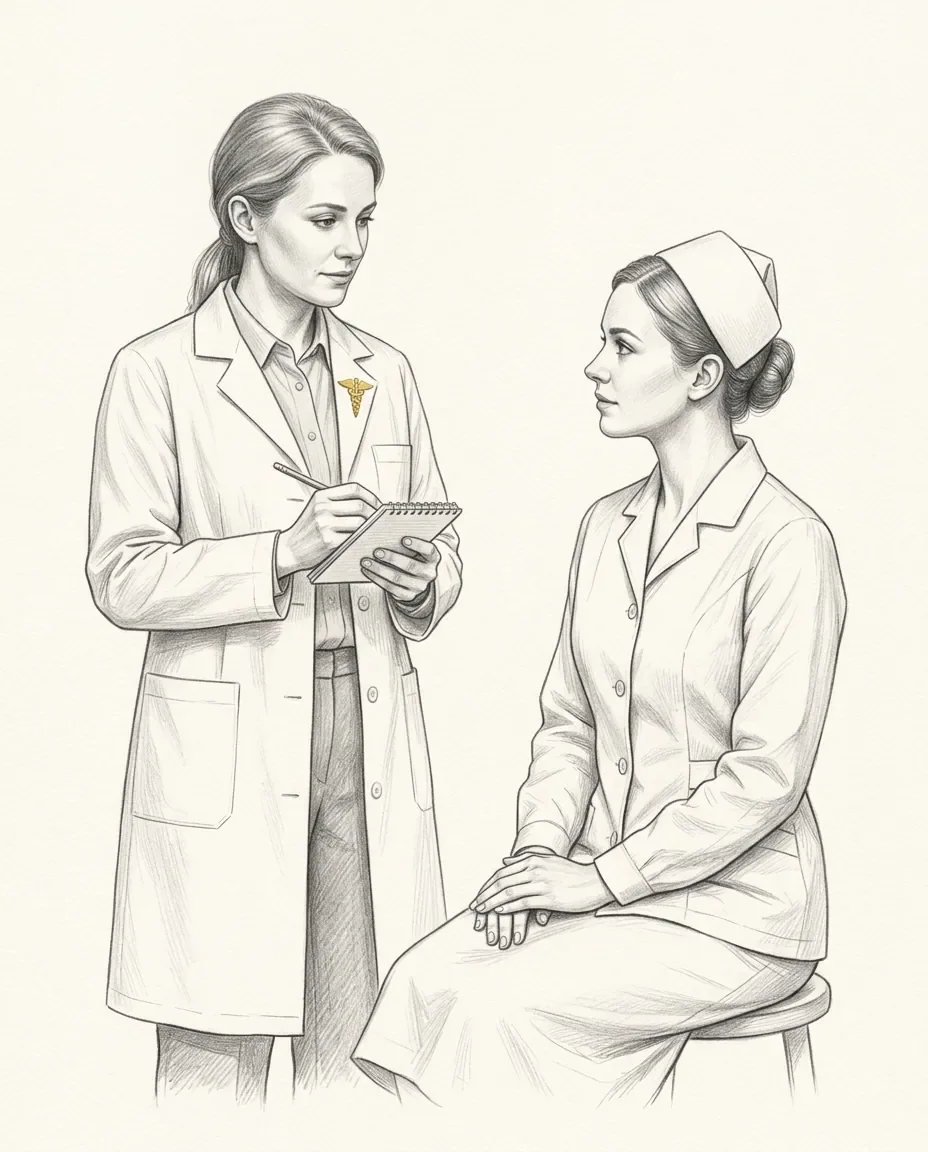
Doctor/Nurse Role-Play
Added 21 Jun 2026 · Updated 22 Aug 2026
Doctor/nurse role-play (medical play) is a consensual role-play sub-genre set in a clinical scenario, such as a doctor or nurse examining a patient. Arousal draws on the authority, vulnerability and ritual of a medical setting, enacted as fiction between adults.
- Prevalence
- Common
- Category
- Power, Roles & Scenarios
- Domain
- Sexual interest
- Confidence
- Medium confidence
- Status
- Not a paraphilia or disorder; a recognized role-play sub-genre among consenting adults.
- Also known as
- Medical role-play, medical fetish role-play, examination play, clinical play, clinical scenario play, medical play
- Added
- 21 Jun 2026
- Updated
- 22 Aug 2026
Featured in
Collection
Roleplay & Scenario Fantasies
Stepping into a role (teacher, doctor, stranger), and the costumes and settings that bring it to life.
17 entries
Collection
Medical & Clinical Play
The clinic as a scene: examinations, instruments and the particular charge of clinical authority, each defined and ranked.
7 entries
Overview
Doctor/nurse role-play (often called medical play) is a category of consensual sexual role-play that stages a clinical scenario: most commonly a practitioner–patient relationship (doctor, nurse, examiner) built around an examination, procedure or consultation. Its eroticism draws on the power asymmetry of the clinic, the enforced passivity and exposure of the patient role, and the precise, ritualised atmosphere of a medical setting, all enacted as fiction between consenting adults. This article traces where the script comes from, how it is typically expressed, what is thought to drive its appeal, and where it sits relative to the broader interest of medical fetishism.
Definition & scope
Doctor/nurse role-play is a scenario, not an object fetish: the erotic frame is the clinic and its roles, not a single instrument. It sits inside the wider medical-setting kink and overlaps with uniform fetishism and general authority role-play, but is defined by the practitioner–patient script specifically. It should be distinguished from the discrete medical-themed fetishes it can borrow from, such as klismaphilia (arousal from enemas), which are interests in a particular procedure rather than in the clinical role-play as a whole.
Examples
The script is unusually well known, which is why it is among the most frequently attempted role-plays and also among the most often confused with the interests around it.
What the term covers. A consultation played out in ordinary clothes, with nothing but the language of the clinic doing the work; a costumed check-up with a coat, gloves and a stethoscope; a longer scene built around a fictional procedure, an admission, or a course of "treatment" running over several sessions; and the same scenario staged as power exchange, where the practitioner's authority is the point and the examination merely the pretext. The setting can be a bedroom dressed with two props or a fully staged room; nothing in the frame requires escalation.
What the term does not cover. It is a scenario, not an object interest, so the medical-themed fetishes it borrows from stay distinct: klismaphilia, needle play, sounding and interests in gloves or latex attach to a particular thing and need no role-play at all. Neighbouring authority scripts (teacher, boss and secretary, captor and captive) share the structure but not the setting. And the fiction has no bearing whatever on real clinical encounters: sexual contact between a practitioner and a patient is misconduct and a criminal matter, not a version of this.
How the word is used. "Doctor/nurse role-play" is the plain descriptive name; medical play is the community shorthand, and the term used in kink spaces and event listings. Neither appears in DSM-5-TR or ICD-11, because consensual role-play is not a diagnosis. The phrase's oldest sense is entirely innocent: "playing doctor" names a childhood curiosity game, and the adult usage borrows the frame rather than the meaning.
History & origins
Clinical lineage
The erotic charge of clothing, ritual and asymmetric roles was catalogued by the founders of sexology long before "medical play" had a name. Richard von Krafft-Ebing's Psychopathia Sexualis (1886) treated the eroticisation of uniforms, authority and fetish objects as a recurring theme, and Havelock Ellis's Studies in the Psychology of Sex (1897–1928) similarly documented how dress and situational ritual become focal points of arousal: the conceptual ancestors of today's uniform and authority play. The clinic is a natural setting for these threads to converge, because it is one of the few socially sanctioned contexts that combine authority, intimacy and permitted exposure.
Within the medical theme specifically, several adjacent interests received dedicated clinical attention. Klismaphilia (arousal from enemas) was named and described by psychiatrist Joanne Denko in her 1973 paper Klismaphilia: Enema as a Sexual Preference, and later writers grouped temperature-taking, examination, catheter and restraint interests under the umbrella of medical fetishism. Doctor/nurse role-play itself is not a clinical diagnosis: neither the DSM-5-TR nor the ICD-11 lists consensual medical role-play as a disorder, and contemporary frameworks treat consensual fantasy as a normal variation rather than a paraphilia.
Cultural & subcultural evolution
As a costume and adult-media genre, doctor/nurse scenarios crystallised across the twentieth century alongside the broader growth of role-play and uniform fetishism, helped by the unusually strong cultural visibility of the nurse's uniform. The childhood game of "playing doctor" gave the motif an early, non-sexual foothold in popular imagination, while the nurse and the white-coated physician became durable stock characters in costume catalogues, comedy and pornography alike. The precise coinage of "medical play" as a community term is not well documented, but practitioner-oriented surveys of kink, notably Gloria Brame's Different Loving (1993), described medical scenarios as an established sub-genre of dominance-and-submission play by the early 1990s. Medical and clinical fetish themes became more visible during the later twentieth-century sexual-liberation movements, and online kink communities later consolidated shared scripts, etiquette and safety norms around them.
In practice
The interest is expressed through clinical props and costumes (gowns, gloves, instruments, a staged exam room), formal practitioner–patient dialogue, and the choreography of a staged examination, consultation or procedure. It overlaps heavily with authority role-play, power exchange, uniform fetishism and restraint themes, and, as with teacher role-play, much of the charge comes from a clearly bounded authority figure rather than from any specific act. Partners typically agree on the scenario, props and limits beforehand, treating the clinical frame as a shared piece of theatre.
Psychology
What drives the appeal?
The appeal is usually understood through the eroticisation of vulnerability and of being "cared for," the safety of a clearly defined authority role, and the tension between the impersonal clinical frame and intimate exposure. A structured, rule-bound setting can make surrender feel both safe and heightened, and the familiarity of the script lowers the effort of improvisation: the roles, props and dialogue are culturally pre-loaded. Learning-theory accounts add that uniforms and clinical cues can become conditioned arousal triggers through association, though the evidence base for any single mechanism behind role-play preferences is thin and largely descriptive rather than experimental.
Prevalence & culture
How common is doctor/nurse role-play?
Doctor/nurse scenarios are a recognisable and moderately common role-play script, long present in adult media and costume culture, which gives them reasonable visibility while remaining more niche than generic role-play. Large fantasy surveys establish the surrounding context: in Justin Lehmiller's Tell Me What You Want (2018), based on 4,175 Americans, BDSM and power/control fantasies were among the most common themes, and only a small minority of respondents reported never having a BDSM-flavoured fantasy. Mainstream lay references treat medical role-play as one of the more accessible, frequently listed kinks (Glamour's A–Z of kinks), and dedicated communities exist around medical fetishism specifically. No survey isolates "doctor/nurse role-play" with a precise prevalence figure, so the directory's estimate is an informed approximation rather than a measured value.
Safety, consent & law
The interest is legal and benign when enacted between consenting adults using fiction and props. Practical safety matters where real equipment is involved: instruments, restraints and any procedure-like elements (for example enema or speculum play) must be handled knowledgeably and hygienically, and several medical-fetish practices, anaesthesia or breath-related play in particular, are genuine edge-play that can cause serious harm and should never be improvised. The fantasy must never be confused with, or used to disguise, non-consensual contact in an actual care setting, which is a grave abuse of trust and unlawful. As a consensual script between adults it is a normal-variation fantasy, not a disorder.
Common questions
Is doctor/nurse role-play safe?
As costume-and-dialogue play, the risk is close to zero, because nothing is actually being done to anyone. Risk enters with real equipment. Anything that goes inside the body, such as a speculum, a catheter or a sound, needs sterile single-use kit and knowledge of how it is meant to be used; restraint needs a reliable way out; and the scenarios drawn from anaesthesia or breath play are genuine edge play that has killed people and should never be improvised.
Do you need real medical equipment for medical play?
No, and most people use very little. A white coat or scrubs, gloves, a stethoscope and the right register of speech carry the scenario further than any instrument does, because the appeal is the role and the ritual rather than the hardware. Props sold as costume items are built to look convincing rather than to function, which for this purpose is exactly right: the fiction is doing the work.
Is it normal to feel aroused during a real medical examination?
It is common and unremarkable. An examination combines close attention, authority and permitted exposure, and bodies do not always distinguish that context from an intimate one; an involuntary response is not a statement of intent, and nothing follows from it. The professional boundary sits entirely on the clinician's side and does not move. A patient's private reaction is not something they need to disclose, apologise for, or act on.
How do you start medical role-play with a partner?
Agree the scenario before anyone puts on a costume: who plays which role, what the examination is nominally for, how far it goes, what is off the table, and a safeword that steps outside the fiction entirely. Starting small, with a consultation rather than a procedure, lets both people find out whether the register works for them. Talking afterwards about how it landed matters as much as the planning did.
What is the difference between medical play and medical fetishism?
Scope. Medical play is the scenario: a clinical setting, a practitioner, a patient, and whatever script the two people agree on. Medical fetishism is the wider family of interests attached to specific objects or procedures (gloves, latex, instruments, enemas, examinations), which can be pursued with no role-play at all. Most people who enjoy one have some interest in the other, but neither requires the other.
Is medical play a type of BDSM?
It overlaps heavily without being contained by it. The clinic supplies a ready-made authority gradient, so medical scenarios sit naturally inside dominance and submission and are usually run with the same negotiation, limits and safewords. But the script works perfectly well as straight theatre between equals, with no power exchange, no restraint and no pain, which is why it is catalogued as role-play first and BDSM second.
Why is the nurse such a common fantasy figure?
Three things converge: an instantly readable uniform, a role defined by care and physical proximity, and a century of stock characters in comedy, advertising and pornography keeping the image in circulation. Nurses themselves frequently object to the trope, and with reason: it attaches a sexual script to a demanding clinical profession that has nothing to do with it. The costume is doing the work here, not the occupation.
- Roleplay81/100Power, Roles & ScenariosAdopting characters, personas, or imagined scenarios to enact sexual fantasy with a partner. One of the most common and versatile sexual interests, role-play frames or heightens arousal through story, character, and pretend.81
- Teacher Roleplay62/100Power, Roles & ScenariosAn authority role-play sub-genre built around an imagined power gap between a figure of rank and a subordinate: teacher and student. Professor, boss and employee, and coach are other pairings in the same mode. Arousal comes from the eroticized hierarchy enacted between consenting adults inside a fictional frame.62
- Uniform Fetish60/100Uniform Fetishism · Clothing & GarmentsAn erotic interest in uniforms and the authority, role, or status they signal: military, police, medical, school, or service dress. A common clothing-and-role fetish rather than a clinical disorder.60
- Master/Slave Dynamic58/100Power, Roles & ScenariosAn intensive, often ongoing form of consensual power exchange in which one adult (master or mistress) holds broad authority over another (slave). The arrangement runs inside a negotiated, ownership-styled framework. A structured, high-commitment expression of dominance and submission.58
- Boss/Secretary Roleplay57/100Power, Roles & ScenariosBoss/secretary roleplay is a consensual erotic scenario in which adults act out a workplace authority dynamic between a manager and an assistant. A common, benign form of office roleplay built on power, hierarchy, and the taboo of desire at work.57
- Netorare / NTR57/100Power, Roles & ScenariosA fiction-driven erotic theme, most associated with Japanese adult media, in which a character's romantic partner is seduced and 'taken' by another. It foregrounds jealousy, betrayal and loss rather than mutual consent.57
Descriptive English compound naming the role-play's setting (a doctor or nurse in a clinic) rather than a Greek/Latin clinical coinage; 'medical play' is the common community shorthand.
role-play · power dynamic · clinical scenario
Prevalence is computed from the entry's cited population estimate. Rows marked ESTare indicative editorial estimates scored against a fixed anchor rubric, not measured quantities. Method & anchors: methodology.
Common · ≈ 1 in 20
- 01Lehmiller (2018), Tell Me What You Want, survey of 4,175 Americansrole-play and power-dynamic fantasies are common; doctor/nurse scenarios rank among popular role-play themes
- 02An A–Z of Kinks and Fetishes, Glamourmainstream lay framing of medical/doctor-nurse role-play as a common, accessible kink
- 03Pornhub Insights, search-term popularity (search-interest proxy)search-interest proxy: doctor/nurse and medical scenarios are a popular role-play search theme
- 04Medical fetishism, Wikipediabackground on medical/clinical role-play and uniform interest as a recognised, consensual kink theme; Gloria Brame's Different Loving (1993) as a cited authority
- 05Psychopathia Sexualis, WikipediaKrafft-Ebing's 1886 catalogue of the eroticisation of uniforms, authority and fetish objects
- 06Havelock Ellis, WikipediaStudies in the Psychology of Sex (1897–1928) documenting dress and ritual as focal points of arousal
- 07Klismaphilia, Wikipediaklismaphilia named by Joanne Denko (1973) as an adjacent medical-themed interest
- 08Denko, J. D. (1973). Klismaphilia: Enema as a Sexual Preference. Report of two cases.clinical coinage and description of klismaphilia, a medical-themed interest, in 1973
- 09Tell Me What You Want, WikipediaWikipedia's article on Lehmiller's 2018 book, summarising its finding that BDSM and power/control themes rank among the most commonly reported fantasy categories; it reports no figure specific to medical or doctor/nurse role-play
- 10DSM-5-TR, American Psychiatric AssociationConsensual medical role-play is not listed as a paraphilic disorder; consensual fantasy is treated as a normal variation.
- 11ICD-11, World Health OrganizationConsensual medical/clinical role-play is not a recognised disorder in the ICD-11.