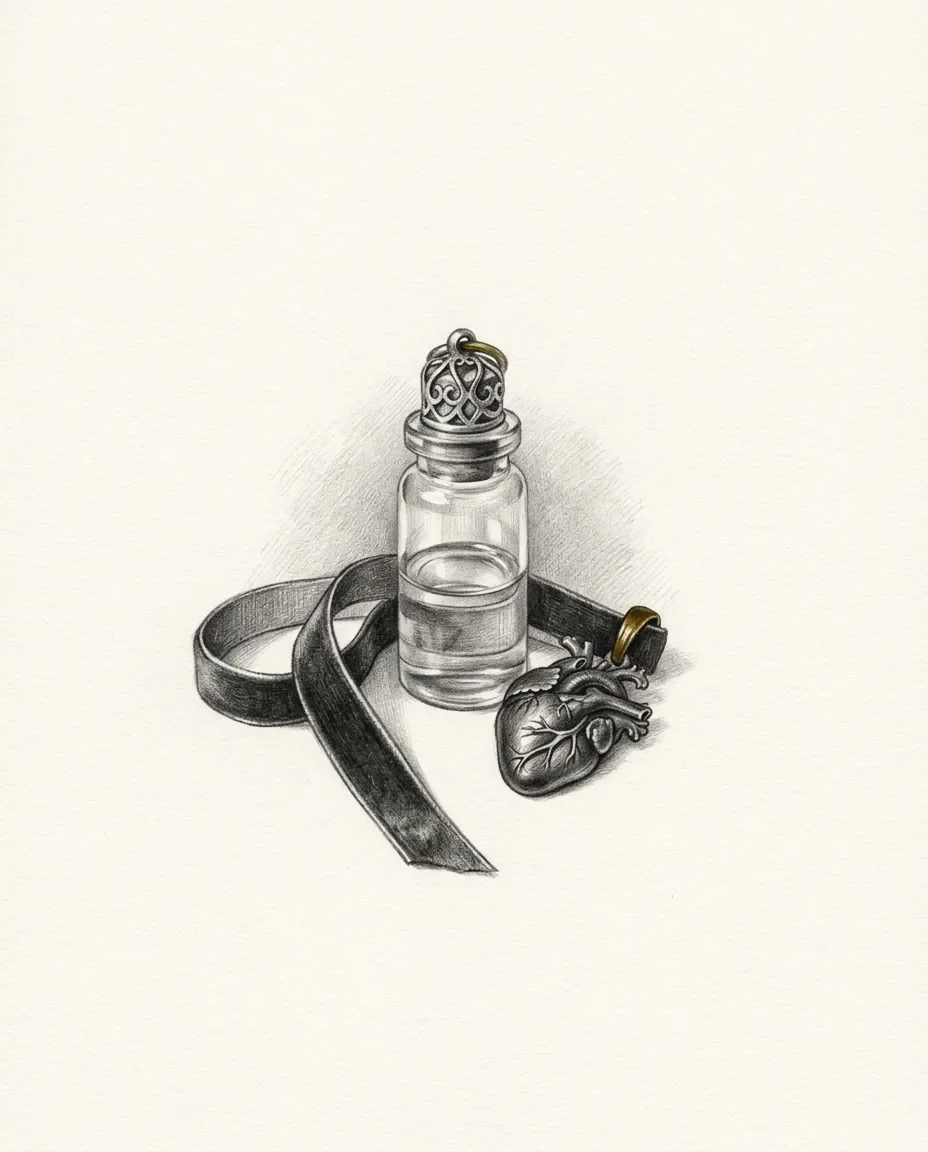
Blood Fetish
Hematolagnia
Added 21 Jun 2026 · Updated 22 Aug 2026
An erotic interest in blood, in its sight, scent, warmth, or symbolic links to vitality, danger, and intimate bonding. Consensual blood play is one form it sometimes takes. It is rare and carries serious bloodborne-infection risk.
- Prevalence
- Rare
- Category
- Body Functions & Fluids
- Clinical term
- Hematolagnia
- Domain
- Sexual interest
- Confidence
- Low confidence
- Status
- Uncommon body-fluid interest; not a recognized disorder in itself, but associated practices carry significant health risk.
- Also known as
- hematolagnia, haematophilia, blood fetishism, vampirism (erotic), blood play, erotic vampirism
- Added
- 21 Jun 2026
- Updated
- 22 Aug 2026
Overview
Hematolagnia is a sexual interest in blood, drawing on its potent symbolism of vitality, mortality, danger, and intimate bonding. It overlaps with erotic vampirism and with consensual blood play, a niche practice within some kink communities, and for many people it is more about imagery, ritual, and symbolism than the substance itself. This article surveys the documented history of the interest, how it is typically expressed, the proposed psychology behind it, and, most importantly, its non-negotiable health risks. It is an uncommon interest that, in its practised forms, is inherently hazardous.
Examples
What the term covers. Most of the interest is imagery rather than substance: gothic and vampire aesthetics, stage blood, fiction and film, the bite as a figure for possession and intimacy. A narrower band involves real blood between partners, where a small wound, a taste, or the marking of a bond carries the charge. Narrower still is the overlap with edge play, in which blood appears as a by-product of knife play or needle play rather than as the point of the scene. Only the first of those three is free of infection risk.
What it does not cover. Clinical vampirism, sometimes called Renfield's syndrome, is an obsessional compulsion to consume blood rather than an erotic interest, and it is not a recognised diagnosis. A vampire fetish is about persona, fangs and mythology, and frequently involves no interest in real blood at all. A period fetish centres on menstruation and its taboo rather than on blood as a substance. Where the appeal is the blade, the needle or the brand itself, the interest is sensation and fear play and belongs under edgeplay. The umbrella above all of these is the body fluids fetish.
How the word is used. Hematolagnia is a registry coinage: it appears in encyclopedic lists of paraphilias, not in Krafft-Ebing or Havelock Ellis, and neither DSM-5-TR nor ICD-11 carries any blood category. Kink communities say blood play for the practice and blood fetish for the interest, while forensic and psychiatric writers reserve clinical vampirism for the different, non-erotic pattern. The Greek dress of "hematolagnia" lends the term a clinical authority it has never actually held.
History & origins
Blood has carried erotic and sacred meaning across mythology, religion, and folklore for millennia, but its clinical labelling is comparatively recent and was never crisp.
Clinical lineage
- 1886: Richard von Krafft-Ebing's Psychopathia Sexualis inaugurated the systematic medical cataloguing of sexual interests; blood- and wound-focused arousal appears within its discussion of sadism and the fusion of pain, danger, and desire rather than as a stand-alone diagnosis.
- From 1892: According to historical reviews, brief and sporadic reports of blood-drinking behaviour linked to sexual pleasure have appeared in the psychiatric literature since the work of Krafft-Ebing, who documented such cases under broad categories of perversion rather than as a discrete paraphilia (see clinical vampirism).
- 1897: Havelock Ellis began publishing Studies in the Psychology of Sex (seven volumes, 1897–1928), whose treatment of "Love and Pain" and erotic symbolism situated blood-tinged arousal within the algolagnic spectrum.
- 1964: Richard L. Vanden Bergh and John F. Kelley published "Vampirism: A Review with New Observations" in Archives of General Psychiatry (11:543–547), often cited as the first formal psychiatric case presentation of the pattern; they defined vampirism as drawing blood from a love object and receiving sexual excitement from it.
- 1992: Clinical psychologist Richard Noll coined "Renfield's syndrome", after the blood-craving character in Bram Stoker's Dracula (1897), in his book Vampires, Werewolves, and Demons. He meant it as a satire of what he saw as the arbitrary, checklist-style diagnostic categories proliferating in the DSM, not as a serious diagnosis. The term, like clinical vampirism itself, has never been a recognised DSM category. Hematolagnia is distinct from these obsessional clinical pictures: it is an erotic interest, not a compulsion to consume blood.
The Greek-derived term hematolagnia, from haima ("blood") plus lagneia ("lust"), belongs to the broader family of -lagnia coinages; its exact first use is not well documented, and it appears chiefly in modern encyclopedic registries such as Wikipedia's List of paraphilias rather than in the foundational texts. Today clinicians do not treat the interest in itself as a disorder.
Cultural & subcultural evolution
Cultural understanding has been shaped less by clinical literature than by the literary lineage of vampire fiction, from nineteenth-century Gothic novels through Stoker's Dracula (1897) to modern film and television, which fused blood with seduction, immortality, and transgression. Gothic and "vampire" subcultures, and later online kink communities, gave the imagery a durable aesthetic home. The interest sits alongside other body-fluid fascinations such as the cum fetish and the wetness fetish, where the charge lies partly in intimacy and partly in transgression.
In practice
Expression ranges from purely fantasy and aesthetic engagement (vampire themes, gothic and theatrical imagery, stage blood) to consensual practices involving small amounts of real blood between partners. The emotional weight of blood as a marker of trust, transgression, surrender, or life-force is central to its appeal, and for a large share of those drawn to it the symbolism and ritual matter more than the substance. This entry is descriptive and contains no instructional content.
Psychology
Proposed mechanisms include erotic conditioning (an early pairing of blood imagery with arousal that is then reinforced) and the deep cultural resonance of blood across mythology, religion, and horror, which lends it strong charge and a sense of taboo. Some accounts connect it to the broader algolagnic family (the blurring of pain, danger, and desire documented since Krafft-Ebing) without implying that interest in blood requires interest in pain. No specific developmental cause is established, the evidence base is thin, and the interest is uncommon.
Prevalence & culture
How common is a blood fetish?
Rare, though its cultural footprint is large. Direct academic study is limited, so prevalence here is uncertain and rests largely on community proxies. The large online survey by Scorolli et al. (2007), which mapped the relative frequency of fetishes across hundreds of discussion groups, found body-fluid and secretion interests to be rare relative to dominant targets such as feet; blood-specific arousal falls within this rare band. Cultural visibility, by contrast, is high: vampire fiction, gothic subcultures, and horror media keep the theme prominent even though dedicated practising communities are small.
Safety, consent & law
This is an inherently high-risk interest in any practised form. Blood is a recognised vector for bloodborne pathogens (chiefly HIV, hepatitis B, and hepatitis C) and any blood-to-blood contact, especially through broken skin or shared implements, carries a serious transmission danger; breaking the skin additionally risks injury and bacterial infection. For these biohazard reasons most organised kink venues prohibit blood play outright. The interest itself is legal between consenting adults, but practices that wound the skin can raise consent and assault questions in some jurisdictions regardless of agreement. Where the interest causes distress or escalating risk, professional medical or psychological consultation is the appropriate route.
Common questions
Is blood play safe?
No, and no technique makes it so. Blood carries HIV, hepatitis B and hepatitis C, and any blood-to-blood contact, through broken skin, a shared blade or a reused needle, is a genuine transmission route. Breaking the skin also risks bacterial infection and injury. Most organised kink venues prohibit blood play outright for exactly these biohazard reasons. The risk can be reduced but it cannot be removed.
Is a blood fetish a disorder?
No. Neither DSM-5-TR nor ICD-11 lists any blood-focused paraphilia, and an erotic interest in blood is not in itself a clinical condition. What sets it apart from most benign interests is not its classification but its practised form, which carries real infection risk. Where the interest causes distress or drives escalating risk-taking, that is the point at which medical or psychological help is worth seeking.
What is the difference between a blood fetish and a vampire fetish?
A vampire fetish is about the figure: fangs, pallor, immortality, seduction and the power exchange the myth carries. Plenty of people drawn to it have no interest in real blood and never encounter any. A blood fetish is about the substance itself and its symbolism of vitality and danger. The two overlap heavily in gothic subculture, which is why the terms are so often used loosely as though they named one thing.
Is blood play legal?
The interest is legal everywhere, and consensual blood play between adults is rarely prosecuted, but the picture is less simple than for most kinks. Some jurisdictions hold that a person cannot consent to being wounded, so deliberately breaking a partner's skin can raise assault questions regardless of agreement. Drawing blood from someone who has not consented is straightforwardly an offence, not a kink.
Can you have a blood fetish without ever touching real blood?
Yes, and that describes most of it. For a large share of the people drawn to the theme the appeal is symbolic and aesthetic, running through vampire fiction, gothic imagery, stage blood and ritual language, and never involving the substance at all. Community accounts and the thin research literature both describe the imagery as carrying more of the weight than the fluid does.
What is Renfield's syndrome?
A term the clinical psychologist Richard Noll coined in 1992, after the blood-craving character in Bram Stoker's Dracula, for an obsessional compulsion to drink blood. He intended it as satire of what he saw as arbitrary, checklist-style diagnostic categories, and it has never been recognised in the DSM. It is also not the same thing as an erotic interest in blood, which is a preference rather than a compulsion.
- Cum Fetish43/100Spermatophilia · Body Functions & FluidsAn erotic interest in which semen and the act of ejaculation become a focus of arousal, through their visual presence or their scent. Symbolic associations with climax, virility and fertility also carry the charge. It is a common element of mainstream adult fantasy rather than a discrete clinical disorder.43
- Wetness Fetish38/100Body Functions & FluidsAn erotic interest in vaginal secretions and signs of physical arousal, including their scent, sensation, or significance as evidence of a partner's excitement. It is a common, low-profile element of mainstream sexuality.38
- Crying Fetish29/100Dacryphilia · Body Functions & FluidsAn erotic interest in tears, crying, or the emotional vulnerability that accompanies weeping: in a partner or in oneself. Documented mainly through one qualitative study and online communities, it overlaps with caretaking, compassion, and power-exchange themes.29
- Period Fetish31/100Menophilia · Body Functions & FluidsAn erotic interest in menstruation: the menstrual blood itself, the knowledge that a partner is menstruating, or associated cues and products. An uncommon, benign interest with a small online following and very little clinical study.31
- Omorashi26/100Urolagnia (desperation/wetting subtype) · Body Functions & FluidsA sexual interest, named from a Japanese word for wetting oneself, centered on bladder desperation and the urgency of needing to urinate. It takes in the sensation of a full bladder and the struggle to hold on, or the loss of control in wetting. The focus is on desperation and release rather than urine itself.26
- Fart Fetish25/100Eproctophilia · Body Functions & FluidsAn erotic interest in flatulence: its sound, scent, or the intimate act and context of a partner passing gas. Clinically termed eproctophilia, it is a rare interest documented mainly through a single 2013 case study and small online communities.25
From Greek haima ("blood") + lagneia ("lust"), literally "lust for blood"; the variant haematophilia uses haima + philia ("love"). One of the Greek-rooted -lagnia sexology terms; precise first coinage is not well documented.
blood · secretion · blood play
Prevalence is computed from the entry's cited population estimate. Rows marked ESTare indicative editorial estimates scored against a fixed anchor rubric, not measured quantities. Method & anchors: methodology.
Rare · ≈ 1 in 1,000
- 01List of paraphilias, Wikipediadefinition/existence of hematolagnia as a blood-focused paraphilia
- 02Scorolli et al. (2007), Relative prevalence of different fetishes, Int. J. Impotence Research 19(4):432-437upper-bound context via the rare body-fluid/secretion fetish band (~9% of body-part fetishes)
- 03Sexual fetishism, Wikipedia (carries the Scorolli 2007 relative-frequency table)places blood/fluid fetishism within the broader fetish taxonomy
- 04Richard von Krafft-Ebing, Psychopathia Sexualis (1886)19th-century clinical documentation of blood- and wound-focused arousal within the sadism literature
- 05Clinical vampirism, WikipediaKrafft-Ebing reporting blood-drinking from 1892; Vanden Bergh & Kelley (1964) first formal case; Richard Noll's Renfield's syndrome (1992) and its non-recognition in the DSM; distinction from erotic hematolagnia
- 06Vanden Bergh R.L. & Kelley J.F. (1964), Vampirism: A Review with New Observations, Archives of General Psychiatry 11:543–547first formal psychiatric case presentation of vampirism; defined as drawing blood from a love object for sexual excitement
- 07Havelock Ellis, Studies in the Psychology of Sex (1897–1928)early sexological treatment of Love and Pain / erotic symbolism situating blood-tinged arousal within the algolagnic spectrum
- 08Blood-borne disease, Wikipediablood as a recognised vector for HIV, hepatitis B and hepatitis C, with blood-to-blood and broken-skin contact as transmission routes