Militaria Collecting
Added 7 Sep 2026
A non-sexual enthusiasm for acquiring, researching and preserving military objects: medals, uniforms, headgear, insignia, deactivated weapons and documents. One of the oldest organised collecting fields, with its own dealers, auction houses and societies.
- Prevalence
- Common
- Category
- Non-Sexual Fetishism
- Domain
- Non-sexual interest
- Confidence
- Low confidence
- Status
- Not a disorder; a mainstream hobby. Neither manual mentions collecting, and the only clinical neighbour, hoarding disorder, describes a different problem.
- Also known as
- militaria, military memorabilia collecting, medal collecting, war relic collecting, military antiques
- Added
- 7 Sep 2026
Featured in
Overview
Militaria collecting is the non-sexual pursuit of acquiring, cataloguing and preserving military objects: medals and orders, uniforms and headgear, insignia and badges, edged and deactivated weapons, equipment, documents and photographs. It is one of the oldest organised collecting fields, with its own dealers, auction houses, research societies and reference literature, and it belongs in this catalog under the everyday sense of fetish, an intense attachment to a class of object, alongside coin and stamp collecting, antiquing and watch collecting. Nothing about it is sexual.
Definition & scope
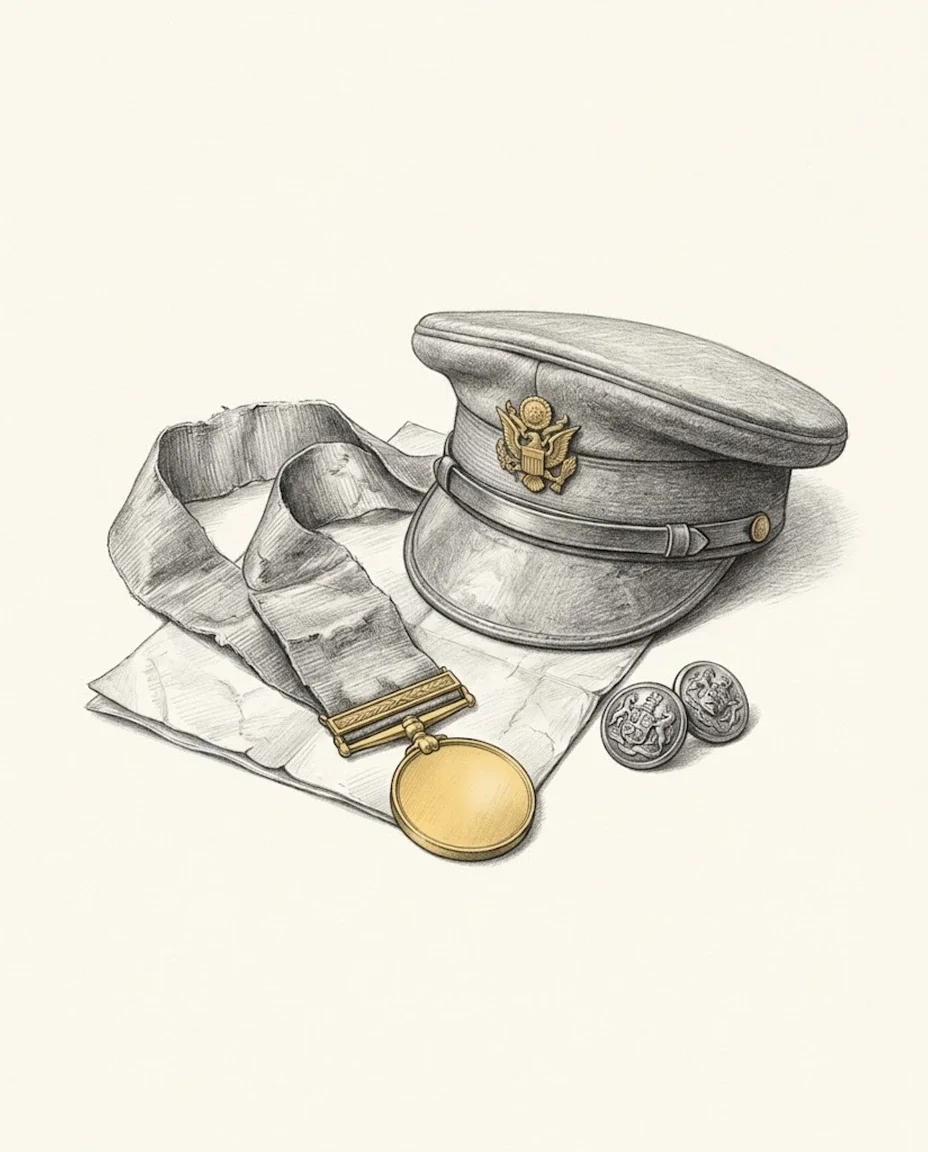
The field divides by object and by period. Medal collecting, the largest strand, follows campaign medals and gallantry awards, often traced to a named recipient through service records. Uniform and headgear collecting covers tunics, helmets and caps from the eighteenth century to the present. Insignia, badges and buttons form a strand of their own, small and cheap to start. Edged weapons, deactivated firearms, field equipment, maps, letters and photographs round out the field. Most collectors specialise: a regiment, a war, a nation, a single award. The value of a piece rests on authenticity, condition and provenance, and the research that establishes those is as much the hobby as the object.
Examples
What the interest covers. Building a collection of medals named to soldiers of one regiment and researching each man's service; assembling a display of helmets by pattern and date; buying and cataloguing badges and buttons at fairs; restoring and displaying uniforms on mannequins; preserving a family member's medals and papers; and attending the auctions, fairs and society meetings where the trade and the research happen.
What the interest does not cover. A uniform fetish is a sexual interest in uniforms worn, and a collector of tunics on mannequins has no part in it. Knife collecting overlaps at the edged-weapon strand and is otherwise a separate field. Compulsive hoarding is a clinical condition; an organised, catalogued, insured collection is the opposite of one. Re-enactment uses reproduction kit and is a performance; collectors of originals often disapprove of it.
How the word is used. Militaria is the trade's word, used by dealers, auction houses and societies for the whole class of military collectibles. The word fetish in this entry's category carries its everyday sense, the same one used of vinyl and watches, and no clinical meaning. Neither the DSM-5-TR nor the ICD-11 mentions collecting of any kind; the only clinical neighbour is hoarding disorder, which describes a different problem.
History & origins
Armouries and cabinets
Collecting arms and armour is older than the word for it. Princely armouries of the sixteenth and seventeenth centuries kept weapons and armour as trophies and as displays of lineage. The history of militaria as a private hobby begins when those objects passed into the trade, and the great nineteenth-century arms collections, later the cores of museum holdings, were assembled by individuals buying at sales.
Medals for everyone, and the collectors who followed
The medal strand has a date. The Waterloo Medal, authorised in 1816, was the first British campaign medal issued to every soldier present regardless of rank, and it was named to each recipient around the rim. A named medal is a research object, and the practice of collecting named medals and reconstructing their recipients' lives grew through the Victorian campaigns. The Orders and Medals Research Society, founded in 1942, gave the strand a journal and a membership, and specialist auction houses hold regular sales for it to this day.
The twentieth century and the surplus trade
Two world wars produced militaria on an industrial scale, and the surplus trade of the 1940s and 1950s put helmets, webbing and uniforms into shops and mail-order catalogues at prices a schoolboy could pay. Collecting broadened from medals and arms to everything the wars had issued. The Cold War and its end added a second wave, as Soviet and Eastern Bloc material came onto the market in the 1990s. At the top of the market, the collection of Victoria Crosses assembled by Michael Ashcroft, the largest in private hands, went on public display at the Imperial War Museum in London in 2010.
In practice
The hobby runs on fairs, auctions, dealers and societies. A collector reads catalogues, attends militaria fairs and arms fairs, follows auction sales in person or online, and joins a society for the journal and the expertise. Research is the other half: service records, regimental histories, casualty rolls and medal rolls turn an object into a biography. Storage and display matter, since textiles, leather and metal each degrade in their own way. Many collectors begin with a relative's medals and never move far from them.
Psychology
The drives are the collector's, described across every field in the collecting and acquisition collection: completion, rarity, the mastery that expertise brings, and the social standing a good collection confers among peers. Militaria adds two of its own. The objects are attached to named people and dated events, so the collector holds a piece of a life and a war, and research turns ownership into a kind of custody. And the objects are charged: a helmet or a medal carries the weight of the conflict it came from, which is part of the appeal and part of the discomfort the field attracts from outside.
Prevalence & culture
No survey counts militaria collectors. The catalog estimates participation at around one adult in fifty, below the broader collecting fields it sits beside, and marks the confidence low; the estimate rests on the size of the trade, with dedicated auction houses in several countries, national societies and a fair circuit, and no population study exists. The field is visible: television programmes on antiques feature it, museums built from private collections anchor it, and the sale of a high gallantry award makes news.
Safety, consent & law
The hobby is legal and the objects, handled with ordinary care, are safe. The law bites at two points. Firearms must be deactivated to the standard the jurisdiction sets before they can be held without a licence, and live ammunition and working weapons fall under firearms law everywhere. National Socialist material is restricted in several countries: Germany's section 86a prohibits the public use of its symbols, with an exemption for historical and educational purposes, Austria and France have comparable rules, and major online marketplaces ban the sale of such items outright. Collectors in that strand work through specialist dealers and keep their holdings private. Fakes are the other hazard: reproductions of rare medals, badges and helmets are common, and provenance is the collector's protection.
Common questions
Is militaria collecting a fetish?
Only in the everyday sense the catalog uses for its non-sexual category: an intense attachment to a class of object, the same sense used of vinyl, watches and stamps. Nothing about it is sexual, and no clinical literature treats it as anything but a hobby. A uniform fetish is a different thing entirely, a sexual interest in uniforms worn, and a collector of tunics on mannequins has no part in it.
What counts as militaria?
Any military object collected for its own sake: medals and orders, uniforms, helmets and caps, badges, buttons and insignia, edged weapons and deactivated firearms, field equipment, maps, letters, documents and photographs. Most collectors specialise by regiment, war, nation or type of award, and the research that establishes a piece's authenticity and provenance is as much the hobby as the object.
How do you start collecting militaria?
Most collectors begin with a relative's medals or papers and read from there. Badges and buttons are the cheapest way in, medals the most researchable, since British campaign medals have been named to their recipients since the Waterloo Medal of 1816. Militaria fairs, specialist auction houses and a society such as the Orders and Medals Research Society, founded in 1942, supply the expertise that protects a beginner from the field's many reproductions.
Is it legal to collect Nazi memorabilia?
It depends on the country. Germany's section 86a prohibits the public use of National Socialist symbols, with an exemption for historical and educational purposes; Austria and France have comparable rules, and major online marketplaces ban the sale of such items outright. In Britain and the United States private ownership and sale are legal. Collectors in that strand work through specialist dealers and keep their holdings out of public display.
Can you own real weapons as militaria?
Yes, edged weapons, subject to local knife law. Firearms must be deactivated to the standard the jurisdiction sets before they can be held without a licence, and working weapons and live ammunition fall under firearms law everywhere. Most collectors in this strand hold deactivated pieces with the certificate that proves it, and treat the paperwork as part of the object.
How common is militaria collecting?
No survey counts it. The catalog estimates participation at around one adult in fifty and marks the confidence low; the figure rests on the size of the trade, with dedicated auction houses in several countries, national societies and a regular fair circuit, and sits below the broader collecting fields such as antiquing.
When does collecting become hoarding?
When acquiring displaces everything else and the objects stop being a collection. A catalogued, insured, displayed collection is the opposite of hoarding, however large. The signals worth taking seriously are spending beyond means, buying compulsively, secrecy or distress about purchases, and living space overwhelmed by uncatalogued stock; those point toward compulsive hoarding, which is a recognised condition with real treatment.
- Coin & Stamp Collecting38/100Non-Sexual FetishismA non-sexual, focused interest in acquiring, organizing, and studying coins, banknotes, and postage stamps (numismatics and philately). It centers on heritage, completeness, and the tactile and historical appeal of small physical artifacts.38
- Antiquing53/100Non-Sexual FetishismA non-sexual hobby of shopping for, sourcing, identifying, and collecting antiques: old furniture, decorative objects, and everyday artifacts. They are valued for age, craftsmanship, and history. It centers on the hunt, connoisseurship, and the tactile appeal of aged material.53
- Watch Collecting41/100Horological Fixation · Non-Sexual FetishismAn intense, non-sexual fascination with mechanical timepieces and luxury watches, centered on craftsmanship, brand heritage, and the act of collecting. It is a hobby and consumer-culture interest rather than a clinical condition.41
- Knife Collecting34/100Non-Sexual FetishismA non-sexual enthusiasm for knives and other edged tools as objects of craftsmanship: steel, grind geometry, and handle materials. Lock mechanisms, maker heritage, and everyday-carry culture matter too. It is a hobby and collecting interest, not a clinical condition.34
- Compulsive Hoarding57/100hoarding disorder · Non-Sexual FetishismA persistent difficulty discarding possessions, regardless of their value, that leads to clutter overwhelming living spaces and significant distress. It is a recognised mental-health condition and an object-attachment phenomenon, not a sexual interest.57
- Conchology42/100Non-Sexual FetishismThe study and collecting of mollusc shells, from beach finds to systematic collections with locality data. One of the oldest collecting hobbies on record and the one that shades into natural science. Non-sexual, with its own societies and shows.42
"Militaria" is a Latin-form plural coined in the collecting trade for military objects of collectible interest, on the pattern of "memorabilia"; "militaris" is the Latin adjective for soldierly. The word entered English dealer and auction usage in the twentieth century.
collecting · history · medals and uniforms
Prevalence is computed from the entry's cited population estimate. Rows marked ESTare indicative editorial estimates scored against a fixed anchor rubric, not measured quantities. Method & anchors: methodology.
Common · ≈ 1 in 20
- 01Militaria, Wikipediadefinition of militaria as collectible military objects; the strands of the hobby (medals, uniforms, headgear, insignia, weapons, documents); its history from armouries and cabinets of curiosities to the modern trade
- 02Waterloo Medal, Wikipediaauthorised in 1816 as the first British campaign medal issued to every soldier present regardless of rank, named to each recipient
- 03Orders and Medals Research Societythe society founded in 1942 that gives medal collecting its journal, membership and research standards
- 04Michael Ashcroft, Baron Ashcroft, Wikipediathe largest private collection of Victoria Crosses, displayed at the Imperial War Museum in London from 2010
- 05Strafgesetzbuch section 86a, WikipediaGermany's prohibition on the public use of National Socialist symbols, with an exemption for historical and educational purposes, which shapes the trade in that strand of militaria
- 06DSM-5-TR (American Psychiatric Association, 2022)collecting appears in no diagnostic manual; hoarding disorder is the only clinical neighbour and describes a different problem