Uniform Fetish
Uniform Fetishism
Added 21 Jun 2026 · Updated 22 Aug 2026
An erotic interest in uniforms and the authority, role, or status they signal: military, police, medical, school, or service dress. A common clothing-and-role fetish rather than a clinical disorder.
- Prevalence
- Common
- Category
- Clothing & Garments
- Clinical term
- Uniform Fetishism
- Domain
- Sexual interest
- Confidence
- Medium confidence
- Status
- Common clothing/role fetish; a normal variation, not a disorder unless it causes distress, impairment, or is required for functioning.
- Also known as
- uniform fetishism, uniform kink, service-dress attraction
- Added
- 21 Jun 2026
- Updated
- 22 Aug 2026
Featured in
Overview
Uniform fetishism is a form of clothing fetishism in which arousal is tied to uniforms and the social roles, authority, and status they signal. Unlike a purely material fetish, the appeal usually blends the look of the garment (its cut, insignia, formality, and fit) with what it symbolises: discipline, competence, rank, protection, or service. Common foci include military, police, and security dress; medical scrubs and nurse outfits; aviation and transit uniforms; school and academic attire; and hospitality, maid, or waitress garb. This article traces how the interest was first documented, how it is expressed, its proposed psychology, and its prevalence and cultural footprint.
Examples
A uniform's appeal is a compound of garment and office, and the term's edges are exactly where one of those two drops away.
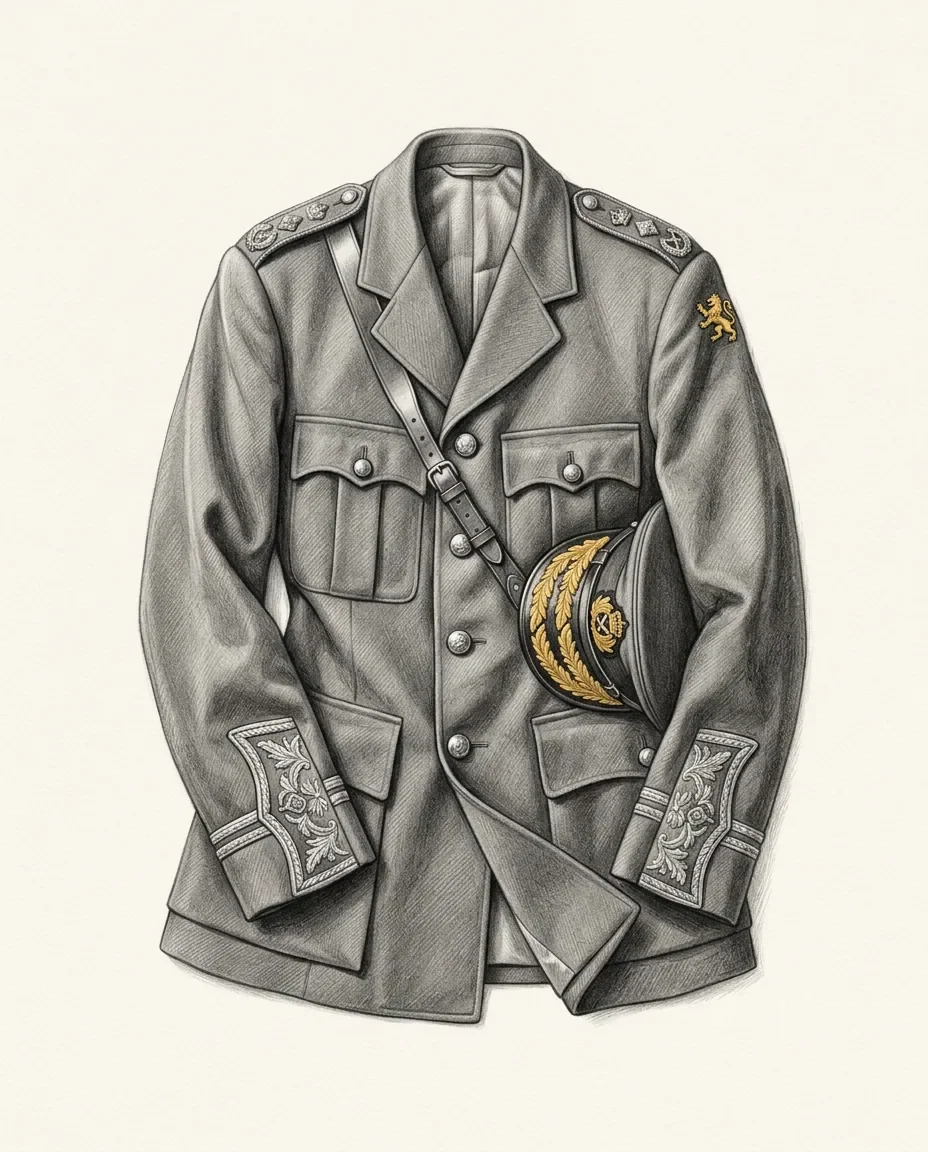
What the term covers. Military, police and security dress; medical scrubs and the nurse outfit; aviation and transit uniforms; academic and school dress, of which the schoolgirl uniform is the best-known single case; and service wear including the maid outfit. It is expressed by a partner wearing the garment, by scenarios built on the role it signals, such as doctor and nurse, teacher and student or boss and secretary, or simply by aesthetic pleasure in structure, insignia and formality with no scenario at all.
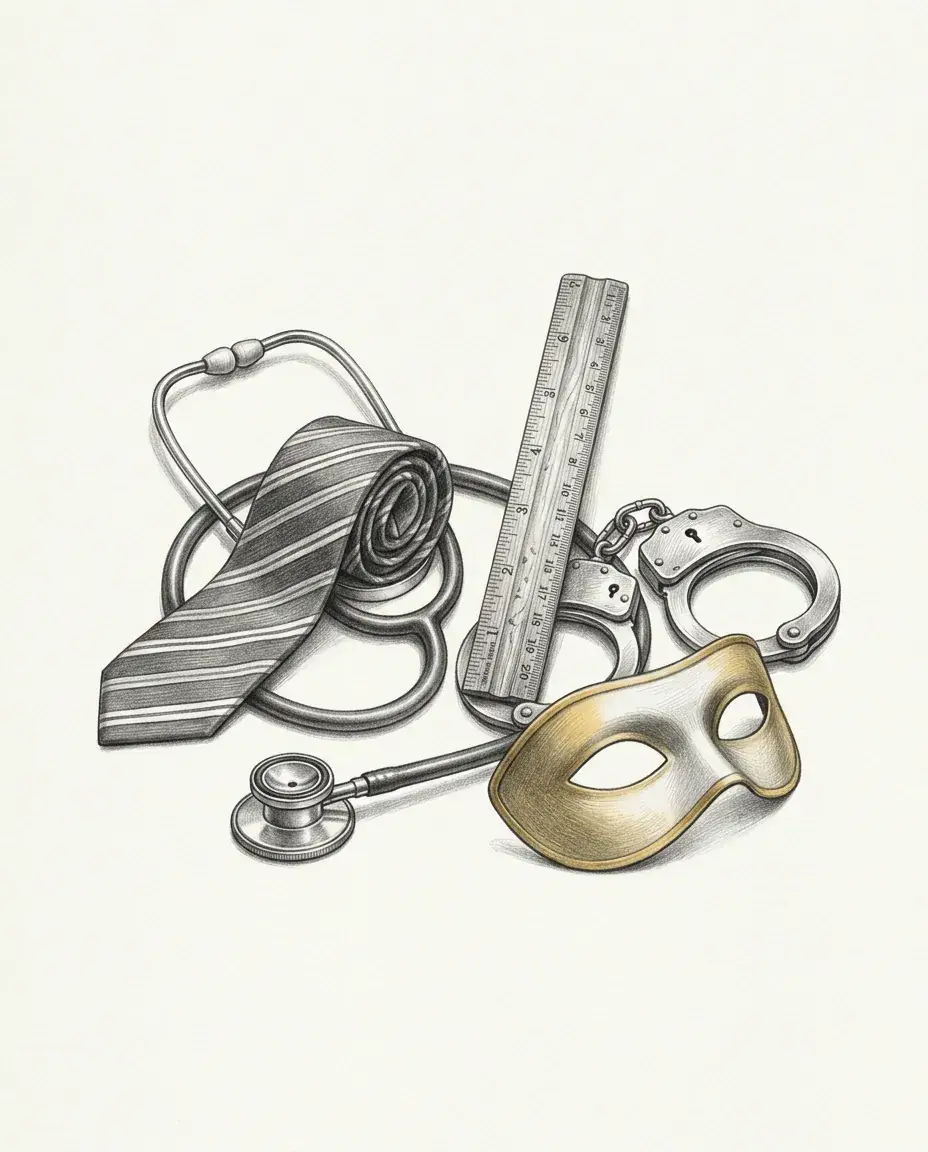
What the term does not cover. Where the appeal is the substance rather than the office, it is a material fetish: leather, latex or denim. Garment interests with no institutional role behind them sit elsewhere again, among them lingerie, the corset and gym wear, as does the suit and tie, which is authority-coded but issued by nobody. Cosplay reproduces one specific character rather than a generic role, and medical-setting kink is about the examination and its instruments rather than the scrubs. The nun's habit is a borderline case usually treated on its own terms.
How the word is used. "Uniform fetish" is the everyday phrase and there is no dedicated clinical coinage; clinicians treat it as a sub-type of clothing fetishism, which DSM-5-TR and ICD-11 call a disorder only where it causes marked distress, impairment or harm. In the organised subculture around the Breeches and Leather Uniform Fanclub the phrase carries a narrower sense, denoting a specific breeches-and-leather uniform code rather than uniforms in general.
History & origins
Etymology and clinical lineage
The word uniform derives from the Latin uniformis (unus ("one") plus forma ("form"), literally "of one form") describing the standardised institutional dress that armies, clergy, schools, and services adopted to signal cohesion and rank. As a distinct erotic interest, uniform fetishism has no single documented coinage; it is instead a long-recognised sub-type of the broader clothing fetishism that early sexologists catalogued.
- 1886: Richard von Krafft-Ebing's Psychopathia Sexualis gave the first systematic clinical account of fetishism, documenting arousal fixed on garments, materials, and footwear and framing such attractions, in the language of the day, as pathological deviations tied to heredity and "degeneration."
- Early 1900s: Havelock Ellis's Studies in the Psychology of Sex discussed the eroticisation of clothing and dress symbolism, the wider lineage in which uniform attraction sits. Sigmund Freud's Three Essays on the Theory of Sexuality (1905) added a developmental, associative account of how a garment can become an erotic focus.
- DSM and ICD lineage: Across the 20th and 21st centuries, clinical classification narrowed: the modern DSM-5-TR and ICD-11 reserve a disorder label only where a clothing or fetishistic interest causes marked distress, impairment, or harm. A consensual preference for uniformed partners is therefore not, in itself, a disorder.
Cultural & subcultural evolution
The uniform's erotic charge entered popular culture distinctly in the later 20th century:
- 1970s: The Dallas Cowboys Cheerleaders popularised the cheerleader aesthetic, and acts such as the Village People embodied uniformed (sailor, officer, construction) fetish iconography in mainstream pop.
- October 1997: The Breeches and Leather Uniform Fanclub (BLUF) was founded online by the Dutchman Leon Jacobs as an international club for (mainly gay) men into breeches and leather uniforms; the first BLUF party followed at San Francisco's Folsom weekend in September 1998, and membership climbed to nearly 6,000 across some 63 countries by 2025, formalising uniform fetishism as an organised subculture.
- Japanese and Western media: Schoolgirl-style and nurse uniforms became staples of both Japanese and Western adult entertainment, and uniform costumes remain a perennial fixture of fancy dress and role-play.
In practice
The interest is expressed through partners wearing uniforms, through uniform-themed role-play and power-exchange scenarios, and through aesthetic enjoyment of the structure, insignia, and formality these garments convey. For many people it functions as an enhancing preference within otherwise conventional attraction rather than a requirement, and it overlaps heavily with authority-coded and dominance/submission dynamics. It sits alongside other clothing-and-material fetishes: uniforms are often modified in leather, latex, or heavy denim, or paired with lingerie, stockings and heels, blending the role cue with a material fetish.
Psychology
Uniform fetishism is usually explained through two complementary threads, though the dedicated evidence base is thin:
- Symbolic compression: A uniform encodes an entire social role in a single visual cue: authority, trust, protection, competence, idealised service, or conversely submission and conformity. That makes it an unusually efficient trigger for fantasy, especially around power and hierarchy.
- Associative learning: Classic conditioning accounts (in the lineage from Krafft-Ebing and Freud) hold that formative or repeated experiences can link the dress with arousal. Cultural transmission through media depictions of uniformed figures reinforces and standardises these associations.
The specific psychology of uniforms, as opposed to clothing fetishism generally, has attracted little rigorous study, so mechanistic claims remain provisional.
Prevalence & culture
Uniforms are among the more visible and widely shared erotic themes, but precise figures are scarce because surveys rarely isolate "uniforms" as a category. The relevant anchors are broader:
- Scorolli et al. (2007), analysing a large body of online fetish-community data, found that garment- and clothing-associated preferences are among the most common fetish foci, with body-associated and object/material fetishes dominating the relative-frequency table.
- General-population work by Joyal & Carpentier (2017) found roughly half of adults reported interest in at least one paraphilic-adjacent category, and fetishism in general exceeded the threshold of "statistically unusual", situating uniform attraction within a commonly held band of interests.
- Joyal, Cossette & Lapierre (2015) similarly showed that fetishistic and role-play fantasies are common rather than rare in the general population.
Culturally, uniform costumes are a staple of fancy dress, organised communities such as BLUF give the interest a durable subcultural home, and popular guides routinely catalogue it as a mainstream, openly discussed kink.
Safety, consent & law
Uniform fetishism among consenting adults is benign and legal, and the garment itself poses no inherent risk. The main consideration is context rather than the interest: impersonating actual police, military, or medical personnel in public, or using genuine insignia to deceive others, can carry legal consequences in many jurisdictions. The activity is therefore appropriately confined to private, consensual settings using costume rather than authentic service uniforms or badges.
Common questions
Why do people find uniforms attractive?
A uniform compresses an entire social role into a single visible cue, whether authority, competence, discipline, rank, service or conformity, which makes it an unusually efficient trigger for fantasy about power and hierarchy. On top of that sits ordinary conditioning: repeated cultural depictions of uniformed figures as desirable teach the association, and formative experiences can attach it to one particular kind of dress.
Is a uniform fetish a disorder?
No. Under DSM-5-TR and ICD-11 a clothing-focused interest counts as a disorder only where it causes marked distress or impairment, or harms someone. Enjoying a partner in uniform, or wearing one, meets none of that. The label fetishistic disorder is reserved for the small minority for whom the object is a rigid requirement and that requirement is itself the problem.
What are the most common uniform fetishes?
Nurse and other medical dress, police and military uniforms, and school uniforms, of which the schoolgirl uniform is the most heavily represented single type in adult media, followed by service wear such as the maid outfit and cheerleading kit. No general-population survey isolates uniforms as a category, so that ranking reflects media and community prominence rather than measured prevalence.
Is it illegal to wear a police or military uniform?
Wearing costume dress privately is not the issue. Impersonating actual police, military or medical personnel in public, or using genuine insignia to mislead people, is an offence in many jurisdictions and the rules vary widely between them. The practical distinction is between a costume used in a private, consensual setting and an authentic uniform worn where strangers might take it at face value.
Is a uniform fetish the same as role-play?
They overlap without being the same thing. The fetish is an attraction to the garment and what it signals; role-play is the enacted scenario. Someone can find a uniform compelling with no interest in playing out the role, and a doctor-and-nurse scene can be run purely for the power dynamic by people indifferent to scrubs.
Does having a uniform fetish mean wanting to date someone in that job?
Usually not. The cue is symbolic, and the actual profession arrives with shift patterns, stress and paperwork that have nothing to do with the appeal. Most people treat it as something a partner can put on, which is also why costume versions, better fitted and more exaggerated than the real thing, are far more common in practice than issued service dress.
How do I ask a partner to wear a uniform?
Ask outside the bedroom, be specific about which uniform and what appeals about it, and make clear whether you are asking them to wear it or simply telling them what you like. Offering to buy the costume yourself removes a practical objection, and starting with one element rather than a complete outfit gives a hesitant partner an easier way in.
- Lingerie Fetish70/100Clothing & GarmentsAn erotic interest in lingerie and intimate apparel in which the garments themselves, their fabrics, and their styling become a focus of arousal. Bras, briefs, stockings, corsets and slips are typical. One of the most common and mainstream garment-related interests.70
- Denim Fetish27/100Denim Fetishism · Objects & MaterialsAn erotic or aesthetic interest centred on denim garments, most often jeans, but also jackets, skirts and overalls. They are valued for their coarse texture, body-shaping fit, scent, and rugged, casual associations. It is a common-variation material and clothing fetish, not a clinical disorder.27
- Leather Fetish65/100Leather fetishism · Objects & MaterialsAn erotic attraction to leather as a material: its look, smell, creak, shine, and feel when worn. It overlaps strongly with BDSM gear and is bound up with a recognised, organised leather subculture with its own bars, codes, and titles.65
- Stocking Fetish57/100Clothing & GarmentsA sexual interest in stockings and hosiery, centered on sheer or textured legwear, seams, garters and the look and feel of nylon and silk. It is among the most common garment and material fetishes.57
- High Heel Fetish56/100Altocalciphilia · Clothing & GarmentsA focused sexual interest in high-heeled shoes (stilettos, pumps, platforms) and the height, posture, and leg line they create. It is a common, generally harmless subtype of shoe fetishism.56
- Shoe Fetish65/100Retifism · Clothing & GarmentsA sexual interest in shoes as objects of attraction or arousal, valued for their style, material, and associations rather than the wearer. Clinically termed retifism, it is among the most frequently documented garment fetishes in survey and case literature.65
From the Latin uniformis, combining unus ('one') and forma ('form'), literally 'of one form', describing the standardised institutional dress whose symbolism of rank, authority, and service underlies the interest.
uniforms · authority dress · role-coded clothing
Prevalence is computed from the entry's cited population estimate. Rows marked ESTare indicative editorial estimates scored against a fixed anchor rubric, not measured quantities. Method & anchors: methodology.
Common · ≈ 1 in 20
- 01Scorolli et al. (2007), Relative prevalence of different fetishes, Int. J. Impotence Research 19(4):432-437prevalence anchor for clothing-associated fetishes within the relative-frequency table
- 02Joyal & Carpentier (2017), The Prevalence of Paraphilic Interests and Behaviors in the General Population, J. Sex Research 54(2):161-171general-population fetishism interest (~44%) into which uniform attraction falls
- 03An A–Z of Kinks and Fetishes, Glamourlay framing of uniform fetish as a mainstream, commonly discussed kink
- 04Havelock Ellis, Studies in the Psychology of Sexearly sexological discussion of the eroticisation of clothing and dress symbolism, the lineage in which uniform fetishism sits
- 05Joyal, Cossette & Lapierre (2015), What Exactly Is an Unusual Sexual Fantasy?, J. Sexual Medicine 12(2):328-340fetishistic and role-play fantasies are common rather than rare in the general population
- 06Clothing fetish, Wikipediauniform fetishism as a sub-type of clothing fetishism; definitional framing
- 07Uniform fetishism, Wikipediauniform types (schoolgirl, cheerleader, nurse, maid, military/police), 1970s cultural popularisation (Dallas Cowboys Cheerleaders), and material modification of uniforms
- 08Psychopathia Sexualis, WikipediaKrafft-Ebing's 1886 first systematic clinical account of fetishism attached to garments and materials
- 09Three Essays on the Theory of Sexuality, WikipediaFreud's 1905 developmental/associative account of how a garment becomes an erotic focus
- 10Fetishistic disorder, WikipediaDSM-5-TR framing whereby a clothing/fetishistic interest is a disorder only where it causes distress, impairment, or harm
- 11BLUF (fetishism), WikipediaBreeches and Leather Uniform Fanclub founded online 1997 by Leon Jacobs as an organised uniform-fetish subculture