Bootblacking
Added 27 Jun 2026 · Updated 22 Aug 2026
The ritual cleaning, conditioning, and shining of boots and leather gear as an act of service, with deep roots in the gay leather subculture. Bootblacking is both a genuine craft and an erotic exchange of attention, care, and authority.
- Prevalence
- Uncommon
- Category
- Acts & Activities
- Domain
- Sexual interest
- Confidence
- Low confidence
- Status
- Benign consensual interest and practice; not a disorder absent distress, impairment, or non-consent.
- Also known as
- boot blacking, leather bootblack service
- Added
- 27 Jun 2026
- Updated
- 22 Aug 2026
Featured in
Overview
Bootblacking is the practice of cleaning, conditioning, and polishing boots and other leather gear as a deliberate, often eroticised act of service. Within the leather and BDSM world it works at once as a genuine craft (the trade once done by professional shoeshine workers) and as a charged ritual of attention, care, and deference. Also called boot blacking, it belongs to the wider family of boot fetishism and leather fetishism, and it overlaps strongly with service submission and broader Master/slave dynamics. This article traces its documented history within the gay leather community, how it is practised, the psychology behind it, and its place in research and culture. Clinically it is a benign consensual interest, not a disorder.
Definition & scope
A bootblack is a person who takes care of boots, footwear, and leather garments and gear; bootblacking is the work they do. In the leather subculture this reaches well beyond shoes to the full range of leather and rubber kit: jackets, vests, chaps, harnesses, and items in neoprene or other materials. As the Wikipedia article on bootblacking notes, outsiders often read the practice as service-oriented submission, but practitioners themselves "might take on any role in a BDSM dynamic." The bootblack is not inherently submissive; the chair can be a place of skill, authority, and pride as much as deference.
Examples
What the term covers. A bootblack working a station at a leather event or bar, taking clients in turn for a paid or donated session; the same work done privately inside a household dynamic, where caring for a partner's boots is a standing duty rather than a transaction; and the upkeep of gear well beyond footwear: a jacket reconditioned across thirty years, a harness, a pair of chaps. A session may be brisk and businesslike or slow and charged, and both are recognisably the same practice.
What the term does not cover. Boot fetishism is the attraction; bootblacking is the work, and the two are independent: a bootblack need not find boots erotic, and a boot fetishist need not know how to condition leather. Foot worship, foot domination and sole licking are directed at the foot inside the boot, which bootblacking is not: the object of attention is the leather. Shoeplay is a voyeuristic interest in how a shoe is worn rather than in its upkeep, and service submission covers any task performed for another, of which this is one particular craft.
How the word is used. "Bootblack" is an old trade word (blacking was the polish, and a bootblack the person who applied it) that the leather community took over for a role of its own, complete with contests and titles. It names both the person and, in the form "bootblacking," the activity. No clinical vocabulary exists for it, and it appears in neither DSM-5-TR nor ICD-11.
History & origins
Pre-modern roots
The eroticisation of boot-cleaning predates the modern leather scene. The published diaries of the Victorian maid-of-all-work Hannah Cullwick (1833–1909) record a real, lived version of fetishised boot care folded into a service dynamic. She meticulously logged the boots she cleaned (on one dated entry, cleaning dozens of pairs in a single day) and treated blacking the boots of her secret partner Arthur Munby as an act of devotion and self-abasement.
"I can always tell where you've bin by the taste o' your boots."
Hannah Cullwick, to Arthur Munby, as recorded in her diaries
Her writings are frequently cited as one of the earliest first-person documents of boot fetishism within a relationship of service.
The leather-bar era
Bootblacking became a recognisable feature of American gay leather culture during the 1970s. According to the Leather subculture article, "another feature of US-leather bars in the 1970s were bootblacks," with dedicated bootblack stands at venues such as the Gold Coast in Chicago and the Ramrod in New York City. The Chicago Eagle and the D.C. Eagle later carried the practice forward, and several future contest producers and titleholders learned their craft bootblacking at these bars. In this setting, having one's boots shined was both a practical service and a public, sociable, and often flirtatious ritual.
Contests and a subculture of its own
Bootblacks gained ground as a distinct identity in the 1990s. In 1993, Harry Shattuck, a former International Mr. Leather (IML) contestant who had bootblacked at the Gold Coast and the IML Leather Market, founded the first International Bootblack competition at IML. The rules were simple: each weekend package contained a ticket redeemable for a bootblack session, and the bootblack who collected the most tickets won. The first International Mr. Bootblack was David Morgan, sponsored by the D.C. Eagle. In 1999 the title structure expanded: International Ms. Bootblack was inaugurated at International Ms. Leather, with Leslie Anderson the first woman to hold an international bootblack title. The contest, produced alongside IML, honours the service and contributions of bootblacks to the community; contestants work a station in the IML Leather Market across roughly twenty hours over three days. As the leather-subculture record puts it, "with the establishment of local, regional and international bootblack contests in the 1990s and early 2000s, bootblacks began to gain visibility as a subculture in their own right."
In practice
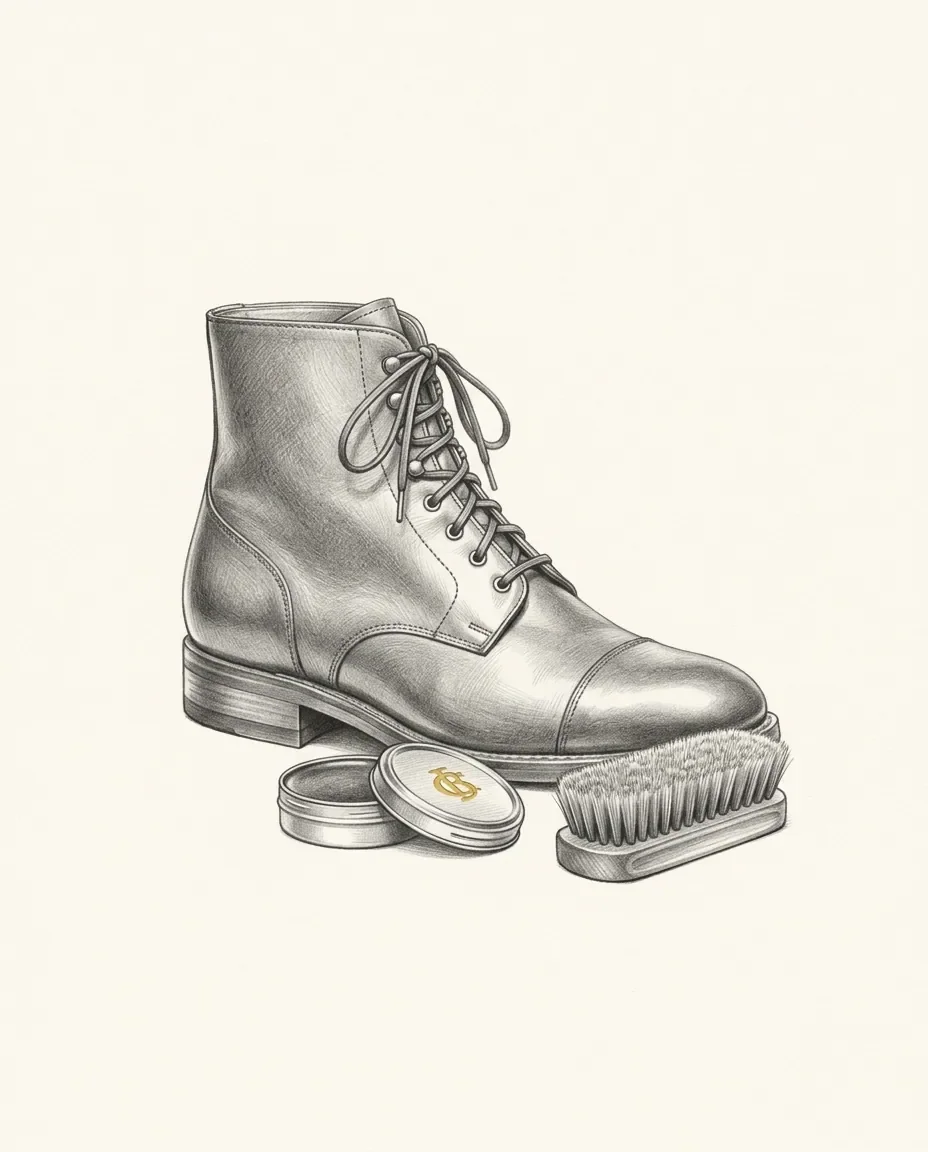
Classic bootblacking centres on a seated client and a bootblack who cleans, conditions, and shines the leather. The work runs through stripping old polish and grime, conditioning the leather, and building up wax; the celebrated "mirror shine" or spit-shine produces a glasslike, high-gloss finish through layered wax and patient buffing. Typical tools include brushes, cloths, daubers, saddle soap and conditioners, waxes, and water. Beyond footwear, bootblacks maintain the wider leather and rubber wardrobe of the scene.
The care is also custodial and historical. Much leather gear is gifted, earned, or inherited, and a bootblack, in tending it, is described as "collecting the stories of their wearers" and so playing "a central role in the oral history of the leather scene." The erotic charge varies: for some it is the intimacy of kneeling and serving; for others, the tactile pleasure of leather and the choreography of skilled, attentive work.
Psychology
Bootblacking sits at the intersection of object interest and relational dynamic. On one side is the sensory and symbolic pull of leather and boots (materials culturally coded for strength, discipline, and masculine authority), which links it to documented boot and leather fetishism. On the other is the relational pleasure of service submission: the gratification of doing a task well for another, the structure of attention and deference, and, in Master/slave frames, an ongoing dynamic of authority and care. The role is not fixed to submission; many bootblacks describe the chair as a seat of competence and command. As with most kink, mainstream accounts emphasise associative learning and symbolic meaning over any single proven mechanism.
Prevalence & culture
How common is bootblacking?
Dedicated prevalence research on bootblacking does not exist; it is a niche practice nested inside the broader, better-studied worlds of boot and leather interest. Large surveys such as Scorolli and colleagues (2007) place footwear and leather/rubber materials among the most common fetish targets, which gives an upper bound but not a bootblacking-specific figure. Its cultural footprint is concentrated and well-organised rather than mass-market: the International Mr. Leather / International Mr. Bootblack institution, regional and local bootblack titles, and active community presence on platforms such as FetLife keep the tradition visible within leather circles even as it remains largely unknown outside them.
Safety, consent & law
Between consenting adults, bootblacking is a benign and low-risk activity with no inherent legal concern. Ordinary precautions apply: ventilation when using solvent-based products, care with any tools, hygiene, and clear negotiation of how much (if any) erotic or power-exchange content a session carries. Where bootblacking is folded into a dominance-and-submission scene, the usual norms of BDSM negotiation, limits, and consent govern.
Common questions
Is bootblacking sexual?
It can be, and often is not. The same session may be a straightforward piece of craft, a charged ritual of attention and deference, or both in sequence, and how much erotic content it carries is one of the things settled beforehand. A good deal of bootblacking at leather events is closer to a well-run barber's chair than to a scene. It is catalogued here as a sexual interest because that dimension is available to it, not because it is always present.
Does being a bootblack mean you're submissive?
No. Outsiders read the kneeling and the service as submission, but bootblacks may hold any role in a power-exchange dynamic, and many describe the chair as a seat of skill and authority: the client is the one sitting still and waiting. The community's contest and title structure, which honours bootblacks for their craft and their service to the scene, reflects that reading rather than the submissive one.
What actually happens in a bootblack session?
The client sits; the bootblack strips old polish and grime from the leather, conditions it, then builds and buffs wax. The tools are unglamorous: brushes, cloths, daubers, saddle soap, conditioners, waxes and water. Sessions run from a few minutes to considerably longer depending on the state of the leather and what has been agreed, and the conversation is frequently as much the point as the shine.
What is a mirror shine?
The high-gloss, glasslike finish also called a spit-shine, produced by building many thin layers of wax and buffing each with water and patience rather than by any single trick. It is the craft's demonstration piece: hard to fake, slow to do well, and the standard by which a bootblack's work is generally judged.
Is bootblacking only for gay men?
It began in American gay leather bars in the 1970s and that remains its deepest root, but it has not been exclusive for a long time. The title structure expanded in 1999 when International Ms. Bootblack was inaugurated at International Ms. Leather, with Leslie Anderson the first woman to hold an international bootblack title, and the practice is now found across pansexual leather and kink communities.
Is bootblacking safe?
Yes, on the ordinary terms of any craft involving chemicals. Some polishes and cleaners are solvent-based, so ventilation matters; hands take a beating without care; tools deserve the respect any tool does. There is no inherent physical risk beyond that. What does need negotiating is content (how much erotic or power-exchange charge a session carries) rather than hazard.
Is bootblacking a paraphilia or a disorder?
No. Neither DSM-5-TR nor ICD-11 names it, and there would be nothing to name: cleaning and conditioning leather for someone is a craft, whatever meaning the participants attach to it. As with everything in this catalog, an interest becomes clinically relevant only through genuine distress, impairment or a non-consenting person, none of which is inherent here.
From the blog
- Boot Fetish52/100Clothing & GarmentsA sexual interest in boots, from knee-high and thigh-high fashion styles through riding, work, combat, and military boots. They are valued for their silhouette, materials, and connotations of authority. It overlaps with shoe, leather, and uniform fetishism.52
- Leather Fetish65/100Leather fetishism · Objects & MaterialsAn erotic attraction to leather as a material: its look, smell, creak, shine, and feel when worn. It overlaps strongly with BDSM gear and is bound up with a recognised, organised leather subculture with its own bars, codes, and titles.65
- Service Submission45/100Power, Roles & ScenariosA submissive style in which fulfillment comes chiefly from attending to a dominant partner's needs through tasks, anticipation, and acts of care. The power exchange is expressed through helpful service and devotion rather than through pain, discipline, or humiliation.45
- Master/Slave Dynamic58/100Power, Roles & ScenariosAn intensive, often ongoing form of consensual power exchange in which one adult (master or mistress) holds broad authority over another (slave). The arrangement runs inside a negotiated, ownership-styled framework. A structured, high-commitment expression of dominance and submission.58
- Hotdogging36/100Coitus Interglutealis · Acts & ActivitiesA non-penetrative act in which the penis is moved along the cleft between a partner's buttocks. Catalogued as coitus interglutealis, it mimics the motion of anal sex without any penetration and is widely practised but sparsely documented.36
- Mirror Fetish35/100Catoptrophilia · Acts & ActivitiesAn interest in using mirrors during intimacy to observe oneself or a partner, finding the reflected view of bodies and activity arousing. It is a common, benign visual preference rather than a clinical condition.35
A plain-English compound from "bootblack," a term dating to the era of professional shoeshine workers who blacked (polished with black wax or blacking) boots; "blacking" was the name for the boot-polish itself. The leather-community sense extends the old trade word to the care of boots and leather gear as a service ritual.
leather practices · service ritual · boot & leather care
Prevalence is computed from the entry's cited population estimate. Rows marked ESTare indicative editorial estimates scored against a fixed anchor rubric, not measured quantities. Method & anchors: methodology.
Uncommon · ≈ 1 in 100
- 01Bootblacking (BDSM), Wikipediadocumented history: Hannah Cullwick's diaries and the boot-taste quotation; 1970s bootblack stands at the Gold Coast (Chicago) and Ramrod (NYC); Harry Shattuck founding the first International Bootblack competition at IML in 1993; David Morgan as first International Mr. Bootblack; International Ms. Bootblack 1999 with Leslie Anderson; mirror/spit-shine technique; bootblacks may take any role in a BDSM dynamic
- 02Leather subculture, Wikipediabootblacks as a feature of 1970s US leather bars; care of leather/rubber gear (jackets, vests, chaps, harnesses); bootblacks as custodians of the scene's oral history; rise of bootblack contests in the 1990s–2000s giving the practice visibility as a subculture
- 03About IMBB, International Mr. Leather / International Mr. Bootblackthe International Mr. Bootblack contest produced alongside IML since 1993, its ticket/ballot format and Leather Market station, recognising bootblacks' service to the community
- 04Scorolli et al. (2007), Relative prevalence of different fetishes, Int. J. Impotence Research 19(4):432-437prevalence context: footwear and leather/rubber materials are among the most common fetish targets, giving an upper bound for the niche practice of bootblacking
- 05FetLife, kink community groups (community-size proxy)community presence for bootblacking within leather and BDSM circles
- 06BDSM, Wikipediasituates bootblacking within the consensual leather and BDSM world as service ritual and power-exchange practice