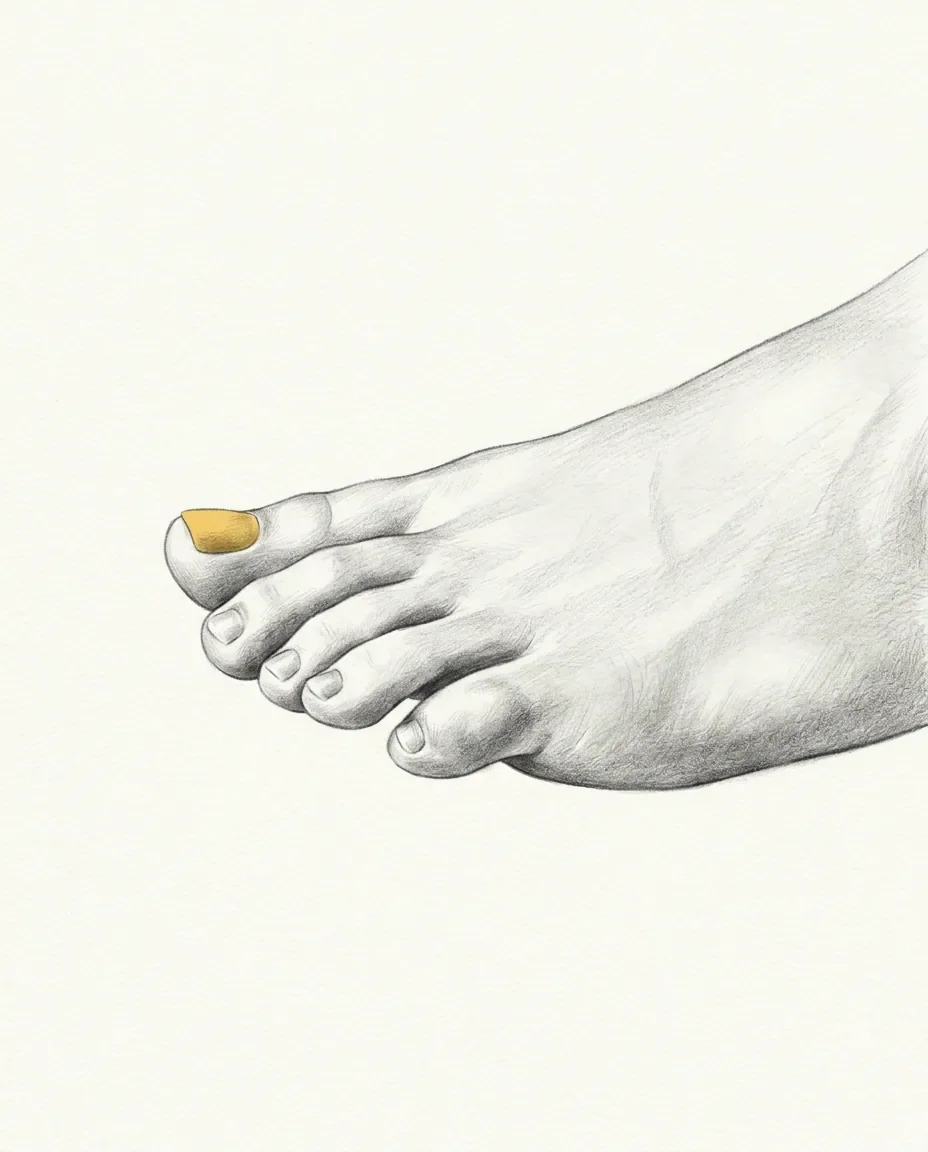
Toejob
Added 8 Aug 2026 · Updated 6 Sep 2026
A non-penetrative sexual act in which the toes, rather than the soles or arches, stimulate a partner. It is the toe-focused form of the footjob and a common expression of foot interest, benign between consenting adults.
- Prevalence
- Uncommon
- Category
- Acts & Activities
- Domain
- Sexual interest
- Confidence
- Low confidence
- Status
- A consensual partnered act. Neither diagnostic manual lists it as a paraphilia, and the underlying foot interest counts as a common variation.
- Also known as
- toe job, toe stimulation, toe play, toe-focused footjob
- Added
- 8 Aug 2026
- Updated
- 6 Sep 2026
Featured in
Overview
A toejob is a non-penetrative sexual act in which one person uses the toes to stimulate a partner. Wiktionary records it as slang for "an oral or genital sex act involving the toes", written either as two words or closed up as toejob. It belongs to a small family of foot practices. A footjob uses the whole foot; a toejob narrows the instrument to the digits. Toe sucking puts the toes in someone's mouth, so a toejob runs the contact the other way. The act is one expression of the interest catalogued as foot fetishism, the best-documented partialism, though you can perform one without having the fetish.
Definition & scope
The body part doing the work defines the act. Contact comes from the toes, the pads and the spaces between them, sometimes curled or gripping, and it may be directed at a partner's genitals or elsewhere on the body. Toes are small, mobile and precise, so writers in the foot-interest community treat the practice as a finer-grained form of the footjob. The two shade into each other in use, and most descriptions of a footjob name the toes among the surfaces involved.
Examples
What the term covers. Stimulation with the toes alone; the same act as one movement within a longer session that also uses the soles and arches; toes used to trace, grip or press instead of stroke; and the practice inside a foot worship dynamic, where attention to the feet is the point. Adornment travels with it, which is why the term sits so close to toe rings, pedicures and nail polish in community writing.
What the term does not cover. Toe sucking is the reverse act: the mouth is the active party and the toes are the object. Sole licking and an aesthetic focus on the sole or the arch belong to the same interest and name different anatomy. Trampling uses the foot to apply weight inside a power exchange; it shares the body part and nothing else. A toe fetish is an attraction. You can have one for a lifetime and never give or receive a toejob.
How the word is used. It is vernacular and British in origin, absent from DSM-5-TR and ICD-11, and it circulates in adult-media category labels, sex-advice writing and everyday speech. Wiktionary's citation from Cosmopolitan's A–Z of Sex (2005), a reader saying toe jobs "really don't do it for me", shows the register: first person, offhand, someone describing a preference.
History & origins
A tabloid coinage
The compound follows the English "-job" pattern that also produced handjob and footjob, and its earliest recorded appearance is a headline. Wiktionary's first citation is The Sun in 1992, "Toe Job to No Job", from British press coverage of the cabinet minister David Mellor. The story behind it did not hold. The publicist Max Clifford supplied the salacious details and later admitted they were untrue, which Mellor confirmed at the Leveson Inquiry in 2011. The word entered the language through an invented story.
Within the longer record of foot eroticism
The act predates the word by centuries. Foot-focused eroticism is documented across antiquity and enters the medical record with Krafft-Ebing's Psychopathia Sexualis (1886) and Havelock Ellis's Studies in the Psychology of Sex (1936). Both catalogue foot fixations without distinguishing the practices they produce. No nosology has named the toejob and no Greek or Latin synonym exists for it, because the clinical literature described the interest and left the vocabulary of its acts to everyday speech.
In practice
Among consenting adults the practice is non-penetrative and low-ceremony. It uses the toes alone or in alternation with the soles, sometimes with a skin-safe lubricant to cut friction, and it goes with grooming: trimmed nails and attention to small cuts matter more here than in most acts, because the digits are the point of contact. It appears on its own and as one moment inside a broader foot scene.
Psychology
Motivation splits the same way it does for the footjob. Some people try it once as a variation and keep it as an occasional preference. Others choose it as the expression of a foot interest they hold. Feet dominate the partialism literature: in the community analysis by Scorolli and colleagues (2007), covering 381 discussion groups and an estimated 5,000-plus people, feet accounted for about 47% of body-part fetishes, far ahead of any other. Explanations for that dominance divide between associative learning and the contested cortical-adjacency conjecture that V. S. Ramachandran popularised. Neither settles the question, and you need neither to explain someone enjoying the sensation.
Prevalence & culture
No survey measures this act. The interest behind it is measured: Justin Lehmiller's 2018 survey of more than 4,000 Americans found roughly one in seven had fantasised about feet. Within that minority the act is common and far from universal, which places it in the low single digits of adults and keeps this entry's estimate conservative. In adult media the term works as a fine-grained tag under the larger foot category; no genre carries the name.
Safety, consent & law
Between consenting adults it is a benign variation with no legal dimension anywhere the underlying activity is lawful, and neither diagnostic manual lists it as a disorder. The precautions are the ones you would expect: clean and trimmed toenails, care around cuts, calluses or fungal infection, a skin-safe lubricant if friction is an issue, and the explicit consent any intimate act requires. Skin-to-skin genital contact can transmit infections such as HPV or herpes, so the risk is lower than intercourse and above zero.
Common questions
What is the difference between a toejob and a footjob?
The instrument. A footjob uses the foot as a whole, usually the soles and arches; a toejob narrows the contact to the digits. In practice the two blend, because a session that uses the sole will use the toes as well. The distinction helps you describe a preference; it does little to classify an act.
Is a toejob the same thing as toe sucking?
No. The direction of contact separates them. In toe sucking the toes are the object of attention and someone's mouth is the active party. In a toejob the toes do the stimulating. Both belong to the same broad foot interest and often appear in the same encounter, and they are opposite acts.
Do you need a foot fetish to enjoy this?
No. Many people who give or receive one have a foot fetish, and plenty try it out of curiosity or because a partner enjoys it. The act carries no diagnostic weight either way. The reverse also holds: someone can have a lifelong foot interest and never do this particular thing.
Where does the word "toe job" come from?
It is built on the same "-job" pattern as handjob and footjob. Its earliest recorded use is a 1992 headline in The Sun, "Toe Job to No Job", from British coverage of the politician David Mellor. The publicist Max Clifford supplied the salacious details in that reporting and later admitted they were untrue.
How common are toejobs?
No survey measures the act. The interest that motivates it is well documented: Lehmiller's 2018 survey of more than 4,000 Americans found roughly one in seven had fantasised about feet, and Scorolli et al. (2007) found feet account for about 47% of body-part fetishes. The specific act sits in the low single digits of adults.
Is it safe?
Yes, with ordinary precautions. Trim and smooth the toenails, since the digits are the point of contact, and wait out cuts, calluses or fungal infection. Skin-to-skin genital contact can transmit infections such as HPV or herpes, so the risk is lower than intercourse and above zero. A skin-safe lubricant helps if friction is an issue.
Is a toejob a paraphilia?
No. It is a consensual act between adults and appears in neither DSM-5-TR nor ICD-11. An underlying foot interest becomes clinically relevant only when it causes the person distress or impairment, or involves someone who has not consented, the same threshold this catalog applies to every interest.
- Footjob54/100Acts & ActivitiesA non-penetrative, partnered sexual practice in which one person stimulates a partner using the feet, soles, or toes. It is an act within foot fetishism, distinct from the attraction itself, and benign between consenting adults.54
- Toe Fetish56/100Toe Partialism · Body Parts & PartialismA focused erotic interest specifically in the toes: a narrower subset of foot partialism. The toes' shape, length, arrangement, adornment such as painted nails or toe rings, or related contact are a primary source of attraction.56
- Toe Sucking55/100Acts & ActivitiesOral stimulation of the toes (licking, kissing, or sucking them) for erotic pleasure. A defining foot-focused act within the broader practice of foot worship, popularly nicknamed "shrimping" and given lasting cultural visibility by a 1992 royal tabloid episode.55
- Foot Fetish83/100Podophilia · Body Parts & PartialismA focused erotic interest in feet (their shape, soles, toes, arches, or grooming) as a primary source of attraction. Within partialism (erotic focus on a non-genital body part) it is the example people report most, by a wide margin.83
- Sole Fetish53/100Body Parts & PartialismSole fetishism is an erotic focus on the underside of the foot, the sole, and especially on its texture and softness. The wrinkles and flex-lines that appear when the foot bends are a particular draw. A narrower form of foot partialism tied to the popular "wrinkled soles" search term.53
- Foot Worship55/100Power, Roles & ScenariosThe submissive, reverent practice of kissing, massaging, caressing or venerating a partner's feet, usually inside a dominance-and-submission dynamic. It names an activity and a ritual of devotion rather than the underlying attraction, which is the foot fetish.55
A plain-English compound of "toe" and the productive erotic "-job" suffix, on the pattern of handjob and footjob. First recorded in British newspaper coverage in 1992; no classical or clinical derivation exists.
foot play · non-penetrative · foot-fetish practice
Prevalence is computed from the entry's cited population estimate. Rows marked ESTare indicative editorial estimates scored against a fixed anchor rubric, not measured quantities. Method & anchors: methodology.
Uncommon · ≈ 1 in 100
- 01toe job (Wiktionary, the free dictionary)definition as slang for an oral or genital act involving the toes; the toejob spelling variant; the 1992 Sun citation and the 2005 Cosmopolitan's A-Z of Sex citation
- 02Footjob (Wikipedia)the parent act: non-penetrative stimulation with the feet, with the toes named as one of the surfaces involved
- 03David Mellor (Wikipedia)the 1992 press coverage behind the term's first citation; that the claims supplied by Max Clifford were untrue, as de Sancha admitted and Mellor confirmed at the Leveson Inquiry in 2011
- 04Scorolli et al. (2007), Relative prevalence of different fetishes, Int. J. Impotence Research 19(4):432-437feet account for about 47% of body-part fetishes across 381 discussion groups and an estimated 5,000+ people
- 05Lehmiller (2018), Tell Me What You Want, survey of ~4,175 Americans, as summarised on the Foot fetishism articlegeneral-population anchor (~1 in 7 had fantasised about feet) used to bound the prevalence estimate; Krafft-Ebing 1886 and Ellis 1936 in the history of foot eroticism
- 06DSM-5-TR, Paraphilic Disorders (American Psychiatric Association, 2022)the act is not a paraphilic disorder; an underlying interest is clinically relevant only with distress, impairment or non-consent
- 07ICD-11, Paraphilic disorders (World Health Organization)no diagnostic category covers the act; a foot-focused interest is a disorder only with distress, impairment or non-consent