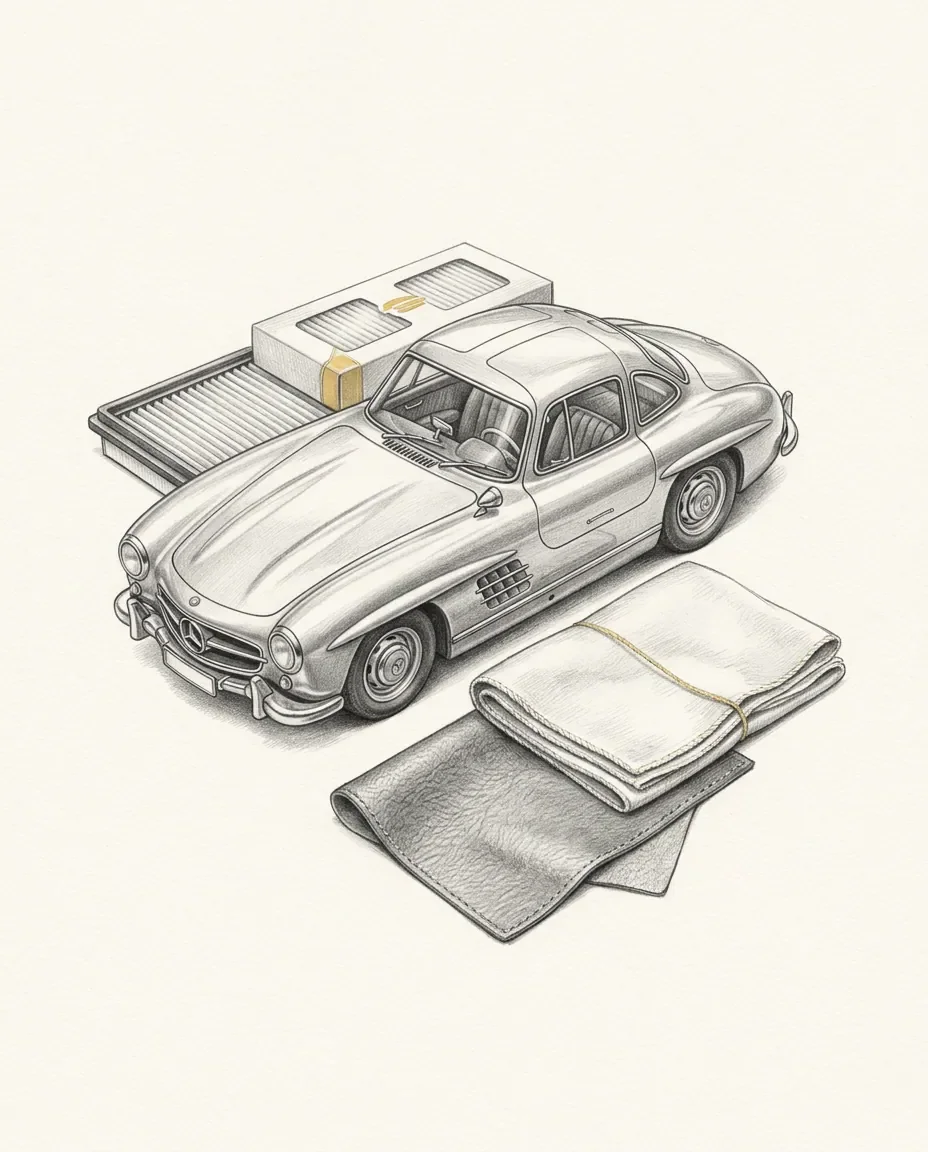
New Car Smell
Added 21 Jun 2026 · Updated 22 Aug 2026
A non-sexual fondness for the distinctive smell of new manufactured goods, most famously the interior of a new car. Freshly printed books, electronics, or packaging carry it too. It is a common, pleasurable sensory and nostalgic experience, not a clinical condition.
- Prevalence
- Very common
- Category
- Non-Sexual Fetishism
- Domain
- Non-sexual interest
- Confidence
- Low confidence
- Status
- Not a disorder; a common sensory/nostalgic preference.
- Also known as
- new-object scent affinity, new book smell, fresh-product scent affinity, new-object smell affinity, olfactory product affinity
- Added
- 21 Jun 2026
- Updated
- 22 Aug 2026
Featured in

Overview
New-object scent affinity is the ordinary, non-sexual enjoyment of the characteristic odours given off by freshly manufactured items: most famously the interior of a new car, but also new (and old) books, electronics, stationery, and packaging. These smells arise largely from volatile organic compounds (VOCs) released by plastics, adhesives, sealants, paper, printing inks, and treated leather or textiles. This article covers where the appeal comes from, what is known of its chemistry and psychology, and why it sits firmly outside the clinical literature on sexual interests: it is a sensory preference, not a disorder and not a fetish in the erotic sense.
Examples
What the term covers. The showroom case is the famous one, but the same pleasure attaches to the gust from a newly opened hardback, the faintly warm plastic-and-solder note of a just-unboxed phone or laptop, fresh printer paper and toner, new trainers, a shrink-wrapped record sleeve, and the resin smell of flat-pack furniture straight out of the carton. The common thread is not the object but the moment: a material still off-gassing, met at the point of acquisition, before use and airing wear the smell away.
What the term does not cover. Adjacent interests are separated by what they are actually keyed to. Olfactophilia is erotic arousal at body odour; car and machine fetish is sexual attraction to vehicles themselves; car enthusiasm is about engineering, history and culture rather than scent. Among the non-sexual sensory affinities, texture fixation is tactile, ASMR is a tingling response to sound and close attention, and stationery fetish is an enthusiasm for pens, ink and paper as objects, of which fresh-paper smell is only one component. Nor is it collecting: the pleasure is momentary and sensory rather than acquisitive.
How the word is used. "New car smell" is advertising shorthand that became an everyday idiom, and it long ago detached from cars; "it still has that new car smell" is said of anything barely used. There is no clinical name for the preference and no -philia coinage covers it; it appears in no edition of the DSM or the ICD, because a widely shared sensory pleasure is not a diagnostic category. "New-object scent affinity" is a descriptive label rather than a term anyone uses in conversation.
History & origins
Unlike most entries in this directory, the appeal of new-product odour has no clinical coinage, no founding sexologist, and no diagnostic history, it is an artefact of mass manufacturing rather than a documented psychological category. Its lineage is therefore industrial and cultural rather than medical.
A by-product of the manufacturing age
The phenomenon could only exist once goods were produced at scale from synthetic plastics, adhesives, and treated materials, so the appreciation of "that smell" emerged alongside twentieth-century mass consumption and the expansion of private car ownership. The precise moment the phrase "new car smell" entered common English usage is not well documented and predates any scientific study of it; it spread as advertising shorthand and everyday vernacular rather than from a coined term.
The chemistry becomes a research subject
- 1995: A chemical analysis of a Lincoln Continental interior reportedly identified over fifty volatile organic compounds emanating from paint, carpeting, vinyl treatments, and residual fuel vapours, an early characterisation of what produces the signature aroma.
- 2001: A two-year study by Australia's CSIRO examined cabin off-gassing and flagged irritant and toxic constituents such as benzene, framing the smell as a health as well as a sensory question.
- 2005 onward: A study of four vehicles found more than sixty compounds, with one cabin reaching 7,500 micrograms per cubic metre of total VOCs and concentrations decaying by roughly 90% over about three weeks as materials finish off-gassing. A separate Japanese measurement recorded levels in a new minivan more than thirty-five times a health guideline the day after delivery, taking years to settle permanently below it.
The signature aroma is a blend rather than one smell, drawn from several material sources:
| Compound | Typical source | Note |
|---|---|---|
| Benzene | fuel vapour, adhesives | classed as a carcinogen |
| Formaldehyde | resins, foams, textiles | irritant |
| Acetaldehyde | plastics, coatings | irritant |
| Styrene | plastics, trim | possible carcinogen |
Commercialisation and cultural divergence
Manufacturers came to treat the scent as a marketing asset, engineering and even spraying it to make showroom cars more appealing, and a consumer market in "new car smell" sprays and air fresheners grew to reproduce the effect in older vehicles. Tellingly, the preference is not universal: many Chinese consumers actively dislike the odour, and automakers have developed processes to remove rather than enhance it for that market: evidence that the "affinity" is partly a learned, culturally framed pleasure rather than a fixed human response.
Why it is not a paraphilia
Reference catalogues of erotic olfactory interests, such as Wikipedia's List of paraphilias, document arousal tied to specific scents, but broad non-erotic scent enjoyment falls outside that scope. New-object scent affinity has never been pathologised, and it appears in no edition of the DSM or ICD.
In practice, how the interest is typically expressed
The affinity is expressed simply by seeking out, noticing, and savouring these odours: lingering in a newly purchased car, inhaling a freshly opened book, or enjoying the smell of new electronics, stationery, or packaging. Some people deliberately buy products, or scent sprays, to recreate the experience. It overlaps with a broader appreciation of materials and surfaces, which is why it sits near sensory interests such as texture fixation.
Psychology, proposed mechanisms
Olfaction has unusually direct links to memory, emotion, and reward. Smell signals reach limbic structures with little intermediate cortical processing, and the olfactory pathway terminates in or near the amygdala, which is why odour-cued memories are measurably more emotional and evocative than the same cue delivered by sight or sound. Odour-linked autobiographical memories also tend to date from the first decade of life, giving smells a distinctive tie to early, formative experience: the mechanism behind the popularly named "Proust phenomenon".
New-object odours become associated with newness, acquisition, anticipation, and pleasant past experiences, so they tend to evoke positive emotion and nostalgia rather than any erotic response. The pleasure is best understood as conditioned association layered onto novelty and the satisfaction of a new purchase. The cross-cultural divergence noted above (desirable in some markets, off-putting in others) supports a largely learned, associative account: the dedicated evidence base specific to this preference is thin, and most of what can be said is extrapolated from general olfactory psychology.
Is it a fetish?
No, not in the erotic sense the rest of this directory documents. A fetish denotes sexual arousal fixed on a specific object or stimulus. New-object scent affinity carries no such charge: it is an everyday sensory pleasure, closer to enjoying the smell of coffee or fresh rain, and it sits alongside benign sensory interests such as texture fixation rather than among paraphilias.
Prevalence & culture
The experience is very widely shared and culturally familiar. "New car smell" is a recurring reference in advertising and casual conversation, and the existence of a commercial spray market confirms broad demand. There is, however, no dedicated prevalence study and no community structure, because it is regarded as an everyday pleasure rather than a defining interest, closer to enjoying fresh coffee or rain than to any catalogued fetish.
Safety, consent & law
The interest is entirely harmless and raises no consent or legal issues. The only practical note concerns the chemistry rather than the preference: some of the responsible compounds (off-gassing VOCs such as benzene, formaldehyde, and acetaldehyde) can be mild irritants, and several studies have measured elevated levels in brand-new, poorly ventilated cabins. Ordinary ventilation of a new vehicle or freshly furnished room, driving with a window cracked for the first weeks, is a sensible precaution and does not detract from the pleasure of the scent.
Common questions
What causes that new car smell?
Off-gassing. Freshly manufactured plastics, adhesives, sealants, foams, coatings and treated leather or textiles release volatile organic compounds into the enclosed cabin, and the smell is the blend rather than any single chemical. A 1995 analysis of a Lincoln Continental interior reportedly identified more than fifty such compounds, and a later study of four vehicles found over sixty, including benzene, formaldehyde, acetaldehyde and styrene.
How long does new car smell last?
Most of it goes quickly. In the study of four vehicles reported by Wikipedia, one cabin measured 7,500 micrograms per cubic metre of total volatile organic compounds, and concentrations fell by roughly 90% over about three weeks as the materials finished off-gassing. The tail is much longer: a Japanese measurement of a new minivan found levels above a health guideline that took years to settle permanently below it.
Is new car smell toxic?
Some of what produces it is genuinely unwelcome. Benzene is classed as a carcinogen and styrene as a possible one; formaldehyde and acetaldehyde are irritants. A two-year CSIRO study in Australia examined cabin off-gassing and flagged exactly these constituents. The practical response is ordinary ventilation (airing a new car, driving with a window cracked for the first few weeks) rather than avoiding new cars.
Why do people like the smell of new books?
The mechanism is the same one behind new car smell: paper, printing inks and binding adhesives give off volatile compounds that are strongest when the book is new. What makes it pleasurable is association rather than chemistry. Odours reach limbic structures with little intermediate processing, and odour-cued memories tend to date from the first decade of life, so a smell tied to bookshops or classrooms carries that weight with it.
Can you buy new car smell?
Yes. A consumer market in "new car smell" sprays and air fresheners exists specifically to reproduce the effect in older vehicles, and manufacturers have treated the scent as a marketing asset in its own right, engineering and even spraying it so that showroom cars smell the part. The reproduction is a fragrance rather than the original off-gassing, which is why enthusiasts often find it approximate.
Why do some people dislike new car smell?
Because the preference is learned rather than universal. Many Chinese consumers actively dislike the odour, and automakers have developed processes to strip it out for that market rather than enhance it. Sensitivity varies too: the same compounds that read as "new" to one person register as chemical or headache-inducing to another, particularly in a poorly ventilated cabin.
Is there a name for liking the smell of new things?
Not a clinical one. No diagnostic manual and no established -philia term covers it, because it has never been treated as a condition; it is an everyday sensory preference closer to enjoying coffee or fresh rain. Catalogues like this one use a descriptive label such as "new-object scent affinity" for indexing purposes, but there is no accepted technical term and no community organised around the interest.
- Texture Fixation39/100Non-Sexual FetishismA non-sexual enjoyment of touching, stroking, or manipulating particular textures for comfort and sensory satisfaction. Soft, smooth, squishy, fuzzy, or grainy surfaces are the usual draw. It overlaps with fidgeting, stimming, and relaxation behaviour.39
- Car Enthusiasm57/100Non-Sexual FetishismA strong, non-sexual fascination with automobiles, including their engineering, aesthetics, performance, history, and the culture surrounding them. It is a widespread hobby and identity rather than a clinical condition.57
- ASMR69/100Autonomous Sensory Meridian Response · Non-Sexual FetishismA non-sexual, pleasant tingling sensation that typically begins on the scalp and moves down the neck and spine. Soft sounds, gentle attention, or close personal care trigger it. It underpins a large online relaxation-media subculture.69
- Body-Odor Fetish42/100Olfactophilia · Body Functions & FluidsOlfactophilia is a sexual interest in body odors and other smells, where scent itself is a primary source of arousal. Mild responsiveness to a partner's natural scent is near-universal; a defined fetish focus is more niche but rarely clinically significant.42
- Plane Spotting37/100Non-Sexual FetishismA hobby centred on observing, identifying, photographing and logging aircraft, often from airport perimeters or dedicated viewing spots. It is a mainstream, non-sexual enthusiasm rooted in wartime aircraft-recognition training rather than a clinical interest.37
- Trainspotting37/100Non-Sexual FetishismA hobby centered on observing, identifying and recording railway locomotives and rolling stock, historically by noting their numbers in a reference booklet. It grew into a broader railway-enthusiast culture of photography, travel and preservation.37
sensory experience · olfactory · consumer culture
Prevalence is computed from the entry's cited population estimate. Rows marked ESTare indicative editorial estimates scored against a fixed anchor rubric, not measured quantities. Method & anchors: methodology.
Very common · ≈ 1 in 7
- 01List of paraphilias, Wikipediacontext that this is an olfactory affinity, not a clinical paraphilia
- 02Google Trends, relative search interest (search-interest proxy)search-interest proxy showing broad mainstream popularity of 'new car smell' as a sensory experience
- 03An A–Z of Kinks and Fetishes, Glamourlay framing of olfactory/sensory affinities within everyday non-sexual preferences
- 04New car smell, Wikipediathe VOC/off-gassing chemistry of new-car odour, the 1995/2001/2005 chemical analyses, the consumer spray market, and cross-cultural divergence in liking the scent
- 05Volatile organic compound, Wikipediathe class of compounds released by plastics, adhesives, and treated materials that produce new-object odours
- 06Odor, Wikipediathe olfactory pathway terminating near the amygdala, odour-cued memories being more emotional than visual/auditory cues, odour memories dating from the first decade of life, and the Proust phenomenon
- 07Diagnostic and Statistical Manual of Mental Disorders, Wikipediacontext that new-object scent affinity appears in no DSM edition and is not a clinical disorder
- 08International Classification of Diseases, Wikipediacontext that the affinity appears in no ICD edition and is not a clinical disorder