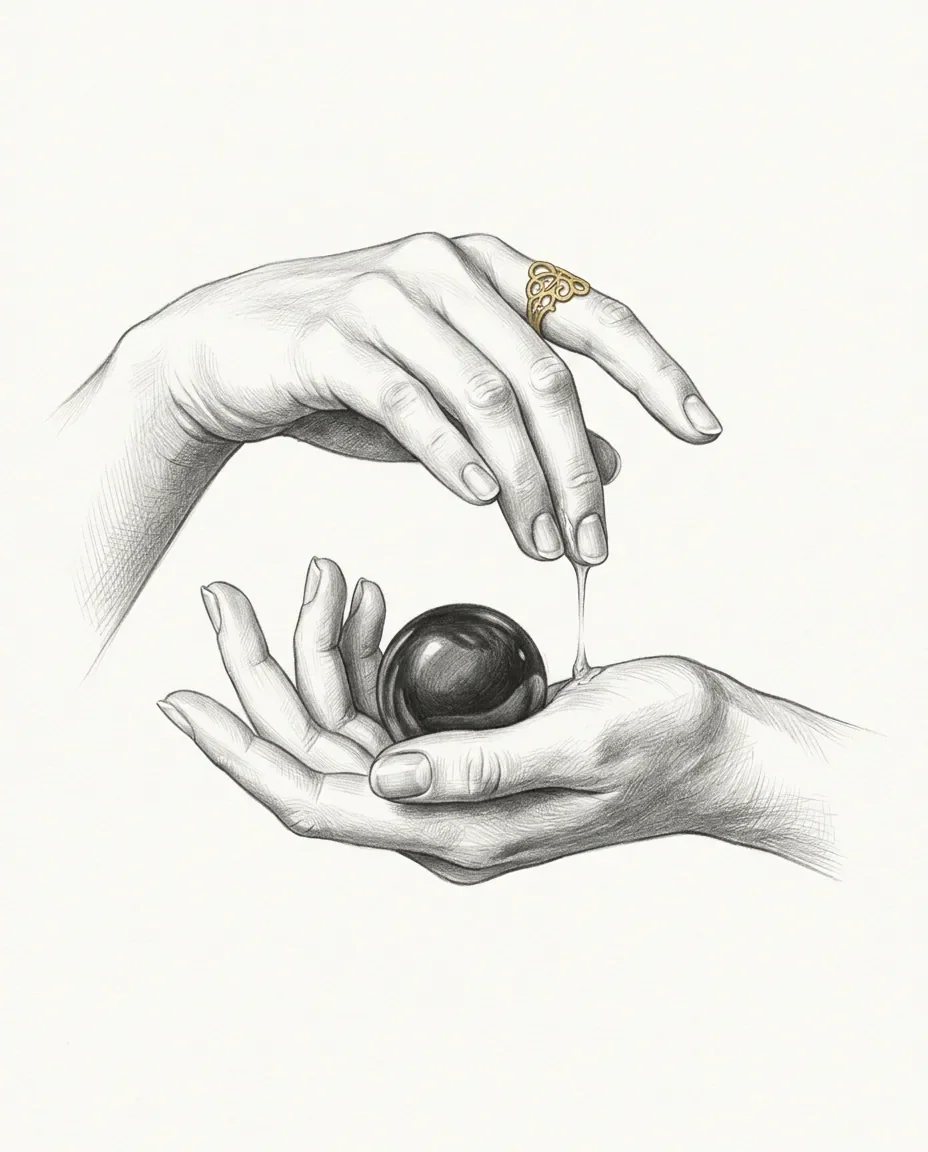
Spit Fetish
Salivaphilia
Added 21 Jun 2026 · Updated 22 Aug 2026
A sexual interest in saliva, spit, or drool, often as part of kissing, oral play, or dominance dynamics. It is generally a benign body-fluid interest among consenting adults rather than a recognized disorder.
- Prevalence
- Common
- Category
- Body Functions & Fluids
- Clinical term
- Salivaphilia
- Domain
- Sexual interest
- Confidence
- Low confidence
- Status
- Benign body-fluid interest, not a distinct recognized paraphilic disorder; a normal variation absent distress or non-consent.
- Also known as
- salivaphilia, saliva fetishism, saliva fetish, spit play, drool fetish
- Added
- 21 Jun 2026
- Updated
- 22 Aug 2026
Overview
Salivaphilia is an erotic interest in saliva, spit, or drool. The appeal can centre on the intimacy and wetness of deep kissing, on the sensory pleasure of sharing saliva, or on the symbolic charge that spitting can carry within dominance and submission play. It belongs to the broad family of body-fluid interests and, between consenting adults, is regarded as a benign variation rather than a distinct disorder. This article traces how fluid-focused interests entered the clinical record, how the interest is expressed and understood, and what is, and is not, known about its prevalence.
Examples
What the term covers. A heightened focus on saliva exchange during deep kissing, where the wetness itself is the draw rather than an incidental feature; an interest in visible drool during oral contact; the use of a partner's saliva as a lubricant, valued for where it comes from; and negotiated spit play inside a dominance dynamic, where spitting on or into a partner is a deliberate, agreed gesture of yielding. Intensity varies enormously, and for most people it is a preference folded into ordinary intimacy rather than a requirement.
What the term does not cover. It is one member of the wider body-fluid interests family and is routinely confused with its neighbours: watersports concerns urine, cum fetish semen, and sweat fetish perspiration, none of which carry saliva's everyday licence. Snowballing passes semen mouth-to-mouth and is about the substance being passed, not the saliva carrying it. A tongue fetish is anatomical rather than fluid-focused, and oculolinctus puts the tongue to an entirely different target. Where spitting is used to belittle, the frame belongs as much to degradation as to saliva.
How the word is used. "Spit fetish" and "spit play" are ordinary community vernacular. Salivaphilia is a glossary coinage rather than a research term: it belongs to the tradition of naming interests as -philias and turns up in catalogues such as the list of paraphilias, not in primary clinical studies. Neither word appears in DSM-5-TR or ICD-11, which name no saliva-specific disorder.
History & origins
A fluid already woven into intimacy
Saliva has carried erotic and social meaning across many cultures, in large part because kissing already makes saliva exchange a routine, sanctioned part of intimacy. That ordinariness is the backdrop against which any fetish framing has to be understood: the interest is less the discovery of a new sensation than the foregrounding and eroticising of one most people already encounter.
Clinical lineage
The clinical framing of fluid-focused interests grew out of nineteenth-century sexology. Richard von Krafft-Ebing's Psychopathia Sexualis (1886) and Havelock Ellis's Studies in the Psychology of Sex catalogued attractions to bodily secretions within broader taxonomies of fetishism, establishing the template later expanded into long lists of named -philias, as collected in the modern list of paraphilias. The specific label salivaphilia, from Latin saliva ("spittle") plus Greek -philia ("love"), belongs to that cataloguing tradition rather than to any single landmark study; its precise coinage is not well documented, and it appears mainly in glossaries rather than in primary clinical research.
A particularly apt early observation comes from Sigmund Freud's Three Essays on the Theory of Sexuality (1905), where he noted that the limits of disgust are "often purely conventional": a man may kiss a partner's lips passionately yet recoil at using the same partner's toothbrush, though there is no rational hygienic difference. That insight, discussed in modern commentary on kissing and disgust, prefigures much of the contemporary psychological account of why saliva can flip so readily between intimate and taboo.
Modern diagnostic status
Contemporary manuals do not treat the interest as a separate diagnosis. Neither the DSM-5-TR nor the ICD-11 names a saliva-specific paraphilic disorder; in those frameworks such an interest would become clinically relevant only if it caused distress, impairment, or non-consensual harm, which an ordinary enjoyment of saliva does not.
In practice
The interest is expressed across a wide range of intensities:
- a heightened enjoyment of saliva exchange during kissing and oral contact
- a focus on drool or visible wetness as a sensory pleasure
- consensual spit play used as a negotiated, often degradation-tinged gesture within dominance, submission, and broader power-exchange dynamics
It frequently overlaps with power-exchange play and with broader interests in the mouth and in other bodily fluids generally, such as sweat or lactation.
Psychology
Two threads recur in the (sparse) literature. The first is intimacy: saliva is bound up with kissing, one of the most strongly affiliative human behaviours, so its exchange can read as deep closeness and trust. The second is transgression: precisely because saliva sits at a culturally arbitrary boundary of disgust, Freud's toothbrush point, using it deliberately outside ordinary contexts can carry a transgressive charge that heightens arousal, especially within a dominance/submission frame where a consensual act of "yielding" is the point. The interest is documented in catalogues of fluid-related interests but has received little dedicated empirical study, and it is not classed as a distinct paraphilic disorder.
Prevalence & culture
Hard figures are scarce. The most-cited frequency data come from Scorolli et al. (2007), an analysis of online fetish communities in which body-fluid interests (saliva, urine, and others grouped together) accounted for roughly 9% of body-part/feature fetishes: a small slice of the overall landscape, with saliva not separated out individually. As a fluid interest, salivaphilia is more commonly reported and more mainstream-adjacent than rarer excretion paraphilias such as watersports, in large part because saliva exchange is already normal in intimacy. Dedicated communities are modest and cultural visibility is moderate, with spit play surfacing in kink and adult media. Because no large general-population survey isolates saliva specifically, prevalence estimates here are approximate and held with low confidence.
Safety, consent & law
Between consenting adults the interest is legal and raises no special concern. Saliva is not risk-free, however, and the exchange is a real one: it can carry oral herpes, Epstein-Barr virus, cytomegalovirus and common respiratory infections, and oral herpes can be passed to a partner's genitals during oral sex. Bleeding gums, mouth ulcers or an active cold sore raise the risk for both people, and spit play sits alongside, not instead of, ordinary barrier use and sexual-health testing. Consent is the other half. Spitting used as a degrading gesture has to be negotiated in advance and actively wanted: an unwanted spit is an act of contempt rather than play, and spitting at a person who has not agreed to it is treated as an assault in many jurisdictions.
Common questions
Why do some people find spit or drool arousing?
Two threads recur. Saliva is already part of kissing, one of the most affiliative things people do, so exchanging it deliberately can read as unusual closeness and trust. It also sits on a culturally arbitrary line of disgust, which is Freud's point that a person may kiss a partner passionately and still recoil at their toothbrush, and crossing that line on purpose carries a transgressive charge. Inside a dominance frame the two combine: yielding to something ordinarily off-limits is the whole gesture.
Can you catch anything from spit play?
Yes, though the risks are the ordinary ones of any mouth contact. Saliva can carry oral herpes, Epstein-Barr virus, cytomegalovirus and common respiratory infections, and oral herpes can be passed to a partner's genitals during oral sex. Bleeding gums, mouth ulcers or an active cold sore raise the risk for both people. Spit play is not a substitute for barrier protection during other activities, and it does not remove the need for routine sexual-health testing.
Is spitting on a partner degrading?
Usually that is the point, which is exactly why it has to be negotiated. Within a dominance dynamic the gesture works because it reads as contemptuous, and both people have agreed in advance to that meaning. Outside such a frame the same act is simply contempt, and an unwanted spit is not play. Plenty of people enjoy saliva purely as sensation in kissing, with no degradation element at all.
How common is a spit fetish?
No general-population survey isolates saliva. The most-cited figures come from Scorolli and colleagues' 2007 analysis of online fetish communities, where body fluids as a whole, saliva and urine and others grouped together, accounted for roughly 9% of body-part and body-feature fetishes, with saliva not separated out. Saliva interest is probably more widespread than rarer excretion interests, since kissing already normalises the exchange, but any single percentage should be read as an estimate.
Does a spit fetish mean you are into other bodily fluids too?
Not necessarily. Fluid interests are more separable than the grouping suggests: many people who enjoy saliva find watersports or a cum fetish unappealing, and the reverse is just as common. Saliva is the outlier in the body-fluid family because kissing already makes its exchange routine, so an interest in it can sit comfortably inside otherwise conventional intimacy without signalling any broader taste.
Is a spit fetish a paraphilia or a disorder?
No. Neither DSM-5-TR nor ICD-11 names a saliva-specific paraphilic disorder, and salivaphilia appears in glossaries rather than in diagnostic manuals. As with any interest, it would become clinically relevant only if it caused the person marked distress or impairment, or if it involved someone who had not consented. A private enjoyment of saliva between willing adults meets none of those conditions.
Is spitting on someone during sex legal?
Between consenting adults, yes, and it raises no legal issue of its own. Spitting at a person who has not agreed to it is a different matter and is treated as an assault in many jurisdictions, whatever the setting. The dividing line is the one that governs the rest of the practice: explicit agreement in advance, and the freedom of either person to withdraw it at any point.
- Watersports55/100Urolagnia · Body Functions & FluidsA sexual interest in urine or urination, commonly called watersports. Clinically named urolagnia or urophilia, it is a recognized paraphilic interest that, when practised safely between consenting adults, is generally regarded as a benign variation.55
- Lactation Fetish42/100Lactophilia · Body Functions & FluidsA sexual interest in lactation, breast milk, or adult nursing, sometimes practised within an adult nursing relationship (ANR). A recognized but uncommon interest that, between consenting adults, is generally regarded as a benign variation.42
- Sweat Fetish46/100Olfactophilia (sweat subtype) · Body Functions & FluidsA sexual interest in sweat and natural body odor, valued for its scent, musk, and sense of physical authenticity. It is a benign olfactophilic interest among consenting adults rather than a recognized disorder.46
- Cum Fetish43/100Spermatophilia · Body Functions & FluidsAn erotic interest in which semen and the act of ejaculation become a focus of arousal, through their visual presence or their scent. Symbolic associations with climax, virility and fertility also carry the charge. It is a common element of mainstream adult fantasy rather than a discrete clinical disorder.43
- Foot Odor Fetish43/100Olfactophilia (foot-specific) · Body Functions & FluidsA foot-specific facet of olfactophilia: arousal centred on the natural scent of feet, worn socks, or the inside of shoes. It overlaps closely with general foot fetishism, where the smell (not only the look) of the foot is part of the attraction.43
- Body-Odor Fetish42/100Olfactophilia · Body Functions & FluidsOlfactophilia is a sexual interest in body odors and other smells, where scent itself is a primary source of arousal. Mild responsiveness to a partner's natural scent is near-universal; a defined fetish focus is more niche but rarely clinically significant.42
"Salivaphilia" combines Latin saliva ("spittle") with Greek -philia ("love, affinity"), literally "love of saliva." It belongs to the modern tradition of cataloguing fluid-focused interests as named -philias; its exact coinage is not well documented.
saliva · secretion · oral
Prevalence is computed from the entry's cited population estimate. Rows marked ESTare indicative editorial estimates scored against a fixed anchor rubric, not measured quantities. Method & anchors: methodology.
Common · ≈ 1 in 20
- 01Scorolli et al. (2007), Relative prevalence of different fetishes, Int. J. Impotence Research 19(4):432-437prevalence anchor: body fluids (saliva, urine, etc.) ~9% of body-part fetishes, general-pop ~2%
- 02Sexual fetishism, Wikipedia (carries the Scorolli 2007 relative-frequency table)saliva/spit listed under body-fluid fetishism; carries the Scorolli relative-frequency table
- 03List of paraphilias, Wikipediadefinition/existence of salivaphilia as a recognized fluid-focused interest; Latin saliva + Greek -philia naming
- 04Psychopathia Sexualis, WikipediaKrafft-Ebing 1886 cataloguing of fetishistic attractions including bodily secretions
- 05Havelock Ellis, WikipediaStudies in the Psychology of Sex and its taxonomy of attractions to bodily secretions
- 06Three Essays on the Theory of Sexuality, WikipediaFreud 1905; the limits of disgust are 'often purely conventional'; the kiss-vs-toothbrush observation about saliva
- 07On Kissing and Other Perversions, Psychology Today (Clemente & Goodman, 2025)modern commentary quoting Freud's toothbrush/disgust passage and the socially constructed boundary of disgust around saliva
- 08DSM-5-TR, American Psychiatric Associationno saliva-specific paraphilic disorder; clinical relevance only with distress, impairment or non-consent
- 09ICD-11, World Health Organizationno saliva-specific paraphilic disorder named in the ICD-11