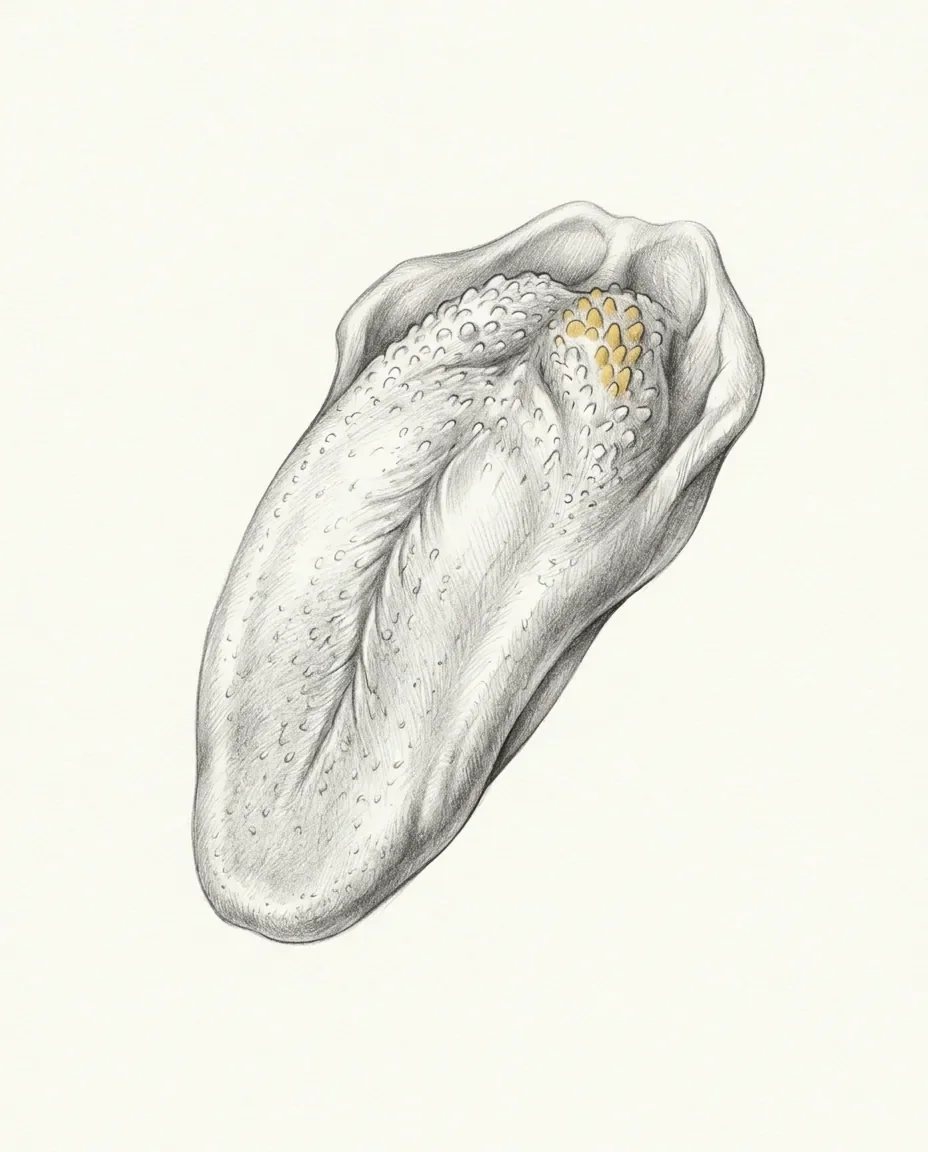
Tongue Fetish
Glossophilia
Added 21 Jun 2026 · Updated 22 Aug 2026
A tongue fetish is a focused erotic interest in the tongue itself: its appearance, movement, or the sensations it produces. The tongue is a primary object of attraction, distinct from a general interest in kissing or the mouth.
- Prevalence
- Uncommon
- Category
- Body Parts & Partialism
- Clinical term
- Glossophilia
- Domain
- Sexual interest
- Confidence
- Low confidence
- Status
- A benign variation of attraction, classified as a partialism; not a recognized standalone paraphilia and not a disorder absent distress or impairment.
- Also known as
- tongue partialism, glossophilia (partialism sense), tongue partialism (clinical)
- Added
- 21 Jun 2026
- Updated
- 22 Aug 2026
Overview
A tongue fetish, or tongue partialism, is an erotic focus directed at the tongue itself: its appearance, texture, movement, and the sensations it produces. While the tongue is broadly involved in ordinary intimacy, here it is a distinct and central point of attraction rather than an incidental part of kissing. The clinical-sounding label glossophilia is sometimes applied to it. This article covers how the interest fits within the clinical concept of partialism, how it is expressed, and what little is known about how common it is. The interest frequently blends into a wider appreciation of the lips and mouth, and of saliva.
Definition & scope
Partialism is an erotic focus on a specific non-genital body part. A tongue fetish is the partialism variant centred on the tongue: the visual of an extended or playful tongue, its movement in kissing, tongue piercings, or the tactile sensations of oral contact. It shades naturally into interest in the lips and mouth, and it is distinct from a general enjoyment of kissing, where the tongue is only one incidental element. As a benign preference it is a variation of ordinary attraction, not a compulsion.
Examples
What the term covers. The look of a tongue in motion (extended, curled, or playful) and of tongue piercings and other oral adornment; the feel of tongue contact during kissing or oral play; and, for some, the tongue's length, texture or dexterity as the specific thing being noticed. It surfaces in flirtation, in photography and stylised art where an out-thrust tongue is the focal gesture, and in exaggerated depictions such as ahegao.
What it does not cover. Ordinary enjoyment of kissing, where the tongue is one incidental element rather than the point. Lip fetish centres on the shape, fullness and colour of the lips and mouth, spit fetish on saliva as a substance, and teeth fetish on the teeth: all neighbours, none the same focus. It is also distinct from acts the tongue happens to perform: toe sucking, anilingus and oculolinctus are defined by what is being licked, not by an interest in the licking organ. The instrument is not the object.
How the word is used. "Tongue fetish" is plain vernacular and is how anyone actually describing the interest says it. Glossophilia is the clinical-sounding alternative, and it is a slippery one: outside sexology the same word far more often means a love of languages. Neither form appears in DSM-5-TR or ICD-11 as a named category; a tongue focus falls under partialism, which DSM-5 folded into fetishistic disorder and made contingent on distress or impairment.
History & origins
Clinical lineage
Tongue partialism has no separately documented coinage; instead its history is the history of partialism, the broader idea of a sexual focus directed at a specific, non-genital body part. That concept grew out of the late-nineteenth-century clinical study of sexuality.
- 1886: Richard von Krafft-Ebing's Psychopathia Sexualis catalogued cases of erotic attachment to particular bodily features, framing such fixations as congenital anomalies of the nervous system.
- 1897–1928: Havelock Ellis's Studies in the Psychology of Sex treated attraction to specific features more sympathetically, as a variation of ordinary desire. Throughout this early sexology the mouth, central to courtship and kissing, was recognised as a natural erotic focus.
- 1987: the revised DSM-III-R introduced partialism as a distinct diagnostic label for arousal centred on a body part; DSM-IV retained the distinction as a paraphilia not otherwise specified.
- 2013: DSM-5 folded partialism back into fetishistic disorder and, crucially, made the diagnosis contingent on marked distress or impairment. A mere erotic preference for a body part is therefore not a disorder. The current DSM-5-TR and the ICD-11 likewise treat a benign tongue interest as an ordinary variation of attraction.
The label glossophilia
The clinical-sounding term glossophilia (Greek glōssa, "tongue," plus -philia, "love") is sometimes applied to this interest, and the Wikipedia article on partialism records "glossophilia (tongue fetish)" among its named body-part variants. The same word more commonly denotes a love of languages; this directory uses it strictly in its body-part, partialism sense. The tongue-specific variant remains informal jargon rather than an established diagnostic category.
In practice
Among consenting adults the interest is typically expressed through:
- Enjoyment of kissing and of the visual of an extended or playful tongue.
- Appreciation of tongue piercings or other oral adornment, overlapping with stigmatophilia.
- Consensual oral contact and play involving the mouth.
- A broader fascination with the lips, mouth, and related sensations, which can overlap with hand- or neck-directed appreciation as part of a wider face-and-body aesthetic.
Psychology
What causes a tongue fetish?
Like other partialisms, tongue interest is generally attributed to aesthetic preference and to learned associations formed around early or memorable intimate experiences. One long-standing account, dating to Krafft-Ebing and elaborated by later learning theorists, holds that body parts repeatedly present during arousal can acquire erotic salience through conditioning. Because the mouth is so central to human bonding, courtship, and the first physical intimacies, it is an especially plausible site for such associations. The evidence base is thin and largely theoretical: there is no dedicated empirical literature on tongue partialism specifically, and it is best regarded as a benign variation rather than a compulsion.
Prevalence & culture
How common is a tongue fetish?
Tongue-specific interest is a niche preference with small communities and little dedicated research, so its prevalence can only be estimated at a low level with low confidence. In Scorolli and colleagues' 2007 analysis of online fetish communities, feet dominated (about 47% of body-part groups), followed by body fluids, body size, hair and muscles; the mouth fell among the rare residual categories "navels, legs, body hair, mouth, and nails," each well under one percent. The Wikipedia summary of that survey situates such minor body-part fetishes far down the relative-frequency table. Tongue interest is consequently more visible as a casual taste, surfacing in everyday flirtation, piercing culture, and the imagery of kissing, than as an organised fetish scene.
Safety, consent & law
Between consenting adults the interest is entirely benign and raises no legal concerns. The only practical considerations are ordinary oral hygiene and explicit mutual consent for any contact.
Common questions
Is a tongue fetish the same as just enjoying kissing?
No, though they overlap constantly. In ordinary kissing the tongue is one part of a whole exchange and nobody is attending to it specifically. In a tongue fetish the tongue is the focus (the thing being watched, wanted and remembered), and it holds that position whether or not kissing is involved at all. Someone with the interest may find a photograph of an out-thrust tongue more compelling than the kiss itself.
Is glossophilia a real clinical term?
Only loosely. The Wikipedia article on partialism lists "glossophilia (tongue fetish)" among named body-part variants, so it circulates in reference material, but it has no diagnostic status and no dedicated literature. It is also ambiguous: the same compound is far more commonly used to mean a love of languages. This directory uses it strictly in the body-part sense, and treats it as informal jargon rather than an established category.
Is having a tongue fetish normal?
Yes. A focused interest in a non-genital body part is a recognised and unremarkable variation of attraction. Since 2013 the DSM has folded partialism into fetishistic disorder and made the diagnosis contingent on marked distress or impairment, so a preference alone, however specific, is not a disorder. ICD-11 takes the same position. Nothing about a tongue interest raises a clinical question by itself.
What is the difference between a tongue fetish and a lip or mouth fetish?
Which part is doing the work. A lip fetish centres on the lips and mouth as a shape (fullness, colour, lipstick, the outline) and is largely a visual, static interest. A tongue fetish centres on the tongue, which is mostly interesting when it moves, so the appeal tends to be about motion, texture and dexterity. People frequently hold both, and the entries are separated because the focal object differs, not because the interests are exclusive.
Do tongue piercings have anything to do with it?
For some people, a great deal. A tongue piercing draws attention to the tongue, adds a visual and tactile element, and reads as deliberate display, all of which sit squarely inside the interest. That overlaps with stigmatophilia, the broader attraction to pierced, tattooed or otherwise modified bodies. The two are separable: plenty of people with a tongue interest are indifferent to piercings, and plenty of piercing enthusiasts have no particular focus on the tongue.
Are there any health considerations?
The interest itself raises none. Anything acted on involves oral contact, which carries the same ordinary considerations as kissing and oral sex generally: routine oral and dental hygiene, care around mouth sores or recent dental work, healed rather than fresh piercings, and the usual infection precautions and testing that apply to any oral contact between partners. Explicit mutual consent covers the rest.
- Back Fetish23/100Dorsal Partialism · Body Parts & PartialismA focused erotic interest in the back and shoulders, where this dorsal region of the torso is a primary source of attraction rather than the body as a whole. It is generally a benign aesthetic preference, best understood as a form of partialism.23
- Nail Fetish24/100Onychophilia · Body Parts & PartialismAn erotic interest centered on fingernails or toenails, particularly their length, shape, color, or adornment. The nails themselves are the primary focus of attraction.24
- Oculolinctus (Eyeball Licking)4/100Oculolinctus · Body Parts & PartialismOculolinctus is a rare partialism in which erotic interest attaches to licking, or being licked on, the surface of another person's eyeball. It is also known as eyeball licking, or colloquially "worming". It carries a real risk of corneal injury and infection, and is best known from a debunked 2013 media scare.4
- Morphophilia22/100Morphophilia · Body Parts & PartialismA clinical term for sexual interest organized around a particular overall body shape or size rather than around a single body part. Slender, athletic, or heavyset builds are typical examples. It is a thinly documented catalog entry more than a described clinical syndrome.22
- Nose Fetish21/100Nasophilia · Body Parts & PartialismNasophilia, or nose partialism, is an erotic interest centred on the nose: its shape, bridge, size, or profile, and sometimes on touch, breath, or proximity. A benign facial partialism, distressing only if it impairs or harms.21
- Tail Fetish24/100Caudaphilia · Body Parts & PartialismTail partialism is an erotic interest centred on tails, most often worn or costume tails rather than anatomical ones. Clinically termed caudaphilia, it is a rare, benign interest that overlaps heavily with furry, pet-play and pony-play.24
Glossophilia is formed from the Greek glōssa ("tongue") and -philia ("love" or "affinity"); the same compound also commonly means a love of languages, and is used here strictly in the body-part partialism sense.
head and face · mouth
Prevalence is computed from the entry's cited population estimate. Rows marked ESTare indicative editorial estimates scored against a fixed anchor rubric, not measured quantities. Method & anchors: methodology.
Uncommon · ≈ 1 in 100
- 01Scorolli et al. (2007), Relative prevalence of different fetishes, Int. J. Impotence Research 19(4):432-437relative-frequency context for body-part partialisms; mouth/tongue falls in the rare residual tail well under 1%
- 02Sexual fetishism, Wikipedia (carries the Scorolli 2007 relative-frequency table)carries the Scorolli relative-prevalence table situating minor body-part fetishes well under 1%
- 03List of paraphilias, Wikipediadefinition/existence of partialism focused on the tongue
- 04Partialism, Wikipediadefinition of partialism as erotic focus on a specific non-genital body part; lists 'glossophilia (tongue fetish)'; DSM-III-R (1987) introduced partialism, DSM-IV retained it, DSM-5 (2013) merged it into fetishistic disorder requiring distress/impairment
- 05Psychopathia Sexualis, WikipediaKrafft-Ebing's 1886 catalogue of erotic fixation on bodily features as foundational to the clinical concept of partialism
- 06Studies in the Psychology of Sex, WikipediaHavelock Ellis's treatment of attraction to specific bodily features as a variation of ordinary desire
- 07DSM-5, Wikipediamodern diagnostic framing under which a benign body-part interest is not a disorder absent distress or impairment
- 08ICD-11, World Health OrganizationICD-11 treats consensual, non-distressing body-part interest as an ordinary variation, not a disorder