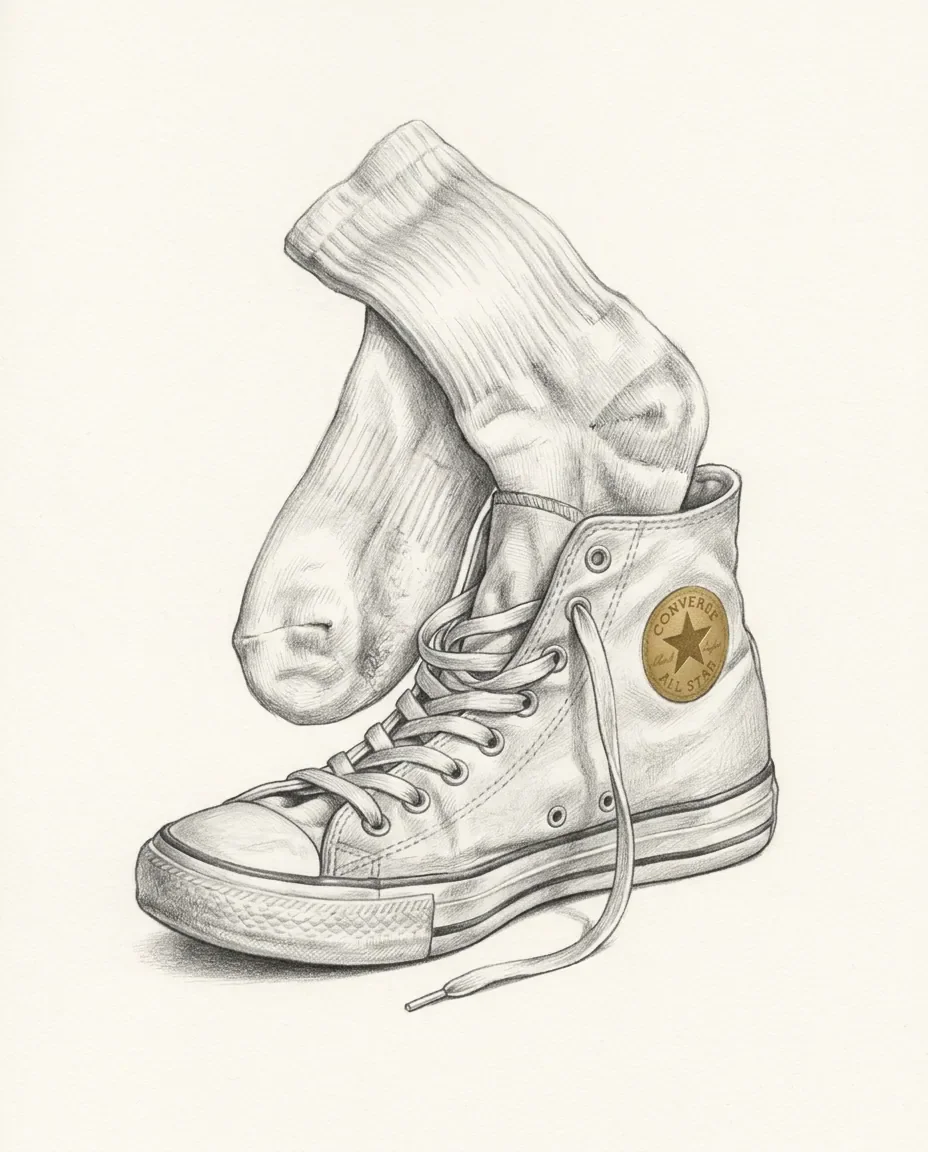
Foot Odor Fetish
Olfactophilia (foot-specific)
Added 27 Jun 2026 · Updated 22 Aug 2026
A foot-specific facet of olfactophilia: arousal centred on the natural scent of feet, worn socks, or the inside of shoes. It overlaps closely with general foot fetishism, where the smell (not only the look) of the foot is part of the attraction.
- Prevalence
- Uncommon
- Category
- Body Functions & Fluids
- Clinical term
- Olfactophilia (foot-specific)
- Domain
- Sexual interest · Paraphilia
- Confidence
- Low confidence
- Status
- A foot-specific facet of olfactophilia within the foot-fetish spectrum; not separately listed in DSM-5-TR and clinically relevant only if it causes distress, impairment, or harm.
- Also known as
- foot smelling fetish, podo-olfactophilia, foot smelling, smelly feet fetish, foot scent fetish
- Added
- 27 Jun 2026
- Updated
- 22 Aug 2026
Featured in
Overview
Foot odor fetish is a scent-focused expression of foot eroticism in which the natural smell of feet, worn socks, or the inside of shoes is itself a source of arousal. It sits at the intersection of two well-documented interests: it is a narrower, foot-specific facet of olfactophilia (the broad erotic interest in body odors) and a sensory dimension of ordinary foot fetishism, where the smell of the foot, and not only its appearance, carries the charge. This article traces its clinical lineage, how it is expressed, the psychology of scent, and what limited prevalence data exist.
Definition
The interest concerns the eroticisation of foot scent specifically: the smell of bare skin after a day in shoes, of sweat-dampened socks or hosiery, or of footwear. It is best understood not as a distinct diagnosis but as a labelled overlap of two recognised partialisms. Foot odor has no separate entry in any nosology; the literature treats it as one facet of olfactophilia applied to the foot, and as the olfactory component of foot partialism. Descriptive accounts commonly single out foot scent as the most familiar form of olfactophilia, which is unsurprising given how prevalent the underlying foot interest is. As with all specific fetishes, it is a benign variation of sexual interest unless it causes distress, impairment, or harm.
Examples
What the term covers. The scent of bare skin after a day in closed shoes; the smell held in worn socks, hosiery, or the lining of shoes and boots; breathing in a partner's feet at close range as part of ordinary intimacy; and the keeping, exchange or purchase of worn items as scent objects, the one expression that has built a visible marketplace of its own. Preference varies widely along a single axis: some are drawn to a faint, clean warmth and others explicitly to the opposite, and where a person sits on that axis is usually the first thing they will say about their own interest.
What the term does not cover. It is narrower than olfactophilia, which covers body scent in general, and it names a different site from the other two common scent foci, sweat and the armpit. It is not a sock fetish, where the garment is the object and a clean pair serves as well as a worn one. It is not the visual side of foot interest (the bare foot, the sole, the toes), which requires no scent at all, nor the reverential attention of foot worship. And it carries none of the power dynamic of foot domination or trampling, although scent can feature within either.
How the word is used. Plain descriptive English: "foot odour fetish", "smelly feet fetish", "foot smelling". The bookish alias podo-olfactophilia is a constructed compound rather than a diagnosis, and no manual splits foot interest this finely: DSM-5-TR recognises only a general fetishistic disorder, applied where an interest causes marked distress or impairment.
History & origins
Clinical lineage
Both parent interests are among the oldest in the sexological record. Richard von Krafft-Ebing, in Psychopathia Sexualis (first published 1886), gave foot and shoe fetishism extended attention and proposed that such fetishes form when an early experience "imprints" an erotic association that persists into adulthood even after its origin is forgotten. Havelock Ellis treated both the foot and the sense of smell as recurring erotic themes across his Studies in the Psychology of Sex (notably the 1905 essay "Sexual Selection in Man," which argues the nose is an underrated organ of attraction), helping legitimise scent as an object of inquiry rather than mere deviance.
The clinical label for scent-focused arousal, olfactophilia (also written osmolagnia, osphresiolagnia, or ozolagnia), is a nineteenth-century coinage from Latin olfactus ("smell") plus Greek -philia ("love, attraction"). Later forensic taxonomies, for example Anil Aggrawal's (2009), define olfactophilia as arousal from body odors and keep it among the more benign partialisms. The descriptive Wikipedia entry on olfactophilia frames body-odor interest broadly, with foot scent as one of its common foci. Neither olfactophilia nor any foot-specific variant is separately listed as a disorder in the DSM-5-TR; like other specific fetishes it would attract a diagnosis of fetishistic disorder only when it causes marked distress or impairment.
A documented olfactory dimension
That foot eroticism often includes smell is recorded directly in the literature. A frequently cited 1994 study reported that roughly 45% of people with a foot fetish were aroused by smelly socks or foot odor specifically: evidence that scent is a major, not incidental, strand of foot interest. The figure is reproduced in the foot fetishism literature. Historically, the eroticisation of foot scent recurs across cultures: in the era of Chinese foot-binding, the distinctive odor of bound feet was, in some accounts, treated as part of their erotic appeal, a much-cited if uncomfortable historical example of foot scent as a sexual signal.
In practice
Among consenting adults the interest is usually expressed gently and within ordinary intimacy:
- inhaling or being close to a partner's bare feet, often after a day in shoes;
- attraction to the scent of worn socks, hosiery, or the inside of footwear;
- exchanging or collecting worn socks or shoes as scent objects;
- combining the smell with the look and touch of the foot, since the interest rarely exists in isolation from general foot appreciation.
For most enthusiasts it is one ingredient of foot attraction rather than an exclusive requirement.
Psychology
The leading explanation grounds scent fetishes in the unusual neuroanatomy of smell. Olfaction is the one human sense that largely bypasses the thalamus and projects directly to forebrain limbic structures (the olfactory system feeds the piriform cortex, amygdala, and hippocampus), so odors are tightly bound to emotion and memory, which can make a remembered scent unusually evocative and arousing. Mainstream accounts also emphasise associative learning: an early or memorable pairing of foot scent with sexual arousal that is later reinforced. A separate, contested neurological idea advanced by neuroscientist V. S. Ramachandran around 1994 notes that the foot's cortical map lies adjacent to the genital map and speculates that cross-wiring could lend the foot an erotic charge; a later imaging study found little foot-related activation, so it remains suggestive rather than established. The evidence base specific to foot scent is thin, and the interest is rarely associated with distress.
Prevalence & culture
How common is a foot odor fetish?
No survey measures it directly, so any figure is an estimate scaled from foot-fetish data. Feet are by a wide margin the most common body-part fetish. In the large internet survey by Scorolli and colleagues (2007), which analysed 381 fetish discussion groups with roughly 5,000 participants in the International Journal of Impotence Research, feet and foot-associated objects were the single most preferred target, about 47% of body-part preferences. Scent is a recurring subtheme within that interest rather than a separately measured category, so no rigorous standalone prevalence figure exists; the ~1.5% estimate here is scaled down from foot-fetish data using the roughly 45% scent-relevance ratio from the 1994 study. The interest sustains visible online communities (worn-sock marketplaces and scent-trading forums among them) overlapping the broader olfactophilia and worn-garment subcultures.
Safety, consent & law
Between consenting adults the interest is benign and legal, and two practical considerations apply. The first is consent over objects as well as bodies: worn socks or shoes should be given or sold willingly, and taking them without permission is theft whatever the motive, while any non-consensual contact is a separate matter that is treated as such. The second is infection. Close foot contact can pass on athlete's foot and fungal nail infection, and plantar warts are caused by a transmissible virus, so cuts, peeling skin and active infections are worth resolving before close contact rather than after. Persistent strong odour can itself signal a treatable condition such as bromodosis or a fungal infection; treating it is a health matter and not a judgement on the interest.
Common questions
Can someone have this without having a foot fetish?
It is possible but uncommon. The scent interest almost always sits inside a broader attraction to feet rather than standing apart from it, and most people who describe it also respond to how feet look and feel. The reverse pattern is far more common: plenty of people with a foot fetish are indifferent to, or actively put off by, the smell. Scent is one available strand of foot interest, not a required one.
What actually causes foot odour?
Bacteria, not sweat. Sweat itself is close to odourless; the smell comes from skin bacteria breaking it down when it is trapped against the skin by shoes and socks, producing the short-chain acids responsible for the characteristic scent. Feet carry an unusually high density of sweat glands and spend the day in a warm, enclosed, poorly ventilated space, which is why they are the body site most reliably associated with odour.
Do people really buy and sell worn socks?
Yes, and it is one of the more visible expressions of the interest. Worn socks, hosiery and shoes are traded through dedicated marketplaces and directly between individuals, often with the wearing time specified. Between consenting adults this is a legal transaction in most jurisdictions. The ethical line is straightforward: items must be given or sold willingly by the person who wore them, and taking someone's belongings without permission is theft whatever the reason for wanting them.
Is being aroused by a partner's natural scent the same thing?
No, and the distinction matters. Mild responsiveness to a partner's natural smell is close to universal and is not a fetish under any definition. What this entry describes is narrower: scent functioning as a primary focus of arousal rather than as background, and localised to the feet specifically. Most people fall well short of that, which is why general scent responsiveness is not treated as a variant of olfactophilia either.
Are there hygiene or infection risks?
Modest and manageable ones. Athlete's foot and fungal nail infections spread through direct contact with infected skin or with items worn against it, and plantar warts are caused by a transmissible virus. None of this is peculiar to the interest (it is how those infections spread generally), but close contact with feet and worn footwear raises exposure. Resolving an active infection first, and keeping cuts and peeling skin covered, is the whole of the precaution.
Is a foot odour fetish a paraphilia or a disorder?
It is classed as a partialism, a focus on a non-genital body part, and as a facet of olfactophilia rather than a category of its own. Neither is separately listed in DSM-5-TR, which recognises only a general fetishistic disorder. That diagnosis applies where an interest causes marked distress or impairment; a consensual, non-distressing scent preference does not meet it, and the forensic literature places olfactophilia among the more benign partialisms.
From the blog
- Body-Odor Fetish42/100Olfactophilia · Body Functions & FluidsOlfactophilia is a sexual interest in body odors and other smells, where scent itself is a primary source of arousal. Mild responsiveness to a partner's natural scent is near-universal; a defined fetish focus is more niche but rarely clinically significant.42
- Foot Fetish83/100Podophilia · Body Parts & PartialismA focused erotic interest in feet (their shape, soles, toes, arches, or grooming) as a primary source of attraction. Within partialism (erotic focus on a non-genital body part) it is the example people report most, by a wide margin.83
- Sock Fetish50/100Clothing & GarmentsA sexual interest in socks, in their look, feel, scent, or association with the feet, treated as a benign relative of foot fetishism. It overlaps with hosiery and scent (olfactophilic) interests.50
- Cum Fetish43/100Spermatophilia · Body Functions & FluidsAn erotic interest in which semen and the act of ejaculation become a focus of arousal, through their visual presence or their scent. Symbolic associations with climax, virility and fertility also carry the charge. It is a common element of mainstream adult fantasy rather than a discrete clinical disorder.43
- Spit Fetish43/100Salivaphilia · Body Functions & FluidsA sexual interest in saliva, spit, or drool, often as part of kissing, oral play, or dominance dynamics. It is generally a benign body-fluid interest among consenting adults rather than a recognized disorder.43
- Lactation Fetish42/100Lactophilia · Body Functions & FluidsA sexual interest in lactation, breast milk, or adult nursing, sometimes practised within an adult nursing relationship (ANR). A recognized but uncommon interest that, between consenting adults, is generally regarded as a benign variation.42
Descriptive English compound rather than a clinical coinage; the bookish alias "podo-olfactophilia" combines Ancient Greek pous, pod- ("foot") with olfactophilia, from Latin olfactus ("smell") plus Greek -philia ("love, attraction").
scent · partialism · olfaction · foot-specific
Prevalence is computed from the entry's cited population estimate. Rows marked ESTare indicative editorial estimates scored against a fixed anchor rubric, not measured quantities. Method & anchors: methodology.
Uncommon · ≈ 1 in 100
- 01Olfactophilia, WikipediaDefines olfactophilia as sexual arousal involving smells and body odors; the parent clinical concept of which foot odor is a facet.
- 02Foot fetishism, WikipediaHistory (Krafft-Ebing 1886 imprinting, Havelock Ellis, Ramachandran ~1994); foot odour as a recognised sub-theme of foot fetishism; the foot-binding odour reference.
- 03Scorolli et al. (2007), Relative prevalence of different fetishes, Int. J. Impotence Research 19(4):432-437Prevalence anchor: feet were the most preferred body-part fetish (~47%); foot scent is a subtheme scaled down from this figure.
- 04Studies in the Psychology of Sex (Havelock Ellis), WikipediaEarly sexological work giving sustained attention to both the foot and the sense of smell as erotic themes (notably 'Sexual Selection in Man,' 1905).
- 05Olfactory system, WikipediaOlfaction bypasses the thalamus and projects directly to limbic structures (amygdala, hippocampus), tying odor to emotion and memory.
- 06DSM-5-TR (American Psychiatric Association)Olfactophilia and its foot-specific variant are not separately listed; specific fetishes are diagnosable only as fetishistic disorder when they cause distress or impairment.