Dominance and Submission
Added 21 Jun 2026 · Updated 6 Sep 2026
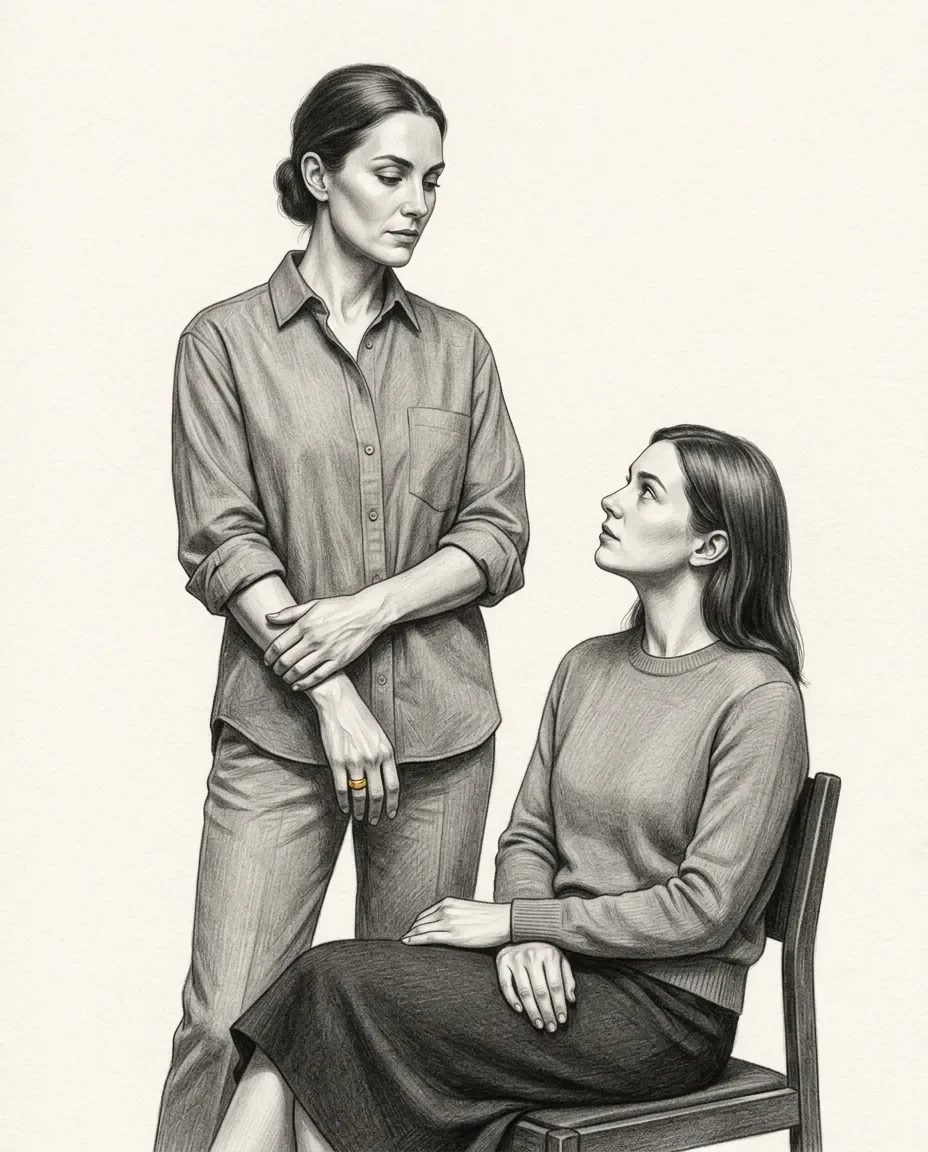
A consensual erotic dynamic in which one partner takes a dominant role and the other a submissive role, exchanging power within agreed limits. It is one of the most widespread elements of BDSM and of human sexual fantasy.
- Prevalence
- Ultra-common
- Category
- Power, Roles & Scenarios
- Domain
- Sexual interest
- Confidence
- High confidence
- Status
- Common, non-pathological interest. Neither manual lists it as a disorder when it is consensual and causes no distress.
- Also known as
- D/s, power exchange, dom/sub, BDSM power dynamic, Dominance and Submission (D/s)
- Added
- 21 Jun 2026
- Updated
- 6 Sep 2026
Featured in
Overview
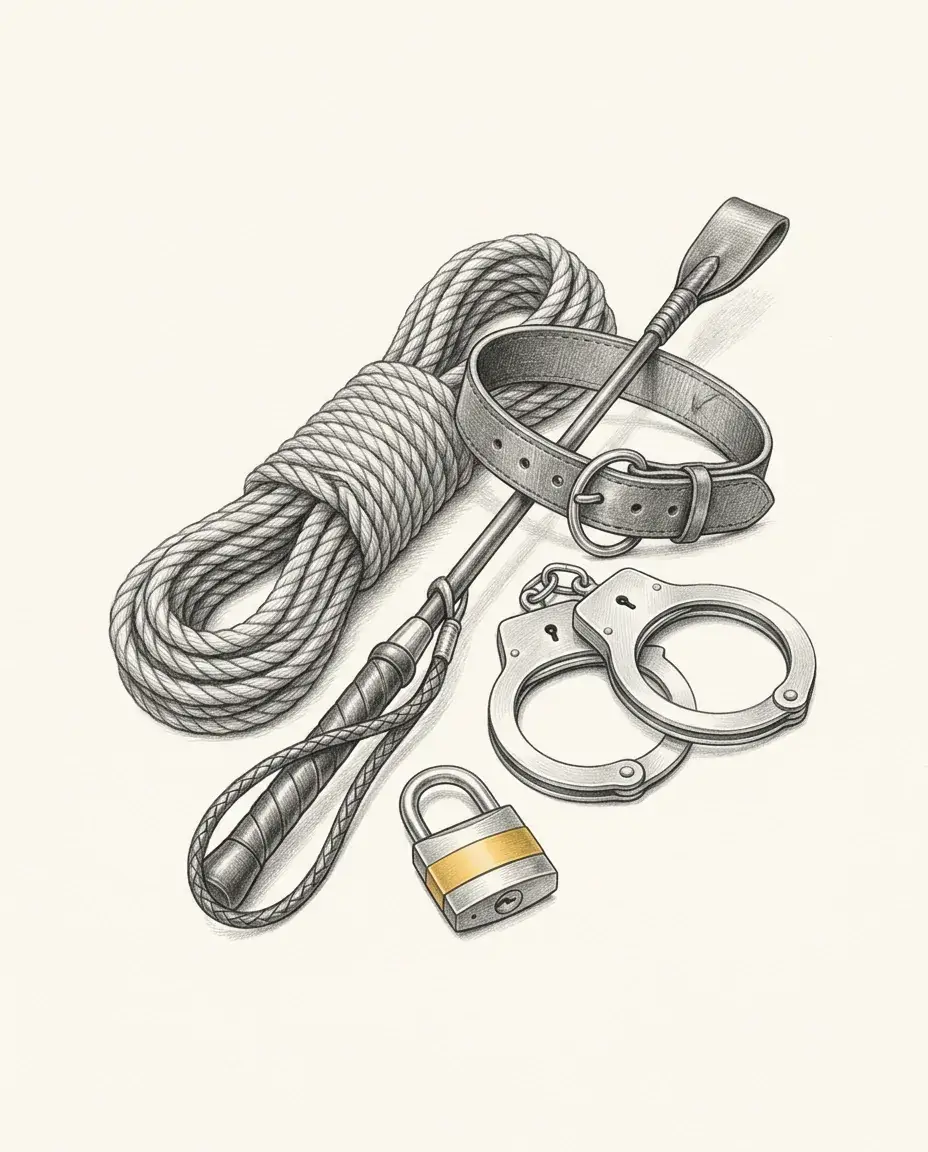
Dominance and submission, abbreviated D/s, is a consensual interest in structured power exchange in which one partner directs and the other yields within mutually agreed boundaries. It forms the psychological core of much of BDSM and exists with or without physical elements such as bondage or impact play. As the "D/s" letters in the wider BDSM acronym, it is one of the most widespread elements of erotic life and of human fantasy.
Examples
D/s names a relationship. The shapes it takes, and the things people mistake for it, mark its edges.
What the term covers. One partner setting the pace and giving instructions during intimacy; agreed forms of address, and small standing rules that persist between meetings; service submission, where the yielding partner's role runs through tasks; ritual markers such as a collar; and formal, long-running arrangements up to a negotiated master/slave bond or total power exchange. Physical activity is optional throughout; partners can conduct a D/s dynamic in speech alone.
What the term does not cover. Bondage, discipline and impact play are the other letters of the BDSM acronym: they are techniques, and any of them can be used without an authority dynamic at all. Sadism and masochism concern who enjoys sensation, and much D/s involves no pain. Roleplay supplies a pretend frame with characters, whereas D/s partners hold their roles as themselves. The term does not imply harshness either: a dynamic rests on praise as readily as on degradation.
How the word is used. D/s is community shorthand, written with a capital D and a lowercase s so that the letters themselves picture the gradient. It is subcultural vocabulary: neither "dominance and submission" nor "D/s" appears as a diagnosis in DSM-5-TR or ICD-11, and the terms the manuals do carry (sadism, masochism) describe sensation; authority has no entry.
History & origins
Clinicians have described the erotic interplay of dominance and submission since the field began; the modern vocabulary and its depathologisation date from the last century.
Clinical lineage
- 1869: Leopold von Sacher-Masoch publishes Venus in Furs, the novella that later lends its author's name to "masochism."
- 1886: Richard von Krafft-Ebing's Psychopathia Sexualis systematises the linked drives, naming "sadism" (after the Marquis de Sade) and "masochism" (after Sacher-Masoch) and framing them as the active and passive poles of a single dynamic.
- 1897 onward: Havelock Ellis, in his Studies in the Psychology of Sex, reframes these impulses as widespread variations.
- 1905: Sigmund Freud discusses the active and passive poles of these drives in his Three Essays on the Theory of Sexuality.
- 2013: The DSM-5 separates a paraphilic interest from a paraphilic disorder, the latter requiring distress, impairment, or a non-consenting party; the DSM-5-TR (2022) retains this line.
- 2022: The World Health Organization's ICD-11 comes into effect, removing consensual sadomasochism from its list of disorders and recognising only coercive sexual sadism, following the reform proposals for the ICD-11 paraphilic disorders.
Cultural & subcultural evolution
The community vocabulary developed alongside the clinical one. The acronym BDSM, which folds D/s together with bondage/discipline and sadism/masochism, is first recorded, per the Oxford English Dictionary, in a Usenet post of 20 June 1991 to the alt.sex.bondage newsgroup, and spread through online forums across the 1990s. Out of the post-war leather and fetish scenes came the shared grammar of D/s: negotiated scenes, the roles of "top" and "bottom," "dominant" and "submissive," the "traffic-light" safewords (red/yellow/green), and explicit codes such as "safe, sane and consensual" and later "risk-aware consensual kink." Mainstream visibility surged in the 2010s, when the Fifty Shades phenomenon brought D/s vocabulary (dominant, submissive, contract, safeword) into ordinary conversation, even as practitioners noted that the books depicted negotiation imperfectly.
In practice
Expression ranges widely, from brief role-play during intimacy to ongoing arrangements with negotiated rules, rituals, protocols, and honorifics; some couples sustain near-continuous "total power exchange," while most confine the dynamic to scenes. It overlaps heavily with structured offshoots such as domestic discipline and spanking, and many partners elaborate it through roleplay. Partners establish limits and safewords in advance, and trust, communication and the ongoing consent of everyone involved sustain the dynamic.
Psychology
Practitioners and researchers link the appeal to the release of relinquishing or assuming control, the focus and intimacy of a clearly defined role, and the trust required to exchange power safely. Proposed mechanisms include learned association between the role and arousal, the regulation of attachment and felt security, and the symbolic meaning of surrender or command. Empirical work on practitioners finds them psychologically healthy, and the manuals treat D/s as a normal variation. The evidence on mechanism, why some people find power exchange compelling and others do not, remains thin and contested.
Prevalence & culture
D/s has high cultural visibility and is supported by large communities, educational events, and an extensive body of informal literature. Population studies place interest in power dynamics among the most prevalent of all surveyed sexual interests. Joyal, Cossette & Lapierre (2015), surveying 1,516 adults, found submission and domination themes common for both men and women and statistically linked to one another: 64.6% of women and 53.5% of men reported fantasising about being dominated, while 59.6% of men and 46.7% of women reported fantasising about dominating a partner. Joyal & Carpentier (2017), in a sample of 1,040 adults in Quebec, found that about 46% expressed interest in at least one paraphilic theme and roughly a third had acted on one, with masochism among the most common. Lehmiller (2018), surveying 4,175 Americans, reported BDSM fantasies near-universal: only about 4% of women and 7% of men had never had one, which makes D/s the most prevalent strand of kink in that sample.
Safety, consent & law
The defining safeguards are informed, ongoing consent, clear negotiation, and the ability to stop at any time. Practised this way among consenting adults it is benign and, under both the DSM-5-TR and ICD-11, not a disorder. Coercion, the removal of consent, or activities causing serious bodily harm fall outside the consensual framework; consent cannot be given by minors and, in many jurisdictions, cannot legally extend to grievous harm, so such acts may carry legal consequences.
Common questions
Can you have a D/s relationship without sex?
Yes, and many people do. The exchange is about who directs and who follows, so it can be carried entirely by rules, rituals, forms of address, tasks and service. Some partners keep the dynamic non-sexual by design, and asexual practitioners are a visible presence in kink communities. Sex is one arena a D/s dynamic can use.
How do you start a D/s dynamic with a partner?
With a conversation held outside the bedroom, when neither person is aroused. Say what appeals and what does not, agree which decisions are being handed over and for how long, pick a way to stop, and start with something small and time-limited: one evening, one rule. Then talk again afterwards. Most problems in D/s start with a dynamic one partner assumed and the other never agreed to.
Does a D/s relationship have to be 24/7?
No. Most are not. The common pattern is episodic: the dynamic is switched on for a scene or an evening and switched off afterwards, with the rest of the relationship run as an ordinary partnership between equals. Continuous arrangements exist and are a recognised style, but they are a minority practice and demand far more negotiation.
What is the difference between a D/s dynamic and an abusive relationship?
Consent that is informed, specific and revocable. In a D/s dynamic the authority is granted in advance, bounded by stated limits, and can be withdrawn at any point without penalty; the submissive partner's ability to end it is the thing that makes it work. Abuse shows the opposite: escalation without agreement, limits ignored or punished, isolation from other people, and no exit.
Who actually holds the power in D/s?
Both, in different currencies. The dominant partner holds directive authority inside the agreement; the submissive partner holds the agreement itself, since it exists only for as long as they consent to it. Communities describe the authority as lent, on loan for as long as the agreement stands. The distinction matters most at a limit: the yielding partner's word stops things.
Do you have to be dominant in everyday life to be a dominant partner?
No, and the correlation is weaker than people expect. Erotic role and social temperament are separate things: many people in high-authority jobs prefer the submissive role, and quiet, unassertive people make confident dominants in a negotiated setting. The relevant skills are communication, attention and reliability.
What is a D/s contract, and is it legally binding?
It is a written record of what two people have agreed: roles, rules, limits, safewords, and how the arrangement can be ended or reviewed. It carries no legal force anywhere, and no document can create consent to something a person later refuses. Its value is practical: writing the terms down surfaces the mismatches that a spoken conversation glosses over.
Can two dominants or two submissives be in a relationship together?
They can be in a relationship, but not usually in a D/s dynamic with each other, because the roles are complementary. Couples in that position keep the dynamic out of their relationship and seek it elsewhere under an agreed arrangement, or discover that one of them is more flexible than assumed (see switching). Role compatibility is one of the more common reasons a dynamic does not get off the ground.
From the blog
Definitions5 min read
What a switch is, and how switching works
What is a switch in BDSM? A person who takes both dominant and submissive roles, estimated at 12 percent of adults, with survey shares and history.

How common6 min read
Do men and women have different kinks, and by how much
Do men and women have different kinks? Bondage appeals to 29.5% of men and 29.2% of women, threesomes to 34.1% and 11.1%. Where the surveys find a gap.
Relationships8 min read
How to tell a partner about a kink, and how partners respond
How to tell a partner about a kink: 71% who shared a favourite fantasy got a positive response, and only 28% who never shared expected one.

Definitions8 min read
What BDSM stands for, and what it covers
What does BDSM stand for? Bondage and discipline, dominance and submission, sadism and masochism: what each pair means, how common it is, where the lines are.
Mental health7 min read
Is my kink normal? One answer from the surveys, another from the manuals
Is my kink normal? By the surveys, yes for nearly everyone: two fantasies of 55 are rare. By the DSM-5-TR and ICD-11, a disorder needs distress or harm.
Definitions8 min read
Kink vs fetish, the difference and where the words come from
Kink is the everyday word for any unconventional sexual interest. Fetish means arousal tied to an object or body part. Where they overlap and where they part.
How common7 min read
The most common kinks, ranked by what the surveys found
The most common kinks, ranked by evidence: dominance and submission, bondage, foot fetish, roleplay and voyeurism lead 474 entries, read tier by tier.
- Spanking78/100Sensation & PainAn interest in giving or receiving consensual, rhythmic blows to fleshy areas of the body, by hand or with implements such as paddles. People do it for erotic sensation, discipline themes, or power exchange between consenting adults.78
- Roleplay81/100Power, Roles & ScenariosAdopting characters, personas, or imagined scenarios to enact sexual fantasy with a partner. One of the most common and versatile sexual interests, role-play frames or heightens arousal through story, character, and pretend.81
- Praise Kink63/100Power, Roles & ScenariosAn erotic enjoyment of receiving verbal praise, affirmation, or encouragement from a partner, phrases such as "good girl/good boy" or "you're doing so well". The interest often, though not exclusively, sits within dominance and submission dynamics.63
- Submission90/100Power, Roles & ScenariosTaking the yielding, following role in a consensual power-exchange dynamic. One of the two halves of dominance and submission (D/s), in which a person cedes control to a trusted partner under negotiated limits.90
- Dominance85/100Power, Roles & ScenariosTaking the leading, controlling role in a consensual power-exchange dynamic. One of the two halves of dominance and submission (D/s) within BDSM, in which a person directs the scene, sets the rules, and guides a willing partner who has agreed to yield control.85
- Femdom (Female Domination)68/100Power, Roles & ScenariosA BDSM practice and scene dynamic in which a woman takes the dominant role over a submissive partner, expressed through control or discipline. It is also expressed through worship or humiliation. It ranges from playful bedroom scenes to paid professional dominatrix sessions.68
"Dominance" derives from Latin dominari, "to be lord/master" (from dominus, "master, lord"); "submission" from Latin submittere, "to place under, yield" (sub-, "under," + mittere, "to send"). The literal sense (one placed above, one placed under) names the consensual authority gradient. The compound "D/s" is a modern community abbreviation.
power exchange · BDSM umbrella · consensual hierarchy
Prevalence is computed from the entry's cited population estimate. Rows marked ESTare indicative editorial estimates scored against a fixed anchor rubric, not measured quantities. Method & anchors: methodology.
Ultra-common · ≈ 1 in 5 or more
- 01Lehmiller (2018), Tell Me What You Want, survey of 4,175 Americansprevalence anchor (BDSM fantasy near-universal; only 4-7% never, active interest ~45-50%)
- 02Joyal & Carpentier (2017), The Prevalence of Paraphilic Interests and Behaviors in the General Population, J. Sex Research 54(2):161-171general-population interest in submission/dominance behaviors supporting high prevalence
- 03List of paraphilias, Wikipediadefinition of dominance/submission within the BDSM umbrella
- 04Krafft-Ebing, Psychopathia Sexualis (1886), Wikipediafirst systematic naming of sadism (after de Sade) and masochism (after Sacher-Masoch), the historical roots of dominance/submission terminology
- 05Joyal, Cossette & Lapierre (2015), What Exactly Is an Unusual Sexual Fantasy?, J. Sexual Medicine 12(2):328-340submission and domination themes are common rather than unusual for both men and women among 1,516 adults, and are statistically linked
- 06DSM-5-TR, Paraphilic Disorders (American Psychiatric Association, 2022)distinction between a paraphilic interest and a paraphilic disorder, which requires distress, impairment, or a non-consenting party
- 07ICD-11, Paraphilic disorders (World Health Organization)ICD-11 (in effect 2022) removed consensual sadomasochism from its list of disorders, recognising only coercive sexual sadism
- 08Krueger et al. (2017), Proposals for Paraphilic Disorders in the ICD-11, PMCreform rationale distinguishing consensual sadomasochistic / power-exchange practice from coercive harm in the ICD-11
- 09BDSM, Wikipediathe acronym BDSM (folding D/s with bondage/discipline and sadism/masochism) is first recorded in a 1991 Usenet post; community grammar of roles, scenes and safewords