Synesthesia
synaesthesia
Added 22 Jun 2026 · Updated 22 Aug 2026
A benign neurological trait in which one sense automatically and involuntarily triggers another: seeing colours in sounds or words, tasting shapes. A documented 'sexual' subtype attaches vivid cross-sensory perceptions to arousal and orgasm.
- Prevalence
- Common
- Category
- Non-Sexual Fetishism
- Clinical term
- synaesthesia
- Domain
- Non-sexual interest
- Confidence
- Medium confidence
- Status
- Common benign perceptual variation, not a disorder; not listed in DSM-5-TR or ICD-11. A 'sexual synesthesia' subtype is documented in sexology research but is not classed as a paraphilia.
- Also known as
- synaesthesia, cross-modal perception, joined sensation, sexual synesthesia, orgasm synesthesia, chromesthesia, grapheme-colour synesthesia
- Added
- 22 Jun 2026
- Updated
- 22 Aug 2026
Featured in
Overview
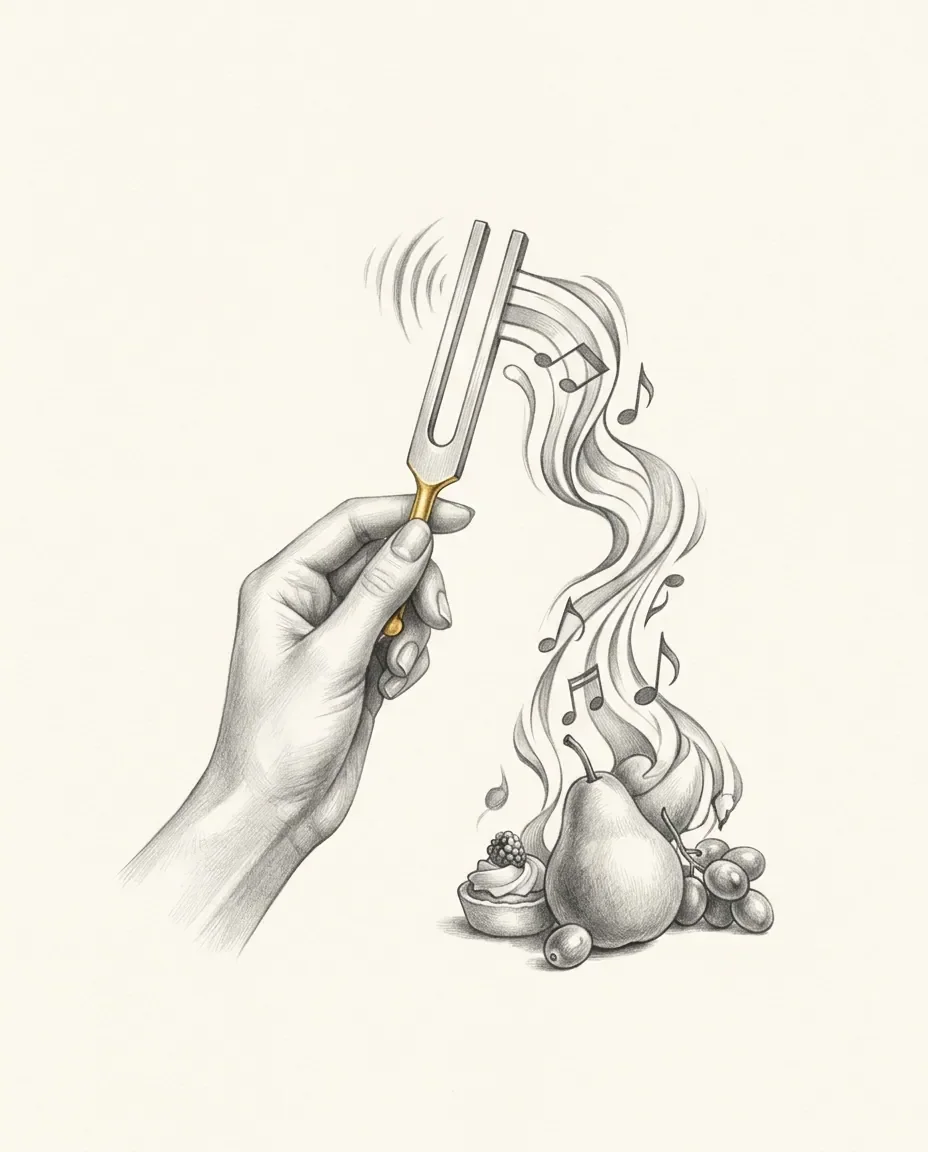
Synesthesia (British spelling synaesthesia) is a benign, largely hereditary perceptual variation in which stimulation of one sense involuntarily and consistently evokes another: perceiving colours when hearing music (chromesthesia), seeing letters and numbers as inherently coloured, or experiencing tastes from spoken words. It is not a sexual interest and not a disorder. It appears in this directory as a non-sexual sensory affinity, included chiefly because sexologists have documented a "sexual" subtype in which arousal, touch, and orgasm trigger heightened synaesthetic perceptions. This article traces the trait's two-century scientific history, the mechanisms proposed for it, its prevalence, and the small literature on its erotic form.
Examples
What the term covers. The documented forms are numerous, and each is named for its trigger and the percept it evokes. Grapheme-colour synesthesia gives letters and numerals inherent colours. Chromesthesia turns heard sound or music into colour and moving form. Day-colour and month-colour associations attach hues to units of time. Number forms, the variant Galton described in 1880, arrange numerals in a fixed spatial layout. Lexical-gustatory synesthesia evokes tastes from spoken words. The rare sexual subtype belongs to the same family, differing only in that the trigger is arousal.
What the term does not cover. Metaphor is not synesthesia: calling a trumpet "bright" or a chord "blue" is figurative language available to anyone, whereas a synaesthete's colour arrives unbidden and is the same colour every time. Drug-induced cross-sensory effects and the sensory disturbances of migraine aura are transient states rather than the lifelong developmental trait. Neither is it hallucination, since synaesthetes know the colour is not physically present. Nor is it the reflexive and affective responses it sits beside in this directory: ASMR is a pleasurable tingling triggered by particular sounds and attention, frisson is the shiver some people get from music, and misophonia is an aversive reaction to specific sounds. None of the three adds a second percept to the first. It is not an attraction either, and has nothing in common with sapiosexuality or a skin fetish.
How the word is used. Scientific rather than clinical. It names a trait, not a diagnosis, and appears in neither the DSM-5-TR nor the ICD-11. British English keeps the diphthong in synaesthesia; American English drops it. A person with the trait is a synaesthete, and the adjective is synaesthetic. Art criticism and everyday speech both use it loosely, for any blending of media or simply for vivid imagery; both are metaphorical extensions of the perceptual sense.
History & origins
The first descriptions (1812–1880)
The earliest agreed-upon medical account is credited to the German physician Georg Tobias Ludwig Sachs, who in 1812 described his own coloured vowels and tones in a doctoral dissertation otherwise devoted to his albinism, Historiae naturalis duorum leucaetiopum ("A natural history of two albinos, the author and his sister"). Its importance became clear only in retrospect, and the phenomenon then drew little systematic attention for decades.
- 1880: Sir Francis Galton, Charles Darwin's half-cousin, published "Visualised Numerals" in Nature, documenting people who saw numbers arranged in coloured spatial "number forms" and arguing that the trait ran in families. Galton wrote of "seers" rather than coining a formal clinical label.
Naming the phenomenon (1890–1895)
A cluster of French works in the early 1890s gave the trait its modern name. According to a detailed history of the term by Jewanski and colleagues (2020), the noun synesthésie was introduced by the physician Jules Millet in his 1892 medical thesis and spread through Théodore Flournoy's 1893 monograph; earlier authors had favoured audition colorée ("coloured hearing"). The word is built from Ancient Greek syn ("together") and aisthēsis ("sensation").
Eclipse and revival (1900–present)
Synesthesia research flourished in the late nineteenth century, then faded during the behaviourist mid-twentieth century, when introspective reports were distrusted. It revived strongly from the 1980s onward as objective tests (such as the consistency-over-time test) and brain imaging let researchers confirm that the associations are real, automatic, and stable. A specifically sexual form was investigated much later, most notably in a 2013 Frontiers in Psychology study by Janina Nielsen and colleagues, though an isolated clinical case of orgasm-linked colour had been recorded as early as 1970.
In practice
Synesthesia is experienced, not performed: the cross-sensory associations are automatic, involuntary, idiosyncratic to each person, and remarkably stable across a lifetime. A grapheme–colour synaesthete will see the same letter in the same colour decade after decade. In the documented sexual subtype, synaesthetes report cross-modal perceptions that intensify with arousal and peak at orgasm: one participant in the Nielsen study described climax as a wall bursting into "ringlike structures" in "bluish–violet tones," while a woman interviewed for a 1970 case report described orgasm accompanied by a "fuzzy blackness with red and white muted bursts." These perceptions accompany ordinary sexual activity rather than constituting any practice in themselves, which distinguishes the trait sharply from a paraphilia such as sapiosexuality or a sensory affinity like a skin fetish.
Psychology
Two leading neuroscientific accounts compete to explain the trait. The cross-activation model attributes it to increased cross-talk between adjacent, normally specialised brain regions (for grapheme–colour synesthesia, between letter-recognition areas and the colour area V4), plausibly from reduced pruning of connections in development. The disinhibited-feedback model instead proposes weaker inhibition of feedback pathways already present in everyone. The trait clusters in families, pointing to a genetic component, and is associated with enhanced memory and creativity. In the sexual context, Nielsen's team found synaesthetes reported significantly higher "oceanic boundlessness" and "visionary restructuralization" (markers of altered, trance-like states) yet lower self-rated sexual satisfaction, which interviews attributed to being absorbed in their own enriched inner imagery and feeling somewhat disconnected from a partner. The evidence base for the sexual subtype specifically remains thin, resting largely on a single small sample.
Prevalence & culture
How common is synesthesia?
The most rigorous population study, Simner and colleagues (2006), tested 500 people drawn from the Edinburgh and Glasgow university communities without relying on self-referral, and found a prevalence of roughly 4.4% for some form of synesthesia. That figure was far higher than older self-report estimates, because those had missed synaesthetes who never volunteered themselves. The study also overturned two long-held beliefs: coloured days of the week turned out to be the single most common variant (more common than the famous letter–colour form), and the female-to-male ratio was close to 1.1 to 1, not the six-to-one female skew earlier work had claimed.
| Form | Trigger → perception | Relative frequency |
|---|---|---|
| Day–colour | weekdays → colour | most common (Simner 2006) |
| Grapheme–colour | letters/numbers → colour | ~1–1.4% of people |
| Chromesthesia | sound/music → colour | common colour-inducing form |
| Sexual synesthesia | arousal/orgasm → colour, form | rare subtype |
The sexual subtype
Sexual synesthesia is a rare subtype within that group. The Nielsen et al. (2013) study recruited only 19 self-identified sexual synaesthetes (17 women and just 2 men) against 36 age-matched controls, so prevalence figures for the sexual form are not reliably established; the British Psychological Society's Research Digest summarised its "light show" findings for a general audience. Culturally, synesthesia is celebrated through synaesthete artists and composers such as Wassily Kandinsky, the novelist Vladimir Nabokov, who described his grapheme–colour synesthesia in his memoir, and Olivier Messiaen, who built composition methods around his sound–colour perceptions. It is a recurring topic of popular-science coverage, including a Scientific American feature on the orgasm-triggered form.
Variations & related interests
Synesthesia sits alongside other involuntary, non-paraphilic sensory phenomena in this directory. The pleasurable tingling of ASMR and the shiver of musical frisson are likewise automatic cross-sensory or affective responses to ordinary stimuli, while misophonia is its aversive counterpart: a strong, involuntary reaction to specific trigger sounds. Where synesthesia heightens the felt texture of experience, a benign skin fetish reflects an affinity for sensory surface, and sapiosexuality describes attraction routed through a non-physical channel; none of these is a disorder, and the sexual subtype of synesthesia is not classed as a paraphilia.
Safety, consent & law
Synesthesia is a harmless, legal neurological variation, not a paraphilia, and not listed in the DSM-5-TR or ICD-11: it is treated as a perceptual difference rather than a disorder, much like perfect pitch. It raises no consent or safety concerns of its own. Experiences vary enormously between individuals, and most synaesthetes regard their cross-sensory world as a gift rather than a burden. A sudden new onset of synaesthetic perception in adulthood, however, is worth raising with a clinician, since it can occasionally accompany unrelated neurological causes rather than the lifelong, developmental trait described here.
Common questions
Is synesthesia real, or are people imagining it?
It is real and measurable. The standard demonstration is a consistency test: participants report the colour of a letter or a sound, are re-tested weeks or months later without warning, and synaesthetes match their earlier answers far more closely than people asked to invent associations and remember them. Brain-imaging work points the same way. The associations are automatic, involuntary and often stable across a whole lifetime.
Is synesthesia a disorder or a mental illness?
No. It is a perceptual variation, comparable to perfect pitch, and it appears in neither the DSM-5-TR nor the ICD-11. Most synaesthetes describe it as neutral or pleasant and would not want it removed. The one situation that warrants a clinician is a sudden new onset in adulthood, which is a different phenomenon from the lifelong developmental trait and can have an unrelated neurological cause.
Can you develop synesthesia or learn it?
The developmental form is essentially lifelong: synaesthetes usually cannot remember a time before it, and it clusters in families. Training studies can teach people letter-colour pairings well enough to reproduce them, but the learned associations rarely acquire the automatic, unwilled quality of the real thing and tend to fade without practice. Cross-sensory experiences that begin abruptly in adulthood are a separate matter and worth raising with a doctor.
Do synaesthetes see the same colours for the same letters?
Rarely. The pairings are idiosyncratic: two synaesthetes will usually disagree about the colour of the letter A, and relatives who both have the trait commonly report different pairings from one another. What is consistent is the individual, not the population. A given person's letter-colour map tends to hold for decades, which is precisely what the consistency test exploits.
Is synesthesia hereditary?
It runs in families, which is the main evidence for a genetic contribution, but no single gene accounts for it and the inheritance does not follow a simple pattern. What appears to be passed on is a disposition to have some form of the trait rather than any particular pairing, which is why a parent and child may both be synaesthetes while perceiving entirely different colours for the same letters.
What is sexual synesthesia?
A rare subtype in which arousal and orgasm act as the trigger, evoking colour and form much as music does for a chromesthete. It is not a fetish or a paraphilia: the perceptions accompany ordinary sexual activity rather than constituting any practice or attraction of their own. The evidence base is thin, resting largely on Nielsen and colleagues' 2013 study of 19 self-identified sexual synaesthetes against 36 controls.
Does synesthesia give you any advantage?
On average synaesthetes score somewhat better on certain memory tasks and are over-represented in creative fields, plausibly because an extra perceptual tag makes material easier to encode and retrieve. The effect is modest and specific rather than a general gift. Some synaesthetes also report the opposite in particular situations, finding a mismatched colour on a sign or a screen genuinely distracting.
- ASMR69/100Autonomous Sensory Meridian Response · Non-Sexual FetishismA non-sexual, pleasant tingling sensation that typically begins on the scalp and moves down the neck and spine. Soft sounds, gentle attention, or close personal care trigger it. It underpins a large online relaxation-media subculture.69
- Frisson54/100Non-Sexual FetishismA pleasurable, non-sexual wave of chills, tingling and goosebumps, often felt down the spine, triggered by emotionally moving music or art. Film and moments of awe trigger it too. Sometimes nicknamed a "skin orgasm."54
- Misophonia57/100misophonia · Non-Sexual FetishismA sound-tolerance condition in which specific repetitive trigger sounds provoke disproportionate irritation, anxiety, disgust or anger. Chewing, breathing, sniffing and tapping are common triggers. It is a non-sexual sensory aversion, not an erotic interest.57
- Skin Fetish29/100Integumentophilia · Body Parts & PartialismA focused erotic interest in human skin itself, its texture, smoothness, warmth, scent and sheen, rather than the body as a whole. The act of touching and being touched is part of it. It is generally a benign aesthetic and tactile preference.29
- Sapiosexuality56/100Identity & TransformationA self-applied identity for people who say intelligence is the trait they find most sexually or romantically attractive. Wit, knowledge and the way a mind works are what they mean, often ranked above physical appearance. Debated as an orientation versus a strong preference.56
- Sneakerhead55/100Non-Sexual FetishismA non-sexual collecting subculture centred on athletic and designer sneakers, whose enthusiasts pursue rare, limited, and historically significant footwear. Such enthusiasts are known as "sneakerheads". The shoes are prized as collectibles, art objects, and identity markers rather than as sources of arousal.55
Coined as the French synesthésie by physician Jules Millet in his 1892 medical thesis and popularised from Flournoy's 1893 monograph; from Ancient Greek σύν (syn, 'together') + αἴσθησις (aisthēsis, 'sensation'), literally 'joined sensation'. The British spelling 'synaesthesia' preserves the Greek diphthong.
neurological trait · cross-modal perception · sensory experience
Prevalence is computed from the entry's cited population estimate. Rows marked ESTare indicative editorial estimates scored against a fixed anchor rubric, not measured quantities. Method & anchors: methodology.
Common · ≈ 1 in 20
- 01Synesthesia, Wikipediadefinition, Greek etymology, ~4% prevalence, main types, and that it is not listed in DSM or ICD
- 02Synaesthesia and sexuality: the influence of synaesthetic perceptions on sexual experience, Nielsen et al., Frontiers in Psychology (2013)the documented 'sexual synesthesia' subtype, the 17-women/2-men sample, orgasm colour descriptions, and 'oceanic boundlessness' findings
- 03The evolution of the concept of synesthesia in the nineteenth century as revealed through the history of its name, PMC7446036Sachs' 1812 dissertation (Historiae naturalis duorum leucaetiopum) as the first documented case, and the 1892 coinage of synesthésie by Jules Millet spread via Flournoy (1893)
- 04Sexual Synesthesia Paints the World in Color at the Moment of Orgasm, Scientific Americanlay framing of orgasm-triggered colour synesthesia and ~4% overall synesthesia prevalence
- 05Why are there different types of synesthete? (discussing Simner et al. 2006 prevalence), PMC3759026Simner et al. (2006) non-self-referral study of 500 people finding ~4.4% synesthesia prevalence, colour-triggering forms most common, ~1.1:1 female-to-male ratio, coloured days most common variant
- 06Synaesthesia and sexuality: the influence of synaesthetic perceptions on sexual experience, Nielsen et al. (2013), PMC3797397Nielsen et al. (2013) sample of 19 synaesthetes (17 women, 2 men) and 36 controls, oceanic boundlessness and visionary restructuralization findings, lower sexual satisfaction, orgasm colour descriptions, and the 1970 case report of orgasm-linked colour
- 07When orgasm triggers a light show, British Psychological Society Research Digestgeneral-audience summary of the Nielsen et al. (2013) findings on orgasm-triggered synaesthetic perception
- 08Chromesthesia, Wikipediachromesthesia as the sound-to-colour form of synesthesia
- 09History of synesthesia research, WikipediaFrancis Galton's 1880 'Visualised Numerals' work on number forms and Théodore Flournoy's 1893 monograph in the history of synesthesia research