Misophonia
misophonia
Added 22 Jun 2026 · Updated 22 Aug 2026
A sound-tolerance condition in which specific repetitive trigger sounds provoke disproportionate irritation, anxiety, disgust or anger. Chewing, breathing, sniffing and tapping are common triggers. It is a non-sexual sensory aversion, not an erotic interest.
- Prevalence
- Common
- Category
- Non-Sexual Fetishism
- Clinical term
- misophonia
- Domain
- Non-sexual interest
- Confidence
- Medium confidence
- Status
- Not a paraphilia and not a sexual interest; a sound-tolerance condition with a 2022 expert consensus definition but no formal code in DSM-5-TR or ICD-11.
- Also known as
- selective sound sensitivity syndrome, 4S, sound-rage, decreased sound tolerance, soft sound sensitivity
- Added
- 22 Jun 2026
- Updated
- 22 Aug 2026
Featured in
Overview
Misophonia (sometimes termed selective sound sensitivity syndrome) is a disorder of decreased tolerance to specific sounds, in which everyday repetitive noises (most often those made by other people, such as chewing or breathing) provoke strong, involuntary negative emotional and physiological reactions. This article surveys the term's coinage, its still-evolving clinical status, what is known of its neurobiology, and its prevalence. It is included in this directory as a sound-related sensory phenomenon rather than a sexual interest: misophonia is fundamentally an aversion to sound, the conceptual inverse of appreciative auditory affinities such as ASMR or musical frisson.
Examples
Misophonia is defined by which sounds provoke it and by how disproportionate the response is, never by volume.
What the term covers. Trigger sounds are almost always quiet, repetitive and human: chewing, crunching, slurping, lip-smacking, swallowing, breathing, sniffing, throat-clearing. Non-human triggers are common too (pen-clicking, keyboard tapping, a ticking clock, a bass line through a wall), and some people react to the sight of the movement that produces a trigger, a pattern usually called misokinesia. What marks the condition is the size of the response: not mild irritation but an immediate surge of anger, disgust or panic, with a racing heart and clenched muscles, to a sound most people filter out entirely.
What the term does not cover. It is not the appreciative inverse: ASMR, the pleasant tingling some people get from soft, deliberate sounds, and musical frisson are responses of the opposite valence, and one person can have both. It is not audiophilia, a trained preference about sound quality. It is not synesthesia, where a stimulus adds a perception rather than an aversion, nor the tactile pull of texture fixation or the mild pleasure of oddly satisfying content. And it is the opposite of the deliberate sensory overload some people seek in play, which is chosen; misophonia is not.
How the word is used. It is a research term rather than a lay one, and it is often used as though it were a diagnosis, which it is not: there is no code for it in the DSM-5-TR or ICD-11, and what exists instead is a 2022 expert consensus definition agreed for research purposes. The honest description is a well-documented phenomenon with a demonstrated neural signature that has not yet been formally classified, neither invented nor official.
History & origins
Coinage and early clinical lineage
The term was coined in 2001 by the audiology researchers Pawel J. Jastreboff and Margaret M. Jastreboff, with the assistance of the classical scholar Guy Lee, and entered wider use in the peer-reviewed literature soon after. The Jastreboffs introduced it while working with patients reporting reduced sound tolerance, in order to distinguish a condition driven by the pattern and meaning of particular sounds from disorders driven by loudness or fear of sound, namely hyperacusis (lowered tolerance to sound intensity) and phonophobia (fear of sound). The label literally means "hatred of sound."
The presentation had been described under other names before this. The audiologist Marsha Johnson characterised a similar pattern as selective sound sensitivity syndrome, abbreviated "4S"; sound-rage and decreased sound tolerance are other informal labels still encountered in clinical and lay writing. The three sound-tolerance conditions are distinct:
| Condition | What drives the reaction | Typical response |
|---|---|---|
| Misophonia | Specific pattern/meaning of a sound (often oral or repetitive) | Irritation, disgust, anger |
| Hyperacusis | Sound intensity/loudness | Discomfort or pain from ordinary volume |
| Phonophobia | Fear of a sound or of hearing it | Anxiety, avoidance |
Neurobiological turning point (2017)
A landmark neuroimaging study, Kumar et al., "The Brain Basis for Misophonia" (Current Biology, 2017), found greatly exaggerated activity in the anterior insular cortex, a hub of the brain's salience network, in response to trigger sounds, together with abnormal functional connectivity to emotion-processing regions and measurable autonomic arousal (raised heart rate and skin conductance). The authors framed misophonia as "a disorder in which abnormal salience is attributed to particular sounds," giving the condition a concrete neural signature for the first time.
Toward a shared definition (2022)
Because the field had used inconsistent criteria, an international expert panel published a consensus definition via a Delphi process (2022), describing misophonia as a disorder of decreased tolerance to specific sounds (or associated stimuli) that produces intense emotional, physiological and behavioural responses not seen in most other people. Crucially, misophonia is not yet listed as a diagnosable condition in the DSM-5-TR, ICD-11, or any comparable manual, the consensus definition functions as a working research and clinical reference rather than a formal diagnostic code.
In practice
Triggers are typically pattern-based, repetitive sounds rather than loud ones: chewing, slurping, lip-smacking, breathing, sniffing, throat-clearing, pen-clicking, keyboard tapping, and similar oral or repetitive noises. Some people are also triggered by associated visual cues (seeing the movement that produces a trigger). Reactions range from irritation and anxiety to disgust, anger and, less commonly, panic, accompanied by sympathetic arousal such as muscle tension, a racing heart and sweating.
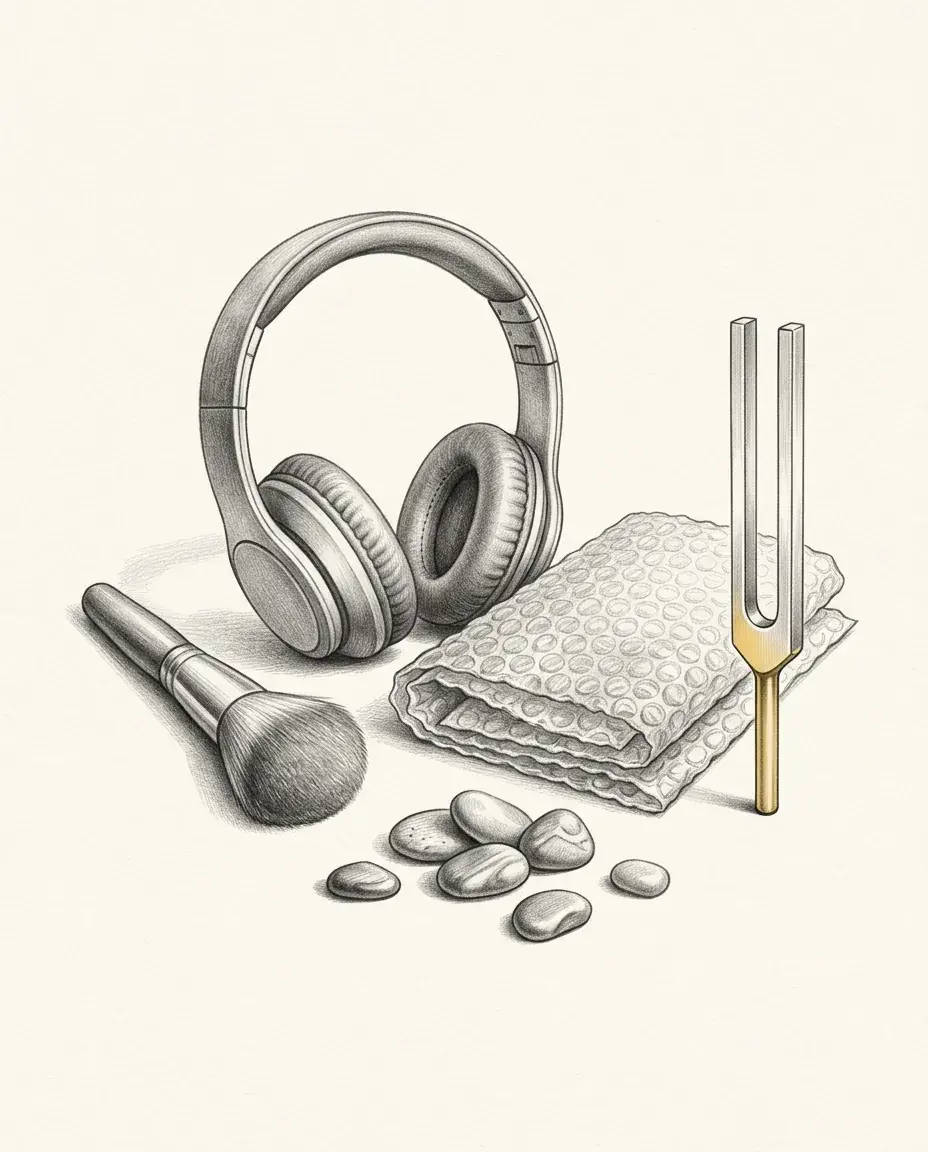
Responses are strongly shaped by context and by the relationship to the trigger's source, and onset is often reported in childhood or adolescence. Many people adopt coping strategies (masking sounds, white noise, earplugs or noise-cancelling headphones, and avoidance) and some pursue cognitive-behavioural therapy or sound-tolerance approaches, though no treatment is yet established as curative.
Psychology
Misophonia is understood as an automatic, conditioned-like overreaction in which specific auditory stimuli become abnormally coupled to emotion- and threat-processing networks, consistent with the salience-network findings of Kumar et al. (2017). It frequently co-occurs with anxiety, obsessive-compulsive traits and heightened sensory sensitivity, though it can also occur on its own. The reaction is involuntary, not a choice, a preference, or a character flaw, and it is conceptually distinct from sensory phenomena such as synesthesia, where one stimulus evokes an additional perception rather than an aversive emotional response.
Prevalence & culture
How common is misophonia?
Estimates vary widely with methodology and population. A UK representative-sample study, Vitoratou et al. (PLOS ONE, 2023), estimated that roughly 18% of adults experience misophonia to a burdensome degree. A nationally representative US study, Dixon et al. (2024), found that while about 78.5% of adults reported some sensitivity to misophonia-type sounds, about 4.6% met clinical criteria, roughly one in twenty, with female respondents and younger adults reporting higher symptom levels. Awareness has grown markedly through media coverage and active online support communities.
Safety, consent & law
Misophonia is benign in the legal sense and carries no consent or legal concerns. The recognised risk is psychological: distress, irritability, social withdrawal, and impaired functioning in work, study and relationships, sometimes with secondary anxiety or low mood. The appropriate response is clinical assessment and support, not stigma, and validation that the reactions are real and involuntary rather than mere intolerance or rudeness.
Common questions
Is misophonia a real condition?
Yes, though not yet an official diagnosis. Neuroimaging by Kumar and colleagues (2017) found an exaggerated brain response to trigger sounds alongside measurable rises in heart rate and skin conductance, so the reaction is physiological rather than imagined or performed. What is missing is formal classification: no diagnostic manual lists it, and clinicians work from a 2022 expert consensus definition instead. Real and documented, in other words, but not yet coded.
Why do chewing sounds make me so angry?
Because in misophonia those sounds are processed as though they were urgent and significant. The response runs through the brain's salience network and the autonomic nervous system, which is why it arrives as a body event (tension, a racing heart, a flare of rage) before any thought about it. It is involuntary and out of all proportion to the sound, and it is typically strongest with sounds made by the people you live with, which is what makes it so socially corrosive.
What is the difference between misophonia and ASMR?
They are opposite responses to a similar class of stimulus. ASMR is a pleasant tingling triggered by soft, close, deliberate sounds such as whispering, tapping or careful handling, while misophonia is an aversive surge triggered by soft, repetitive, usually oral ones. Some sounds appear on both lists, and some people report experiencing both, which is one reason the two are so often discussed together.
Is misophonia a symptom of autism, OCD or anxiety?
It co-occurs with all three and is identical to none. Heightened sensory sensitivity is common in autistic people, obsessive-compulsive traits often accompany misophonia, and living with untreated triggers reliably produces anxiety of its own. But it also occurs in people with no other diagnosis, and its trigger set (specific, patterned, usually human sounds) is far narrower than general sensory over-responsivity.
Can misophonia be cured?
No treatment is established as curative. What helps in practice is a combination: cognitive-behavioural approaches aimed at the reaction rather than at the sound, sound-tolerance and masking techniques, and practical accommodations at work, at school or at home. Many people manage well with white noise, earplugs or noise-cancelling headphones plus an agreement with the people they live with. Because there is no diagnostic code, access to specialist help is inconsistent and often depends on finding a clinician who already knows the term.
Do noise-cancelling headphones help, or do they make it worse?
They help a great deal in the moment, and total reliance on them carries a cost. Blocking triggers is a legitimate coping strategy and is often the difference between a workable office and an impossible one. The caution clinicians raise concerns avoidance more broadly: a life arranged entirely around never meeting a trigger tends to narrow, and the tolerance-building approaches used in therapy pull in the other direction. Most people end up using both.
- ASMR69/100Autonomous Sensory Meridian Response · Non-Sexual FetishismA non-sexual, pleasant tingling sensation that typically begins on the scalp and moves down the neck and spine. Soft sounds, gentle attention, or close personal care trigger it. It underpins a large online relaxation-media subculture.69
- Synesthesia55/100synaesthesia · Non-Sexual FetishismA benign neurological trait in which one sense automatically and involuntarily triggers another: seeing colours in sounds or words, tasting shapes. A documented 'sexual' subtype attaches vivid cross-sensory perceptions to arousal and orgasm.55
- Frisson54/100Non-Sexual FetishismA pleasurable, non-sexual wave of chills, tingling and goosebumps, often felt down the spine, triggered by emotionally moving music or art. Film and moments of awe trigger it too. Sometimes nicknamed a "skin orgasm."54
- Audiophilia39/100Non-Sexual FetishismA non-sexual devotion to high-fidelity sound reproduction and the equipment behind it: amplifiers, speakers, turntables, headphones, and cables. It is a hobby and connoisseurship interest, not a clinical condition or sexual paraphilia.39
- Compulsive Hoarding57/100hoarding disorder · Non-Sexual FetishismA persistent difficulty discarding possessions, regardless of their value, that leads to clutter overwhelming living spaces and significant distress. It is a recognised mental-health condition and an object-attachment phenomenon, not a sexual interest.57
- Car Enthusiasm57/100Non-Sexual FetishismA strong, non-sexual fascination with automobiles, including their engineering, aesthetics, performance, history, and the culture surrounding them. It is a widespread hobby and identity rather than a clinical condition.57
From Ancient Greek mîsos (μῖσος, 'hatred' or 'dislike') and phōnḗ (φωνή, 'sound' or 'voice'), literally 'hatred of sound'. Coined in 2001 by Pawel J. and Margaret M. Jastreboff with the assistance of classicist Guy Lee, deliberately to distinguish the condition from hyperacusis and phonophobia.
sound sensitivity · sensory aversion · auditory condition
Prevalence is computed from the entry's cited population estimate. Rows marked ESTare indicative editorial estimates scored against a fixed anchor rubric, not measured quantities. Method & anchors: methodology.
Common · ≈ 1 in 20
- 01Misophonia, Wikipedia2001 coinage by Jastreboff & Jastreboff with classicist Guy Lee, Greek etymology, prior names (selective sound sensitivity syndrome / 4S, sound-rage), and lack of DSM-5-TR/ICD-11 listing
- 02Consensus Definition of Misophonia: A Delphi Study (Frontiers in Neuroscience, 2022)2022 expert consensus defining misophonia as a disorder of decreased tolerance to specific pattern-based sounds with strong emotional, physiological and behavioural responses
- 03The Brain Basis for Misophonia, Kumar et al., Current Biology (2017)neuroimaging evidence of exaggerated anterior insular cortex / salience-network responses to trigger sounds, with raised heart rate and skin conductance
- 04The Brain Basis for Misophonia, Kumar et al., Current Biology 27(4):527-533, PubMed (2017)PubMed record for the 2017 Kumar study; misophonia framed as a disorder in which abnormal salience is attributed to particular sounds, with anterior insular cortex involvement
- 05Misophonia in the UK: Prevalence and norms from the S-Five in a UK representative sample, Vitoratou et al. (PLOS ONE, 2023)UK representative-sample estimate that roughly 18% of adults experience burdensome misophonia
- 06Prevalence, phenomenology, and impact of misophonia in a nationally representative sample of U.S. adults, PubMed (2024)US national estimate of about 4.6% misophonia at clinical levels alongside high rates of milder sound sensitivity