Frisson
Added 22 Jun 2026 · Updated 22 Aug 2026
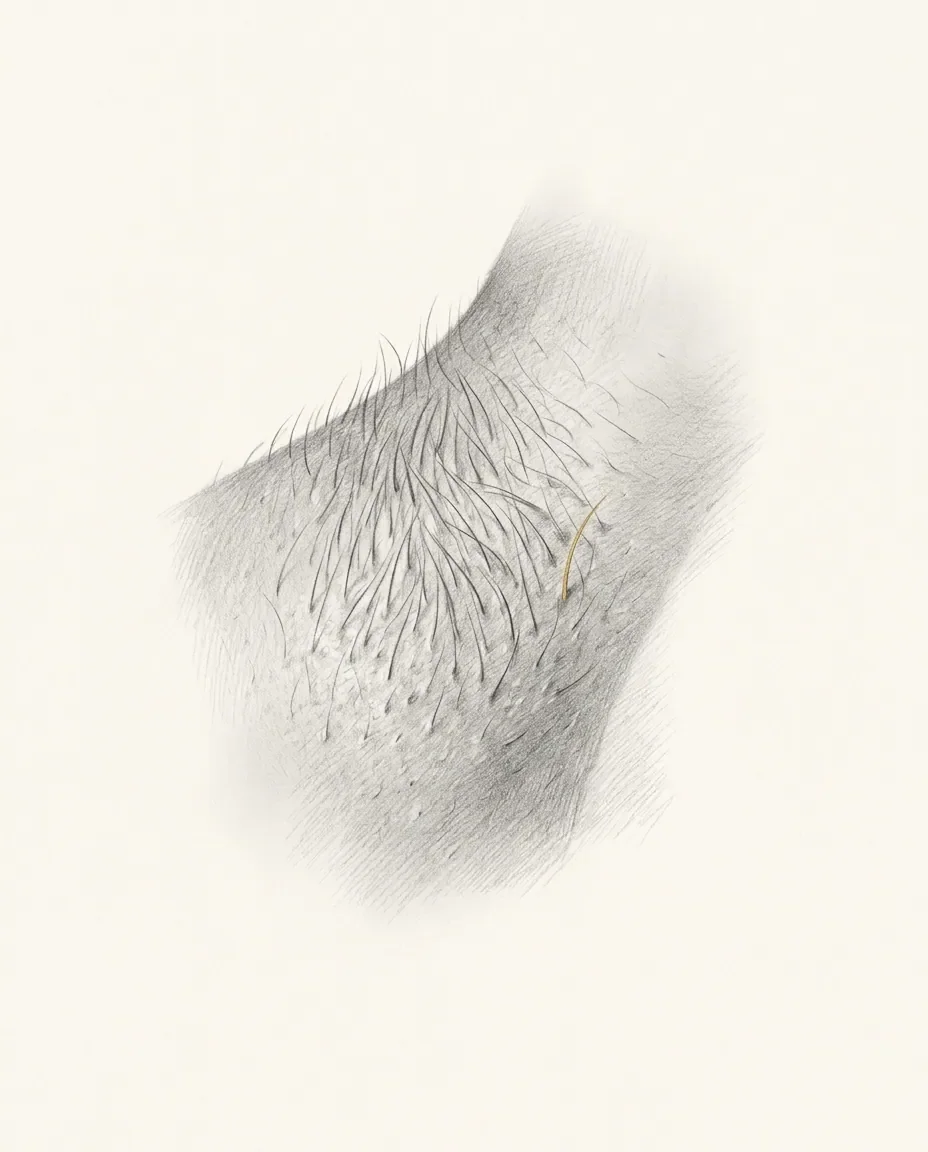
A pleasurable, non-sexual wave of chills, tingling and goosebumps, often felt down the spine, triggered by emotionally moving music or art. Film and moments of awe trigger it too. Sometimes nicknamed a "skin orgasm."
- Prevalence
- Very common
- Category
- Non-Sexual Fetishism
- Domain
- Non-sexual interest
- Confidence
- Medium confidence
- Status
- Not a paraphilia or disorder; a common, benign non-sexual psychophysiological response studied in affective neuroscience and music psychology.
- Also known as
- aesthetic chills, musical chills, skin orgasm, psychogenic shivers, chills, shivers up the spine, goosebumps response
- Added
- 22 Jun 2026
- Updated
- 22 Aug 2026
Featured in
Overview
Frisson is a brief, pleasurable psychophysiological response, a wave of chills, tingling and goosebumps (piloerection) classically felt down the back, neck, shoulders and arms, evoked by emotionally moving stimuli such as a swelling passage of music, a striking image, a moving scene, or a moment of awe. This entry documents it as a non-sexual sensory and aesthetic affinity rather than an erotic interest, although one of its informal nicknames, "skin orgasm," nods to the intensity of the pleasure some listeners report. The article below traces how the phenomenon moved from a poetic curiosity to a well-mapped subject of affective neuroscience, and surveys what is known about how it works and how common it is.
Examples
What the term covers. The bodily event is specific: a wave of tingling running down the back, neck, shoulders or arms, the hair lifting (piloerection), a catch in the breath, sometimes tears; it lasts a few seconds and arrives unbidden. The reliable triggers are structural rather than stylistic: a sudden swell in volume, an unexpected harmonic turn, a solo voice or instrument emerging from a dense texture, a long-delayed resolution finally arriving. Music is the commonest source, but the same response is reported to poetry, film, sweeping scenery, oratory, and moments of intellectual insight.
What the term does not cover. ASMR is a slow, calming tingle that starts at the scalp and is produced by quiet, close, repetitive sound and personal attention; frisson is a brief peak driven by aesthetic climax and rides a spike of sympathetic arousal rather than a lull in it. Misophonia turns comparable sounds into anger or disgust. Synesthesia is an automatic cross-sensory perception rather than an episode of pleasure. Audiophilia is connoisseurship of sound reproduction rather than any bodily response. Oddly satisfying media trades on order and completion, with no chill at all. A shiver from cold, fever or fear is likewise not frisson: the skin does the same thing, but the pleasure and the aesthetic trigger are missing.
How the word is used. Frisson is ordinary English borrowed from French, used loosely for any thrill of excitement ("a frisson of anticipation"), and only narrowly for this response. Researchers prefer aesthetic chills, musical chills, psychogenic shivers or thrills; "skin orgasm", Jaak Panksepp's 1995 coinage, is descriptively apt but never took hold because of the connotation. None of these names appears in DSM-5-TR or ICD-11, and the absence is not an oversight: frisson is a common, benign response, not a condition.
History & origins
The term
The word frisson is simply French for "shiver," borrowed into English in the eighteenth century to mean a sudden passing thrill of emotion or excitement. As a scientific label the phenomenon has gone by many names (aesthetic chills, musical chills, psychogenic shivers, thrills), reflecting the fact that it was studied in parallel by music psychologists, personality researchers and neuroscientists who each favoured different vocabulary.
Clinical & scientific lineage
- 1980: Psychologist Avram Goldstein, a co-discoverer of the body's endogenous opioids, published an early empirical study of "thrills" in response to music and other stimuli in Physiological Psychology. About half of those he surveyed reported the sensation, most reliably from music, and in a small preliminary experiment the opioid antagonist naloxone attenuated the thrill in some subjects, an early hint that the brain's reward chemistry is involved.
- 1995: Affective neuroscientist Jaak Panksepp coined the evocative term "skin orgasm" in The emotional sources of "chills" induced by music, published in the journal Music Perception. In contrast with Goldstein, he reported that chills were more often elicited by sad than by happy music, and by a stark solo voice or instrument emerging from a richer texture. The phrase, though descriptively apt, never gained scholarly traction because of its sexual connotations.
- 2001: Anne Blood and Robert Zatorre used PET imaging to show that intensely pleasurable musical chills correlate with activity in brain regions implicated in reward and emotion, among the first hard neural evidence that aesthetic pleasure engages the same circuitry as biological rewards.
- 2011: Salimpoor, Benovoy, Larcher, Dagher and Zatorre, writing in Nature Neuroscience, combined [11C]raclopride PET with autonomic measures to demonstrate that peak musical pleasure is accompanied by endogenous dopamine release in the striatum, with anatomically distinct release in the caudate during anticipation and the nucleus accumbens at the emotional peak.
- 2014: Luke Harrison and Psyche Loui surveyed the whole field in Thrills, chills, frissons, and skin orgasms, proposing an integrative model that ties frisson to violations and resolutions of musical expectation.
- 2016: Matthew Sachs and colleagues reported that people who feel frequent chills have greater white-matter connectivity between auditory regions and areas processing emotion and reward, a structural correlate of individual susceptibility.
Cultural evolution
Long before it was instrumented, frisson lived in everyday language: the "shiver up the spine," the moment that "gives me chills." In the internet era it has become a shared point of reference for fans of film scores, live performance and viral musical moments, and is frequently discussed alongside other sensory phenomena such as ASMR and synaesthesia, even though its mechanism is distinct from both.
In practice, how the response is experienced
Frisson is involuntary and fleeting, usually lasting only a few seconds. It is most often elicited by music (particularly loud or unexpected passages, sudden harmonic shifts, a soaring vocal or instrumental entry, and the violation and subsequent resolution of a musical expectation) but also by poetry, film, sweeping scenery, visual art and powerful oratory. Most people feel it in the back, neck, arms and scalp; reports of chills travelling down the spine are common but not universal. A minority say they can summon a mild version deliberately, without any external trigger.
Psychology, proposed mechanisms
What causes frisson?
The response recruits the sympathetic nervous system (producing goosebumps and piloerection) together with the brain's reward circuitry, including the nucleus accumbens, caudate and orbitofrontal cortex. As the Salimpoor et al. (2011) findings suggest, anticipation appears to matter as much as the climactic moment, which is why music that sets up and then fulfils (or surprises) an expectation is such a reliable trigger. Goldstein's early naloxone result and later dopamine imaging point to overlapping opioid and dopamine systems, the same chemistry that underlies more basic rewards.
Why do some people never feel it?
Individual differences are pronounced. Frisson is consistently linked to the personality trait of openness to experience, and the Sachs et al. (2016) white-matter result offers a plausible structural basis for why some people are "chill-prone" and others rarely feel anything. Evolutionary accounts, for example linking piloerection to thermoregulation or to ancestral responses to separation calls, remain speculative.
Prevalence & culture
How common is frisson?
Frisson is very common but not universal. Estimates of how many people experience it at all vary widely, roughly from 55% to 86% across studies, meaning a substantial minority feel little or nothing: a normal variation rather than a deficit. It is an everyday pleasure woven through concerts, soundtracks, religious and ceremonial settings and "gives me chills" moments online, and it sustains active discussion in audiophile, music-fan and ASMR communities. Because it is benign and widely felt, it attracts steady research attention as a window onto how the brain assigns pleasure to abstract, culturally learned rewards.
Safety, consent & law
Frisson is entirely benign, legal and non-sexual. It involves no other person, no physical risk and no consent considerations. The only practical note is that sensitivity differs greatly between individuals: not experiencing chills is a normal variation, and there is nothing to treat or correct.
Common questions
What kind of music gives people chills?
No fixed repertoire does it; particular structural moments do. Chills cluster around a sudden rise in volume, the entry of a new voice or instrument, an unexpected harmonic turn, and the arrival of a resolution the music has withheld. That is why the effect crosses genres: a choral entry, a key change in a pop chorus and a film-score swell all use the same device. Which specific pieces work varies sharply between listeners.
Is frisson the same thing as a "skin orgasm"?
Yes: "skin orgasm" is a nickname for the same response, introduced by the affective neuroscientist Jaak Panksepp in 1995 to convey how intensely pleasurable listeners find it. It never became standard vocabulary, precisely because the sexual connotation misleads: frisson involves no sexual arousal and no genital response. What the metaphor points at is that aesthetic pleasure recruits the brain's reward circuitry, the same machinery that handles more biological rewards.
Why do I get goosebumps from music when I am not cold?
Goosebumps are a sympathetic-nervous-system reflex: tiny muscles pull each hair upright, a mechanism that in furred mammals traps heat or makes the animal look larger. Emotional and aesthetic arousal recruits the same pathway, so a moving passage produces the thermal response with no thermal cause. The reflex is involuntary, which is why frisson arrives before you have decided anything about the music.
What is the difference between frisson and ASMR?
Mostly the direction of arousal. ASMR is a slow, spreading, calming tingle triggered by quiet close sounds and personal attention, and it lowers arousal: people use it to fall asleep. Frisson is a short peak triggered by an emotional or aesthetic climax, and it raises arousal, with goosebumps and a quickened pulse. Different triggers, different time course, different physiology. Many people feel one and not the other, and the two have largely separate research literatures.
Why does sad music give the strongest chills?
For many listeners it does. Jaak Panksepp reported in 1995 that chills were elicited more often by sad than by happy music, and that a stark solo voice or instrument emerging from a fuller texture was a particularly reliable trigger, a device sad music leans on constantly. That sits awkwardly beside Avram Goldstein's earlier 1980 survey, which did not single sadness out, and the tension has never been fully resolved.
Should I worry if I get chills for no reason?
Frisson itself is benign and needs no attention. It is worth distinguishing from other things that produce the same skin response: shivering from cold, the chills of a fever or infection, and persistent tingling, numbness or crawling sensations, which are neurological symptoms rather than aesthetic ones. If shivers are unpleasant, painful, prolonged, or arrive with no emotional or aesthetic trigger at all, that is a question for a doctor and not a description of frisson.
- ASMR69/100Autonomous Sensory Meridian Response · Non-Sexual FetishismA non-sexual, pleasant tingling sensation that typically begins on the scalp and moves down the neck and spine. Soft sounds, gentle attention, or close personal care trigger it. It underpins a large online relaxation-media subculture.69
- Synesthesia55/100synaesthesia · Non-Sexual FetishismA benign neurological trait in which one sense automatically and involuntarily triggers another: seeing colours in sounds or words, tasting shapes. A documented 'sexual' subtype attaches vivid cross-sensory perceptions to arousal and orgasm.55
- Misophonia57/100misophonia · Non-Sexual FetishismA sound-tolerance condition in which specific repetitive trigger sounds provoke disproportionate irritation, anxiety, disgust or anger. Chewing, breathing, sniffing and tapping are common triggers. It is a non-sexual sensory aversion, not an erotic interest.57
- Audiophilia39/100Non-Sexual FetishismA non-sexual devotion to high-fidelity sound reproduction and the equipment behind it: amplifiers, speakers, turntables, headphones, and cables. It is a hobby and connoisseurship interest, not a clinical condition or sexual paraphilia.39
- Heartbeat Fetish19/100Cardiophilia · Body Functions & FluidsAn erotic or sensual interest in the heart and heartbeat, its sound through a stethoscope or an ear pressed to the chest. The pulse felt at the wrist or neck counts too, as does how it quickens with emotion and exertion. A rare interest with a small, durable online community.19
- Antiquing53/100Non-Sexual FetishismA non-sexual hobby of shopping for, sourcing, identifying, and collecting antiques: old furniture, decorative objects, and everyday artifacts. They are valued for age, craftsmanship, and history. It centers on the hunt, connoisseurship, and the tactile appeal of aged material.53
From the French *frisson* ("shiver, thrill"), in turn from Late Latin *frictio* / Latin *frigere* ("to be cold"). Used in English since the 18th century for a sudden passing thrill of emotion or excitement; the informal alias "skin orgasm" was introduced by neuroscientist Jaak Panksepp in 1995.
sensory experience · aesthetic response · music psychology
Prevalence is computed from the entry's cited population estimate. Rows marked ESTare indicative editorial estimates scored against a fixed anchor rubric, not measured quantities. Method & anchors: methodology.
Very common · ≈ 1 in 7
- 01Frisson, Wikipediadefinition, French etymology, aliases (aesthetic chills, psychogenic shivers), piloerection, link to openness to experience, and key studies (Blood & Zatorre 2001; Sachs et al. 2016)
- 02Thrills, chills, frissons, and skin orgasms: toward an integrative model of transcendent psychophysiological experiences in music, Harrison & Loui, Frontiers in Psychology (2014)scholarly framing of frisson and the 'skin orgasm' term attributed to Panksepp (1995); integrative model of chills and individual variation
- 03Anatomically distinct dopamine release during anticipation and experience of peak emotion to music, Salimpoor et al., Nature Neuroscience 14:257-262 (2011)[11C]raclopride PET evidence that peak musical pleasure (frisson) is accompanied by striatal dopamine release in the caudate (anticipation) and nucleus accumbens (peak)
- 04Intensely pleasurable responses to music correlate with activity in brain regions implicated in reward and emotion, Blood & Zatorre, PNAS 98(20):11818-11823 (2001)PET imaging showing musical chills/frisson correlate with activity in reward and emotion brain regions
- 05Thrills, chills, frissons, and skin orgasms, Frontiers in Psychology (2014), publisher landing pageintegrative model of musical frisson; Panksepp (1995) 'skin orgasm' coinage in Music Perception; expectancy-violation mechanism
- 06Thrills in response to music and other stimuli, Goldstein, Physiological Psychology 8(1):126-129 (1980)early empirical study of musical 'thrills'; ~half of respondents report them; preliminary naloxone experiment attenuated thrills in some subjects, implicating endogenous opioids
- 07Why do only some people get 'skin orgasms' from listening to music?, The Conversation (2016)Sachs et al. (2016) white-matter connectivity finding and individual differences in who experiences frisson
- 08Here's Why Some People Get 'Skin Orgasms' From Listening to Music, ScienceAlertlay-accessible summary of frisson triggers and the chills phenomenon, popularising the Sachs et al. (2016) white-matter findings for a general audience