
Sneakerhead
Added 21 Jun 2026 · Updated 22 Aug 2026
A non-sexual collecting subculture centred on athletic and designer sneakers, whose enthusiasts pursue rare, limited, and historically significant footwear. Such enthusiasts are known as "sneakerheads". The shoes are prized as collectibles, art objects, and identity markers rather than as sources of arousal.
- Prevalence
- Common
- Category
- Non-Sexual Fetishism
- Domain
- Non-sexual interest
- Confidence
- High confidence
- Status
- Not a clinical condition; a hobby and consumer subculture.
- Also known as
- sneaker culture, sneaker collecting, kicks culture, hypebeast (footwear)
- Added
- 21 Jun 2026
- Updated
- 22 Aug 2026
Featured in
Overview
Sneaker culture is a global hobby and consumer subculture built around collecting, trading, and the connoisseurship of sneakers. Its participants, called sneakerheads, track release calendars, brand lineages, collaborations, and resale values, treating certain models as cultural artefacts and investment-grade collectibles. The interest is entirely non-sexual: the shoe is an object of connoisseurship, a fashion statement, and a badge of belonging, not a source of arousal, which is precisely what separates it from the much smaller shoe fetish and foot fetish interests. This article traces where the subculture came from, how it is practised, what drives its devotees, and the consumer-protection issues that surround it.
Definition & scope
"Sneakerhead" names a collector and enthusiast, not a clinical category. The defining behaviours are acquisition, curation, and connoisseurship: knowing a silhouette's designer, release year, materials, and colourway lore, and prizing scarcity. Two boundaries matter. First, sneaker collecting is a consumer subculture, not a paraphilia; the word "fetish" applied to sneakers here carries its anthropological and marketing sense of a prized object, not the clinical meaning found on the list of paraphilias. Second, it is distinct from the sexual shoe fetish, in which the footwear itself is eroticised. A sneakerhead can own hundreds of pairs with no erotic dimension whatsoever.
Examples
What the term covers. Owning one silhouette in a dozen colourways and being able to date each of them; hunting deadstock, meaning unworn and out of production; entering an online raffle for a limited release and losing; keeping a "grail" boxed and unworn while a battered pair does daily duty; rotating a display; travelling to Sneaker Con or Sneakerness; and following the resale market closely enough to know what a pair is worth without looking it up. Depth of knowledge counts for as much as size of collection: provenance, materials, designer and release lore are the currency of standing in the scene.
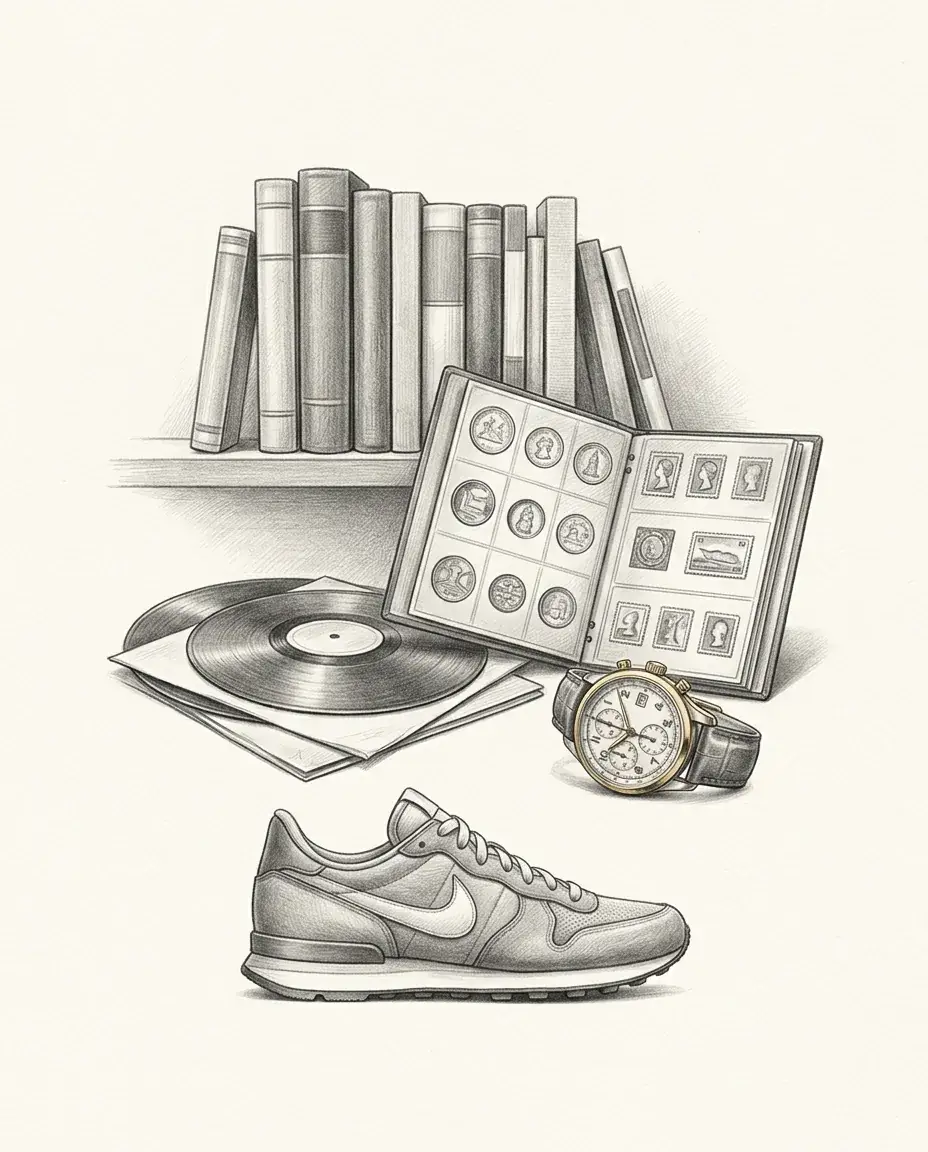
What the term does not cover. Anything erotic. A shoe fetish or boot fetish eroticises the footwear itself; a foot fetish or sock fetish targets the wearer; shoeplay concerns how a shoe is dangled or slipped off. A sneakerhead's relationship to a shoe is connoisseurship, the same relationship a watch collector or a record collector has to their object, and general collecting is the honest parent category. It is also not compulsive shopping or hoarding, which are defined by loss of control and undifferentiated accumulation rather than by curation, a distinction routinely lost in coverage of expensive collections.
How the word is used. Vernacular, formed on the enthusiast "-head" suffix, and current since 1990s urban youth culture. It travels with a whole jargon: kicks, drop, grail, colourway, DS for deadstock, and hypebeast for the buyer chasing status over knowledge, which is almost always an insult. When fashion writing calls sneakers a "fetish" it is using the word in its anthropological and marketing sense; no diagnostic manual has anything to say about the subculture at all.
History & origins
Birth in 1980s New York
Sneaker collecting coalesced as a recognisable subculture in 1980s New York City, at the meeting point of basketball, hip-hop, and street fashion, as documented in the Wikipedia survey of sneaker collecting. Two catalysts are usually cited.
- 1984–85: the Air Jordan. Nike signed the rookie Chicago Bulls guard Michael Jordan in 1984 and brought the first Air Jordan to the public in 1985. A black-and-red colourway fell foul of an NBA rule requiring on-court shoes to be at least 51% white; the league's warning, and the "Banned" mythology that grew up around it, became a marketing engine. Nike had expected to sell roughly 100,000 pairs in the first year and instead moved 1.5 million pairs in the first six weeks, proving a performance shoe could become a coveted cultural object.
- 1986: "My Adidas." Hip-hop's embrace of footwear as a status symbol crystallised in Run-DMC's track "My Adidas", which led to a landmark endorsement deal between the group and Adidas and wove specific models into music, dance, and identity. Earlier styles such as the Adidas Superstar and Puma Suede had already been adopted by b-boys and playground players.
The precise coinage of the word sneakerhead is not well documented, but it was in common use within urban youth culture by the 1990s. Around the same time the idea of sneaker exclusivity took hold, as collectors hunted deadstock (unworn, out-of-production pairs forgotten in warehouses and back rooms) in search of something nobody else owned.
Going global and going commercial
The hobby spread well beyond its origins. Per the same Wikipedia survey, sneaker culture became global by the end of the 1990s; originally popular among urban Black youth and white skateboarders, it built a cult following in Japan and across Asia through the 1990s. The internet then transformed it: release-tracking sites, raffles, and dedicated resale marketplaces turned limited "drops" and brand collaborations into a worldwide event calendar. The secondary market grew alongside the passion, becoming a speculative economy in its own right.
| Year | Global sneaker resale market | Source |
|---|---|---|
| 2019 | ~US$6 billion | Cowen / StockX |
| 2021 | ~US$10 billion | Cowen / StockX |
| 2030 (projected) | ~US$30 billion | Cowen / StockX |
The subculture's reach is reflected in mainstream coverage such as National Geographic's account of how sneaker culture took over the world and the EBSCO research-starter overview.
In practice
Sneakerheads typically express the interest by:
- acquiring limited or deadstock (unworn, out-of-production) pairs;
- queuing for releases or entering online raffles for high-demand "drops";
- displaying and rotating curated collections, sometimes on dedicated shelving;
- trading and reselling on specialised marketplaces;
- attending conventions such as Sneaker Con (North America and Southeast Asia) and Sneakerness (Europe), and taking part in online communities.
Fluency in provenance, colourways, materials, and silhouettes confers social standing within the scene.
Psychology
Sneaker collecting blends the completionist and connoisseur drives common to all collecting hobbies with identity expression, nostalgia, and the thrill of scarcity. Logos and high-profile collaborations heavily shape desirability, so the interest overlaps with broader brand worship and the commodity fetishism at work whenever an object's social aura outruns its use-value. For some participants, resale adds a speculative, market-trading dimension on top of the aesthetic and tribal appeal. None of this is sexual; the term "fetish" here is used in its anthropological and consumer-culture sense, not the clinical paraphilic one.
Prevalence & culture
Sneaker culture has high mainstream visibility, large and active online communities, and significant commercial scale, even though formal academic study of it remains comparatively modest. Sustained mainstream interest shows up in long-running Google Trends search demand for terms like sneakerhead and specific release names. Rooted in hip-hop, basketball, and skate cultures, the subculture has spread worldwide and is reinforced by documentaries, museum exhibitions, brand storytelling, and a continuous cycle of branded releases.
Safety, consent & law
The interest is benign and raises no consent or harm dimension whatsoever. The only notable concerns are consumer-protection matters: counterfeit goods, bot-driven scalping, inflated resale pricing, and occasional fraud in peer-to-peer marketplaces, rather than anything sexual or coercive. Authentication services and marketplace verification exist largely to address those risks.
Common questions
How many pairs do you need to be a sneakerhead?
There is no threshold, and collectors will tell you the count is the wrong measure. What marks a sneakerhead is knowledge and intent: recognising a silhouette, knowing its designer, release year and colourway lore, and buying deliberately rather than incidentally. Someone with twenty carefully chosen pairs sits more obviously inside the culture than someone with a hundred bought at random.
Is being a sneakerhead a fetish?
Not in the clinical sense. Sneaker collecting is a consumer subculture with no erotic dimension, and when fashion or marketing writing calls it a fetish it is using the word anthropologically, to mean a prized object charged with meaning. The sexual shoe fetish, in which footwear itself is the source of arousal, is a separate and much smaller interest.
What does deadstock mean?
Deadstock, usually abbreviated DS, means a pair that is unworn and out of production: original stock that never sold, or that was never taken out of the box. It commands a premium because condition and scarcity compound, and it is what collectors hunt in old warehouse and back-room inventory. Once a pair has been worn it is no longer deadstock at any price.
Why do limited sneakers cost so much on the resale market?
Because supply is deliberately constrained and demand is not. Brands issue limited runs and collaborations in small numbers, automated buying software absorbs much of the stock at retail, and resellers capture the difference on secondary marketplaces, with authentication and platform fees added on top. The price reflects scarcity and hype rather than materials or manufacturing cost.
Is sneaker collecting the same as hoarding?
No, and the two resemble each other only from outside. Collecting is selective and curated: pairs are chosen, catalogued, displayed and traded away. Compulsive hoarding is a clinical condition marked by an inability to discard, accumulation without organisation, and living space rendered unusable. A large collection is evidence of neither that nor compulsive shopping, though spending beyond one's means is its own problem.
How do you tell if sneakers are fake?
Not reliably by eye, which is the honest answer: counterfeits have become good enough that experienced collectors get caught. That is why marketplaces built authentication into the transaction and why third-party verification services exist at all. The practical approach within the scene is to buy where pairs are authenticated, keep receipts and boxes, and treat an unusually cheap example of a scarce model as the warning it usually is.
Do sneakerheads actually wear their sneakers?
It varies, and it is a live argument inside the culture. Some collectors wear everything they own, on the view that shoes are made to be worn; others keep certain pairs unworn indefinitely, since wearing a pair ends its deadstock status and takes most of the resale value with it. Many split the difference and buy a wearable duplicate of anything they want to preserve.
From the blog
How common7 min read
Shoes, heels, socks and stockings: when the fetish is what covers the foot
A shoe fetish centres on footwear, not the foot. Heels, boots, socks, stockings and pantyhose: what the surveys count and where each ranks on the index.
Definitions5 min read
Is collecting a fetish, and when does it stop being one
Is collecting a fetish? Only in the everyday sense: a non-sexual drive to complete sets, estimated at 18 percent of adults, and distinct from hoarding.
- Brand Worship44/100Non-Sexual FetishismA non-sexual fixation on brands, logos, and designer labels, in which the brand itself becomes a source of identity, status, and emotional attachment. Branded goods are valued largely for their symbolic and signalling power rather than their function.44
- Tech Fetish50/100Non-Sexual FetishismA non-sexual fascination with gadgets, devices, and technology, marked by a drive to acquire, upgrade, and master the newest gear. Often called technophilia, its appeal lies in novelty, capability, and the identity of being an early adopter.50
- Commodity Fetishism34/100Non-Sexual FetishismA concept from Marxist economic and social theory describing how commodities appear to possess intrinsic value and social power. That appearance masks the human labor and social relations that actually produce them. It is a non-sexual, analytical use of the word "fetish."34
- Synesthesia55/100synaesthesia · Non-Sexual FetishismA benign neurological trait in which one sense automatically and involuntarily triggers another: seeing colours in sounds or words, tasting shapes. A documented 'sexual' subtype attaches vivid cross-sensory perceptions to arousal and orgasm.55
- Frisson54/100Non-Sexual FetishismA pleasurable, non-sexual wave of chills, tingling and goosebumps, often felt down the spine, triggered by emotionally moving music or art. Film and moments of awe trigger it too. Sometimes nicknamed a "skin orgasm."54
- Limerence56/100Non-Sexual FetishismAn involuntary state of intense romantic infatuation centred on one person, marked by obsessive intrusive thoughts. It brings emotional dependency on that person's responses and an aching craving for reciprocation. It is an affective experience, not a fetish or a recognised disorder.56
An English compound of "sneaker" (a rubber-soled shoe, so named because its quiet sole let the wearer move stealthily, or "sneak") and the suffix "-head," denoting an enthusiast or devotee, as in "gearhead" or "hophead." The compound came into common use in 1980s–1990s US urban youth culture.
collecting · consumer culture · subculture
Prevalence is computed from the entry's cited population estimate. Rows marked ESTare indicative editorial estimates scored against a fixed anchor rubric, not measured quantities. Method & anchors: methodology.
Common · ≈ 1 in 20
- 01Google Trends, relative search interest (search-interest proxy)sustained mainstream search interest in sneaker collecting / sneakerhead culture (non-sexual consumer subculture)
- 02List of paraphilias, Wikipediacontrast framing, sneaker collecting is a non-sexual fetishism/consumer enthusiasm, not a paraphilia
- 03Pornhub Insights, search-term popularity (search-interest proxy)search-interest proxy distinguishing the sexual sneaker fetish niche from the much larger non-sexual collecting culture
- 04Sneaker collecting, Wikipediahistory and origins of sneakerhead culture (1980s NYC, Air Jordan launch, hip-hop influence, deadstock, global spread, conventions)
- 05Air Jordan, Wikipedia1984 Jordan signing, 1985 public release of the first Air Jordan, the colourway controversy and the line's marketing impact
- 06How the Air Jordan 1 Banned Colorway Sparked a Sneaker Revolution, NikeNBA 51%-white uniform rule, the 'Banned' mythology, and Nike selling ~1.5 million Air Jordan 1 pairs in the first six weeks against a ~100,000 first-year expectation
- 07My Adidas (Run-DMC), Wikipedia1986 track that crystallised hip-hop's embrace of sneakers and led to the Run-DMC / Adidas endorsement deal
- 08The global sneaker resale market could reach $30 billion by 2030, Cowen / StockX (Yahoo Finance)sneaker resale market size figures: ~US$6bn in 2019, ~US$10bn in 2021, projected ~US$30bn by 2030 (Cowen / StockX)
- 09How sneaker culture took over the world, National Geographicmainstream documentation of sneakerhead culture's spread, cultural visibility, and Air Jordan lineage
- 10Sneaker culture (sneaker collecting), EBSCO Research Startersreference overview of sneaker culture as a non-sexual collecting subculture, its origins and commercial scale