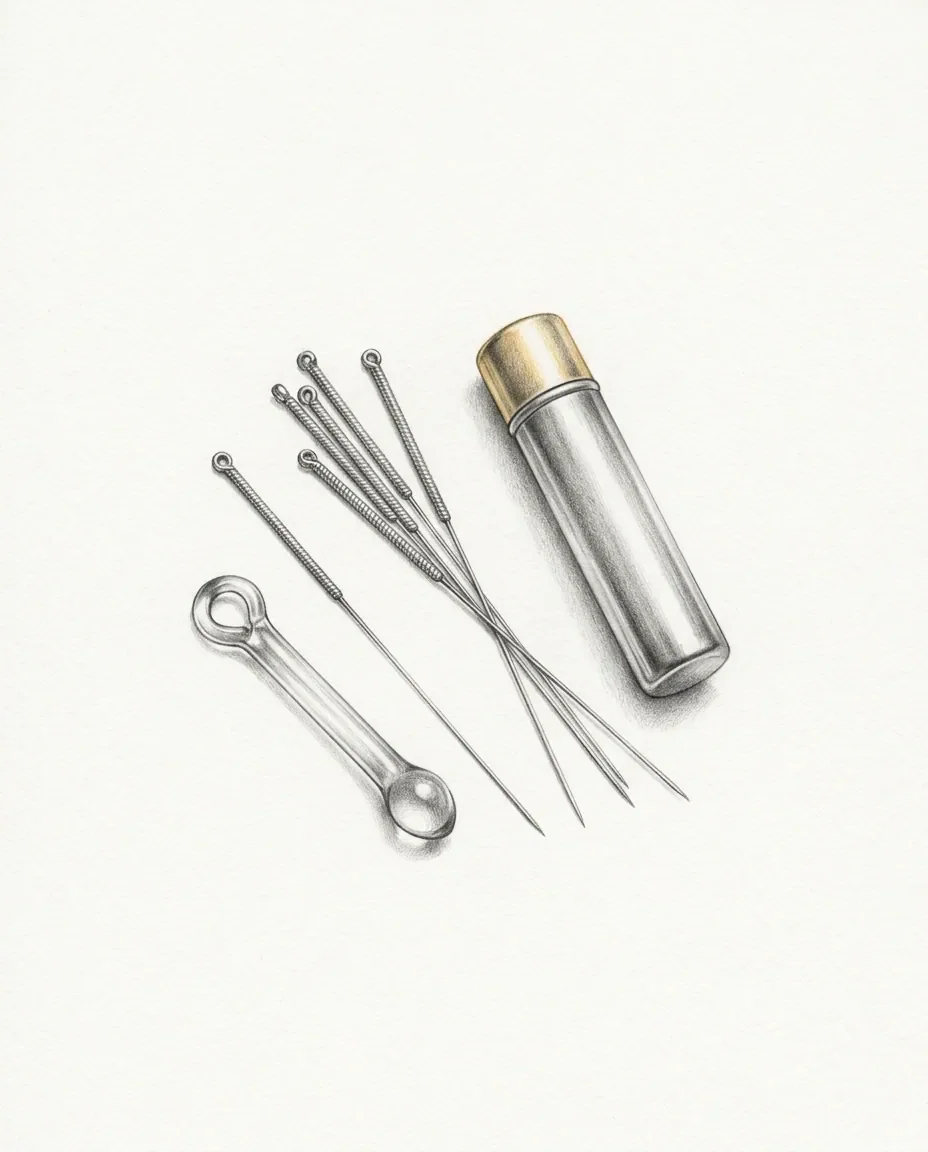
Needle Play
Added 21 Jun 2026 · Updated 22 Aug 2026
Consensual BDSM practice in which fine sterile needles are passed temporarily through the surface of the skin for sensation, ritual, or visual effect. They are removed at the end of the scene. A higher-risk edge practice distinct from permanent body piercing.
- Prevalence
- Uncommon
- Category
- Sensation & Pain
- Domain
- Sexual interest
- Confidence
- Low confidence
- Status
- Consensual BDSM edge practice; benign variation in consenting adults, not a disorder absent distress or non-consent, but recognized as higher-risk due to skin penetration and infection potential.
- Also known as
- play piercing, temporary piercing, needle BDSM
- Added
- 21 Jun 2026
- Updated
- 22 Aug 2026
Featured in
Collection
BDSM Kinks & Dynamics
The core of BDSM: bondage, discipline, dominance, submission, sadism and masochism, each defined and ranked.
87 entries
Collection
Medical & Clinical Play
The clinic as a scene: examinations, instruments and the particular charge of clinical authority, each defined and ranked.
7 entries
Overview
Needle play (also play piercing, temporary piercing, or recreational acupuncture) is a consensual BDSM practice in which thin sterile needles are passed temporarily through the upper layers of the skin and removed at the close of a scene, leaving no permanent jewellery. The needles enter and exit the surface so that both ends remain accessible, which distinguishes it sharply from medical injection (into the body) and from permanent body piercing (which leaves a lasting hole). The appeal blends intense, focused sensation, a meditative or ceremonial atmosphere, and the striking visual patterns that rows of needles can create. It belongs to the sensation play and pain play family but sits at its edge, demanding careful sterile technique because it deliberately breaks the skin.
Examples
What the term covers. A negotiated scene in which fine sterile needles are passed through a pinched fold of skin on a padded area (the back, chest or forearm), often in symmetrical rows or a decorative pattern, then withdrawn at the end and dropped into a sharps container. In more advanced play the needles carry ribbon in a corset-style lacing or hold a temporary attachment. Some scenes are built around the sharpness of each insertion; others around the slow, repetitive rhythm and the trance-like headspace it can produce.
What the term does not cover. A body piercing leaves jewellery and a lasting channel; needle play leaves nothing, and that is the whole distinction. It is therefore separate from body modification, which is about a permanent mark, and from stigmatophilia, an attraction to bodies already tattooed or pierced. Knife play usually turns on the threat and the cold edge rather than on penetrating skin, branding and burning works with heat, and a blood fetish makes the blood the focus rather than a by-product. Medical-setting kink borrows clinical imagery and props without necessarily breaking skin at all. And piquerism (arousal from pricking or stabbing a person who has not consented) is a forensic paraphilia and a violent crime, not a variant of this.
How the word is used. Community vernacular. Play piercing is the older and more precise term, "needle play" the common one, and both sit under the community label edgeplay, used for practices whose risk cannot be negotiated away. There is no clinical coinage: the diagnostic manuals address sexual masochism disorder, which requires distress or harm, and say nothing about the technique.
History & origins
Ritual roots
The deliberate, symbolic piercing of skin is ancient and cross-cultural, appearing in religious devotion, rites of passage, and trance-induction long before any erotic framing. These body-ritual traditions, including hook suspension, supplied much of the imagery and the transcendence-through-sensation logic later borrowed by Western practitioners.
Clinical lineage of sharp sensation
The desire to receive intense sharp sensation sits within the much older clinical lineage of masochism. Richard von Krafft-Ebing's Psychopathia Sexualis (1886) catalogued masochism as a named category, and Havelock Ellis discussed the pleasure-pain spectrum under "algolagnia" in his Studies in the Psychology of Sex. Modern psychiatry draws a firm line between consensual practice and disorder: the DSM-5-TR (2022) and the ICD-11 classify sexual masochism disorder only where the interest causes distress or harm, so consensual needle play between adults is a benign variation, not a pathology.
Naming and modern conventions
Needle play is not a separately coined clinical term but a specific technique that crystallised within the late-twentieth-century leather and kink subcultures of North America and Europe, alongside other risk-aware "edgeplay". The wider revival of ritual piercing in the West is closely associated with the performance artist Fakir Musafar (Roland Loomis, 1930–2018), who coined the term "modern primitives" in 1979 to describe himself and a few kindred spirits. His practice was documented in the influential RE/Search volume Modern Primitives (1989) and in his magazine Body Play and Modern Primitives Quarterly (1992–1999); he and his wife Cléo Dubois became prominent educators bridging body-ritual and BDSM communities. The sterile, single-use conventions of contemporary play piercing were shaped by such community educators rather than by any single documented clinical originator.
In practice
Needle play is conducted within a negotiated scene using new, individually packaged single-use hypodermic or acupuncture-style needles. The top typically pinches and lifts a fold of skin and passes the needle through the surface: often working in symmetrical rows or decorative patterns (and, in advanced play, corset-style lacing or temporary attachments) across padded areas such as the back, chest, or forearms. Some practitioners value the slow, repetitive rhythm as a route to an altered, trance-like headspace; others focus on the sharp point of sensation or the visual result. Needles are removed at the close of the scene and discarded in a sharps container. This article describes the practice in general terms and gives no procedural instruction.
Psychology
The draw typically blends endorphin and adrenaline release, intense present-moment focus, trust and surrender, and the ritual quality of a controlled, ceremonial act. Community accounts describe endorphin states lasting well beyond the scene. For many the central experience is the headspace and the bond of care between participants rather than pain as such. As with adjacent practices such as knife play and branding and burning play, the controlled threat and the demonstration of trust are often more important than the nociception itself. In consenting adults it is understood as a benign variation, not a disorder.
Prevalence & culture
How common is needle play?
Needle play is a comparatively niche, advanced practice: better known within experienced kink communities than among the general public. Direct prevalence figures are scarce, so estimates rely on the much larger masochism population that bounds it: in Joyal & Carpentier's (2017) representative Quebec survey, masochistic interest was reported by a substantial minority of respondents, of whom only a small fraction would pursue an edge technique like needle play. It sustains a dedicated instructional culture centred on safety and sterile method, with a presence on community platforms such as FetLife and in body-ritual and performance-art contexts as well as private play.
Safety, consent & law
Is needle play safe?
It is one of the higher-risk BDSM practices, not a beginner activity. Because it intentionally breaks the skin, needle play carries real, non-trivial risks: infection, bloodborne-pathogen transmission, nerve damage, and vasovagal fainting. Risk-aware practitioners use only new sterile single-use needles, gloves, skin antisepsis, anatomical knowledge to avoid vessels and nerves, and proper sharps disposal: with negotiated consent, safewords, and aftercare as standard. Between consenting adults it is generally lawful, but piercing a non-consenting person is assault, and in some jurisdictions consent does not extend to serious bodily injury.
Common questions
What is the difference between needle play and body piercing?
Permanence. In needle play the needle passes through the surface of the skin, stays for the length of a scene, and comes out; nothing is left behind and no jewellery is fitted. A body piercing is made to keep: the channel is meant to heal open around jewellery, and it is usually done by a licensed piercer working under health regulation. The tools can look similar; the intent and the aftermath do not.
Does needle play hurt?
Yes, though people describe it very differently. Each insertion is a brief bright sting rather than a sustained pain, and finer needles in fleshy areas hurt less than thicker ones placed near bone. Many practitioners report that the sensation changes character after the first few as adrenaline and endorphins arrive, and some find a long rhythmic sequence more meditative than painful. Others simply find it sharp, and that is what they came for.
What kind of needles are used?
New, individually packaged, single-use sterile needles (hypodermic or acupuncture-style), opened in front of the person receiving them, never reused, never shared between people, and never rinsed and kept for later. They go into a rigid sharps container at the end of the scene. Anything else, including sewing needles, safety pins or "sterilised" reused equipment, is how the serious risks in this practice actually materialise.
Can you catch an infection from needle play?
Yes, and it is the main hazard. A needle that has broken skin can transmit bloodborne viruses including hepatitis B, hepatitis C and HIV if it is shared or reused, and any skin penetration can introduce bacteria and cause a local infection or abscess. Sterile single-use needles, gloves, skin antisepsis before insertion and safe sharps disposal are what reduce that risk. They reduce it; they do not remove it.
Does needle play leave scars?
Usually not. Fine needles passed through the surface of the skin tend to leave pinprick marks, and sometimes small bruises, that fade over days, because nothing stays in place to hold the channel open. Scarring becomes more likely with thicker needles, with needles placed under tension or moved once inserted, and wherever a site becomes infected, one more reason the practice is treated as advanced rather than casual.
Why do people enjoy needle play?
The reported draw is rarely the pain by itself. It is the adrenaline and endorphin response, the very narrow present-moment focus that a sharp sensation forces, and the trust involved in letting someone do something that demands care and competence. The ritual quality matters too: the slow, deliberate, almost ceremonial pace is what many describe as the point, and the visual result of a finished pattern is part of it for others.
What happens if someone faints?
Vasovagal fainting is common enough around needles that it should be planned for rather than treated as a surprise. The warning signs are pallor, nausea, sweating, ringing ears and narrowing vision; the response is to stop, lay the person flat with their legs raised, and keep them there until colour and orientation return. Doing needle play with someone standing, or over a hard floor, is what turns a faint into a head injury.
Is needle play legal?
Between consenting adults it is generally lawful, with two real caveats. Piercing someone who has not consented is assault, without qualification. And in a number of jurisdictions consent is not a defence to serious bodily injury, so an outcome that puts someone in hospital can be prosecuted regardless of what was agreed beforehand. Commercial or public settings may additionally fall under local health and skin-penetration rules.
- Pain Play58/100Algolagnia · Sensation & PainPain play (algolagnia) is a clinical umbrella term for sexual arousal connected to physical pain, whether that pain is received or inflicted. The received form is labelled active/masochistic, the inflicted form passive/sadistic. It frames pain itself, not any specific implement, as the source of erotic interest.58
- Knife Play36/100Sensation & PainA high-risk form of consensual BDSM sensation and fear play using the touch, presence, or threat of a sharp edge such as a knife. The appeal centres on intense sensation, trust, adrenaline and psychological charge within a negotiated frame, not on injury, and it is distinct from blood play.36
- Branding And Burning Play21/100Sensation & PainAn interest in consensual heat and burn sensation, ranging from transient fire play that leaves no mark to deliberate permanent branding or cautery. Such marking sits within power-exchange or body-modification contexts. It is a rare, high-risk practice confined to experienced niche communities.21
- Sensation Play45/100Sensation & PainAn interest in heightened, varied skin sensations created with soft, textured, or lightly stimulating implements. Feathers, fur, silk, brushes, ice, or pinwheels are typical, often combined with anticipation and the contrast between soothing and prickling touch. It is a common, gentle form of erotic play.45
- Electro Play39/100Sensation & PainA consensual sensation interest in which mild electrical current is used to produce tingling, buzzing, or muscle-twitching sensations on the body. It is practiced within BDSM and sensation-play communities using purpose-built or repurposed devices.39
- Bastinado / Foot Whipping37/100Sensation & PainConsensual impact play that concentrates strokes on the bare soles of the feet, a foot-centred subset of BDSM sensation play. Because the soles are nerve-dense and lightly padded, it yields intense sensation and carries elevated injury risk, so practitioners keep it firmly risk-aware.37
A plain descriptive English compound of "needle" and "play"; the synonym "play piercing" distinguishes the temporary, scene-based use of needles from permanent body piercing. There is no separate clinical coinage.
edgeplay · piercing/skin-penetration · sharp sensation
Prevalence is computed from the entry's cited population estimate. Rows marked ESTare indicative editorial estimates scored against a fixed anchor rubric, not measured quantities. Method & anchors: methodology.
Uncommon · ≈ 1 in 100
- 01Play piercing, Wikipediadefinition of temporary scene-based needle play and its distinction from permanent body piercing, plus its place within BDSM edgeplay
- 02Krafft-Ebing, Psychopathia Sexualis (1886), Wikipediaearly clinical documentation of masochistic desire to receive sharp sensation, the historical lineage of consensual needle play
- 03Joyal & Carpentier (2017), Prevalence of Paraphilic Interests and Behaviors in the General Populationgeneral-population masochism interest that bounds the small subset engaging in advanced edge practices such as needle play
- 04Fakir Musafar, Wikipediamodern revival of ritual piercing; coinage of 'modern primitives' (1979); RE/Search Modern Primitives (1989); Body Play magazine (1992-1999); educator role bridging body-ritual and BDSM communities
- 05Havelock Ellis, Studies in the Psychology of Sex, Wikipediaearly sexological discussion of the pleasure-pain spectrum (algolagnia) underlying the desire to receive sharp sensation
- 06DSM-5-TR, Paraphilic Disorders (American Psychiatric Association, 2022)sexual masochism disorder is diagnosed only with distress or harm, so consensual needle play is a benign variation rather than a disorder
- 07ICD-11, Paraphilic disorders (World Health Organization)depathologisation of consensual masochistic interest; disorder requires distress or non-consent
- 08FetLife, kink social networkcommunity presence and instructional culture around play piercing and other edge practices