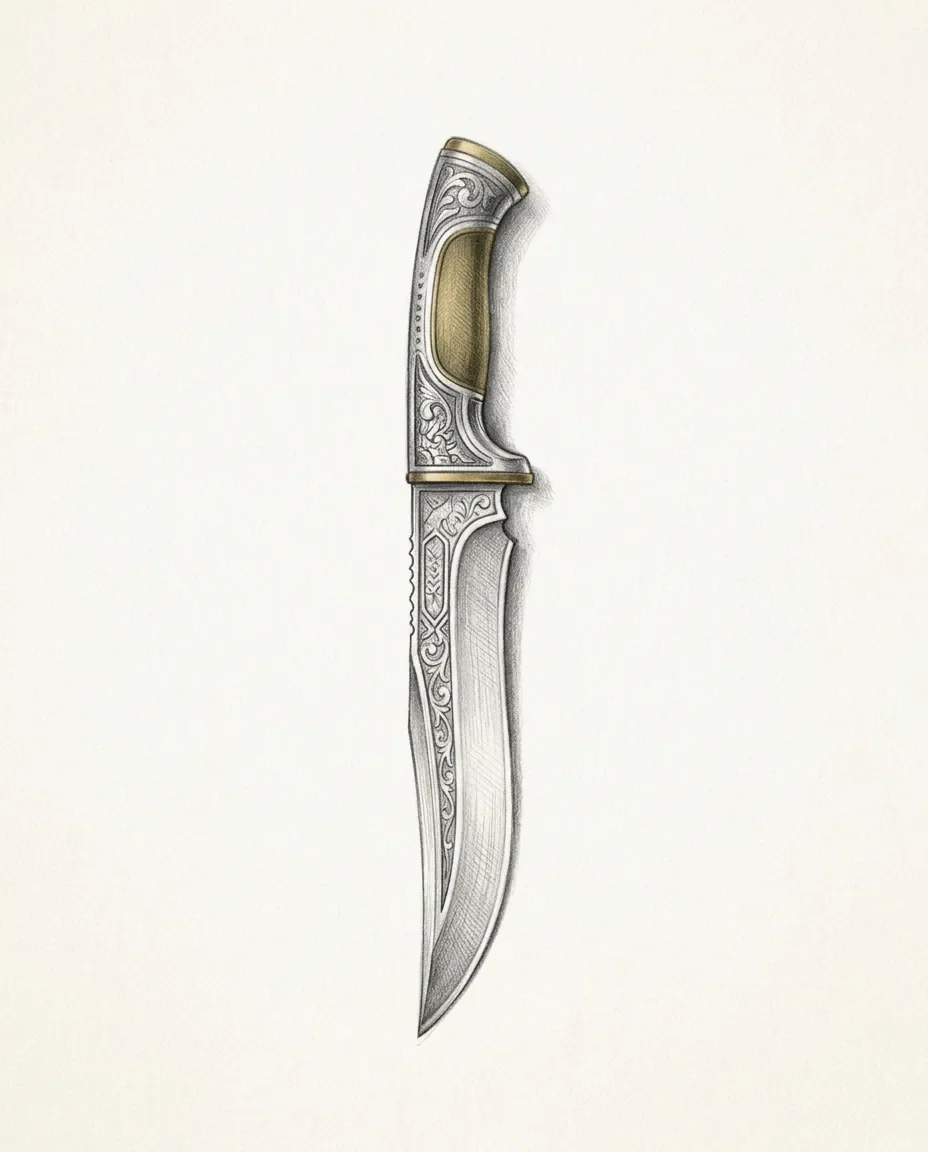
Knife Play
Added 21 Jun 2026 · Updated 22 Aug 2026
A high-risk form of consensual BDSM sensation and fear play using the touch, presence, or threat of a sharp edge such as a knife. The appeal centres on intense sensation, trust, adrenaline and psychological charge within a negotiated frame, not on injury, and it is distinct from blood play.
- Prevalence
- Uncommon
- Category
- Sensation & Pain
- Domain
- Sexual interest
- Confidence
- Low confidence
- Status
- Consensual high-risk BDSM activity, not a clinical paraphilia; classed within community 'edge play'.
- Also known as
- Edge / Knife Play (Consensual), blade play, knifeplay, sharp-sensation play
- Added
- 21 Jun 2026
- Updated
- 22 Aug 2026
Featured in
Overview
Knife play is a high-risk form of consensual BDSM sensation and fear play that uses a sharp implement (usually a knife, sometimes a dagger or blunted blade) to deliver intense tactile sensation and a strong psychological charge. Also called blade play or knifeplay, it belongs to edge play: the branch of kink at the riskiest end of the spectrum, where advanced trust, negotiation and skill matter most. The appeal is anticipation, fear and sensation held inside a negotiated frame, not injury, and the practice is conventionally distinguished from blood play: the draw is the presence and feel of the edge rather than cutting. This article covers how knife play is defined, its history in modern kink culture, the psychology of fear play, the limited prevalence data, and the safety and legal framing responsible practitioners insist on.
Definition & scope
Knife play describes a cluster of consensual acts in which a blade supplies sensation, symbolism and fear within an agreed scene. It is not a diagnosis and not, in itself, self-harm or assault: the defining features are consent, negotiation and the intention to stop short of injury. Most of what practitioners call knife play involves the flat, the spine, or a chilled or dulled edge rather than a cutting stroke, and much of the charge comes from the mere presence of the implement. Where a scene deliberately draws blood it crosses into blood play, a separate and higher-risk practice with its own hygiene concerns. Knife play is therefore best understood as fear and sensation play that happens to use a sharp object, closer in spirit to a controlled scare than to cutting.
Examples
What the term covers. The flat, the spine, or a deliberately dulled edge drawn slowly across the skin; the point traced lightly enough to raise gooseflesh without breaking the surface; a chilled blade used for the shock of cold rather than for sharpness; a knife used to cut away clothing; and, at the least physical end, a blade simply laid in view so that its presence does the work. Plenty of scenes use a blunt prop or a letter-opener throughout, because the anticipation, not the edge, is the point.
What the term does not cover. Deliberately breaking the skin belongs to blood play, a separate and higher-risk practice with its own wound-care and infection problems, and needle play is the sterile, medicalised version of that same boundary. Scratching and abrasion play produce comparable surface sensation with fingernails or coarse texture and none of the cutting risk, and Wartenberg wheel play delivers a similar prickle from a blunt instrument. Knife collecting is a non-sexual enthusiasm for blades as objects of craftsmanship. Knife play is also not self-harm, and it is not assault: a blade used on a person who has not agreed to it is a criminal offence whatever the intention behind it.
How the word is used. "Knife play", "blade play" and "knifeplay" are community vernacular, coined inside BDSM culture rather than in any manual, and practitioners file them under edgeplay, the umbrella for risks that negotiation can reduce but never remove. Neither DSM-5-TR nor ICD-11 names the practice, because consensual sensation play between adults is not a diagnosis; it appears instead in community primers, glossaries and lay kink journalism.
History & origins
Knife play has no documented single coiner; the term arose within modern BDSM subculture as a label for one branch of edge play. Its lineage runs along two threads: the long sexological study of fear, sensation and surrender, and the practical safety culture built by twentieth-century leather and kink communities.
Clinical & sexological lineage
- 1886: Richard von Krafft-Ebing's Psychopathia Sexualis catalogued the entanglement of intense stimulation, dominance and submission in erotic life, framing much of it as pathology in the language of its era.
- 1897 onward: Havelock Ellis's Studies in the Psychology of Sex examined how pain, fear and tenderness interweave, helping to normalise the idea that charged sensation need not be pathological.
- Late 20th–21st century: the DSM and ICD-11 lineages converged on a key distinction: consensual sensation play between adults is not a disorder. A paraphilic diagnosis requires distress, impairment, or non-consent, none of which is intrinsic to negotiated knife play, so it is documented as a community practice rather than a research-heavy clinical category.
Cultural & subcultural evolution
- 1974: the founding of the Society of Janus in San Francisco typified the shift from clandestine, improvised play toward structured practice shared through clubs and underground publications, where edge-play vocabulary took shape.
- 1983: David Stein coined safe, sane and consensual (SSC) in August of that year for New York's Gay Male S/M Activists, a group he had co-founded two years earlier, an ethical minimum distinguishing consensual play from abuse.
- 1999: Gary Switch proposed risk-aware consensual kink (RACK) on The Eulenspiegel Society's mailing list, arguing that nothing is truly risk-free and that practitioners should be treated as competent adults who can understand a danger and still choose it. RACK is the framework most often invoked for edge play like knife play, because it foregrounds informed risk over a promise of safety.
- 2005: The Toybag Guide to Erotic Knifeplay by Miranda Austin and Sam Atwood (Greenery Press) offered one of the first concise published primers, formalising negotiation and handling norms that had previously circulated only orally.
In practice
Knife play is typically expressed by drawing the flat, dull or cool surface of a blade across the skin, tracing the point lightly to raise sensation, using a knife to cut away clothing, or relying on the mere presence of the implement to evoke vulnerability and heightened alertness. Experienced practitioners stress controlled, non-cutting contact and the theatrical and psychological dimension over actual sharpness; some use deliberately dulled or prop blades so the idea of the knife does the work. It overlaps with neighbouring sensation practices such as scratching and pinching and clamping, and with power-charged acts like hair pulling and spanking. This entry is descriptive only and gives no instruction.
Psychology
What drives the appeal?
Fear play is often described as running on adrenaline rather than the endorphin-driven analgesia associated with masochism: the sight or touch of a blade triggers a primal, hyper-alert state that the negotiated frame reinterprets as arousal. The draw is linked to a controlled brush with danger, deep trust and surrender, the focusing intensity of fear held safely, and the symbolism of power exchange. As commentary on fear play notes, the effect mirrors the appeal of a horror film: a bounded outlet in which to feel frightened without real threat. The risk itself, held within limits, is central to the draw rather than incidental. Evidence specific to knife play is thin; it is usually explained through the same associative-learning and arousal-transfer accounts applied to BDSM generally.
Prevalence & culture
How common is knife play?
Reliable figures are scarce, and knife play is a specialised niche even inside kink. The most-cited datapoint comes from Jennifer Eve Rehor's study of women in the kink community (2015), which surveyed 1,580 women about 126 behaviours and found roughly 38% reported interest in knife play: a high figure within an already self-selected sample, not the general population. Broader work such as Lehmiller's Tell Me What You Want (2018) shows pain and sensation fantasies are common, with knife play a small high-risk subset of that interest.
| Source | Year | Population | Finding |
|---|---|---|---|
| Rehor | 2015 | 1,580 kink-community women | ~38% reported interest in knife play (self-selected sample) |
| Lehmiller | 2018 | ~4,175 US adults | pain/sensation fantasies common; knife play a small high-risk subset |
Its wider visibility comes largely from dramatised depictions in film and fiction rather than documentation of real practice; lay references such as Glamour's A–Z of kinks treat it as a recognised but advanced kink.
Safety, consent & law
Between fully informed, sober, consenting adults knife play can be legal, but it is genuinely dangerous: it carries serious risks of cuts, infection and accidental injury, and in many jurisdictions consent does not extend to grievous bodily harm. Responsible framing, consistent with the RACK ethos, stresses extensive negotiation, sobriety, skill, first-aid readiness, clean implements, and clear limits and safewords. The risk is real, which is why the practice sits at the far edge of what the community considers advanced play.
Common questions
Is knife play safe?
No, and responsible practitioners do not claim otherwise. A sharp implement near skin carries real risk of cuts, wound infection and accidental injury, and no amount of skill removes it. That is why the practice is described under the risk-aware consensual kink framing rather than the older "safe, sane and consensual" one: the honest claim is that the danger is understood and accepted, not that it has been engineered away.
Does knife play always involve cutting the skin?
No, and most of it does not. The usual contact is with the flat, the spine, or a dulled or chilled edge, and a great deal of the effect comes from the sight and threat of the blade rather than from any pressure at all. Scenes that deliberately draw blood cross into blood play, which practitioners treat as a different activity with different precautions.
Is knife play legal?
It can be, between informed, sober, consenting adults, but consent is not a blanket defence. In many jurisdictions a person cannot lawfully consent to serious bodily harm, so an injury that goes beyond the trivial can be prosecuted regardless of prior agreement. Carrying certain knives in public is separately restricted in most countries. Using a blade on someone who has not agreed is assault everywhere.
What is the difference between knife play and blood play?
Knife play is fear and sensation play that happens to use a sharp object; the draw is the edge's presence, coolness and threat. Blood play is defined by blood actually being drawn, and its appeal is the blood itself. The distinction matters practically as well as definitionally: once skin is broken, bloodborne-infection risk, sterilisation and wound care enter the picture, none of which apply to non-cutting contact.
Is knife play a paraphilia or a mental disorder?
Neither. Consensual sensation play between adults is not a diagnosis, and knife play is named in no diagnostic manual. Under both DSM-5-TR and ICD-11 an interest becomes clinically relevant only where it causes the person genuine distress or impairment, or involves someone who has not consented. What makes knife play notable is its physical risk, which is a separate question from its psychiatric status.
Is knife play the same as self-harm?
No. Self-harm is solitary, usually secret, and driven by distress; knife play is negotiated between partners, framed as play, and normally stops well short of injury. That said, the two can look similar from outside, and community guidance is consistent that a person using blades to manage distress rather than for play should seek support rather than reframe it as kink.
What is edge play, and why is knife play part of it?
Edgeplay is the community's label for practices whose risk cannot be negotiated away: blades, fire, breath restriction, blood, consensual non-consent. It is defined by where the risk sits rather than by any particular act. Knife play qualifies because the worst outcome is a genuine injury rather than a scene going badly, which is why it is treated as advanced play requiring sobriety, skill and first-aid readiness.
- Scratching46/100Amychesis · Sensation & PainAmychesis is a consensual interest in arousal from scratching or being scratched with the fingernails, producing sharp surface sensation. It sometimes leaves temporary marks. A form of sensation play that links touch with intimacy and marking.46
- Pinching and Clamping45/100Sensation & PainA consensual sensation-play interest in steady, focused pressure applied to the skin or sensitive areas, by the fingers or by implements. Clamps and clothespins are typical. The appeal lies in the slow build of controlled pressure and the vivid rush of sensation when it is released.45
- Spanking78/100Sensation & PainAn interest in giving or receiving consensual, rhythmic blows to fleshy areas of the body, by hand or with implements such as paddles. People do it for erotic sensation, discipline themes, or power exchange between consenting adults.78
- Hair Pulling44/100Trichophilia · Sensation & PainA consensual interest in the sensation and dynamic of pulling, or having one's hair pulled, during intimacy. The appeal blends scalp tension, dominance and surrender, and the guided movement the grip allows.44
- Cock And Ball Torture36/100Sensation & PainA consensual BDSM practice involving controlled pain, pressure, restriction, or intense sensation applied to the male genitals. It is typically practised within a dominance-submission dynamic. A high-intensity activity practised by a small subset of kink communities, defined throughout by negotiated consent.36
- Bastinado / Foot Whipping37/100Sensation & PainConsensual impact play that concentrates strokes on the bare soles of the feet, a foot-centred subset of BDSM sensation play. Because the soles are nerve-dense and lightly padded, it yields intense sensation and carries elevated injury risk, so practitioners keep it firmly risk-aware.37
Plain-English descriptive compound of "knife" (Old English cnif, of Germanic/Norse origin) and "play." There is no Greek- or Latin-derived clinical term; the practice is classed within BDSM sensation and fear play ("edge play") rather than as a named -philia.
sharp sensation · fear play · high-risk play
Prevalence is computed from the entry's cited population estimate. Rows marked ESTare indicative editorial estimates scored against a fixed anchor rubric, not measured quantities. Method & anchors: methodology.
Uncommon · ≈ 1 in 100
- 01List of paraphilias, Wikipediaexistence of knife/edge play as a documented sharp-sensation BDSM practice
- 02Lehmiller (2018), Tell Me What You Want, survey of 4,175 Americanscontext that pain/sensation play fantasies are common, while knife play specifically is a small high-risk subset
- 03An A–Z of Kinks and Fetishes, Glamourlay framing of knife/blade play as a recognized but advanced kink
- 04Knife play, Wikipediadefinition of knife play as consensual BDSM edge play, distinction from blood play, and the Toybag Guide to Erotic Knifeplay (Austin & Atwood, 2005)
- 05Fear play, Wikipediafear play as edge play operating via adrenaline rather than masochistic endorphins, with knife play as an example, and the horror-film analogy
- 06Risk-aware consensual kink, WikipediaGary Switch coined RACK in 1999 on The Eulenspiegel Society list; RACK as the framework most often applied to edge play such as knife play
- 07Safe, Sane, Consensual, LeatherpediaDavid Stein coined SSC in August 1983 for Gay Male S/M Activists as an ethical minimum distinguishing consensual play from abuse
- 08Society of Janus, Wikipedia1974 founding exemplifies the move from clandestine improvised play toward structured BDSM practice and edge-play vocabulary
- 09Rehor (2015), Sensual, Erotic, and Sexual Behaviors of Women from the 'Kink' Community, Archives of Sexual Behavior 44:825survey of 1,580 kink-community women across 126 behaviours; roughly 38% expressed interest in knife play (within a self-selected kink sample)
- 10DSM-5-TR, Paraphilic Disorders (American Psychiatric Association, 2022)consensual sensation play is not a paraphilic disorder absent distress, impairment or non-consent
- 11ICD-11, Paraphilic disorders (World Health Organization)ICD-11 framing that consensual, non-distressing kink between adults is not a disorder
- 12BDSM, Wikipediaplaces knife play within consensual BDSM sensation and edge play
- 13Psychopathia Sexualis, Richard von Krafft-Ebing (1886)1886 cataloguing of intense stimulation, dominance and submission in erotic life, framed as pathology in its era
- 14Studies in the Psychology of Sex, Havelock Ellis, WikipediaEllis's exploration (from 1897) of how pain, fear and tenderness interweave, helping normalise charged sensation
- 15Sadomasochism, Wikipediacontrast of fear-play adrenaline with the endorphin-driven analgesia associated with masochism