Branding And Burning Play
Added 21 Jun 2026 · Updated 22 Aug 2026
An interest in consensual heat and burn sensation, ranging from transient fire play that leaves no mark to deliberate permanent branding or cautery. Such marking sits within power-exchange or body-modification contexts. It is a rare, high-risk practice confined to experienced niche communities.
- Prevalence
- Rare
- Category
- Sensation & Pain
- Domain
- Sexual interest
- Confidence
- Low confidence
- Status
- Rare consensual edge play / body-modification practice; not a disorder when consensual. Distinguished clinically from non-consensual self-injury.
- Also known as
- branding, burn play, fire play, cautery play, consensual branding, heat play
- Added
- 21 Jun 2026
- Updated
- 22 Aug 2026
Featured in
Overview
Branding and burning play covers a spectrum of consensual heat-based activities. At the milder, transient end is fire play, in which brief flame, warmth, or a flammable agent is applied to or passed near the skin for fleeting sensation that leaves no lasting mark. At the extreme, permanent end is branding or cautery: the intentional creation of a fixed scar in a chosen design as body modification or symbolic marking. Across that range it is among the highest-risk practices documented in this directory, and it is confined to small, experienced communities. This article traces its long pre-history as imposed marking, its convergence with modern kink and body-art subcultures, and the distinctive consent and legal questions raised by an act that cannot be undone.
Examples
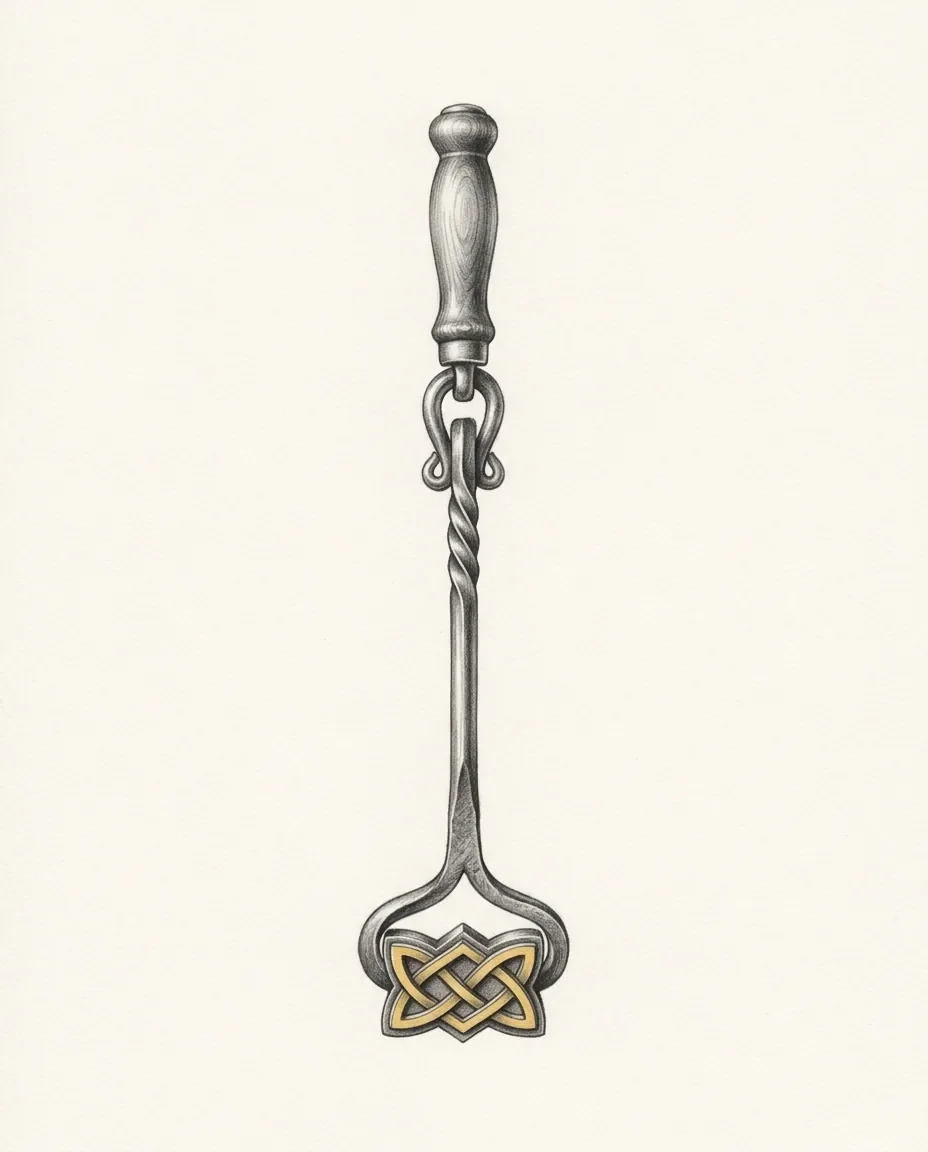
What the term covers. At the transient end, fire play: brief flame or radiant heat passed across or near the skin for a startling flash of warmth that leaves nothing behind, staged for theatre as much as for sensation. At the permanent end, branding proper: strike branding, in which a heated shape is pressed to the skin, and cautery or electrocautery branding, which trace finer and more controlled lines. Permanent work is usually ceremonial (a mark of ownership, of a master/slave commitment, or of a passage) and is increasingly done by experienced body-art practitioners rather than improvised mid-scene.
What the term does not cover. Wax play drips warm candle wax for a brief heat that is not meant to burn, and is far gentler and far more common. Temperature play uses warmth and cold as sensation with no mark at all. Pyrophilia is arousal at fire itself, where the flame rather than the skin is the object: a genuine ambiguity, because both interests answer to the name "fire play". Needle play and knife play are sharp rather than thermal, and are temporary. Body modification is the wider category a permanent brand belongs to, and collaring carries the same ownership meaning in removable form. Burning someone who has not agreed to it is assault, and burning oneself outside any erotic or ceremonial frame is self-injury.
How the word is used. All of it is plain descriptive English and community vernacular; "cautery" is borrowed from surgery. Neither branding nor fire play is a named condition in DSM-5-TR or ICD-11, and neither is treated as a disorder when consensual; the questions this practice raises are questions of physical risk and of law, not of diagnosis.
History & origins
Marking by heat before consent
Deliberate marking of skin by heat is ancient, but for most of recorded history it was imposed, not chosen. Human branding served as a sign of ownership, punishment, and group identity: ancient Romans burned FVG (for fugitivus) into runaway slaves; European and colonial slavers branded enslaved people during the Atlantic slave trade; and judicial branding marked offenders across the early modern period, such as an A for adultery or a T for theft in colonial North America, or a B burned into the Quaker James Nayler for blasphemy in 1655. Most Western states abolished judicial branding in the nineteenth century: Britain abolished most branding by 1829, France ended fleur-de-lis branding in 1832, and Russia in 1863. In parallel, scarification, the permanent patterning of skin by cutting or burning, long featured as a marker of clan, status, and passage to adulthood in indigenous cultures of West Africa, Melanesia, and Australia, and among the ancient Maya. These traditions establish the deep symbolic vocabulary of the permanent mark (belonging, ownership, transformation) that the consensual practice later reclaimed.
Clinical lineage
Within clinical sexology, the eroticization of pain and marking was first catalogued in the late nineteenth century. Richard von Krafft-Ebing's Psychopathia Sexualis (1886) described masochism and the pleasure some derive from inflicted pain, and in 1892 the German psychiatrist Albert von Schrenck-Notzing coined algolagnia (from Greek álgos, "pain," and lagneía, "lust") as an umbrella for the fusion of pain and arousal. Havelock Ellis's Studies in the Psychology of Sex elaborated the theme. None of these authors isolated branding as a discrete interest; it sits, clinically, within consensual masochism and the marking and ownership currents of sadism.
Cultural & subcultural evolution
The contemporary consensual form is far newer and converges from two late-twentieth-century movements. The first is organized BDSM and its "edge play" subcultures, in which branding became read as the most permanent possible expression of dominance and submission and master/slave commitment: a chosen mark of belonging that deliberately echoes, and inverts, branding's coercive history. The second is the modern body-modification revival of the 1980s and 1990s, in which strike branding, cautery branding, and later electrocautery ("laser") branding entered the body-art repertoire alongside tattooing, piercing, and scarification. Voluntary branding also persists in other settings, notably the initiation traditions of some historically African-American fraternities. The precise origin of consensual branding as a distinct kink is not well documented; it is best understood as a convergence of these traditions rather than a single coinage.
In practice
Expression is shaped by context and intent. Transient fire play emphasizes warmth, theatricality, and the thrill of flame near the body for sensation that leaves no mark. Permanent branding is usually approached as a deliberate, ceremonial act (of ownership, commitment, or rite of passage) within a long-term power-exchange relationship or a body-modification subculture, and is increasingly performed by experienced body-art practitioners rather than improvised. Technique matters to outcome: strike branding (a heated shape pressed to the skin) is imprecise and tends to spread on healing, while cautery and electrocautery branding trace finer, more controlled lines. Both fire play and branding are typically slow, carefully staged, and treated with gravity.
Psychology
The appeal draws on intense sensation, trust, endurance, and the lasting meaning attached to a permanent mark. The act demands extreme trust in the person wielding heat, which can itself deepen a power-exchange bond, and the irreversibility of a brand heightens its symbolic weight for those who seek it: a body that carries the mark permanently records the relationship or the passage. It overlaps with consensual masochism, with the marking and ownership themes of primal play, and with broader body-modification interests. There is essentially no dedicated empirical research isolating this interest, so accounts of motivation remain largely qualitative; reactions to heat and to permanence vary greatly between individuals.
Prevalence & culture
No survey has measured branding or fire play in isolation, so figures are rough low-end estimates anchored to its rarity. The broad container is, by contrast, near-universal: Lehmiller's Tell Me What You Want (2018) survey of 4,175 Americans found BDSM fantasy almost ubiquitous, with about 65% reporting fantasies of receiving pain: but the extreme edge of that umbrella, including permanent marking, is vanishingly rare by comparison. Community-size proxies such as FetLife groups show branding and fire-play interest is small relative to general BDSM, and the topic surfaces mainly through body-modification journalism rather than research.
Safety, consent & law
Is branding play safe?
No: it is among the highest-risk activities in this domain, and it carries irreversible consequences even when everything goes to plan. Burns carry serious dangers of infection, nerve damage, disfigurement, and permanent, irreversible scarring; "solar branding" using a magnifying lens has produced documented full-thickness burns requiring surgical care. Permanent marking also raises distinct consent considerations, because a mark made under impaired judgment or fleeting feeling cannot be withdrawn. Responsible practice depends on advanced skill, sterile technique, sober and fully informed consent, and medical-grade aftercare.
Legality is genuinely unsettled. In English law, consent is generally not a defence to actual or grievous bodily harm: R v Brown (1993) held that consensual sadomasochistic injury, including branding, was unlawful absent a recognised "good reason." Yet R v Wilson (1996) quashed the conviction of a man who branded his initials onto his wife's skin at her request, the Court of Appeal treating it as akin to consensual tattooing rather than the infliction of harm for its own sake. The 2018 Court of Appeal decision in R v BM (the body-modification artist Brendan McCarthy, "Dr Evil") then held that consent could not justify extreme body modification such as tongue-splitting or flesh removal, rejecting the tattooing analogy for those procedures. The practical line therefore varies by jurisdiction and by how a court characterises the act. It is a benign interest only as carefully managed consensual adult activity; reckless or non-consensual burning is a serious assault.
Common questions
Is consensual branding legal?
It depends on the jurisdiction and on how a court characterises the act. In England and Wales, R v Brown (1993) held that consent is generally no defence to actual or grievous bodily harm, while R v Wilson (1996) quashed the conviction of a man who branded his initials onto his wife at her request, treating it as akin to tattooing. R v BM (2018) then refused that analogy for extreme body modification. The line is genuinely unsettled.
What is the difference between fire play and branding?
Intent and permanence. Fire play uses brief flame or heat for a sensation that leaves no lasting mark; branding deliberately creates a fixed scar in a chosen design. The two are discussed together because both involve heat and both demand serious skill, but only one is irreversible. Confusingly, "fire play" is also used for pyrophilia, arousal at fire itself, where the flame rather than the skin is the focus.
Does a brand last forever, and can it be removed?
A brand is a scar, and scars are permanent by design; that permanence is the point for most people who choose one. It does not fade the way a temporary mark does, and there is no simple reversal: scar tissue can be revised or covered by later work, but it cannot be returned to unmarked skin. That is why permanence is treated as a consent question in its own right, since a decision made in a charged moment cannot be withdrawn later.
How is a brand different from a tattoo?
A tattoo deposits pigment beneath the skin and holds its line. A brand is a controlled burn that heals into scar tissue, so the design changes as it heals: strike branding, where a heated shape is pressed to the skin, is the least precise and tends to spread, while cautery and electrocautery branding trace finer lines with more control. English courts have at times treated consensual branding as analogous to tattooing, but the two are not equivalent procedures.
Why would someone want to be branded?
The appeal has more to do with meaning than with sensation. A brand records something permanently on the body: belonging to a partner, the seriousness of a master/slave or dominance-and-submission commitment, or a passage survived. Placing that much trust in the person holding the heat is itself part of the exchange. The practice also inverts branding's history as a mark imposed on people without their consent, turning an emblem of ownership into one that is chosen.
How common is branding or fire play?
Very rare, even by the standards of BDSM. No survey measures either practice on its own, so the estimate here rests on community-size proxies, which show branding and fire-play groups are small relative to general BDSM interest. For contrast, Lehmiller's 2018 survey of 4,175 Americans found around 65% had fantasised about receiving pain: the umbrella is near-universal, its permanent-marking edge is not.
- Dominance and Submission92/100Power, Roles & ScenariosA consensual erotic dynamic in which one partner takes a dominant role and the other a submissive role, exchanging power within agreed limits. It is one of the most widespread elements of BDSM and of human sexual fantasy.92
- Master/Slave Dynamic58/100Power, Roles & ScenariosAn intensive, often ongoing form of consensual power exchange in which one adult (master or mistress) holds broad authority over another (slave). The arrangement runs inside a negotiated, ownership-styled framework. A structured, high-commitment expression of dominance and submission.58
- Primal Play33/100Identity & TransformationA consensual style of intimacy in which partners drop social restraint and act from an instinctual, animalistic headspace. It most often takes the form of predator-and-prey dynamics. In its feral register it overlaps with therian identity and inner-animal embodiment rather than scripted scenes.33
- Algophilia (Arousal from Pain)21/100Algophilia · Sensation & PainAn archaic sexological label for sexual arousal or pleasure derived from pain. A near-synonym of algolagnia that overlaps heavily with sexual masochism, the term clinicians use today.21
- Stress Position Play22/100Sensation & PainA consensual BDSM practice in which one partner holds a physically demanding posture to test endurance and obedience. It uses fatigue and gravity rather than restraints. The same term also names a coercive interrogation technique, a distinct and non-consensual meaning this entry separates clearly.22
- Urtication20/100Urtication · Sensation & PainUrtication is the deliberate stinging of skin with nettles, producing a hot, prickling rash. It began as a folk-medicine counter-irritant for arthritis and paralysis and survives today as a form of sensation and pain play.20
"Branding" derives from Old English *brand*, "a burning, a firebrand," reflecting marking by hot metal; "burning" and "fire play" are plain descriptive English; "cautery" comes from Greek *kautḗrion*, "branding iron," from *kaíein*, "to burn."
heat sensation · permanent marking · high-risk play
Prevalence is computed from the entry's cited population estimate. Rows marked ESTare indicative editorial estimates scored against a fixed anchor rubric, not measured quantities. Method & anchors: methodology.
Rare · ≈ 1 in 1,000
- 01List of paraphilias, Wikipediaexistence of consensual branding/burning as a sensation-play practice
- 02Lehmiller (2018), Tell Me What You Want, survey of 4,175 Americansplaces branding within the broad BDSM/pain-play umbrella whose extreme edge practices are far rarer than masochism overall
- 03FetLife, kink community group sizes (community-size proxy)community-size proxy showing branding/fire-play groups are small relative to general BDSM
- 04Richard von Krafft-Ebing, Psychopathia Sexualis (1886)early clinical documentation of masochism and the eroticization of pain that frames consensual pain/marking play
- 05Human branding, Wikipediahistory of branding as imposed ownership, punishment and group marking; abolition dates; modern voluntary branding including BDSM, body art and fraternity initiation; strike vs cautery vs electrocautery technique
- 06Scarification, Wikipediascarification by cutting or burning as permanent marking of clan, status and rite of passage in West African, Melanesian, Australian and Maya cultures
- 07Algolagnia, WikipediaAlbert von Schrenck-Notzing's 1892 coinage of 'algolagnia' for the fusion of pain and arousal; Greek roots algos (pain) + lagneia (lust)
- 08Studies in the Psychology of Sex (Havelock Ellis), WikipediaHavelock Ellis's early-twentieth-century elaboration of algolagnia / pleasure linked to pain
- 09James Nayler, Wikipedia1655 judicial branding of the Quaker James Nayler with 'B' for blasphemy, as an instance of imposed punitive branding
- 10R v Brown, WikipediaHouse of Lords ruling (1993) that consent is not a defence to actual/grievous bodily harm in consensual sadomasochism, including branding
- 11R v Wilson (1996), LawTeacherCourt of Appeal quashed conviction for consensual branding of a spouse, treating it as akin to consensual tattooing rather than harm for its own sake
- 12Tongue splitting, ear removal and branding, the limits of consent (R v BM / 'Dr Evil', 2018), Kingsley Napley2018 Court of Appeal holding that consent cannot justify extreme body modification, rejecting the tattooing analogy for those procedures
- 13Complication of solar branding: report of a case (NCBI/PMC)documented full-thickness burn injury from solar branding illustrating the serious physical risk of heat-based marking