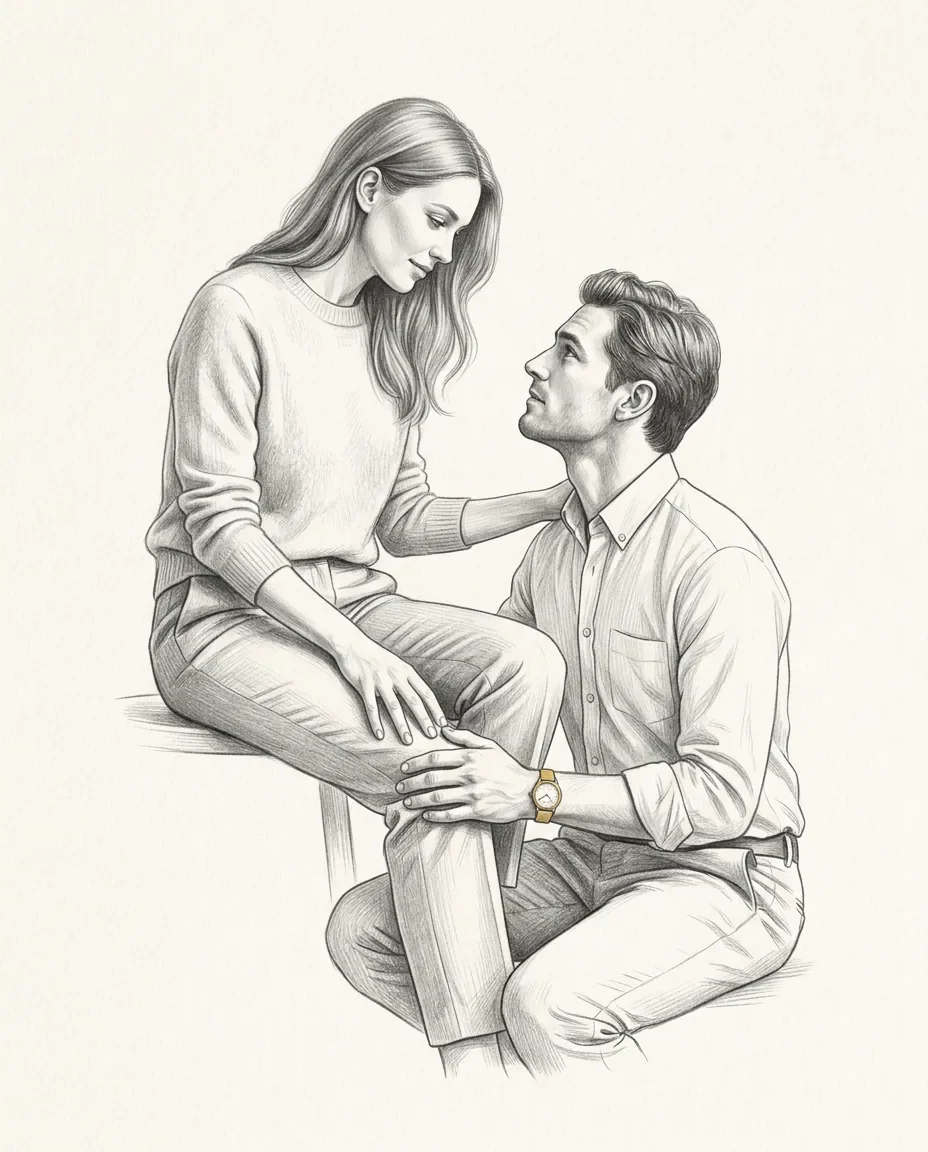
Clothed Sex (CFNM / CMNF)
Added 28 Jun 2026 · Updated 22 Aug 2026
Arousal from staying partly or fully clothed during sex, especially the power contrast when one partner is dressed and the other is nude. The two best-known framings are CFNM (clothed female, nude male) and CMNF (clothed male, nude female).
- Prevalence
- Common
- Category
- Power, Roles & Scenarios
- Domain
- Sexual interest
- Confidence
- Low confidence
- Status
- Normal sexual variant; not a paraphilia or disorder.
- Also known as
- CFNM, CMNF, clothed female nude male, clothed male nude female, clothed sex, fully clothed sex, clothing-contrast play, one-clothed-one-nude
- Added
- 28 Jun 2026
- Updated
- 22 Aug 2026
Overview
Clothed sex is sexual activity in which one or both partners stay partly or fully dressed, with the charge coming less from the clothing itself than from the contrast it creates. The most recognised versions are abbreviated CFNM (clothed female, nude male) and CMNF (clothed male, nude female), where one person stays dressed while the other is exposed. The interest is a normal variant of consensual adult sexuality, not a paraphilia or disorder.
Definition & scope
The defining feature is asymmetry of dress, not any particular garment. That distinguishes clothed sex from a uniform fetish or a lingerie fetish, where a specific outfit or fabric is the focus, and from naturism, which centres on nudity itself and is often non-sexual. In clothed-sex play the dressed-versus-nude gap is the point: swap either partner into the other state and the appeal changes.
Examples
What the term covers. The two named configurations, CFNM and CMNF, in which one partner stays fully dressed while the other is undressed; the softer everyday version in which clothes simply stay on, a skirt pushed aside, a shirt left buttoned, shoes or stockings kept, because undressing would break the mood; and staged scenes built around the gap, with the dressed partner composed and directing while the undressed one is exposed. Same-sex and mixed configurations work the same way; only the acronyms are gendered.
What the term does not cover. Endytophilia is the adjacent paraphilia in which arousal depends on a partner staying clothed, a requirement rather than a preference. Ecdysiophilia attaches to the act of undressing rather than to a state of dress. Where a particular garment is the target, the interest belongs to that garment instead, whether a uniform, lingerie, stockings or latex. Naturism centres on nudity rather than on the contrast with it, and femdom names who holds authority, which a CFNM scene often accompanies but does not require.
How the word is used. CFNM and CMNF are initialisms rather than clinical terms: coined online, hardened into adult-media category tags, and read letter by letter rather than spoken as words. CFNM is much the more widely used of the two, and "clothed sex" is the plain descriptive phrase covering the same territory. None of these terms appears in DSM-5-TR or ICD-11, being community and industry vocabulary that never passed through a clinic.
History & origins
The practice has no clinical lineage; its history is that of its acronyms, which are products of the early consumer internet.
- Early 1990s: the term clothed female, nude male is generally credited to Brad Thompson, who ran a site oriented to women's appreciation of the male form and used the phrase to describe its discussion-board conversations, as recounted in Grazia. Early participants half-jokingly framed it as a feminist inversion of the usual gaze.
- 2000s onward: CFNM and its mirror CMNF hardened into standard adult-media tags and community shorthand, spreading through forums, tube-site categories, and kink glossaries.
Because the terms were born online rather than in the clinic, they carry no diagnostic history and appear in popular kink taxonomies rather than the psychiatric literature.
In practice
The appeal turns on the contrast: the clothed partner reads as composed, in control, or simply ordinary, while the nude partner is vulnerable and on display. Couples stage it many ways, from keeping everyday clothes on during otherwise conventional sex to scenes built around a fully dressed partner directing a fully undressed one. It overlaps with dominance-and-submission play when the dressed person takes the controlling role, but plenty of people enjoy it for the visual and tactile contrast alone, with no power exchange intended.
Psychology
Several threads are usually offered for the appeal: the heightened sense of exposure and vulnerability on the nude side, the implied status or authority on the clothed side, and a voyeurism-and-exhibitionism dynamic in which one partner watches and the other is watched. Fantasies of watching and of being observed are among the more common in the general population: Joyal, Cossette & Lapierre (2015) found voyeuristic and exposure themes reported far more widely than their clinical labels suggest. Partial clothing both conceals and frames the body, which can sharpen ordinary anticipation. None of this requires distress or compulsion, which is why the interest sits among common, non-clinical variants rather than in the diagnostic manuals.
Prevalence & culture
How common is it?
Formal research on clothed sex specifically is thin, so prevalence rests on community and search signals rather than survey data. The acronyms circulate widely in online communities, adult-media tagging, and kink glossaries, which keeps the terms visible: CFNM in particular has had a long run as a named adult-media genre, and it appears in mainstream round-ups such as Glamour's A–Z of kinks. Coverage tends to fold clothed sex into broader lists of bedroom interests rather than treating it as a standalone topic.
Safety, consent & law
Clothed sex between consenting adults in private carries no special physical risk and no legal concern beyond those that apply to any sexual activity. As with any role-tinged play, partners benefit from agreeing in advance on what the dressed-and-nude framing does and does not signal, since the same scene can read as playful contrast to one person and as status or humiliation play to another.
Common questions
Is CFNM the same as femdom?
No, though the two overlap often enough to be confused. CFNM describes a state of dress: one partner clothed, the other not. Femdom describes who holds authority. A CFNM scene can be a straightforward power exchange with the dressed woman in charge, or it can be nothing of the kind, since plenty of people enjoy the visual contrast with no dominance or submission intended at all.
Why is it arousing when only one person is naked?
The asymmetry does the work. Being the only one undressed sharpens the sense of exposure and of being looked at, while staying dressed as a partner is not confers an unearned composure that reads as status or control. It is a watching-and-being-watched dynamic that needs neither partner to leave the room, and interest in both halves of it is far more widespread than the clinical labels for watching and exposure would suggest.
Is clothed sex a fetish?
Not in the clinical sense, and usually not in the loose one either. A fetish has a specific target, a garment, a fabric, a body part, whereas here the target is the relationship between two states of dress, which is why swapping who is clothed changes the appeal entirely. If a particular outfit is what actually matters, the interest is really a uniform or lingerie one wearing this label.
Does one partner have to be fully dressed and the other fully naked?
No. The acronyms describe the clean version, but most of what happens in practice is partial: clothes pushed aside rather than removed, a shirt left on, shoes or stockings kept. What matters is that a gap exists between how dressed the two people are, and how wide that gap is, is a matter of taste. Both partners staying clothed also falls under the broader phrase clothed sex.
Is it always a woman clothed and a man naked?
No. CFNM names that configuration and CMNF names the mirror image, and only the acronyms are gendered: the underlying interest is in the asymmetry, which works the same way in same-sex pairings and in any combination of partners. CFNM is simply the better-known term, having been coined first and used as an adult-media category for longer, which is why it dominates the vocabulary.
How do you bring it up with a partner?
Directly, and by naming what the framing means to you, because the same scene reads very differently to different people: playful contrast to one, status and control to another, humiliation to a third. It costs nothing to try, since no equipment, venue or new act is involved, only a decision about who undresses. Agreeing in advance which of those readings is intended prevents most of the ways it goes wrong.
- Uniform Fetish60/100Uniform Fetishism · Clothing & GarmentsAn erotic interest in uniforms and the authority, role, or status they signal: military, police, medical, school, or service dress. A common clothing-and-role fetish rather than a clinical disorder.60
- Lingerie Fetish70/100Clothing & GarmentsAn erotic interest in lingerie and intimate apparel in which the garments themselves, their fabrics, and their styling become a focus of arousal. Bras, briefs, stockings, corsets and slips are typical. One of the most common and mainstream garment-related interests.70
- Naturism Fetish48/100Gymnophilia · Settings & SituationsAn erotic interest in being nude, or in nude social settings such as clothing-optional or naturist environments. Arousal comes from consensual openness and exposure. Distinct from the non-consensual paraphilia of exhibitionistic disorder.48
- Exhibitionism72/100Acts & ActivitiesArousal from being seen, watched, or displaying oneself to willing audiences within agreed limits. As a consensual interest it is a common, non-pathological variation of erotic expression, distinct from the clinical disorder that involves exposure to non-consenting observers.72
- Service Submission45/100Power, Roles & ScenariosA submissive style in which fulfillment comes chiefly from attending to a dominant partner's needs through tasks, anticipation, and acts of care. The power exchange is expressed through helpful service and devotion rather than through pain, discipline, or humiliation.45
- Captor/Captive Roleplay44/100Power, Roles & ScenariosA consensual BDSM dynamic in which one partner plays a captor holding and controlling the other, a resisting captive. It is built on sustained confinement rather than a single abduction plot. The “capture” is entirely staged fantasy, negotiated in advance between consenting adults.44
Not a clinical coinage. CFNM and CMNF are descriptive initialisms of "clothed female, nude male" and "clothed male, nude female," credited to internet fetish communities of the early 1990s rather than to sexology.
clothing-contrast · cfnm · cmnf · exposure-and-vulnerability · voyeurism-exhibitionism
Prevalence is computed from the entry's cited population estimate. Rows marked ESTare indicative editorial estimates scored against a fixed anchor rubric, not measured quantities. Method & anchors: methodology.
Common · ≈ 1 in 20
- 01An A–Z of Kinks and Fetishes, GlamourPopular reference situating clothing-contrast and dressed-versus-nude interests within the mainstream A–Z of recognised bedroom practices.
- 02FetLife, kink community group sizes (community-size proxy)Community-size proxy for the visibility of CFNM and CMNF as named interests, with active groups and fetish tags around clothed-versus-nude play.
- 03Is the Clothed Female Naked Male fetish feminist?, GraziaRecounts the early-1990s coinage of the CFNM phrase in an online community oriented to women's appreciation of the male form, and its framing as an inversion of the usual gaze.
- 04CFNM, WiktionaryConfirms CFNM as the initialism for clothed female, nude/naked male and its use as a named fetish and adult-media category.
- 05Joyal, Cossette & Lapierre (2015), "What Exactly Is an Unusual Sexual Fantasy?", PubMedPopulation-based evidence that voyeuristic and being-watched sexual fantasies are common, supporting the voyeurism-and-exhibitionism reading of clothed-versus-nude play.