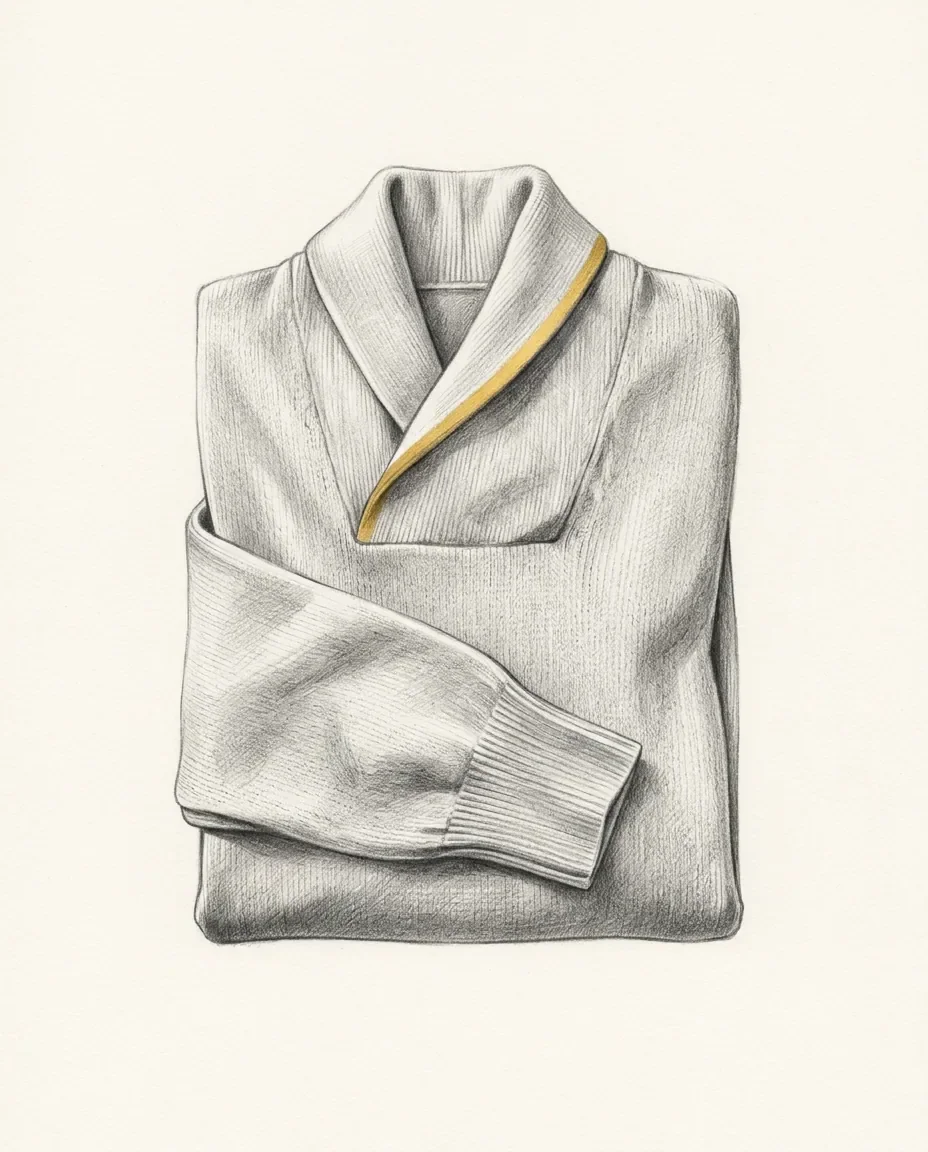
Endytophilia
Endytophilia
Added 26 Jul 2026 · Updated 22 Aug 2026
A documented but essentially unstudied paraphilia in which sexual arousal depends on a partner staying clothed, or partly clothed, during sex, rather than nude. It is the reverse of the assumption behind most clothing-related fetishes, where the goal is exposure.
- Prevalence
- Uncommon
- Category
- Clothing & Garments
- Clinical term
- Endytophilia
- Domain
- Sexual interest · Paraphilia
- Confidence
- Low confidence
- Status
- Not classified in the DSM-5-TR or ICD-11 and has no peer-reviewed research; documented only in popular sexology glossaries and blogs, which uniformly describe it as benign and harmless.
- Also known as
- endytophile, clothed-partner fetish
- Added
- 26 Jul 2026
- Updated
- 22 Aug 2026
Overview
Endytophilia names a sexual interest in which arousal depends on a partner remaining clothed, or at least partly dressed, during sexual activity, rather than on undressing them. Most discussion of clothing and sex assumes the opposite direction: that clothing is a barrier to be removed, or that a specific garment (lingerie, a uniform) is itself the object of desire. Endytophilia inverts that assumption: for the person who experiences it, the partner staying dressed is the condition for arousal, not an obstacle to it. It is one of a cluster of terms collected in popular sexology writing under the heading of paraphilias that have never received dedicated academic study, and this article is transparent about that limit throughout.
Definition & scope
The defining feature is the state of the partner's dress during sex itself, not the appeal of any particular item of clothing. That distinguishes endytophilia from clothing fetishism, where a specific garment, fabric, or style (stockings, latex, a uniform) is the fixed erotic object regardless of whether a partner is present at all. It also differs from the visual-contrast play catalogued as CFNM and CMNF, where the charge comes from the asymmetry of one partner dressed and the other nude; endytophilia can involve both partners staying clothed, and the reported appeal centres on concealment itself rather than on a status contrast between two people in different states of dress.
Examples
What the term covers. As the sources that carry it describe it: keeping some or all clothing on during sex rather than undressing; asking a partner to stay dressed even while undressing oneself; finding a clothed or half-clothed body more arousing than a nude one; and experiencing full nudity as neutral rather than exciting. The state of dress is the whole of the definition, which is why no particular garment recurs across the accounts.
What the term does not cover. Garment-specific interests are a different thing. Lingerie, uniforms, latex and stockings each name an object of desire that holds whether or not a partner is present, and they are instances of fetishism in the clinical sense; endytophilia attaches to no item in particular. Clothed sex in its CFNM and CMNF framings turns on the contrast between one dressed and one nude partner, whereas here both may stay dressed and the reported appeal is concealment rather than asymmetry. Naturism is the opposite pole, arousal in nudity and openness. And ordinary modesty is not this: reluctance to be seen naked, whether from shyness, body image or habit, is an absence of comfort rather than a source of arousal, and the two are routinely conflated.
How the word is used. It is glossary vocabulary. Endytophilia is written far more often than it is spoken, circulating through kink dictionaries and list articles, and the -philia ending lends it a clinical air it has not earned. People who hold the preference describe it in plain words, that they like it better when a partner keeps something on, and the label is more useful for finding the topic than for naming an identity.
History & origins
A term with no formal coinage
Unlike many of the Greek-suffixed terms in this catalogue, endytophilia has no traceable coiner, no entry in the standard psychiatric nomenclature, and no citation in Wikipedia's list of paraphilias. Its clearest documented appearance is in a 20 February 2013 blog post by Dr. Mark Griffiths, Distinguished Professor of Behavioural Addiction at Nottingham Trent University, titled "From the University of Perversity: An A to Z of Non-Researched Sexual Paraphilias." Griffiths compiled 26 terms, one per letter, that circulate in popular and online glossaries but that he found had "absolutely no empirical or clinical research" behind them. His entry for endytophilia states plainly that it describes people who "derive sexual arousal only from partners who are clothed during sexual intercourse," and adds that the only notable things he turned up online were a piece of wordplay (the term contains all the letters of "depilation") and an unverified claim, from a lifestyle article, that Elvis Presley was history's most famous endytophile.
Terminology
The word follows the standard -philia pattern (Greek philia, "love, attraction") built onto a root describing the object of interest. Here that root traces to the Ancient Greek verb ἐνδύω (endyō), "to put on, to invest with clothing," formed from en- ("in") and dynō ("to sink into, to enter"), a compound recorded in classical lexicons such as Strong's Greek dictionary. The resulting sense, "attraction to the clothed," matches the definition Griffiths and later glossary sites give. Popular kink dictionaries such as Kinkly repeat the same definition, describing endytophiles as people who "may prefer to have sex with clothed or partially-clothed people" and noting that "scientific research on this topic remains limited," and that the interest is "considered harmless."
Why it stayed undocumented
The term's history is really the history of its absence from research. It sits in a class of internet-era sexological trivia: definitions that spread through glossary sites and listicles without ever generating a clinical case series, a survey item, or a diagnostic entry. That pattern is common for narrowly specific paraphilia labels once academic attention moved, over the twentieth century, toward broader categories like fetishism and partialism rather than cataloguing every possible object of desire individually.
In practice
Where the preference is reported, it is described as a simple, low-key one: a partner who prefers their lover to keep some or all clothing on during sex, sometimes because the sight of a dressed body is itself the more arousing state, sometimes because full nudity is experienced as neutral or unremarkable rather than exciting. It overlaps loosely with the broader appeal of a partially concealed body found in uniform and naturism-adjacent interests, though those centre on specific garments or on nudity itself rather than on the general state of "staying dressed."
Psychology
No dedicated psychological model exists. Popular sources speculate about novelty, modesty, or the way clothing can heighten anticipation by withholding full visual access, echoing broader theories of arousal built on partial concealment rather than exposure. None of this rests on a study designed around endytophilia itself; it is inference from adjacent, better-studied territory such as general sexual fetishism research.
Prevalence & culture
There is no survey data measuring how many people experience this preference. Its visibility rests entirely on a handful of glossary entries, a professor's blog post explicitly framing it as unresearched, and repetition across kink-dictionary sites rather than on search-trend or community-size data comparable to better-documented interests in this directory. It is reasonable to assume the underlying behaviour, some preference for a partly dressed partner, is not rare in the population at large, since partial dress during sex is common; what is unusual is treating it as an exclusive requirement, which is precisely the part no research has measured.
Safety, consent & law
The interest is not classified as a disorder in either the DSM-5-TR or the ICD-11, neither of which lists it at all, and every popular source describing it treats it as harmless. Between consenting adults it raises no legal or safety concerns beyond the ordinary expectation of open communication about what each partner wants to wear or remove.
Common questions
Is it normal to prefer having sex with clothes on?
Yes. Partly dressed sex is common and preferring it is unremarkable. What this term picks out is narrower and much rarer: arousal that depends on a partner staying clothed, so that undressing them reduces it rather than building it. No survey has measured how many people sit at that end of the range, which is why the estimate on this page is a low-confidence inference rather than data.
What is the difference between endytophilia and CFNM?
CFNM and CMNF are contrast play: the charge comes from one partner being dressed while the other is nude, and the asymmetry is the point. Endytophilia imposes no such requirement, since both partners may stay clothed, and the appeal is described as concealment itself. The two overlap in practice, but only one of them needs a second person in a different state of dress.
Is endytophilia a real paraphilia?
It is a real term with no research behind it. Its clearest source is a 2013 post by Mark Griffiths, Distinguished Professor of Behavioural Addiction at Nottingham Trent University, who collected twenty-six such labels precisely because he could find no empirical or clinical study of any of them. Neither DSM-5-TR nor ICD-11 lists it, so calling it a paraphilia describes the vocabulary rather than a diagnosis.
Was Elvis Presley an endytophile?
There is no evidence for it. The claim comes from a lifestyle article and is repeated in Griffiths's write-up as one of only two things he could find online about the word, alongside a piece of wordplay. He presents it as unverified trivia rather than biography. It survives because it is the one memorable fact attached to an otherwise undocumented term.
Why would a clothed body be more arousing than a naked one?
Nobody has studied it, so every answer is inference. The explanations popular sources reach for are novelty, modesty, and the way partial concealment sustains anticipation by withholding full visual access, the same logic that makes suggestion more charged than display elsewhere. All of it is borrowed from better-researched territory in fetishism; none of it has been tested on this preference itself.
Is endytophilia harmful?
No. Every source that describes it calls it harmless, and between consenting adults a preference about what stays on carries no legal or safety implication at all. The one thing worth attending to is the conversation: a partner who wants to undress and one who wants clothes kept on will each read the other's preference as rejection unless it is said out loud.
- Clothed Sex (CFNM / CMNF)45/100Power, Roles & ScenariosArousal from staying partly or fully clothed during sex, especially the power contrast when one partner is dressed and the other is nude. The two best-known framings are CFNM (clothed female, nude male) and CMNF (clothed male, nude female).45
- Uniform Fetish60/100Uniform Fetishism · Clothing & GarmentsAn erotic interest in uniforms and the authority, role, or status they signal: military, police, medical, school, or service dress. A common clothing-and-role fetish rather than a clinical disorder.60
- Lingerie Fetish70/100Clothing & GarmentsAn erotic interest in lingerie and intimate apparel in which the garments themselves, their fabrics, and their styling become a focus of arousal. Bras, briefs, stockings, corsets and slips are typical. One of the most common and mainstream garment-related interests.70
- Naturism Fetish48/100Gymnophilia · Settings & SituationsAn erotic interest in being nude, or in nude social settings such as clothing-optional or naturist environments. Arousal comes from consensual openness and exposure. Distinct from the non-consensual paraphilia of exhibitionistic disorder.48
- Fetishism64/100Fetishistic Disorder · Clinical ParaphiliasA DSM-5-TR paraphilic disorder defined by recurrent, intense arousal from nonliving objects or a strong focus on non-genital body parts. The body-part form is partialism, and the arousal must cause clinically significant distress or impairment. An object or body-part preference without distress is not a disorder.64
- Apron Fetish20/100Apron Fetishism · Clothing & GarmentsAn erotic interest centered on aprons, including kitchen, household, and glossy PVC styles, valued for their domestic symbolism, texture, and coverage. It is a niche clothing fetish, not a clinical disorder.20
From Ancient Greek ἐνδύω (endyō), "to put on, to invest with clothing" (from en-, "in," + dynō, "to sink into, enter"), plus the standard combining suffix -philia (φιλία, "love, attraction"): literally, attraction to the clothed state.
clothed sex · partner clothing · concealment
Prevalence is computed from the entry's cited population estimate. Rows marked ESTare indicative editorial estimates scored against a fixed anchor rubric, not measured quantities. Method & anchors: methodology.
Uncommon · ≈ 1 in 100
- 01From the University of Perversity: An A to Z of Non-Researched Sexual Paraphilias, Dr. Mark GriffithsPrimary documented source for the term: definition, framing as unresearched, date (20 Feb 2013), and the Elvis Presley anecdote; author is Distinguished Professor of Behavioural Addiction, Nottingham Trent University.
- 02Endytophilia, KinklyPopular-glossary definition confirming the meaning (preference for clothed or partly clothed partners), and its framing as common, harmless, and scientifically unstudied.
- 03Strong's G1746, ἐνδύω (endyō), Blue Letter BibleEtymology of the Greek root endyō, 'to put on, invest with clothing,' underlying the term's coinage.
- 04Clothing fetish, WikipediaDefinition of garment-specific clothing fetishism, used to distinguish it from endytophilia's focus on the partner's state of dress rather than a specific item.
- 05Sexual fetishism, Wikipedia (carries the Scorolli 2007 relative-frequency table)General context on sexual fetishism as the broader clinical category endytophilia is popularly grouped under.
- 06List of paraphilias, WikipediaConfirms endytophilia is absent from the standard reference list of named paraphilias, supporting its framing as undocumented in formal nosology.
- 07DSM-5-TR, Paraphilic Disorders (American Psychiatric Association, 2022)Confirms the term and concept are absent from current clinical diagnostic criteria.
- 08ICD-11, Paraphilic disorders (World Health Organization)Confirms the term and concept are absent from the WHO's current classification of disorders.