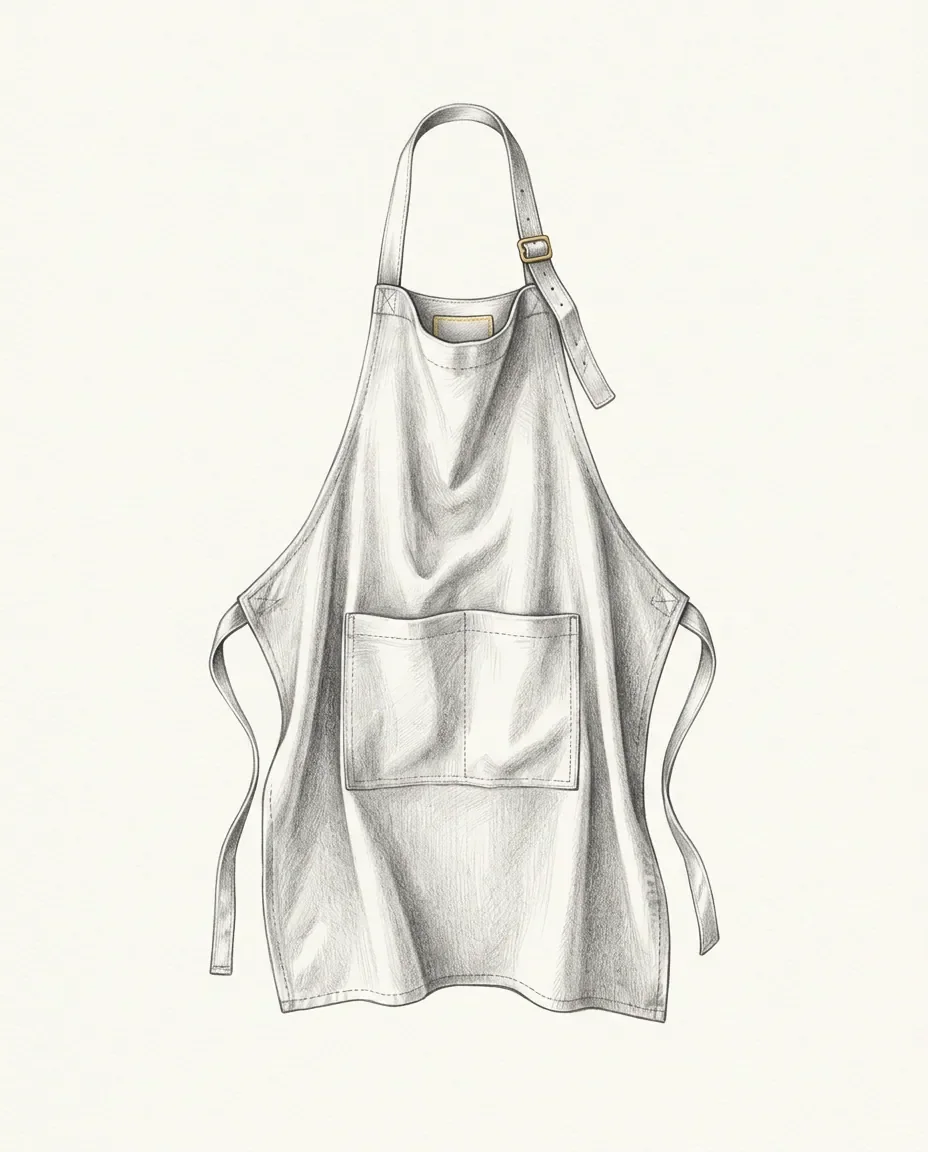
Apron Fetish
Apron Fetishism
Added 21 Jun 2026 · Updated 22 Aug 2026
An erotic interest centered on aprons, including kitchen, household, and glossy PVC styles, valued for their domestic symbolism, texture, and coverage. It is a niche clothing fetish, not a clinical disorder.
- Prevalence
- Rare
- Category
- Clothing & Garments
- Clinical term
- Apron Fetishism
- Domain
- Sexual interest
- Confidence
- Low confidence
- Status
- Obscure clothing fetish; a normal variation, not a disorder unless it causes distress or impairment.
- Also known as
- apron fetishism, domestic-dress kink, PVC apron attraction, garment fetishism
- Added
- 21 Jun 2026
- Updated
- 22 Aug 2026
Overview
Apron fetishism, or apron fetish, is an erotic interest in which the apron (a fabric kitchen apron, a household pinafore, or a glossy PVC or rubberised style) becomes a notable source of arousal or fixation. The appeal can rest on the garment's domestic and caregiving symbolism, the way it frames the torso while leaving the front covered, or, in the PVC and rubberised variants, the smooth shiny surface and its tactile, faintly rustling material. As a garment fetish it belongs to the long-recognised family of clothing fetishisms rather than to any distinct clinical category, and it is benign: ordinary clothing, consenting adults, no inherent risk. This article sketches the apron's history, where the interest fits within clothing-fetish research, and how common it is.
Definition & scope
Apron fetishism is best understood as a garment fetish: the focus is a single, everyday article of dress and everything it carries with it. Three loosely different draws sit under the one label. Some responders are pulled by meaning, the apron as shorthand for homemaking, cooking, and care. Some are pulled by cut and coverage, the way a bib apron frames the body without exposing it. And some, particularly around PVC and rubberised aprons, are pulled by material itself, the sheen, smoothness and sound of the surface. That last strand shades into shiny-material and rubber fetishism, so an apron interest is often one facet of a wider taste rather than a standalone fixation. It is not a clinical diagnosis and, in the ordinary case, not a precondition for arousal but a preference layered onto otherwise conventional attraction.
Examples
What the term covers. The plain cotton or linen bib apron of a working kitchen; the frilled pinafore of mid-century domestic imagery, which is also the standard costume of the maid fetish; the glossy PVC or rubberised apron worn in a workshop or laboratory, where the draw is the surface rather than the symbolism; and the heavy leather apron of a smith or butcher, where it is the working role the garment announces. Some people care that the apron is worn over ordinary clothes, so that it reads as everyday; others care that it is worn over very little, so that its partial coverage becomes the point.
What the term does not cover. A uniform fetish is keyed to a complete occupational costume rather than to a single article. That maid interest is a role-and-scenario fetish that happens to include a pinafore; an apron interest survives without the role. Where the pull is sheen and rustle rather than the apron shape, the accurate label is a PVC, rubber or latex fetish. Lingerie and corset fetishes share the single-garment focus but not the domestic register, and a leather fetish claims the smith's apron on material grounds. An apron worn to keep flour off a shirt carries no erotic content whatever.
How the word is used. "Apron fetish" is ordinary community vernacular; "apron fetishism" is the slightly more formal variant, modelled on the older clinical -fetishism pattern. Neither is a diagnosis. DSM-5-TR and ICD-11 recognise only the general category of fetishistic interest in inanimate objects, and no manual has ever singled out a garment. A sentence such as "his apron fetish is really a PVC fetish with a domestic accent" is idiomatic precisely because those two strands come apart so often.
History & origins
The garment
The apron is one of the oldest protective garments, worn by cooks, smiths, masons and tradespeople for centuries to shield clothing from heat, blades and dirt. Its domestic connotations sharpened across the nineteenth and twentieth centuries: by the 1610s the apron had become a byword for a wife's household duties, and the laundered pinafore went on to serve as a visual emblem of mid-century homemaking, an association the fetish draws on directly.
Clinical lineage of garment fetishism
The apron has no clinical literature of its own; its place is as one narrow branch of clothing fetishism, a category that was systematised early. Richard von Krafft-Ebing's Psychopathia Sexualis (1886) catalogued arousal directed at specific articles of clothing, and Havelock Ellis, in his Studies in the Psychology of Sex, explored how items of dress acquire erotic meaning, both leaning toward an associative-learning account. Neither author singled out the apron, and the term's precise coinage as a named interest is not documented: it is a modern, community-driven label for the kind of clothing fetishism those early sexologists described. Garment and material fetishism remain recognised within the general framework summarised in Wikipedia's Sexual fetishism article, which also carries the relative-frequency data discussed below.
Cultural & subcultural evolution
The spread of glossy PVC and rubberised aprons in the later twentieth century gave the interest a distinct material dimension that overlaps with shiny-surface and rubber fetishism, linking it to the broader latex fetish world. Small dedicated online groups have since given apron fetishism a stable, if obscure, identity, frequently overlapping with PVC, rubber and retro-domestic imagery.
In practice
Expression is generally mild: a preference for a partner wearing an apron in homely or culinary settings, enjoyment of the look, feel and sound of a particular material, or working the garment into role-play around domestic, nostalgic or caregiving themes. It overlaps in spirit with uniform fetish, where a coded outfit carries the charge, and with lingerie fetish in its focus on a single emblematic garment. For most people it functions as a heightened preference rather than a requirement.
Psychology
The interest fits established models of fetish formation. Associative learning can tie the apron to formative domestic memories, while its symbolic charge around nurturing, retro home life and gender-coded roles supplies meaning beyond the object. For those drawn to PVC and rubberised aprons, the appeal overlaps with shiny-material fetishes, where the surface, sheen and rustle are themselves the draw. The specific evidence base for the apron is absent, so these are extrapolations from the wider clothing-fetish literature rather than direct findings.
Prevalence & culture
How common is apron fetish?
Apron fetishism is rare and seldom studied on its own. The largest relevant dataset, Scorolli et al. (2007), which mapped the relative frequency of fetishes across roughly 5,000 online groups, found that preferences for body parts (33%) and for objects usually associated with the body (30%) were by far the most common, with feet and footwear the single most frequent target. A specialised whole-body garment such as the apron sits far down that distribution, well below shoes and legwear. Against the broad ceiling of fetishistic interest documented in general-population work like Joyal & Carpentier (2017), a single uncommon garment plainly falls near the bottom of the range. Small dedicated communities exist online, often overlapping with rubber and PVC groups, and cultural visibility is limited and largely tied to retro or culinary imagery.
Safety, consent & law
There are no inherent safety, consent or legal concerns: the interest involves ordinary clothing and consenting adults. Standard norms of mutual consent and privacy apply.
Common questions
Is an apron fetish the same as a maid fetish?
No, though they overlap in imagery. A maid fetish is about a role and the dynamic inside it (service, instruction, deference), and the pinafore is one prop among several. An apron fetish survives without the role: the garment can appear on a cook, a smith, a shopkeeper or nobody in particular and still be the thing that holds the attention. People who have both usually notice that the maid interest fades if the scenario is dropped, while the apron interest does not.
Why do PVC aprons appeal to a different crowd than cotton ones?
Because they answer different draws. A cotton or linen apron carries meaning (homemaking, cooking, care, a particular era of domestic imagery), and the fabric is incidental to it. A glossy PVC or rubberised apron offers sheen, smoothness and a faint rustle, and its appeal is the surface itself, the same appeal that drives PVC, rubber and latex interests generally. Someone drawn to one may respond to the other not at all.
Is an apron fetish a paraphilia or a disorder?
Neither, in the ordinary case. It is a clothing fetish, and clothing fetishes are treated as a normal variation unless the interest causes real distress or impairment, or displaces the rest of a person's sexual life. No diagnostic manual names the apron, and the general category of fetishism is itself a disorder only under those conditions. For most people it functions as a preference layered onto otherwise conventional attraction.
How do people usually act on an apron fetish?
Mildly, and mostly at home. The common expressions are wanting a partner to wear an apron in a kitchen or domestic setting, enjoying the look and feel of a particular material, or writing the garment into light role-play with a homely, nostalgic or caregiving theme. It needs no special equipment and no negotiation beyond the ordinary kind, because an apron is a household object rather than gear.
Is there a clinical name for an apron fetish?
Not a real one. "Apron fetishism" is sometimes written as though it were a clinical label, but it is only the formal-sounding version of the everyday phrase. There is no Greek or Latin coinage behind it, because sexology never treated a single garment as a category: nineteenth-century writers catalogued clothing fetishism as a whole and left the particular article to the individual case.
Does an apron fetish say anything about someone's views on gender roles?
There is no evidence that it does. The garment's domestic symbolism is part of what makes it charged for some people, but responding erotically to an image is not the same as endorsing the arrangement that image depicts, a distinction that holds across kink generally. A good deal of the interest attaches to butcher's, workshop and laboratory aprons, which carry no domestic connotation at all.
- Uniform Fetish60/100Uniform Fetishism · Clothing & GarmentsAn erotic interest in uniforms and the authority, role, or status they signal: military, police, medical, school, or service dress. A common clothing-and-role fetish rather than a clinical disorder.60
- Latex Fetish62/100Latex fetishism · Objects & MaterialsAn erotic interest in latex garments and their tight, glossy, second-skin qualities. A common material fetish involving the look, feel, sound, smell, and enveloping sensation of clinging latex on consenting adults.62
- Lingerie Fetish70/100Clothing & GarmentsAn erotic interest in lingerie and intimate apparel in which the garments themselves, their fabrics, and their styling become a focus of arousal. Bras, briefs, stockings, corsets and slips are typical. One of the most common and mainstream garment-related interests.70
- Endytophilia19/100Endytophilia · Clothing & GarmentsA documented but essentially unstudied paraphilia in which sexual arousal depends on a partner staying clothed, or partly clothed, during sex, rather than nude. It is the reverse of the assumption behind most clothing-related fetishes, where the goal is exposure.19
- Wedding Dress Fetish23/100Clothing & GarmentsAn erotic interest centered on wedding dresses, bridal veils, and related ceremonial attire, valued for their romantic symbolism. Their fabrics and ritual associations are part of the appeal. It is a niche clothing and costume fetish, not a clinical disorder.23
- Homeovestism15/100Homeovestism · Clothing & GarmentsA psychoanalytic term for erotic arousal from wearing clothing typical of one's own gender, worn in an exaggerated or rigid way. Coined as the deliberate mirror image of transvestism, it describes dressing hyper-conventionally rather than cross-gender.15
From English 'apron', itself a reanalysis of Middle English 'a napron' (from Old French 'naperon', a small tablecloth, diminutive of 'nappe', cloth, from Latin 'mappa'). 'Fetish' derives from Portuguese 'feitiço', a charm or sorcery, from Latin 'facticius', artificial.
domestic dress · garment fetishism
Prevalence is computed from the entry's cited population estimate. Rows marked ESTare indicative editorial estimates scored against a fixed anchor rubric, not measured quantities. Method & anchors: methodology.
Rare · ≈ 1 in 1,000
- 01Sexual fetishism, Wikipedia (carries the Scorolli 2007 relative-frequency table)garment fetishism context; clothing fetishes are a recognized subset of object/material fetishism
- 02Scorolli et al. (2007), Relative prevalence of different fetishes, Int. J. Impotence Research 19(4):432-437relative-frequency framing: body parts 33% and objects associated with the body 30% dominate, feet/footwear the most common target, so a whole-body garment like the apron ranks far down
- 03Joyal & Carpentier (2017), The Prevalence of Paraphilic Interests and Behaviors in the General Population, J. Sex Research 54(2):161-171broad fetishism interest ~44% sets the ceiling; a single uncommon garment sits well under 1%
- 04Richard von Krafft-Ebing, Psychopathia Sexualis (1886)earliest clinical systematisation of clothing/garment fetishism within which apron interest sits
- 05Studies in the Psychology of Sex (Havelock Ellis), WikipediaHavelock Ellis's exploration of how items of dress acquire erotic meaning and the associative-learning view of clothing fetishism
- 06Apron, Online Etymology Dictionaryetymology of 'apron' (a napron > an apron, Old French naperon, dim. of nappe, from Latin mappa) and the 1610s domestic-duties association