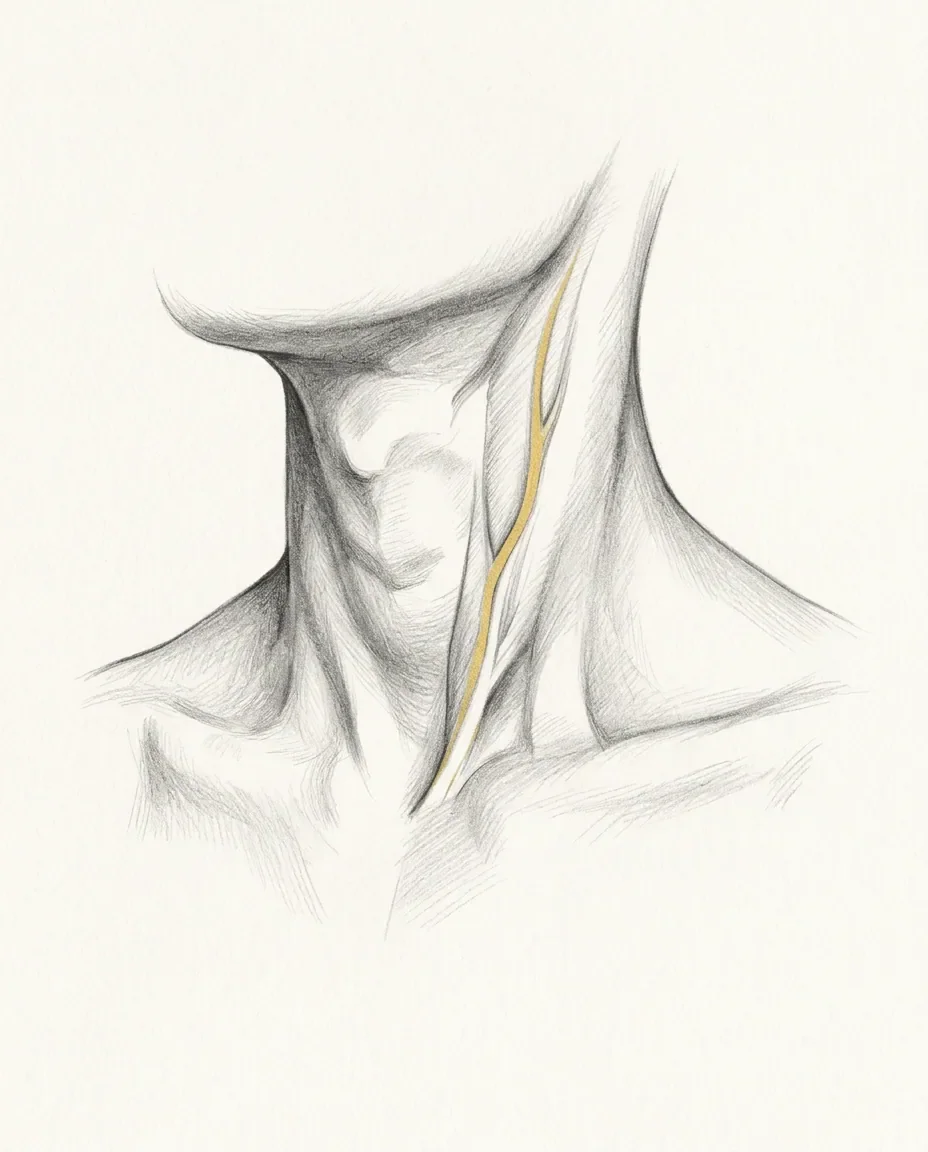
Neck Fetish
Trachelophilia
Added 21 Jun 2026 · Updated 22 Aug 2026
A partialism (trachelophilia) in which the neck, nape and throat are a focus of erotic interest, both in appearance and in sensation. Light touch, breath and kissing are typical. A benign body-part interest unless it causes distress.
- Prevalence
- Uncommon
- Category
- Body Parts & Partialism
- Clinical term
- Trachelophilia
- Domain
- Sexual interest · Paraphilia
- Confidence
- Low confidence
- Status
- Partialism; benign variation unless distressing or impairing. Noted under fetishistic/partialism framing in DSM-5-TR.
- Also known as
- neck partialism, trachelophilia, throat fetish, neck partialism (trachelophilia)
- Added
- 21 Jun 2026
- Updated
- 22 Aug 2026
Overview
Neck fetishism, sometimes labelled trachelophilia, is a partialism in which the neck, nape, and throat carry strong erotic significance. The interest may centre on the neck's contour and line, the bared nape, or the throat, and it frequently connects to closely associated intimate behaviours: gentle touch, warm breath, and kissing along a region that is, for most people, a genuine erogenous zone. As a partialism, an erotic focus on a particular non-genital body part, it is regarded as a benign variation rather than a disorder in itself. This article covers the term's etymology, the documented history, how the interest is expressed, why the neck is so often eroticised, what little prevalence data exists, and the one real safety caveat around throat pressure.
Is a neck fetish normal?
In ordinary usage, yes. Finding the neck attractive or arousing is common and unremarkable, since the neck is a recognised erogenous zone. It becomes a matter for clinical attention only in the narrow sense that any partialism does: when the focus causes the person distress or impairment, or drives non-consensual behaviour. Absent those, it is treated as normal variation.
Examples
What the term covers. Attention to the line of the throat and the soft hollow above the collarbone; the bared nape, whether exposed by short hair, a pinned-up style or a low back; kissing, light touch and warm breath along the side of the neck; and an attraction to what frames the area, from a shirt collar to a slim chain. For most people who describe it, the focus is a strong preference woven into ordinary affection rather than a requirement for arousal.
What the term does not cover. Neck interest is not choking or breath play. Those apply pressure to the neck and carry a real risk of injury, whereas a partialism concerns how the region looks and how sensitive it is; the two are constantly conflated because they share a body part. Collaring places something around the neck as a negotiated symbol of commitment or ownership, which is a relationship marker rather than a body-part attraction. Biting, and the fangs-and-pallor imagery of a vampire fetish, borrow the neck as a setting for something else. An interest confined to the lips or teeth is a neighbouring facial partialism, not this one.
How the word is used. "Neck fetish" is vernacular. Trachelophilia is built transparently from the Greek for neck but circulates in online paraphilia lists rather than in the clinical canon, where the interest is simply an instance of partialism; neither word appears in ICD-11. In casual use the phrase is stretched well past what it names, since English offers no tidier way to say that someone particularly likes being kissed on the neck.
History & origins
Cultural roots
The neck has been treated as an erogenous and emotionally charged zone across art and literature for centuries: the bared nape idealised in some East Asian aesthetics, the swan-like neck of Western portraiture, and the long-standing pairing of the throat with vulnerability and desire in romantic and gothic imagery, the vampire's kiss being the most familiar shorthand for neck-as-erotic-site. The erotic charge of the neck is therefore deeply embedded in culture, even though the clinical label is recent and rarely used.
Terminology and clinical lineage
As a distinct named fetish, the precise coinage of trachelophilia is not well documented; the word is built transparently from the Greek trakhēlos ("neck") and -philia ("love, affinity"). The broader clinical idea of a focus on a single body part belongs to late-nineteenth-century sexology. Richard von Krafft-Ebing's Psychopathia Sexualis (1886) catalogued erotic fixations on isolated body regions as pathologies, and Havelock Ellis's Studies in the Psychology of Sex later reframed many such partial attractions as ordinary variation. In current diagnostic terms, a focus confined to a non-genital body part is partialism, grouped with fetishistic disorder in the DSM-5-TR and clinically relevant only when it causes distress, impairment, or harm. Compilations such as the list of paraphilias record neck-focused partialism among many minor body-part interests rather than as a separately studied condition.
The neck in erogenous-zone research
Where the neck does appear in the empirical literature is in studies of erogenous sensitivity. In Turnbull and colleagues (2014), 793 participants rated 41 body areas from 0 (no erotic charge) to 10 (highest); the nape of the neck landed among the most highly rated extra-genital regions, behind only the genitals and the mouth/lips and alongside the nipples and inner thighs. The ranking held across gender, sexual orientation, and nationality. Notably, the study failed to support the popular "somatosensory cortex" theory that erogenous zones map onto adjacent regions of the brain's touch map, so the neck's erotic pull is not simply a matter of cortical geography. The finding is consistent with the neck's classification as a sensitive erogenous zone on Wikipedia. That work studies general sensitivity rather than fetishism specifically, but it grounds why the neck is so commonly eroticised.
In practice
Common expressions include appreciation of an exposed neck or nape, enjoyment of gentle touch, warm breath, or kissing along the neck, and attraction to the area as a site of intimacy. Because the neck is a culturally recognised erogenous zone rich in nerve endings, this interest usually integrates seamlessly into conventional affection rather than standing apart. It sits alongside closely related facial and head partialisms such as the lip fetish and teeth fetish.
Psychology
The neck is highly sensitive and socially exposed: baring it signals vulnerability and trust, and stimulation there can produce strong somatosensory arousal, which together may explain its erotic salience. As with other partialisms, the strength and specificity of the focus likely reflect a mix of individual preference and associative learning rather than any single established cause. Dedicated research on neck fetishism as such is essentially absent, so these accounts remain interpretive.
Prevalence & culture
How common is a neck fetish?
As a distinct, named fixation it is uncommon and only lightly documented, though the neck features broadly in romantic and pop-cultural imagery. The most cited survey of relative fetish frequency, Scorolli et al. (2007), drew on roughly 5,000 members of 381 online fetish groups: body parts were the single most common target of preference, but feet dominated that category (about 47%), leaving neck- and throat-focused interest in the rare residual tail well below the leading partialisms. The same relative picture is summarised on Wikipedia's sexual fetishism article. No population study isolates a neck-specific prevalence, so any figure here is an estimate rather than a measured rate. Dedicated communities are modest in size.
Safety, consent & law
Trachelophilia is generally benign, and neck-focused affection is non-harmful when gentle and consensual. The one real caveat concerns pressure on the throat. Any force applied to the throat or airway carries serious physical risk: even brief strangulation or breath restriction can cause injury, loss of consciousness, or death, and the danger is not reliably predicted by how the person looks or feels in the moment. Practices that apply pressure to the neck or airway (choking and breath play) therefore require careful, informed consent and risk awareness, are a specific criminal offence in some jurisdictions even between willing partners, and fall outside the scope of ordinary partialism. Absent distress, impairment, or non-consent, neck-focused interest is considered a normal variation.
Common questions
Why is the neck such a sensitive spot?
It rates high in the one large study to measure this directly. Turnbull and colleagues (2014) had 793 people score 41 body areas for erotic charge; the nape landed among the most highly rated non-genital regions, behind only the genitals and the mouth, and the ranking held across gender, orientation and nationality. Notably, the same study failed to support the popular idea that erogenous zones map onto adjacent parts of the brain's touch map.
Is a neck fetish the same as a choking kink?
No, and the difference matters. A neck fetish is an attraction to how the neck looks and feels: the nape, the line of the throat, kissing and light touch. A choking kink is about applying pressure to the neck, which restricts blood flow to the brain and carries documented risk of injury. Sharing a body part does not make them one interest, and one is benign in a way the other is not.
Is it safe to squeeze someone's neck during sex?
No. No technique makes neck pressure safe. Even brief compression reduces blood and oxygen to the brain, loss of consciousness can follow within seconds and signals at least mild injury, and serious complications including stroke can appear hours later with no external bruising. In England and Wales non-fatal strangulation is a specific criminal offence and a person cannot consent to serious harm. Neck-focused affection requires no pressure at all.
What does trachelophilia mean?
Literally love of the neck, from the Greek trakhelos. The construction is sound, but the word is not established clinical vocabulary: it appears in popular paraphilia lists and wiki compilations rather than in the diagnostic manuals or the research literature, where a neck-focused interest is described simply as a partialism.
What is the difference between a neck fetish and liking chokers or collars?
One is about the body, the other about an object and what it signifies. A neck fetish focuses on the neck itself. A liking for chokers is an accessory interest, and collaring goes further still: within BDSM a collar is a negotiated symbol of commitment or ownership, closer in function to a ring than to jewellery. The three often coincide, but they answer different questions.
Where does the vampire association come from?
From gothic fiction, which fixed the throat as the meeting point of vulnerability and desire, and from the bite as a compact image of surrender. That imagery is now the most familiar cultural shorthand for the neck as an erotic site, and it feeds a related but separate interest, the vampire fetish, which is about persona and mythology rather than anatomy.
- Lip Fetish43/100Labia Oris Partialism · Body Parts & PartialismLip and mouth partialism is a pronounced erotic focus on the lips and mouth, typically centering on lip fullness, shape, color, and movement. Associated cues such as lipstick, glossy lips, or kissing are often part of it. A benign, mainstream-adjacent variation.43
- Teeth Fetish24/100Odontophilia · Body Parts & PartialismOdontophilia is a partialism in which the teeth are a focal point of erotic interest. Attention may center on the appearance, shape, or arrangement of teeth, including features such as gaps, fangs, or braces.24
- Skin Fetish29/100Integumentophilia · Body Parts & PartialismA focused erotic interest in human skin itself, its texture, smoothness, warmth, scent and sheen, rather than the body as a whole. The act of touching and being touched is part of it. It is generally a benign aesthetic and tactile preference.29
- Belly Fetish32/100Abdominal Partialism · Body Parts & PartialismAbdominal partialism is a strong erotic focus on the belly and stomach area. Preferences vary widely, from toned or soft midriffs to the navel itself, and may include gentle touch of the region. It is a benign variation in consenting adults.32
- Eye Fetish26/100Oculophilia · Body Parts & PartialismA focused erotic interest in the eyes: their colour, shape, gaze, or framing features such as lashes and makeup. It is an uncommon facial-feature partialism with limited dedicated study.26
- Navel Fetish32/100Alvinophilia · Body Parts & PartialismA focused erotic interest in the navel and surrounding abdomen: its shape, depth, or adornment. Clinically a partialism (alvinophilia / omphalophilia); an uncommon, benign body-part interest with a small but visible online following.32
From Greek trakhēlos ("neck") + -philia ("love, affinity"), literally "love of the neck." The term circulates in popular and wiki references rather than the established clinical canon, where the interest is described simply as a neck-focused partialism.
upper body · head and face
Prevalence is computed from the entry's cited population estimate. Rows marked ESTare indicative editorial estimates scored against a fixed anchor rubric, not measured quantities. Method & anchors: methodology.
Uncommon · ≈ 1 in 100
- 01Scorolli et al. (2007), Relative prevalence of different fetishes, Int. J. Impotence Research 19(4):432-437relative-frequency context; neck/throat partialism sits in the rare residual tail of body-part fetishes
- 02Sexual fetishism, Wikipedia (carries the Scorolli 2007 relative-frequency table)carries the Scorolli table situating minor body-part fetishes well under 1%
- 03List of paraphilias, Wikipediadefinition/existence of neck-focused partialism
- 04Richard von Krafft-Ebing, Psychopathia Sexualis (1886)historical sexological framing of erotic fixation on an isolated body region as a documented variation
- 05Erogenous zone, Wikipediathe neck, nape and clavicle as sensitive erogenous zones stimulated by light touch, kissing and caressing
- 06Turnbull, Lovett, Chaldecott & Lucas (2014), Reports of intimate touch: Erogenous zones and somatosensory cortical organization, Cortex 53:146-154survey of ~800 people rating 41 body parts for erogenous intensity; neck and nape reliably among the strongly arousing extra-genital regions
- 07DSM-5-TR, Paraphilic Disorders (American Psychiatric Association, 2022)partialism (focus on a non-genital body part) grouped with fetishistic disorder; clinical only when it causes distress, impairment, or harm