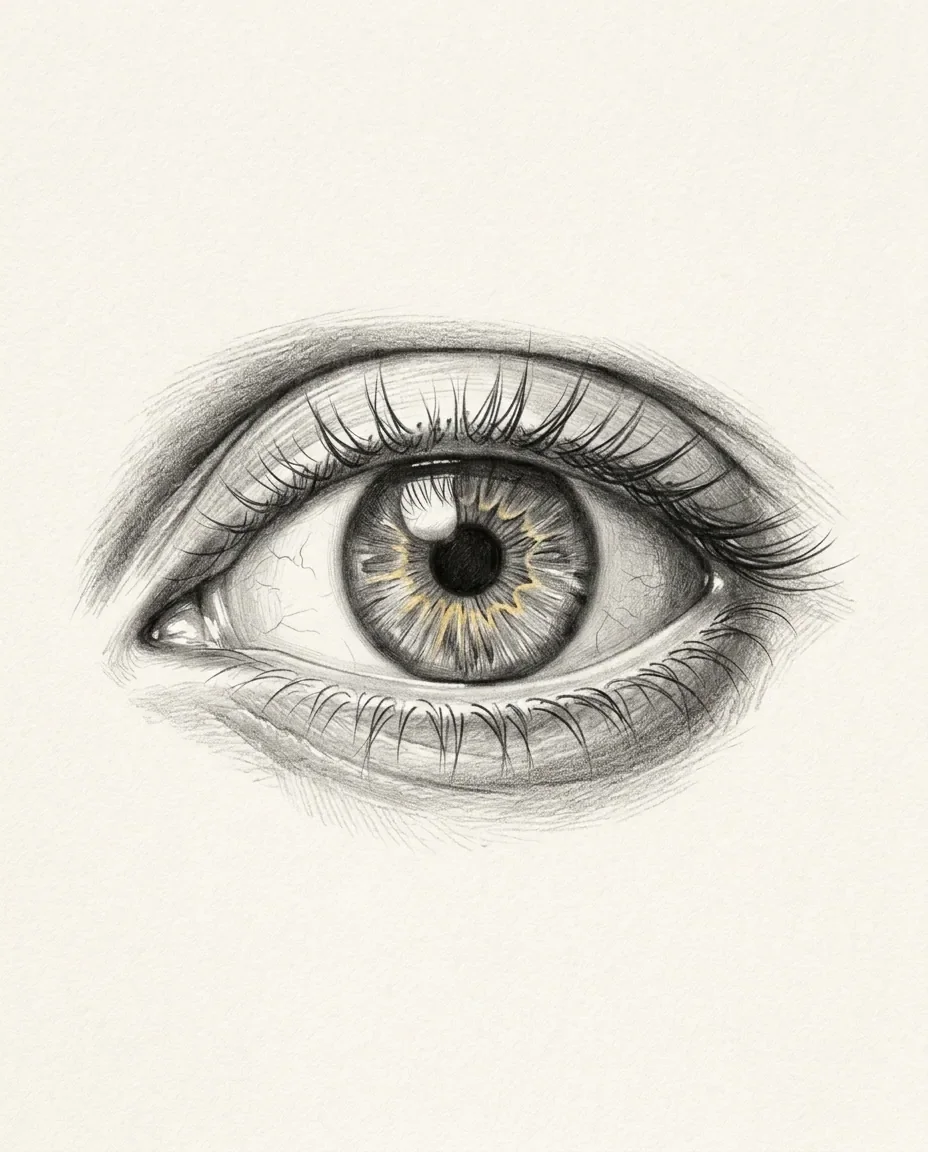
Eye Fetish
Oculophilia
Added 21 Jun 2026 · Updated 22 Aug 2026
A focused erotic interest in the eyes: their colour, shape, gaze, or framing features such as lashes and makeup. It is an uncommon facial-feature partialism with limited dedicated study.
- Prevalence
- Uncommon
- Category
- Body Parts & Partialism
- Clinical term
- Oculophilia
- Domain
- Sexual interest · Paraphilia
- Confidence
- Low confidence
- Status
- Partialism; uncommon, benign variation, not a disorder unless it causes distress, impairment, or non-consent.
- Also known as
- Eye Partialism, oculophilia, eyeball fetish
- Added
- 21 Jun 2026
- Updated
- 22 Aug 2026
Overview
Eye partialism, sometimes termed oculophilia, is a sexual interest in which the eyes are the primary focus of attraction. The interest may attach to eye colour and shape, to the quality of a gaze or of sustained eye contact, or to the features that frame the eyes: eyelashes, brows and eye makeup. Because the eyes carry exceptionally strong emotional and social meaning, this partialism often shades into a broader sensitivity to gaze and connection rather than a narrowly physical preoccupation. This article covers its lineage within the wider history of partialism, how it is typically expressed, the psychology of gaze, and what little is known of its prevalence.
Examples
What the term covers. An erotic focus on iris colour or on the shape of the eye and the way lids and lashes frame it; a strong response to sustained mutual gaze, or to being looked at in a particular way; and attention to the features that dress the eye: long lashes, liner, shadow, brows. In practice it usually surfaces as noticing someone's eyes first and remembering them longest, rather than as any distinct activity.
What the term does not cover. Oculolinctus, the licking of another person's eyeball, is a separate and far rarer interest involving direct contact with the eye surface, and it carries real injury risk that a gaze-and-feature interest does not. Attraction to eyewear rather than to eyes is a glasses fetish. The neighbouring facial partialisms attach to the lips, teeth, nose, ears or cheeks, and interest in the hair framing the face is a hair fetish. Enjoying being looked at is exhibitionism and enjoying looking is voyeurism; both concern the act of watching rather than the eye as a feature.
How the word is used. "Eye fetish" is plain English and the form nearly everyone uses. Oculophilia is catalogue vocabulary, appearing in reference lists and dictionary entries with no recorded coiner or first attestation, and in no diagnostic manual. The umbrella term, partialism, does have a clinical pedigree: it was a named paraphilia in DSM-IV and was folded into fetishistic disorder in DSM-5, diagnosable only where the focus causes genuine distress or impairment.
History & origins
A term with thin documentation
The precise coinage of oculophilia is not well documented. It follows the standard clinical pattern of joining a body-part root with the Greek -philia ("love of") and appears in reference catalogues of partialisms, for example Wikipedia's list of paraphilias and the Wiktionary entry for oculophilia, rather than in a single landmark medical text. Neither a first attestation date nor an original coiner is recorded in these sources, and this article does not invent one.
The lineage of partialism
The broader concept the interest belongs to (partialism, an erotic focus on a specific non-genital body part) has a much longer and better-documented pedigree.
- 1882: The psychiatrists Jean-Martin Charcot and Valentin Magnan described part- and object-focused erotic attractions in their work on sexual inversion, the precursor to the modern concept.
- 1886: Krafft-Ebing's Psychopathia Sexualis catalogued feature-focused attractions among its taxonomy of atypical sexuality.
- 1887: Alfred Binet's essay Le fétichisme dans l'amour gave the foundational account of how a particular feature ("a part of the body, a psychological quality, or even an inanimate object") could become the centre of desire through early, striking association, the framework still invoked for partialisms today.
- 1905: Sigmund Freud's Three Essays on the Theory of Sexuality developed the idea that early experience channels desire toward specific objects and features.
- DSM lineage: Partialism was listed as a distinct paraphilia (NOS) in the DSM-IV and was later folded into fetishistic disorder in the DSM-5, diagnosable only when it causes significant distress or impairment. Oculophilia is not separately recognised in the diagnostic manuals; it is documented only in reference and community catalogues.
A deep cultural backdrop
The eye has carried symbolic and erotic weight across art and literature for centuries. The "language of the eyes" and the lover's gaze are long-standing tropes, which gives this otherwise sparsely studied interest a rich cultural setting even where the clinical record is thin.
In practice
Expression is generally subtle and centred on looking and mutual gaze, with attention to the features that frame the eyes: lashes, liner, the colour of an iris, the way someone holds eye contact. It is typically woven into ordinary attraction rather than enacted as a separate ritual, which places it close to related facial and feature interests such as the hair fetish.
Psychology
What causes it?
No specific cause is established. As with other partialisms, learning and early association (the Binetian framework above) are the usual explanatory frameworks, set against the central role of the eyes in human communication, attachment and bonding. Eye contact reliably triggers strong affective and physiological responses: heart rate and skin conductance rise and pupils dilate within a second or two of sustained mutual gaze. Research on mutual gaze finds that pupil dilation tracks preferred mutual-gaze duration (Binetti et al., Royal Society Open Science, 2016), and separate work shows that faces with dilated pupils are rated as more attractive. An erotic emphasis on the eyes can thus be read as an intensification of an already powerful social signal. The interest is treated as a benign and uncommon variation of normal attraction.
Prevalence & culture
How common is it?
Facial-feature partialisms form only a small minority of body-part fetishes in the available survey data. In the largest such analysis, Scorolli et al. (2007) examined the relative frequency of fetish interests across online communities and found the foot fetish and objects associated with the feet and legs to dominate, with focuses on the eyes and other facial features comparatively rare. Oculophilia in particular has very limited dedicated study, so any prevalence figure is low-confidence. Community visibility is modest, with small dedicated interest groups and occasional appearances in fashion and beauty culture, where lashes, liner and gaze are already aestheticised.
Safety, consent & law
The common aesthetic interest described here (gaze, eye colour, lashes and makeup) raises no safety or legal concerns between consenting adults. A separate, rarer and clinically distinct practice, oculolinctus (eyeball licking), is sometimes noted alongside the term in reference works; per the Wikipedia entry on oculolinctus and ophthalmological commentary, direct contact with the eye carries genuine injury risk including conjunctivitis, corneal abrasion and infection, and is not the gaze-and-feature interest documented in this entry.
Common questions
Is an eye fetish the same as just liking eye contact?
Not quite, though the two sit on a continuum. Nearly everyone responds to sustained mutual gaze; it reliably raises heart rate and skin conductance and dilates the pupils within a second or two. An eye fetish describes the case where eyes or gaze are a primary, organising focus of attraction rather than one social signal among many. Because it is a difference of degree, the boundary is genuinely fuzzy.
Is an eye fetish a partialism or a paraphilia?
Both labels apply, at different levels of description. A partialism is an erotic focus on a specific non-genital body part, which is what an eye focus is; partialism in turn sits inside the broader family of paraphilias, meaning atypical erotic interests. Neither word means disordered. In DSM-5 partialism was folded into fetishistic disorder, which is diagnosed only when the focus causes distress or impairment.
Is having an eye fetish a disorder?
No. It is a benign and uncommon variation of ordinary attraction, and oculophilia is not separately recognised in any diagnostic manual. It would become clinically relevant only on the same terms as any other interest: if it caused the person significant distress, interfered with their life or relationships, or involved someone who had not consented. An aesthetic preference for eyes does none of those things.
Is it safe to touch or lick someone's eye?
No. The cornea is fragile and easily scratched, and the eye tolerates foreign material and bacteria poorly. Oculolinctus, eyeball licking, has documented risks including conjunctivitis, corneal abrasion and infection, and ophthalmological commentary is uniformly against it. The gaze-and-feature interest described in this entry involves no contact with the eye at all and raises no comparable concern.
What is the difference between an eye fetish and a glasses fetish?
An eye fetish attaches to the eye itself (colour, shape, lashes, gaze), so it survives the wearer switching to contact lenses. A glasses fetish attaches to the eyewear and to what it signals, commonly intelligence or a particular kind of poise, and does not. The two can coexist, but one is a body-part focus and the other a clothing-and-accessory focus.
Can an eye fetish be about lashes and makeup rather than the eye itself?
Yes, and that is a common form of it. The framing features (lashes, liner, shadow, brows) carry much of the visual signal, and an interest centred on them still counts as an eye-focused partialism. It also explains part of the interest's cultural footprint, since beauty and fashion culture already treat the eye area as the most heavily worked and most heavily coded part of the face.
- Hair Fetish52/100Trichophilia · Body Parts & PartialismA focused erotic interest in hair, most often scalp hair, attaching to its length, thickness, texture, colour or styling. It sometimes attaches to acts such as brushing, growing or cutting. Clinically termed trichophilia, it is a recognized but moderately uncommon partialism.52
- Foot Fetish83/100Podophilia · Body Parts & PartialismA focused erotic interest in feet (their shape, soles, toes, arches, or grooming) as a primary source of attraction. Within partialism (erotic focus on a non-genital body part) it is the example people report most, by a wide margin.83
- Oculolinctus (Eyeball Licking)4/100Oculolinctus · Body Parts & PartialismOculolinctus is a rare partialism in which erotic interest attaches to licking, or being licked on, the surface of another person's eyeball. It is also known as eyeball licking, or colloquially "worming". It carries a real risk of corneal injury and infection, and is best known from a debunked 2013 media scare.4
- Nail Fetish24/100Onychophilia · Body Parts & PartialismAn erotic interest centered on fingernails or toenails, particularly their length, shape, color, or adornment. The nails themselves are the primary focus of attraction.24
- Tail Fetish24/100Caudaphilia · Body Parts & PartialismTail partialism is an erotic interest centred on tails, most often worn or costume tails rather than anatomical ones. Clinically termed caudaphilia, it is a rare, benign interest that overlaps heavily with furry, pet-play and pony-play.24
- Teeth Fetish24/100Odontophilia · Body Parts & PartialismOdontophilia is a partialism in which the teeth are a focal point of erotic interest. Attention may center on the appearance, shape, or arrangement of teeth, including features such as gaps, fangs, or braces.24
A clinical coinage joining Latin *oculus* ("eye") with Greek *-philia* ("love of, affinity for"), literally "love of eyes." No first attestation or coiner is documented. The colloquial name "eye fetish" is plain English.
head and face · facial features
Prevalence is computed from the entry's cited population estimate. Rows marked ESTare indicative editorial estimates scored against a fixed anchor rubric, not measured quantities. Method & anchors: methodology.
Uncommon · ≈ 1 in 100
- 01Scorolli et al. (2007), Relative prevalence of different fetishes, Int. J. Impotence Research 19(4):432-437relative prevalence of body-part/partialism fetishes; facial-feature fetishes form a small minority of body-part fetishes
- 02Sexual fetishism, Wikipedia (carries the Scorolli 2007 relative-frequency table)carries the Scorolli relative-frequency table covering body-part partialisms
- 03List of paraphilias, Wikipediadefinition/existence of oculophilia as eye partialism
- 04Partialism, Wikipediaconcept and DSM-IV/DSM-5 history of partialism; lists oculophilia as an eye partialism
- 05Krafft-Ebing, Psychopathia Sexualis (1886), Wikipedia1886 cataloguing of feature-focused attractions among atypical sexual behaviours
- 06Alfred Binet, Le fétichisme dans l'amour (1887), PhilPapersfoundational 1887 account of how a body part or feature becomes the centre of desire through early association
- 07oculophilia, Wiktionaryetymology of oculophilia (Latin oculus + Greek -philia) and its definition as eye fetishism; no coiner or first attestation recorded
- 08Pupil dilation as an index of preferred mutual gaze duration, NCBI/PMCphysiological evidence that pupil dilation tracks preferred mutual-gaze duration, underpinning the social-signal account of eye attraction
- 09Binetti et al. (2016), Pupil dilation as an index of preferred mutual gaze duration, Royal Society Open Science 3:160086journal-of-record citation for the mutual-gaze/pupil-dilation study, dating it to 2016 and naming the authors
- 10Oculolinctus, Wikipediathe distinct, rarer eyeball-licking practice and its documented injury risks (conjunctivitis, corneal damage, infection)