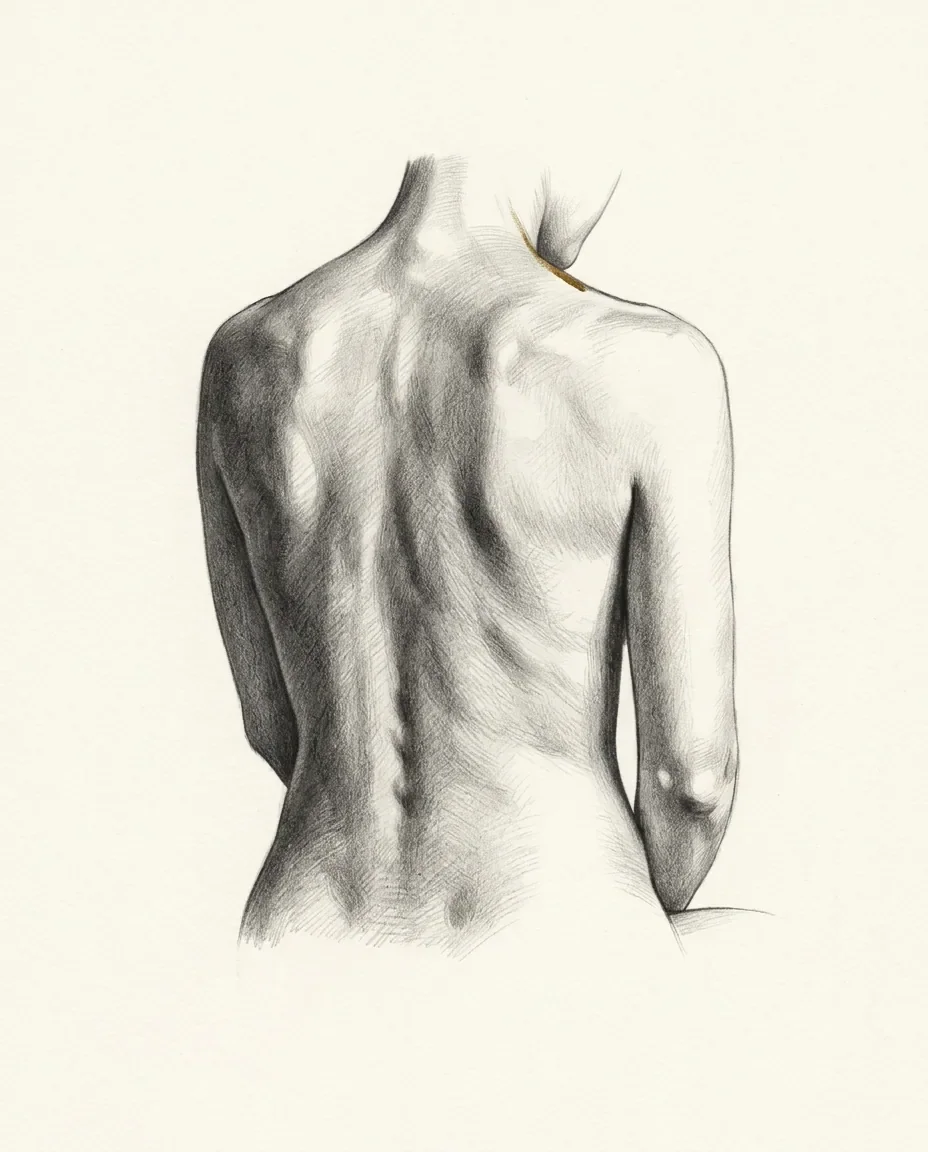
Back Fetish
Dorsal Partialism
Added 21 Jun 2026 · Updated 22 Aug 2026
A focused erotic interest in the back and shoulders, where this dorsal region of the torso is a primary source of attraction rather than the body as a whole. It is generally a benign aesthetic preference, best understood as a form of partialism.
- Prevalence
- Uncommon
- Category
- Body Parts & Partialism
- Clinical term
- Dorsal Partialism
- Domain
- Sexual interest
- Confidence
- Low confidence
- Status
- Common variation of attraction; not a disorder and not a recognized paraphilia.
- Also known as
- back & shoulder partialism, shoulder fetish, dorsal partialism, back partialism
- Added
- 21 Jun 2026
- Updated
- 22 Aug 2026
Overview
A back fetish, describable in clinical terms as dorsal partialism, is a focused erotic interest in the upper back, shoulder blades, and shoulders. For people who experience it, this dorsal region is a strong or even primary object of attraction, valued for its broad lines, musculature, posture, and the way movement or clothing reveals it. It is generally a benign variation of ordinary aesthetic preference rather than a mental disorder or a formally recognised paraphilia. This article traces how the back came to be understood through the wider clinical concept of partialism, how the interest is expressed, and what little is known about its prevalence.
Examples
The back is a large region with no single agreed boundary, so the interest is best described by where attention actually lands.
What the term covers. The shoulder blades and the way they shift under the skin; the line of the spine; the taper from shoulders to waist that fitness culture calls the V; posture and carriage; and the shoulder line itself. Clothing does much of the framing (a backless dress, an open-backed top, a shirt pulled tight across the shoulders), and touch belongs here too, in tracing the spine, in massage, and in the back's ordinary role as the surface a partner reaches for.
What the term does not cover. Muscle worship is about developed musculature and displays of strength wherever they appear, so it overlaps with a back interest without being one. A neck fetish covers the nape and throat as its own focus, and a skin fetish attaches to texture and warmth rather than to any region. Scratching uses the back as its most common surface but is an interest in sensation, not in anatomy. And usage keeps the term to the upper torso: the lower back and hips shade into a butt fetish, which is counted separately.
How the word is used. "Back fetish" is plain vernacular, and it is the only name the interest reliably has. "Dorsal partialism" is a descriptive construction rather than an established clinical term: unlike feet or hands, the back never acquired a -philia coinage of its own, which is itself a measure of how little it has been catalogued. It is named in neither DSM-5-TR nor ICD-11, where a body-part focus is considered only under fetishistic disorder and only where distress or impairment is present.
History & origins
The attraction to the back has no documented coinage of its own. There is no Greek- or Latin-rooted clinical name in the established literature for a back-specific interest, so its history is best read through two larger stories: the clinical concept of partialism and the broader idea of sexual fetishism.
Clinical lineage
- 1886: Richard von Krafft-Ebing catalogues numerous fixations on isolated body parts and garments in Psychopathia Sexualis, giving the first systematic medical vocabulary for part-focused desire.
- 1887: Alfred Binet introduces the word fétichisme into an erotic context, framing such interests as the product of early associative learning, the conceptual root of the modern term fetishism.
- late 1890s–1928: Havelock Ellis, across his multi-volume Studies in the Psychology of Sex, discusses the eroticisation of particular features and likewise attributes it to association.
- 1905: Sigmund Freud treats focused part-interests in his Three Essays on the Theory of Sexuality, embedding them in psychoanalytic theory.
- 1980 onward: The DSM lineage shifts repeatedly: DSM-III (1980) excluded body parts from the fetishism criteria; DSM-III-R (1987) introduced partialism as a separate diagnostic label for arousal centred on a body part; DSM-IV retained that distinction; and DSM-5 (2013) merged partialism back into fetishistic disorder. Under current criteria a body-part interest is a disorder only when it causes significant distress or impairment.
- 2018: ICD-11 removes consensual fetishism from its list of disorders entirely, completing a broad depathologisation of non-distressing kink.
Cultural framing
The back itself carries an old double-coding: a site of strength and athleticism on one hand, of vulnerability and exposure on the other. The sculpted dorsal musculature of classical statuary, the backless evening gown, and the eroticised "V-taper" of fitness culture all keep the region aesthetically charged, but these are cultural currents rather than a clinical history of the interest.
In practice
The interest is usually expressed through aesthetic appreciation, touch, massage, gentle tracing of the spine or shoulder blades, and attention to backless garments or athletic poses that emphasise the area. It frequently overlaps with broader appreciation of physique, posture, and skin, and shades naturally into muscle worship where the appeal is the developed musculature itself.
Psychology
Partialisms are generally explained through a mixture of ordinary aesthetic preference, early associative learning (in the tradition running from Binet and Krafft-Ebing), and cultural framing of the body part in question. The evidence base specific to the back is essentially nonexistent (it is too small a niche to have been studied directly), so any mechanism is inferred from the general literature on body-part interest. For most people the back is simply a pronounced taste rather than anything clinically notable, and the focus coexists comfortably with attraction to the whole person.
Prevalence & culture
How common is a back fetish?
A back fetish is uncommon compared with the most-reported body-part interests, and it is rarely counted as its own category in research. Surveys of fetish interest are overwhelmingly dominated by feet: in the widely cited analysis of online fetish communities by Scorolli et al. (2007), feet accounted for about 47% of body-part foci, with body fluids and body size at roughly 9% each, hair at 7%, and muscles at 5%, leaving the torso and back a small residual share that does not appear as a named category at all. Dedicated communities are correspondingly small, the topic attracts little specific research, and so any prevalence figure for a back fetish is a rough estimate rather than a measured one.
Is a back fetish normal?
Yes. A focused liking for the back and shoulders is a benign variation of ordinary aesthetic taste, not a disorder. It only becomes a clinical matter in the rare case where a body-part interest causes marked distress or impairment, the threshold that separates a preference from a diagnosis under current DSM-5-TR and ICD-11 criteria.
Safety, consent & law
This interest is a benign variation of normal attraction. It requires only the ordinary conditions of mutual consent and is not associated with harm, distress, or impairment in typical cases, placing it firmly outside the paraphilias that imply clinical concern. Where it overlaps with massage or other touch, the usual norms of consent and comfort apply.
Related interests
- Muscle worship: admiration of developed musculature, with which a back fetish heavily overlaps.
- Tongue fetish, another body-part partialism documented in this directory.
Common questions
What do people with a back fetish actually find attractive?
Most descriptions centre on line and movement rather than on a single feature: the shoulder blades shifting under skin, the length of the spine, the taper from shoulders to waist, and posture. Clothing matters disproportionately, because the back is usually covered: a backless dress or an open-backed top does the framing. Touch is often part of it too, particularly tracing the spine or massage.
Is there a clinical name for a back fetish?
Not really. "Dorsal partialism" is a descriptive construction (Latin dorsum for back, plus the clinical term for an erotic focus on one body part) rather than an established diagnostic label. Unlike feet or hands, the back never acquired its own -philia coinage in the sexological literature, which reflects how rarely it has been studied as a category.
Is a back fetish the same as muscle worship?
No, though they overlap heavily. Muscle worship is an interest in developed musculature and displays of physical strength, wherever on the body they appear. A back fetish is regional: the appeal can be a slim back with visible shoulder blades just as easily as a heavily built one. Someone drawn to a muscular back may sit in either category, or both.
Does a back fetish include the lower back?
Usage generally keeps it to the upper back and shoulders. The lower back and hips are conventionally counted with the butt fetish, and the nape is treated as part of a neck fetish. These boundaries are conventions of how people talk rather than clinical divisions, so a given person's interest may cross them freely.
Why do backless dresses and open-back tops come up so often?
Because the back is normally covered, so exposure of it is a deliberate act of design. A garment that opens the back turns an everyday region into a displayed one, and the reveal, rather than the anatomy alone, is a large part of what holds attention. The same logic sits behind the eroticism of the nape in cultures where hair is customarily worn up.
How do you tell a partner you have a back fetish?
Plainly, and as a compliment rather than a confession. This is among the least loaded interests in the catalog: it asks for nothing beyond looking and ordinary touch, involves no risk, and is close enough to common aesthetic taste that most partners will hear it as flattery. Naming a specific thing (the shoulders, the line of the spine) tends to land better than the word "fetish" on its own.
- Muscle Worship45/100Sthenolagnia · Body Parts & PartialismAn erotic interest in muscular physique and displays of physical strength, encompassing admiration of developed musculature. For some, arousal is tied to demonstrations of power and the hands-on appreciation of a partner's muscles.45
- Tongue Fetish22/100Glossophilia · Body Parts & PartialismA tongue fetish is a focused erotic interest in the tongue itself: its appearance, movement, or the sensations it produces. The tongue is a primary object of attraction, distinct from a general interest in kissing or the mouth.22
- Morphophilia22/100Morphophilia · Body Parts & PartialismA clinical term for sexual interest organized around a particular overall body shape or size rather than around a single body part. Slender, athletic, or heavyset builds are typical examples. It is a thinly documented catalog entry more than a described clinical syndrome.22
- Nail Fetish24/100Onychophilia · Body Parts & PartialismAn erotic interest centered on fingernails or toenails, particularly their length, shape, color, or adornment. The nails themselves are the primary focus of attraction.24
- Tail Fetish24/100Caudaphilia · Body Parts & PartialismTail partialism is an erotic interest centred on tails, most often worn or costume tails rather than anatomical ones. Clinically termed caudaphilia, it is a rare, benign interest that overlaps heavily with furry, pet-play and pony-play.24
- Teeth Fetish24/100Odontophilia · Body Parts & PartialismOdontophilia is a partialism in which the teeth are a focal point of erotic interest. Attention may center on the appearance, shape, or arrangement of teeth, including features such as gaps, fangs, or braces.24
"Dorsal" from Latin dorsum "back"; "partialism" from Latin pars/partis "part," denoting an erotic focus on one body part: together, an attraction centred on the back.
torso · upper body
Prevalence is computed from the entry's cited population estimate. Rows marked ESTare indicative editorial estimates scored against a fixed anchor rubric, not measured quantities. Method & anchors: methodology.
Uncommon · ≈ 1 in 100
- 01List of paraphilias, Wikipediadefinition/existence of partialism focused on the back and shoulders
- 02Scorolli et al. (2007), Relative prevalence of different fetishes, Int. J. Impotence Research 19(4):432-437relative-frequency context: non-foot body parts make up a small share of body-part fetishes (feet dominate at 47%)
- 03Sexual fetishism, Wikipedia (carries the Scorolli 2007 relative-frequency table)carries the Scorolli body-part relative-prevalence table placing the torso/back among rarer foci
- 04Partialism, Wikipediahistory of partialism as a clinical concept and its shifting status across DSM editions (DSM-III-R separate label, merged into fetishistic disorder in DSM-5)
- 05Psychopathia Sexualis, WikipediaKrafft-Ebing's 1886 cataloguing of fixations on isolated body parts and garments as the early medical vocabulary for part-focused desire
- 06DSM-5-TR, Paraphilic Disorders (American Psychiatric Association)DSM lineage: body-part interest is a disorder only with distress/impairment; partialism merged into fetishistic disorder in DSM-5
- 07ICD-11, Paraphilic disorders (World Health Organization)2018 depathologisation of consensual fetishism, removing non-distressing kink from the list of disorders