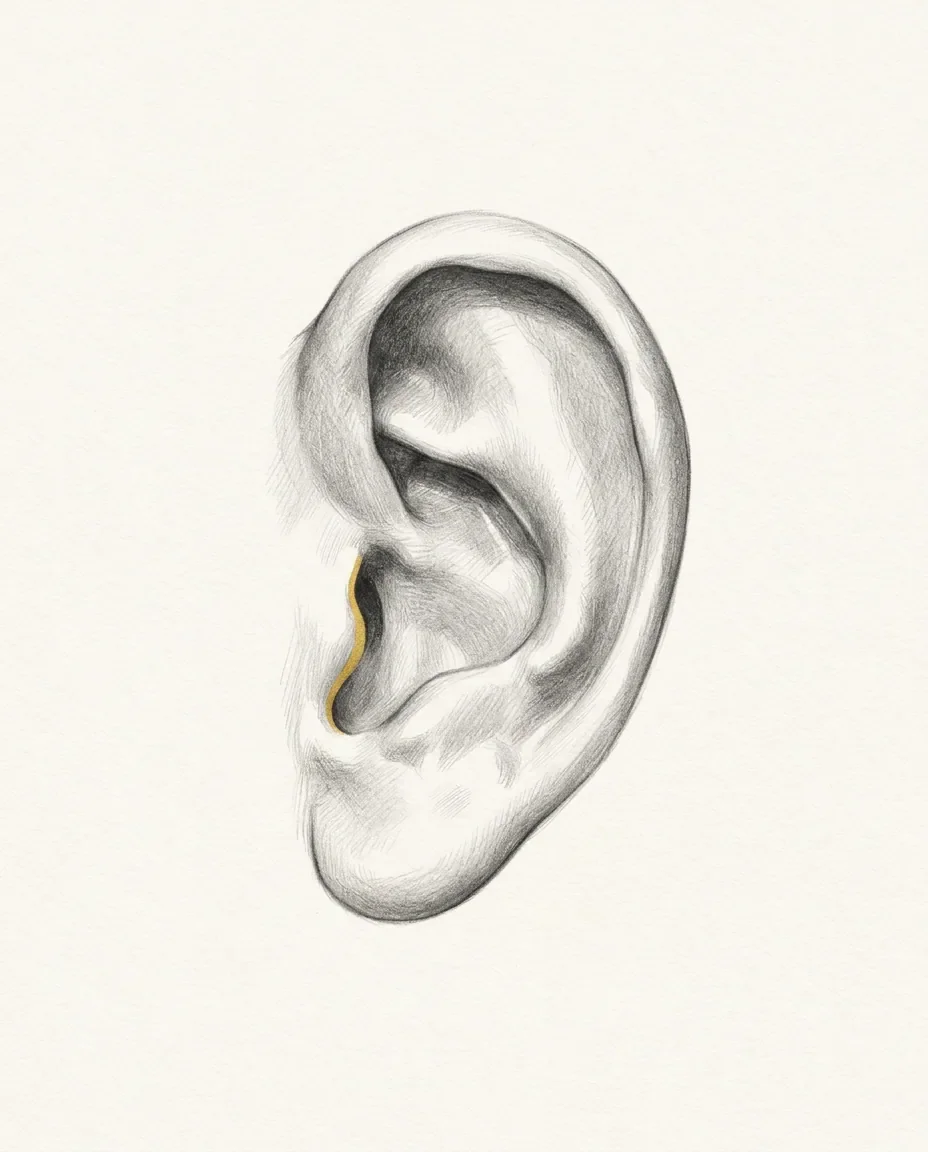
Ear Fetish
Auriculophilia
Added 21 Jun 2026 · Updated 22 Aug 2026
Ear partialism is a sexual interest focused on the ears, their shape and appearance, and the heightened sensitivity of the region to touch or breath. Ear-related adornment is part of it, and it sometimes overlaps with arousal from whispered sound (auralism).
- Prevalence
- Rare
- Category
- Body Parts & Partialism
- Clinical term
- Auriculophilia
- Domain
- Sexual interest · Paraphilia
- Confidence
- Low confidence
- Status
- Partialism; a benign paraphilic variation, not a disorder absent distress or impairment.
- Also known as
- ear partialism, auriculophilia, auralism
- Added
- 21 Jun 2026
- Updated
- 22 Aug 2026
Overview
Ear partialism (clinically auriculophilia) is a sexual focus on the ears: a partialism, in which the outer ear becomes a primary site of arousal rather than an incidental one. The appeal may centre on the visual form of the auricle and lobe, the genuine nerve-rich sensitivity of the region, or activities such as whispering, breathing close to the ear, gentle kissing, or light touch. It overlaps with an interest in earrings and other adornment, and shades into auralism, arousal from sound, voice, and whispered closeness. This article sets out the documented framework around the interest, its likely psychology, and why hard data on the ear as a discrete focus is scarce.
Examples
What the term covers. Attention to the outer ear as a form: the curve of the helix, the lobe, the way a piercing or a single earring draws the eye. The region's genuine sensitivity, approached through light touch, kissing, or breath at the ear. And whispered speech, where the appeal is the closeness of a voice as much as any contact. For some people the adornment carries most of the charge, for others the sound does, and many describe both at once.
What the term does not cover. Enjoying having your ears kissed is not a fetish; the ear is a standard erogenous zone and most people respond to it, while partialism means the part is the primary focus rather than one stop among many. Neighbouring head-and-face interests are separate ones: the nose, the cheek, the eyes, the neck, the hair. An earwax fetish attaches to cerumen and the ritual of ear cleaning rather than to the ear's shape. ASMR is a typically non-sexual tingling response to whispered, close-proximity sound, and misophonia is its aversive counterpart. Phone sex and dirty talk are voice interests in which the ear is the channel rather than the object.
How the word is used. Auriculophilia is a regularly formed but rarely spoken coinage; in practice people say "ear fetish". It appears in neither DSM-5-TR nor ICD-11, which recognise body-part interests only through the general nongenital-body-part specifier of fetishistic disorder. "Auralism" circulates in kink writing for the sound-based interest that overlaps this one, and the two labels get swapped freely even though one names a body part and the other a channel.
History & origins
The partialism framework
The ear has been treated as an erogenous and symbolically charged feature across many cultures, reflected in long traditions of ear ornamentation and in the romantic motif of the whispered word. As a named erotic focus, ear partialism has a thin documentary record, and most of its lineage is inherited from the broader category that contains it.
- 1886: Richard von Krafft-Ebing's Psychopathia Sexualis inaugurates the systematic clinical cataloguing of sexual interest directed at specific bodily features, the seed of the modern concept of partialism.
- 1897–1928: Havelock Ellis, in his Studies in the Psychology of Sex, documents attraction to particular non-genital features and reframes such attractions as variations of normal eroticism.
- Mid-to-late twentieth century: partialism, the channelling of sexual interest onto a specific non-genital body part, is consolidated as a clinical term and folded into the sexual-fetishism literature.
- DSM-5 / DSM-5-TR: partialism is treated as a form of fetishistic interest and is a disorder only where it causes the individual clinically significant distress or functional impairment, a framing that applies equally to attraction centred on the ear.
The clinical name auriculophilia is a modern, regularly formed coinage from Latin auricula ("little ear") plus Greek -philia ("love of"). Unlike podophilia or trichophilia, it does not trace to a single documented author, and its precise first use is not well attested.
The auditory thread
A distinct strand connects the ear to sound rather than touch. Modern writing on auralism describes arousal from voice, whispering, and audio erotica, and popular and emerging-research accounts increasingly link ear-focused intimacy to ASMR (autonomous sensory meridian response), in which whispered and close-proximity audio triggers produce tingling, calming sensations. The two are not the same, since ASMR is typically non-sexual, but they share the ear as a privileged channel and help explain why whispered closeness features so often in descriptions of the interest.
In practice
The interest is usually integrated into foreplay and intimacy, where the ear is approached as a particularly responsive erogenous zone. Common expressions include soft speech or breath at the ear, light touching or kissing of the auricle and lobe, and appreciation of earrings or piercings. For some, the auditory dimension (voice, whispering, ambient closeness) matters as much as physical contact, linking the interest to the wider family of sound-focused arousal.
Psychology
What causes an ear fetish?
Like other partialisms, ear attraction is generally explained through associative learning combined with the area's real physiology. The ear is densely innervated (popular science accounts cite roughly 25,000 nerve endings in the structures that convert sound to neural impulses), which makes it a credible erogenous focus, and clinical reviews recognise that orgasm can occur through stimulation of extragenital erogenous zones. Early intimate experiences, the symbolism of whispered closeness, and the privacy implied by speaking near someone's ear may all reinforce the association. Very little research treats ear interest as a discrete category, so most understanding is inferred from broader partialism and ASMR studies, and the evidence base is correspondingly thin.
Prevalence & culture
How common is an ear fetish?
Ear partialism is a rare named interest with modest online visibility, small dispersed communities, and little mainstream cultural presence beyond the general recognition that ears are sensitive. The best comparative anchor is Scorolli et al. (2007), which tabulated the relative frequency of fetishes across large online communities: feet dominated body-part interest at about 47%, while the ear does not register as a major standalone category. That is consistent with a very low estimate of the ear as a primary focus rather than as one of many incidental erogenous zones. It is closely related to neighbouring facial-feature partialisms such as the nose and to the hair fetish, with which it shares the head as a site of attraction, and to the armpit fetish among adjacent body-part interests.
Safety, consent & law
The interest is benign. It involves consenting adults and ordinary, non-injurious contact, and raises no safety or legal concerns beyond mutual consent and basic care. The auricle and ear canal are sensitive and easily irritated, so gentleness and hygiene are the only meaningful practical considerations.
Common questions
Why are ears so sensitive to touch?
The ear is densely innervated. Popular medical accounts put the count in the structures that convert sound to nerve impulses at roughly 25,000 nerve endings, and the skin of the lobe and the hollow behind the ear is thin and well supplied. That physiology, plus the fact that anyone close enough to touch your ear is already well inside your personal space, is why a light touch, a breath or a whisper there registers so strongly.
Is an ear fetish the same as auralism?
Not quite. An ear fetish is a body-part interest: shape, sensitivity, adornment. Auralism is arousal from sound itself, a voice, a whisper, audio erotica, and the ear is simply where it arrives. They overlap wherever whispering is involved, which is often enough that the words get used for each other, but someone aroused by a recorded voice through headphones is describing auralism rather than an interest in ears.
Is ASMR sexual?
Usually not. ASMR names a tingling, calming response to soft sounds and close personal attention, and research such as Greer and colleagues (2025) treats it as a sensory and emotional phenomenon rather than an erotic one. Some people do experience the two together, and whispered close-proximity audio is a trigger on both sides, which is exactly why ear-focused interest and ASMR are so often confused.
Can someone orgasm from ear stimulation alone?
It is uncommon but not impossible. Clinical reviews recognise that orgasm can occur through stimulation of extragenital erogenous zones, and Medical News Today's overview covers the ear among them. Reports are anecdotal rather than measured, and for most people ear stimulation intensifies arousal rather than producing climax by itself.
Is an ear fetish a disorder?
No. Partialism is treated as a form of fetishistic interest, and under DSM-5-TR it rises to a disorder only where it causes the person clinically significant distress or functional impairment, a threshold an interest in ears does not approach on its own. Between consenting adults it is a benign preference, and one of the least intrusive body-part interests there is.
Is it safe to touch or lick someone's ears?
The outer ear, yes, with ordinary care: the auricle and lobe are delicate, easily irritated, and skin around piercings reacts to friction and to metal. Nothing should go into the ear canal, improvised objects and cotton buds included, because the canal and eardrum are easily damaged. Pain, discharge or any change in hearing is a matter for a clinician rather than a partner's reassurance.
- Armpit Fetish35/100Maschalagnia · Body Parts & PartialismMaschalagnia (armpit fetishism) is a partialism in which the armpit is a primary focus of sexual attraction. Interest may center on the underarm's appearance, hair, natural scent, or touch; the related term axillism denotes underarm sexual contact specifically.35
- Nose Fetish21/100Nasophilia · Body Parts & PartialismNasophilia, or nose partialism, is an erotic interest centred on the nose: its shape, bridge, size, or profile, and sometimes on touch, breath, or proximity. A benign facial partialism, distressing only if it impairs or harms.21
- Hair Fetish52/100Trichophilia · Body Parts & PartialismA focused erotic interest in hair, most often scalp hair, attaching to its length, thickness, texture, colour or styling. It sometimes attaches to acts such as brushing, growing or cutting. Clinically termed trichophilia, it is a recognized but moderately uncommon partialism.52
- Knee Fetish19/100Genuphilia · Body Parts & PartialismA partialism in which the knee, its shape, texture, movement, or the area behind it, is the primary focus of sexual attraction. It is not an incidental feature of leg or foot appreciation.19
- Wrist & Forearm Fetish18/100Body Parts & PartialismA partialism in which the wrists and forearms, their shape, veins, tendons, or the fine bones at the wrist, are a primary focus of erotic attraction. It sits alongside hand fetishism as one of the lesser-documented upper-limb interests.18
- Pubic Hair Fetish17/100Pubephilia · Body Parts & PartialismA focused erotic interest in pubic hair: its presence, density, or texture. Treated as a narrow subset of hair fetishism (trichophilia), not an independent clinical entity, and a benign variation among consenting adults.17
From Latin auricula, "little ear" (diminutive of auris, "ear"), plus Greek -philia, "love of"; a modern clinical-style coinage whose precise first use is not well documented.
head and face · facial features
Prevalence is computed from the entry's cited population estimate. Rows marked ESTare indicative editorial estimates scored against a fixed anchor rubric, not measured quantities. Method & anchors: methodology.
Rare · ≈ 1 in 1,000
- 01Sexual fetishism, Wikipedia (carries the Scorolli 2007 relative-frequency table)partialism context; ears as a recognized but minor body-part fetish focus
- 02Scorolli et al. (2007), Relative prevalence of different fetishes, Int. J. Impotence Research 19(4):432-437relative-frequency table where ears rank far below feet (47%), supporting a small estimate
- 03List of paraphilias, Wikipediadefinition/existence of partialism toward the ear
- 04Krafft-Ebing, Psychopathia Sexualis (1886)1886 origin of the partialism framework that catalogues attraction to specific body features
- 05Auralism: 10 Ways To Explore This Sound-Based Fetish, mindbodygreenauralism (arousal from sound/voice/whispering) as the auditory thread overlapping ear-focused intimacy
- 06Greer et al. (2025), Do whispering minds tingle alike? ASMR-sensitivity, trait-ASMR and trigger preference, PMC12240330ASMR research on whispering and close-proximity auditory triggers linked to ear-focused sensation
- 07Is it possible to experience an ear orgasm?, Medical News Todayear nerve density (~25,000 nerve endings) and orgasm via extragenital erogenous zones, supporting the ear as a credible erogenous focus