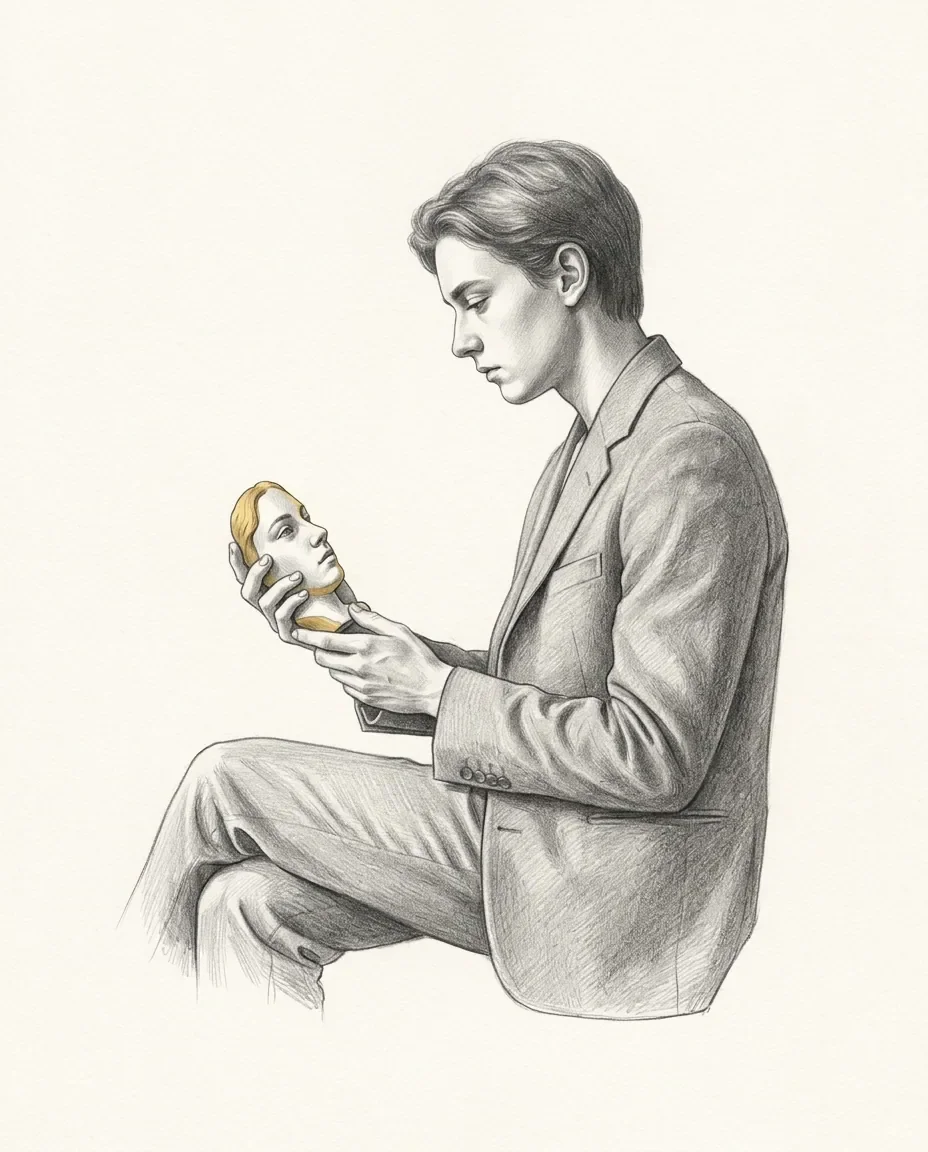
Erotic Target Identity Inversion
erotic target identity inversion
Added 22 Jun 2026 · Updated 22 Aug 2026
A theorized sexological pattern in which arousal is directed inward, at the fantasy of *becoming* the target rather than at the target itself. The person embodies the kind of being they are attracted to (a woman, an animal, an amputee). It is the inward-facing form of the erotic target location error.
- Prevalence
- Rare
- Category
- Identity & Transformation
- Clinical term
- erotic target identity inversion
- Domain
- Sexual interest · Paraphilia
- Confidence
- Low confidence
- Status
- A theorized paraphilic dimension in sexology, not a standalone DSM-5-TR or ICD-11 diagnosis; its component inversions may be discussed under Other Specified Paraphilic Disorder. The theory is actively researched and partly contested.
- Also known as
- ETII, erotic-target identity inversion, erotic target location error (parent concept), ETLE (parent concept), wish to become what one loves
- Added
- 22 Jun 2026
- Updated
- 22 Aug 2026
Overview
Erotic target identity inversion (ETII) is a sexological concept describing arousal turned inward: instead of desiring an external partner who has a particular feature, a person is aroused by the fantasy of being that feature, embodying the very kind of being they are attracted to. Anne Lawrence memorably glossed it as the wish to "become what we love." ETII is the inward-facing form of the broader erotic target location error (ETLE), the proposed family of conditions in which sexual interest is mislocated: shifted onto a peripheral part of a partner (the basis some theorists give for fetishism) or turned inward onto one's own body and identity, which is the inversion. This article covers the theory's lineage, its component inversions, the evidence base, and why it remains both actively researched and genuinely contested.
Definition & scope
ETLE, as summarised on Wikipedia, names a strong sexual interest in features located somewhere other than on a sexual partner. ETII is the specific case where the interest is relocated onto the self: arousal based on imagining oneself in another physical form, such as a woman, an animal, an infant, or an amputee. The key claim is that the outward attraction and the inward inversion are two expressions of one underlying interest, not separate conditions. ETII is a theoretical dimension, not a diagnosis, and it is distinct from gender identity: the model addresses patterns of arousal, and applying it to lived identity is exactly where much of the controversy sits.
Examples
What the term covers. ETII names a claimed structure rather than a behaviour: in every proposed case an outward attraction is paired with an inward wish to embody the same target, and the theory's whole content is the assertion that these are one interest and not two. Its documented instances are catalogued below under In practice, and each is a research claim about self-reported arousal, not a category of person.
What it does not cover. It is not a gender identity. Being a trans woman or a trans man is a statement about who someone is; ETII is a proposed description of a pattern of arousal, and treating one as an account of the other is the specific move most of the dispute concerns. It is not fetishism, which the parent model casts as the outward-facing error, displaced onto a peripheral part of a partner. It is not transformation fetish or gender swap fetish, fantasy genres about a body changing that make no claim about where an erotic target sits. It is not therianthropy or otherkin identity, which those communities describe as non-sexual. And body integrity dysphoria, an ICD-11-coded condition about limb ownership, is a live point of disagreement rather than a settled member of the family.
How the word is used. Purely academic. ETII and ETLE live in sexology journals and in the arguments about them; neither appears in the DSM-5-TR or the ICD-11, and vanishingly few people use either term to describe themselves. When the words surface outside the literature it is almost always inside a dispute about the underlying typology rather than as neutral description.
History & origins
Clinical lineage
The paired terms entered the literature in 1993, when sexologists Kurt Freund and Ray Blanchard published "Erotic target location errors in male gender dysphorics, paedophiles, and fetishists" in The British Journal of Psychiatry (162:558–563). The paper grew out of Blanchard's earlier work on autogynephilia and proposed that certain paraphilias arise from anomalies in how an erotic target is "located": sometimes shifted onto the wrong part of a partner, sometimes turned inward onto the self.
The framework was substantially developed by Anne Lawrence in her 2009 article "Erotic Target Location Errors: An Underappreciated Paraphilic Dimension" in the Journal of Sex Research (46(2–3):194–215). Lawrence catalogued the inward-facing variants and tied them explicitly to identity, arguing that wishing to embody a desired target can reshape a person's sense of self rather than merely their arousal. She also extended the model to plush- and costume-related variants such as autoplushophilia and fursuiting.
Testing the theory
In the 2010s and 2020s Kevin Hsu and J. Michael Bailey formalised ETII theory into a falsifiable prediction: for every external erotic target to which people are attracted, a subset will develop a corresponding internalized attraction and matching identity inversion. Hsu and Bailey first demonstrated the pattern in "Autopedophilia: Erotic-Target Identity Inversions in Men Sexually Attracted to Children" (Psychological Science, 2017). The team then tested the general prediction across three internet samples in Bailey, Hsu & Jang (2023), Archives of Sexual Behavior 54(8):2805–2823: men attracted to amputees (322), to animals (1,501), and to severely obese persons (402). Each sample contained a substantial minority reporting the matching inversion, and the strength of internalized attraction correlated almost perfectly (near 1.0 after correction for attenuation) with the strength of the identity inversion, which the authors read as strong support for a shared mechanism.
In practice
ETII is expressed mainly through fantasy and self-identification rather than any single behaviour. Documented forms each pair an outward attraction with an inward inversion:
- Autogynephilia: arousal at the thought or image of oneself as a woman, in a person assigned male at birth; the most-discussed internalized attraction in this literature, and the most disputed.
- Autoandrophilia: the counterpart in which arousal attaches to the thought of oneself as a man; far less studied than its opposite number.
- Autozoophilia: arousal at the idea of being an animal, which the theory places alongside some fursuiting and therian experiences, an overlap those communities largely reject, since both are usually described as non-sexual identity or performance.
- Autonepiophilia (paraphilic infantilism): arousal at occupying the role or self-image of an infant, conceptually distinct from any attraction to children.
- The amputation-focused inversion, the inward counterpart of attraction to amputees, linked to apotemnophilia.
Psychology
The theory proposes that an external attraction can become "internalized," so that the self is recruited as the erotic object. Lawrence connected this to identity formation, while Hsu and Bailey emphasise the tight statistical coupling between an attraction and its inversion as evidence of a single underlying process. The mechanism remains a hypothesis: it is inferred from self-report questionnaires in self-selected internet samples, not from biological markers, and the direction of causation is not established.
Prevalence & culture
How common is it?
Reliable population figures do not exist, so any estimate carries low confidence. As a named concept ETII is rare and lives mostly in academic sexology rather than mainstream kink culture, although its component interests vary widely in visibility. The Brown, Barker & Rahman (2020) internet study reported that mild inversion-related arousal is fairly common while strong forms are rarer, and rarer still in women.
Is the theory accepted?
No, not uniformly. ETII is contested. Critics dispute aspects of the underlying autogynephilia research and the typological claims built on it, particularly where the model is applied to transgender identity. It is best treated as an actively studied hypothesis rather than settled fact.
Safety, consent & law
As an abstract concept ETII describes private fantasy and identity and is neither illegal nor inherently harmful. Risk lies only within specific component interests: the amputation-focused inversion can involve self-harm urges that warrant clinical support, while any interest whose conduct would involve children or animals is criminal and harmful in practice, documented here strictly for clinical completeness. Responsible handling of the concept is descriptive, never instructional.
Common questions
What is the difference between an erotic target location error and an erotic target identity inversion?
The location error is the parent idea: sexual interest attaching somewhere other than to a whole partner. It has two directions. Outward, the interest lands on a peripheral part or attribute of a partner, which is the account some theorists give of fetishism. Inward, it lands on the person's own body and identity, the wish to be the thing rather than to have it. That inward case is the identity inversion.
Does the theory claim transgender people are motivated by a fetish?
That reading is the heart of the controversy, and this entry does not settle it. The model addresses self-reported patterns of arousal; critics argue that extending it to explain transgender identity mistakes one kind of claim for another, and dispute both the typology and the research it rests on. Proponents maintain the pattern is real and measurable. Being transgender is a matter of identity, and nothing in this literature establishes anything about any individual's.
Is autogynephilia the same thing as ETII?
No. One is an instance of the other. Autogynephilia is a single proposed inversion, and historically the first. ETII is the general class the theory built around it, covering the male counterpart and the animal, infant and amputee versions too. Because the general term was reverse-engineered from that one case, criticism of the original construct tends to travel to the whole framework.
Is erotic target identity inversion a diagnosis?
No. Neither ETII nor its parent concept appears as a diagnosis in DSM-5-TR or ICD-11. Individual inversions can be discussed clinically under the residual other-specified paraphilic disorder category, and only where the interest causes marked distress or impairment or involves someone who cannot consent. The framework itself is a research hypothesis about how interests are organised, not a label anyone is given.
How strong is the evidence for ETII theory?
Suggestive but limited, and the limits are not really disputed even where the conclusions are. The findings come from questionnaires filled in by self-selected internet volunteers, so the samples are not representative and nothing is measured beyond what people report about themselves. The correlations are strong, but a correlation between an attraction and its inversion does not establish which produces which, or that one mechanism underlies both. No biological marker has been identified.
Who proposed the idea, and when?
Kurt Freund and Ray Blanchard introduced the parent term, erotic target location error, in a 1993 paper in the British Journal of Psychiatry. Anne Lawrence developed the inward-facing side in 2009 and supplied its best-known gloss, the wish to become what we love. Kevin Hsu and J. Michael Bailey then turned it into a testable prediction from 2017 onward, which is the form most current argument is about.
- Desire to Be an Amputee21/100Apotemnophilia · Clinical ParaphiliasApotemnophilia is a rare condition in which a person desires to become an amputee, experiencing the absence of a specific limb as arousing. It may equally be felt as essential to their true body image. It overlaps closely with body integrity dysphoria, in which a healthy limb is felt as not belonging to the self.21
- Cross-Dressing60/100Transvestism · Identity & TransformationWearing clothing associated with another gender, sometimes for erotic arousal and sometimes for comfort, self-expression, or relaxation. When arousal is persistent and causes distress it is diagnosed clinically as transvestic disorder; the interest itself is benign and distinct from transgender identity.60
- Transvestic Disorder50/100Transvestic Disorder (Transvestic Fetishism) · Clinical ParaphiliasThe clinical diagnosis applied when recurrent sexual arousal from cross-dressing causes significant distress or impairment. It names the disordered presentation of an interest that is, in its non-distressing form, a common and benign variation.50
- Therianthropy / Therian Identity36/100Identity & TransformationA non-sexual subcultural identity in which a person feels themselves to be, in a personal and integral way, one or more non-human animals. It is distinct from clinical lycanthropy and from role-play.36
- Fursuiting37/100Identity & TransformationWearing a full or partial animal costume, a fursuit, to physically embody an anthropomorphic character, typically one's own fursona. It is predominantly a performative, playful, craft-driven and social activity within the furry fandom rather than a sexual one.37
- Dollification23/100Identity & TransformationA role-play and transformation kink in which one partner, the "doll", is styled, posed and treated as a lifelike human doll by a partner, the "maker". Costume, makeup, restrictive material or a doll-like persona create it. The charge comes from performing as a doll, not from attraction to an actual inanimate object.23
An English descriptive coinage: "erotic target" = the focus of sexual attraction; "identity inversion" = the turning of that target inward onto one's own identity. Coined in 1993 by sexologists Kurt Freund and Ray Blanchard as a subtype of the broader 'erotic target location error.'
erotic target location error · autoerotic identity · sexological theory
Prevalence is computed from the entry's cited population estimate. Rows marked ESTare indicative editorial estimates scored against a fixed anchor rubric, not measured quantities. Method & anchors: methodology.
Rare · ≈ 1 in 1,000
- 01Erotic target location error, Wikipediadefinition of ETII and ETLE, 1993 coinage by Freund and Blanchard, and the catalogue of inversions (autogynephilia, autoandrophilia, autozoophilia, autonepiophilia, apotemnophilia)
- 02Bailey, Hsu & Jang (2023), Elaborating and Testing Erotic Target Identity Inversion Theory in Three Paraphilic Samples, Archives of Sexual Behavior 54(8):2805-2823ETII theory prediction and empirical test in samples of men attracted to amputees (322), animals (1,501) and severely obese persons (402), each showing substantial minorities with the matching inversion
- 03Brown, Barker & Rahman (2020), Erotic Target Identity Inversions Among Men and Women in an Internet Sample, Journal of Sexual Medicine 17(1):99-110ETIIs across natal males and females, autogynephilia/autoandrophilia/autoanthropomorphozoophilia/autonepiophilia, and that mild inversion arousal is fairly common while strong forms are rarer and rarer in women
- 04List of paraphilias, Wikipediaclassification of the component inversions as recognized but uncommon paraphilic interests
- 05Freund & Blanchard (1993), Erotic target location errors in male gender dysphorics, paedophiles, and fetishists, British Journal of Psychiatry 162:558-5631993 coinage of 'erotic target location error' and the proposal that some paraphilias arise from anomalies in how the erotic target is located
- 06Hsu & Bailey (2017), Autopedophilia: Erotic-Target Identity Inversions in Men Sexually Attracted to Children, Psychological Science 28(1):115-123first empirical demonstration that an external attraction pairs with a matching internalized identity inversion, the founding test of ETII theory
- 07Lawrence (2009), Erotic Target Location Errors: An Underappreciated Paraphilic Dimension, Journal of Sex Research 46(2-3):194-215 (via Erotic target location error, Wikipedia)Anne Lawrence's elaboration of the inward inversions, the 'become what we love' gloss, and extension to plush/fursuit variants
- 08Sexual fetishism, Wikipediathe ETLE account of fetishism as the outward-facing form of an erotic target location error