Agonophilia
agonophilia
Added 7 Sep 2026
Arousal from a staged struggle: wrestling, pinning and mock resistance between partners who agreed to it. A forensic-glossary term for what most people who do it call wrestling or rough-housing.
- Prevalence
- Common
- Category
- Acts & Activities
- Clinical term
- agonophilia
- Domain
- Sexual interest
- Confidence
- Low confidence
- Status
- A consensual activity with no diagnostic status. It appears in forensic glossaries as a named paraphilia and in neither DSM-5-TR nor ICD-11.
- Also known as
- wrestling fetish, erotic wrestling, mock-struggle play, play-fighting kink, wrestling kink
- Added
- 7 Sep 2026
Featured in
Overview
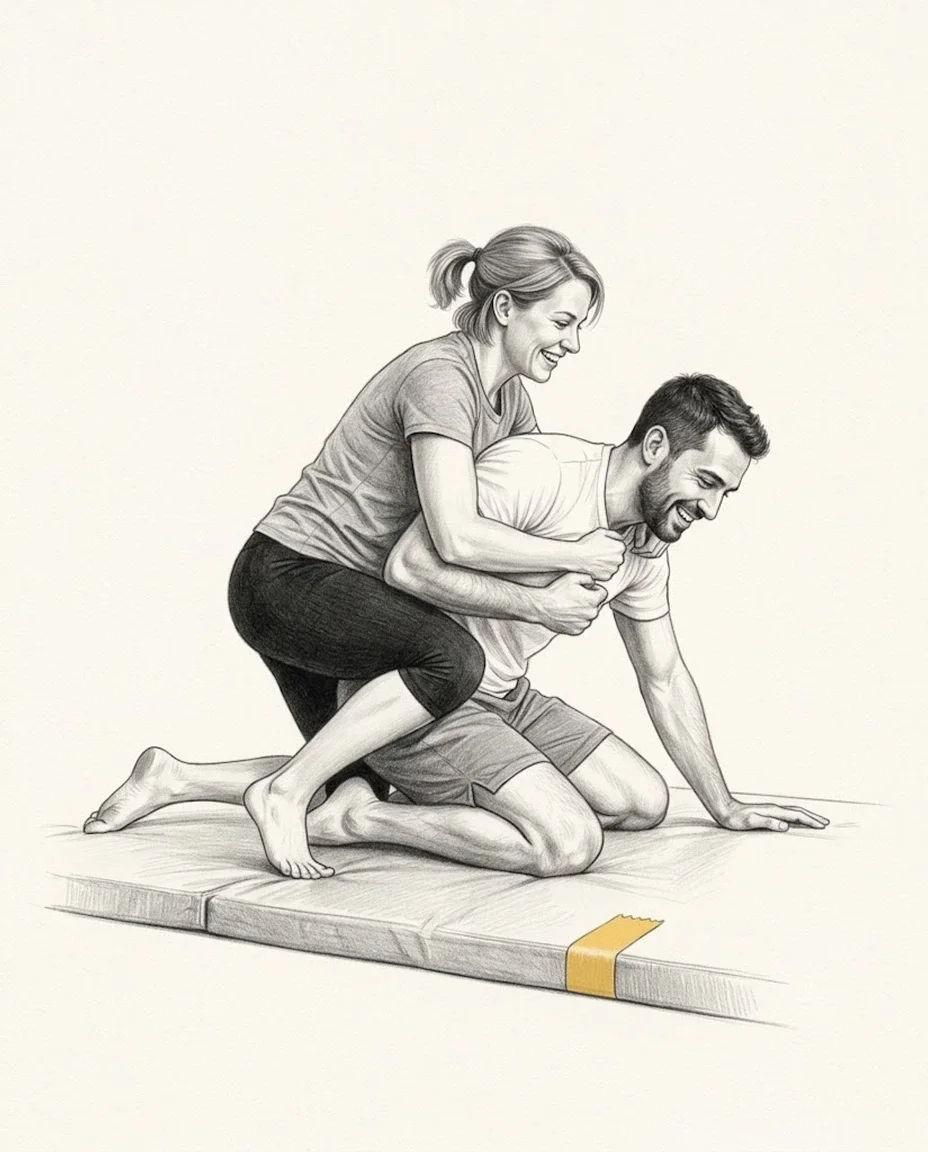
Agonophilia is arousal from a staged struggle: wrestling, pinning, play-fighting and mock resistance between partners who have agreed to it in advance. The word is a coinage of the forensic literature, built on the Greek agon, a contest, and it names a scene that most people who enjoy it call wrestling, rough-housing or primal play. The contest is the point. One partner tries to pin, hold or overpower the other; the other resists with real effort inside agreed limits; and the arousal comes from the exertion, the contact and the moment one of them wins.
Definition & scope
Physical contest defines the term. Two people (in some scenes more) grapple with the whole body, using strength, weight and balance the way wrestlers do, and the outcome is open enough that the struggle is real. What separates it from sport is the erotic charge and the setting; what separates it from a fight is consent, agreed rules and the absence of any intent to injure. Some couples wrestle as foreplay and stop when one is pinned. Some make the pin the scene and what follows the reward. Some treat the mock resistance as the whole act and never move past it.
Examples
What the term covers. Wrestling a partner for real until one is pinned; play-fighting that ends in a hold; a scripted contest with a wager on the outcome; the pleasure of being overpowered, or of overpowering, by physical means alone; watching filmed wrestling for its erotic charge; and the strength-and-balance contest that opens many primal play scenes before the biting and growling begin.
What the term does not cover. Consensual non-consent is a scripted scene in which one partner plays at not agreeing; the struggle in agonophilia is real and the resistance is honest effort inside the rules. Fear play trades on the feeling of danger; a wrestling bout trades on exertion. Impact play delivers sensation with implements and a still receiving partner; wrestling has no implements and no one holds still. Muscle worship admires the body that could win the bout without staging one. Tickling can look like a struggle and is a different sensation with a different aim.
How the word is used. It is a dictionary term. The forensic pathologist Anil Aggrawal listed agonophilia among several hundred paraphilias in his 2009 reference on unusual sexual practices, as the Wikipedia article on Aggrawal notes of the work, and the word has stayed in glossaries since. Neither DSM-5-TR nor ICD-11 mentions it. The people who do it say wrestling.
History & origins
The contest as spectacle
Wrestling has carried an erotic charge for as long as it has been watched. The Greek agon named the athletic contest of the ancient games, and the Online Etymology Dictionary traces agony itself to the same root, through the struggle of the contestant. In 1957 Roland Barthes opened Mythologies with an essay on professional wrestling as a spectacle of suffering, defeat and justice acted out with the body, and the Wikipedia article on the book records the essay as its best known.
The forensic coinage
The word came late and from an unlikely place. Aggrawal's 2009 Forensic and Medico-legal Aspects of Sexual Crimes and Unusual Sexual Practices compiled a glossary of paraphilias from the earlier literature, gave many of them Greek names for the first time in print, and listed agonophilia as arousal from a pretended struggle, with wrestling as its typical form. The list was written for forensic readers and made no claim that any item on it was a disorder. Popular glossaries copied the term, and reference lists, including this one, file the interest under it.
The market and the fantasy
The filmed genre is older than the word: mixed wrestling films were sold by mail order from the 1950s and moved online in the 1990s, with a session-wrestling market beside them. On the fantasy side, the interest borders on the ravishment fantasies that Critelli and Bivona studied in 2008, finding that 62 percent of 355 women in their sample had had a fantasy of being overpowered. A wrestling scene is one of the ways such a fantasy is played safely, with the resistance real and the outcome agreed.
In practice
The scene needs a soft floor, clear rules and a word that stops it. Couples agree what counts as a win, usually a pin held for a count, and what is out: no strikes, no chokes, no locks on the joints, nothing that a wrestler would call illegal. Mismatched strength makes it a handicap bout, and couples adjust the rules to keep the result uncertain. The bout may end the scene or open it. Where it opens a primal play scene, the wrestling sets the roles that the rest of the scene keeps.
Psychology
No dedicated research exists on the interest, and the standing accounts are borrowed from its neighbours. Exertion raises heart rate and adrenaline, and the arousal-transfer effect that Dutton and Aron described in 1974 predicts that the excitement of a contest is read, in an erotic setting, as desire. The power dimension runs through dominance and submission: winning and losing a bout are dominance and submission decided by the body, with no negotiation needed beyond the rules. Competition is pleasurable in itself, and here the stakes are set at what both players want.
Prevalence & culture
No survey measures the interest by name. The catalog's estimate of about 2 percent of adults is an editorial figure anchored to the size of the filmed-wrestling market and to the neighbouring entries, primal play and consensual non-consent, whose scenes contain it. The fantasy of being overpowered is far more common than the practice: the 62 percent in Critelli and Bivona's 2008 sample covers every version of the fantasy, and a wrestling bout is one of its gentler enactments. Culturally the interest is visible through professional wrestling's long flirtation with it and through the mixed-wrestling genre, which has its own studios, performers and conventions.
Safety, consent & law
Between consenting adults the practice is legal everywhere. The risks are the risks of wrestling: sprains, bruises, a knock to the head on a hard floor, and the joint and neck injuries that come from holds a trained wrestler would refuse. Mats, agreed rules, no chokes and a stop word that both partners honour at once remove most of it. The interest has no diagnostic status in either manual, and it becomes a clinical matter only on the general threshold: distress, impairment, or a partner who has not agreed.
Common questions
What is a wrestling fetish called?
Agonophilia, in the paraphilia glossaries, from the Greek word for a contest. The term comes from Anil Aggrawal's 2009 forensic reference and has no clinical standing; the people who have the interest call it wrestling, play-fighting or rough-housing, and the catalog lists it under the glossary name so that both searches land here.
Is erotic wrestling the same as consensual non-consent?
No. In consensual non-consent one partner plays at not agreeing to a scripted scene. In a wrestling bout both partners agree to the contest and the resistance is honest effort inside the rules, with an outcome that is open until someone is pinned. The two can share an evening, and they are different scenes.
Is wrestling with a partner safe?
Yes, with the precautions any wrestling needs. A soft floor or mat, no strikes, no chokes, no locks on the joints, and a stop word that ends the bout at once remove most of the risk. Sprains and bruises remain possible, as in any grappling sport. The interest has no diagnostic status in the DSM-5-TR or the ICD-11.
Why is wrestling arousing to some people?
No study has asked about the interest by name, so the standing explanations are borrowed. Exertion raises adrenaline, and the arousal-transfer effect Dutton and Aron described in 1974 predicts that excitement in an erotic setting reads as desire. A bout also decides dominance and submission by the body alone, and competition is pleasurable in itself.
How common is a wrestling fetish?
No survey measures it. The catalog's estimate of about 2 percent of adults is an editorial figure anchored to the filmed-wrestling market and to the neighbouring entries whose scenes contain a struggle. The related fantasy is far commoner: Critelli and Bivona found in 2008 that 62 percent of 355 women had fantasised about being overpowered.
What is session wrestling?
A private bout bought from a trained wrestler, usually a woman advertising to male clients, with rules agreed in advance and no sexual contact as the norm. It grew alongside the mixed-wrestling film genre from the 1990s and is the commercial form of the interest; the catalog's subject is the interest itself, between partners.
- Primal Play33/100Identity & TransformationA consensual style of intimacy in which partners drop social restraint and act from an instinctual, animalistic headspace. It most often takes the form of predator-and-prey dynamics. In its feral register it overlaps with therian identity and inner-animal embodiment rather than scripted scenes.33
- Consensual Non-Consent64/100Power, Roles & ScenariosA negotiated power-exchange scenario in which adults agree in advance to enact a scene of simulated non-consent. The fiction of resistance or being overpowered is staged while real, ongoing consent underlies the whole encounter. Categorically distinct from actual assault.64
- Fear Play33/100Sensation & PainA consensual BDSM practice that deliberately evokes controlled fear, startle, or adrenaline within a negotiated scene to heighten arousal. It draws on the body's fight-or-flight response. A niche, psychologically intense form of edge play.33
- Impact Play71/100Sensation & PainAn umbrella term for consensual BDSM activities in which one partner strikes another's body with a hand or implement for erotic sensation or power exchange. It spans light spanking through to firmer use of paddles, floggers, crops, and canes within negotiated limits.71
- Muscle Worship45/100Sthenolagnia · Body Parts & PartialismAn erotic interest in muscular physique and displays of physical strength, encompassing admiration of developed musculature. For some, arousal is tied to demonstrations of power and the hands-on appreciation of a partner's muscles.45
- Dominance and Submission92/100Power, Roles & ScenariosA consensual erotic dynamic in which one partner takes a dominant role and the other a submissive role, exchanging power within agreed limits. It is one of the most widespread elements of BDSM and of human sexual fantasy.92
From the Greek agon, "contest", the athletic struggle of the ancient games, plus -philia. The compound entered the paraphilia glossaries through Anil Aggrawal's 2009 forensic reference and has no earlier clinical history.
wrestling · rough play · physical contest · power play
Prevalence is computed from the entry's cited population estimate. Rows marked ESTare indicative editorial estimates scored against a fixed anchor rubric, not measured quantities. Method & anchors: methodology.
Common · ≈ 1 in 20
- 01Anil Aggrawal, Wikipedia (Forensic and Medico-legal Aspects of Sexual Crimes and Unusual Sexual Practices, 2009)the 2009 forensic reference whose glossary of several hundred paraphilias lists agonophilia
- 02Critelli & Bivona (2008), Women's erotic rape fantasies: an evaluation of theory and research, J. Sex Research 45(1):57-7062 percent of 355 women reported having had a fantasy of being overpowered; the fantasy neighbourhood the interest borders
- 03Mythologies (book), WikipediaRoland Barthes's 1957 essay on professional wrestling as a spectacle of domination and defeat acted out with the body
- 04agony, Online Etymology Dictionarythe Greek root agon, contest, from which the term is built
- 05DSM-5-TR, Paraphilic Disorders (American Psychiatric Association, 2022)no listing; the interest has no diagnostic status
- 06ICD-11, Paraphilic disorders (World Health Organization)no listing; consensual physical play is outside the paraphilic disorders