Primal Play
Added 21 Jun 2026 · Updated 7 Sep 2026
A consensual style of intimacy in which partners drop social restraint and act from an instinctual, animalistic headspace. It most often takes the form of predator-and-prey dynamics. In its feral register it overlaps with therian identity and inner-animal embodiment rather than scripted scenes.
- Prevalence
- Uncommon
- Category
- Identity & Transformation
- Domain
- Sexual interest
- Confidence
- Low confidence
- Status
- Not a recognized paraphilia; a consensual instinct-driven intimacy and role-play style, benign among consenting adults.
- Also known as
- feral primal identity play, feral play, therian role-play, therianthropic role-play, primal predator/prey, instinctual play
- Added
- 21 Jun 2026
- Updated
- 7 Sep 2026
Featured in
Overview
Primal play (also called feral play) is a consensual style of intimacy in which adults set aside ordinary social composure and act from an instinctual, animalistic headspace, most often through predator-and-prey or hunter-and-hunted dynamics. In its feral-identity register it overlaps with therianthropic role-play, where a participant channels an inner, non-human sense of self. The focus falls on embodied instinct and sensory immediacy rather than the scripted scenes and formal protocols of structured kink. This article traces the feral/therian variant of primal play: where it came from, how it is expressed, why it appeals, and how practitioners keep it safe.
Definition & scope
Primal play sits inside the wider world of BDSM and power exchange, but it defines itself against that world's rulebooks. Where a formal scene may run on contracts, honorifics, and rehearsed protocol, primal play is described by community glossaries as instinctual and responsive to in-the-moment impulse, with the accent on the visceral experience rather than the script. The most common form is the predator-and-prey dynamic: one partner stalks or chases, the other flees and is caught, with the charge coming from a controlled mix of fear, pursuit, and release.
The terms primal and feral are often used interchangeably, though feral tends to signal the more thoroughly animal, less humanly self-aware end of the register. This entry documents that far end, where the practice touches on identity: a participant may not merely act feral for a scene but experience an inner-animal sense of self drawn from the therian subculture. That distinction, mood versus identity, is what separates this variant from ordinary hunter/prey primal play.
Examples
What the term covers. Between consenting adults, the recognisable forms are physical and unscripted: a chase in which one partner stalks and the other flees and is caught; wrestling, pinning and holding down; growling, snarling and other pre-verbal vocalisation; biting and scratching within negotiated limits. Participants usually describe themselves as running "predator" or "prey," and many switch between the two. At the feral end documented here, a participant may not be performing an animal at all but embodying an inner-animal sense of self drawn from therian identity, in which case the scene expresses something they already are rather than a role adopted for the evening.
What the term does not cover. Pet play and Agonophilia is the wrestling form, a mock struggle with rules and a winner, where primal play has no rules at all. animal role-play (including human pup play and kitten play) take on a domesticated persona, usually with a handler, gear and a caretaking dynamic that can be entirely tender; primal is undomesticated and often uses no gear at all. The furry fandom is a fan culture built around anthropomorphic characters and is largely non-sexual, and fursuiting is costume rather than headspace. Therianthropy and otherkin are sincere non-sexual identities that some primal players hold and most do not. A chase built on scripted refusal is consensual non-consent and needs that negotiation on top of this one. Clinical lycanthropy, a delusional psychiatric syndrome, has nothing to do with any of it.
How the word is used. Both "primal" and "feral" are community coinages from kink spaces in the 2000s, used loosely and often interchangeably, with feral signalling the more thoroughly animal end of the register. Neither is a diagnosis and neither appears in DSM-5-TR or ICD-11; therian is a self-descriptive subcultural term in continuous use since the 1990s.
History & origins
The feral-identity variant of primal play is a recent, community-generated practice rather than a clinical category, and its precise coinage is not well documented.
Clinical lineage
Feral play does not descend from the classical sexological catalogues. Richard von Krafft-Ebing's Psychopathia Sexualis (1886) and Havelock Ellis's Studies in the Psychology of Sex named dozens of attractions but not this one, and it appears in neither the DSM-5-TR nor the ICD-11 as a disorder. Both manuals reserve a paraphilic diagnosis for interests that cause distress, impairment, or harm to a non-consenting party, and a consensual instinct-driven intimacy style does not meet that bar. In clinical terms it is best read against the broad, largely depathologised understanding of consensual power exchange.
Cultural & subcultural evolution
The modern shape of feral play was forged at the meeting point of several online subcultures rather than in a single coinage:
- 1993: The therian subculture coalesces online. The Usenet werewolf-fiction group alt.horror.werewolves shifts from recommending fiction to hosting sincere personal accounts of experiencing animal transformation on a mental or spiritual level. Members settle on neologisms such as "shifter," "were," and eventually "therianthrope." This inner-animal identification supplies the identity layer of feral play.
- 2000s: The broader "primal" kink label spreads through kink forums, educational writing, and the growth of the furry fandom, framing an instinctual, less rule-bound alternative to protocol-heavy BDSM.
- 2008 onward: Community platforms such as FetLife (launched 2008) give primal- and feral-leaning practitioners groups to organise around, and the therian/feral register consolidates as a distinct, if niche, expression alongside other transformation play like pony play.
- 2010s–2020s: Mainstream lay coverage begins to catalogue primal/feral play as an emerging but small kink, as in Glamour's A-Z of kinks.
The distinguishing feature of this entry, set against the more general hunter/prey form, is its closeness to identity: acting from an inner animal self rather than merely adopting a feral mood.
In practice
Feral play is expressed through unscripted, kinetic behaviour: chasing, pinning, growling, wrestling, biting, scratching, and other physical interaction, with little reliance on the formal contracts and protocols of conventional BDSM. Participants may identify with a therian or inner-animal sense of self, or simply slip into a feral headspace for a scene. The accent falls on embodied instinct, sensory immediacy, and a primal exchange of energy rather than on a pre-written script.
Psychology
The appeal is usually described in terms of authenticity and release, a feeling of returning to something pre-verbal, instinctual, and unselfconscious, and a power exchange expressed through raw physicality rather than rules. For therian-identified practitioners, the activity can also be the embodiment of an existing inner-animal identity rather than a purely erotic role. The interest draws from furry, therian, and broader kink communities, though many practitioners experience it simply as a more visceral mode of intimacy.
Is feral play normal?
Yes, among consenting adults it is a benign variant of consensual power-exchange play, not a mental disorder. The evidence base specific to feral/therian play is thin, and survey research on dominance-and-submission desire provides only a broad backdrop, but nothing about the practice meets the clinical threshold for a paraphilic disorder.
Prevalence & culture
How common is feral play?
It is rare. Prevalence can only be estimated from dedicated online groups and the practice's presence inside larger kink and furry communities, since no dedicated prevalence study exists. For scale, Lehmiller's Tell Me What You Want (2018), a survey of 4,175 Americans, found BDSM-flavoured fantasies to be near-universal (only about 4% of women and 7% of men reported never having one, and roughly 60-65% had fantasised about inflicting or receiving pain). The specific feral/therian identity register is a small fraction of that broad appetite. Cultural visibility is limited and grows mainly through kink-education content; formal clinical literature remains minimal.
Safety, consent & law
The practice is not a recognised paraphilia and is legal and benign among consenting adults. Because it can become physically vigorous, responsible practice stresses clear prior negotiation, safewords or non-verbal signals (which matter especially when speech is limited in a feral headspace), and awareness of real injury risk: bites and scratches break skin, which means blood contact and a genuine infection risk, while chasing and wrestling produce bruises, strains and falls. Attentive aftercare closes the scene. Where a scene leans into a struggle or capture dynamic, it shades into consensual-non-consent territory, and the same advance-negotiation standards apply.
Variations & related interests
Feral play sits adjacent to other transformation and power-exchange interests, including pony play, female masking, and scenario-based teacher role-play, as well as the broader hunter/prey form of primal play.
Common questions
What is the difference between primal play and pet play?
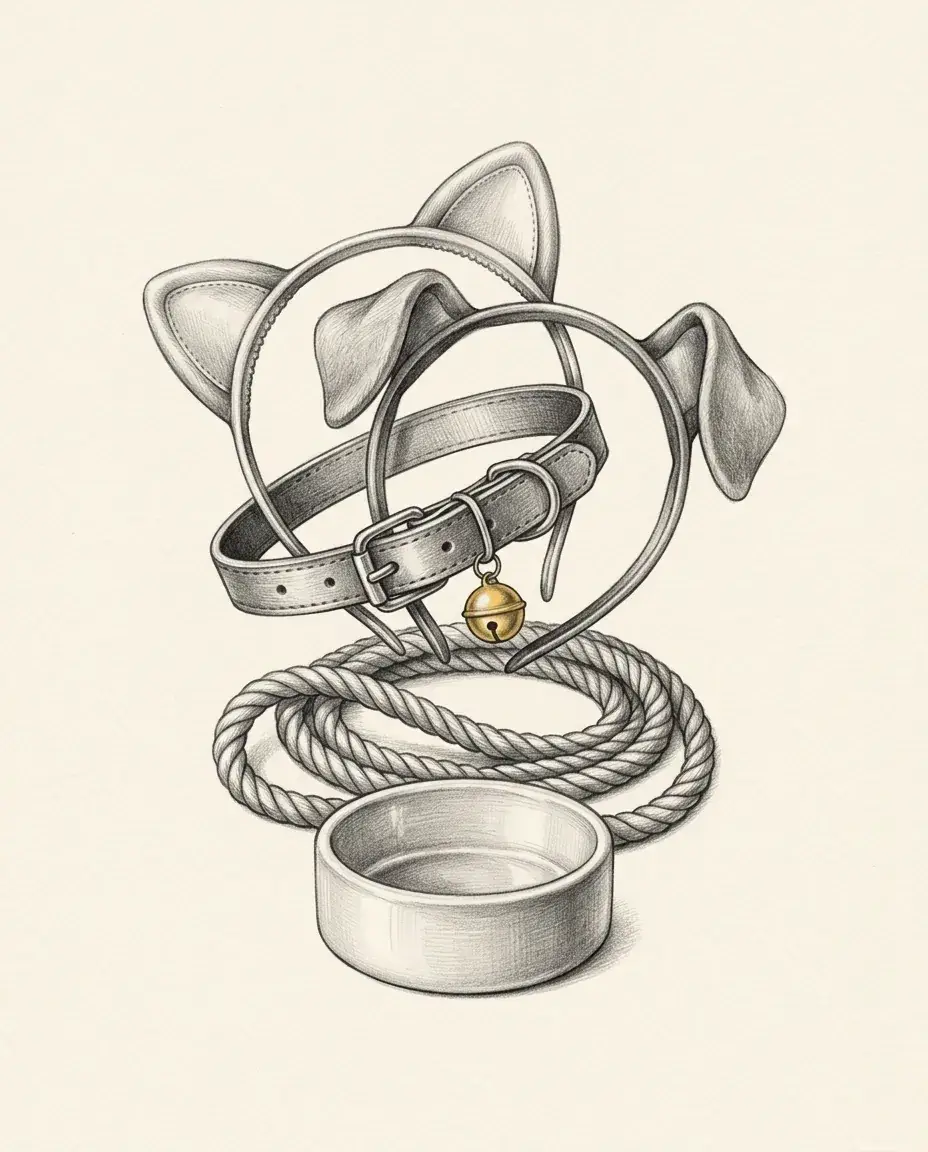
Domestication. Pet play casts a partner as an animal inside a human household: a puppy, kitten or pony with a handler, frequently with collars, mitts, tails and a caretaking dynamic that can be wholly tender. Primal play has no owner and usually no gear; the animal register is wild rather than kept, and the interaction is chasing, pinning and wrestling rather than being looked after. Plenty of people do both, in different moods.
Do you have to be a therian to enjoy primal play?
No, and most players are not. Therianthropy is a sincere, non-sexual identity in which a person experiences themselves as a non-human animal in some integral way. Primal play is a style of intimacy anyone can drop into for an evening. The two meet at the feral end of the register, where a therian-identified player may be embodying an existing sense of self, but the practice does not require the identity.
How do you use a safeword in primal play if you are not speaking?
By agreeing on something that is not a word. A feral headspace often suppresses speech, so players commonly settle in advance on a physical signal (repeated tapping on a partner or the floor, dropping a held object, or a specific gesture) that stops everything immediately. Because the play is fast and unscripted, that signal has to be negotiated before anything begins rather than improvised mid-scene.
Is primal play the same as consensual non-consent?
No, though the two are easy to confuse and often combined. Primal play is about instinct and physicality, and a chase can be pure energy rather than a fiction of refusal. Consensual non-consent specifically means agreeing in advance to enact resistance that will be overridden. A primal scene that builds in real struggle or capture crosses into that territory and needs its own explicit limits.
What are the injury risks in primal play?
Real ones, because the play is fast and physical. Bites and scratches break skin, which raises the same blood-contact and infection questions any exchange of body fluids does, and wrestling and chasing produce bruises, strains, falls and harder impacts than intended. Nails and teeth are the two hazards players name most often. Agreeing limits on force and visible marks in advance, and checking each other afterwards, is standard practice.
Is primal play always sexual?
Not necessarily. Many people describe primal scenes that are intensely physical and entirely non-genital: chasing, wrestling, being caught, ending in closeness rather than sex. For therian-identified participants the feral element can sit closer to self-expression than to arousal. It is catalogued here as a sexual interest because that is its most common context, not because the register demands it.
Is being into primal play a sign of a mental disorder?
No. Neither DSM-5-TR nor ICD-11 lists it, and both reserve a paraphilic diagnosis for interests that cause the person distress or impairment, or that involve a non-consenting party. A consensual, instinct-driven style of intimacy between adults meets none of those conditions. Feeling more like yourself while acting from instinct is not a symptom of anything.
How common is primal play?
Rare, and no study measures it directly. The nearest frame is Lehmiller's 2018 survey of 4,175 Americans, which found BDSM-flavoured fantasy close to universal: only about 4% of women and 7% of men reported never having one. The specific feral and therian-identified register is a small fraction of that, visible mainly through dedicated online groups rather than any published count.
- Pony Play34/100Power, Roles & ScenariosA consensual adult role-play in which one partner adopts the persona, posture, and movement of a horse while another acts as handler, trainer, or rider. It is a specialized branch of animal role-play emphasizing equestrian tack and trained behaviour.34
- Female Masking17/100Identity & TransformationFemale masking is the practice of wearing a lifelike full-head silicone or latex mask to present as a woman or as an idealized doll-like figure. A matching body suit is usually worn with it. It centres on transformation, embodiment and total concealment of the wearer's own identity.17
- Teacher Roleplay62/100Power, Roles & ScenariosAn authority role-play sub-genre built around an imagined power gap between a figure of rank and a subordinate: teacher and student. Professor, boss and employee, and coach are other pairings in the same mode. Arousal comes from the eroticized hierarchy enacted between consenting adults inside a fictional frame.62
- Transformation Fetish33/100Metamorphophilia · Identity & TransformationA transformation fetish is an erotic or imaginative fascination with the process of a body changing form into something else. That might be an animal, an object, or another kind of being. The appeal centers on the metamorphosis itself rather than the end state.33
- Self-As-Female Arousal32/100Autogynephilia · Identity & TransformationAutogynephilia is a contested research construct describing sexual arousal at the thought or image of oneself as female. The proposed pattern concerns people assigned male. It appears in the DSM-5 only as a specifier for transvestic disorder, not as a stand-alone diagnosis.32
- VTuber Attraction32/100Identity & TransformationAn eroticized or romantic attraction to VTubers, online entertainers who perform behind computer-generated avatars. It is largely a parasocial interest, directed at a designed persona and its avatar rather than at a known real-world partner, and is an emerging, culturally current phenomenon.32
Plain-English descriptors: 'primal' (Latin primus, 'first') in the sense of 'instinctual, pre-civilized', and 'feral' (Latin fera, 'wild animal'). The associated identity term 'therian' derives from Greek thērion ('wild beast') plus anthrōpos ('human being'); therianthropy appears in English as early as 1901 for animal-transformation folklore, and the modern self-descriptive usage was coined within the online therian community from 1993 onward. No formal clinical derivation.
animal role-play · instinctual embodiment · power exchange
Prevalence is computed from the entry's cited population estimate. Rows marked ESTare indicative editorial estimates scored against a fixed anchor rubric, not measured quantities. Method & anchors: methodology.
Uncommon · ≈ 1 in 100
- 01An A–Z of Kinks and Fetishes, Glamourmainstream lay coverage of primal/feral play as an emerging but niche kink
- 02FetLife, kink community group sizes (community-size proxy)community-size proxy for primal-play groups indicating a small but active interest base
- 03Lehmiller (2018), Tell Me What You Want, survey of 4,175 Americansinstinctual power-exchange role-play falls within the broader BDSM fantasy spectrum but at a far rarer sub-niche level
- 04Fantasy Island: Research Probes the Science of Sexual Desire, Psychology TodayPsychology Today's write-up of Lehmiller's fantasy research and the near-universal reach of BDSM/dominance-submission fantasies, the broad backdrop feral play sits within; it reports no figure specific to primal or feral play
- 05Primal Play, Consent Culture glossaryCommunity definition of primal play as instinctual, impulse-driven and unscripted, with predator/prey dynamics and an emphasis on negotiation, safewords and aftercare.
- 06Therian subculture, WikipediaDocuments the therian community's online emergence around 1993 on alt.horror.werewolves and the Greek etymology (thērion + anthrōpos); supplies the inner-animal identity layer of feral play.
- 07Psychopathia Sexualis, WikipediaKrafft-Ebing's 1886 sexological catalogue, used to show feral play has no classical clinical pedigree.
- 08BDSM, WikipediaContext for the consensual power-exchange spectrum against which feral play is read clinically.
- 09DSM-5-TR, Paraphilic Disorders (American Psychiatric Association, 2022)Diagnostic manual reserving paraphilic diagnosis for distress/impairment/harm; feral play is not listed.
- 10ICD-11, Paraphilic disorders (World Health Organization)International classification reserving paraphilic disorder for harm to others; feral play is not listed.