
Chastity Play
Added 21 Jun 2026 · Updated 22 Aug 2026
Chastity play is a consensual power-exchange practice in which one partner surrenders control over their own sexual release, often via a wearable device. That control passes to a partner ('key-holder') who governs if and when orgasm is permitted. A form of orgasm control, not a paraphilia.
- Prevalence
- Common
- Category
- Power, Roles & Scenarios
- Domain
- Sexual interest
- Confidence
- Medium confidence
- Status
- Not a paraphilia or disorder; a negotiated consensual power-exchange and orgasm-control dynamic among adults.
- Also known as
- enforced chastity, orgasm control, denial play, key-holding, chastity device play, chastity key holding, keyholding
- Added
- 21 Jun 2026
- Updated
- 22 Aug 2026
Featured in
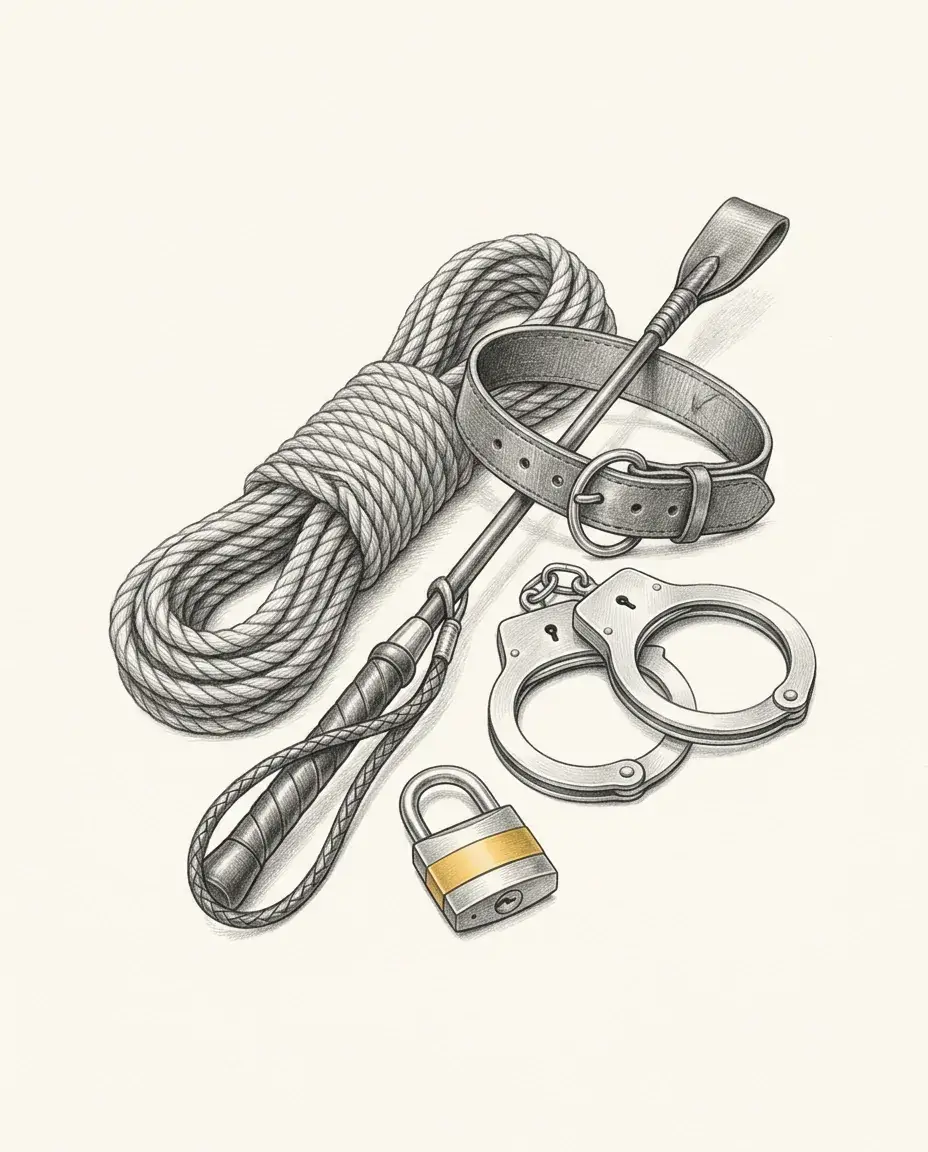
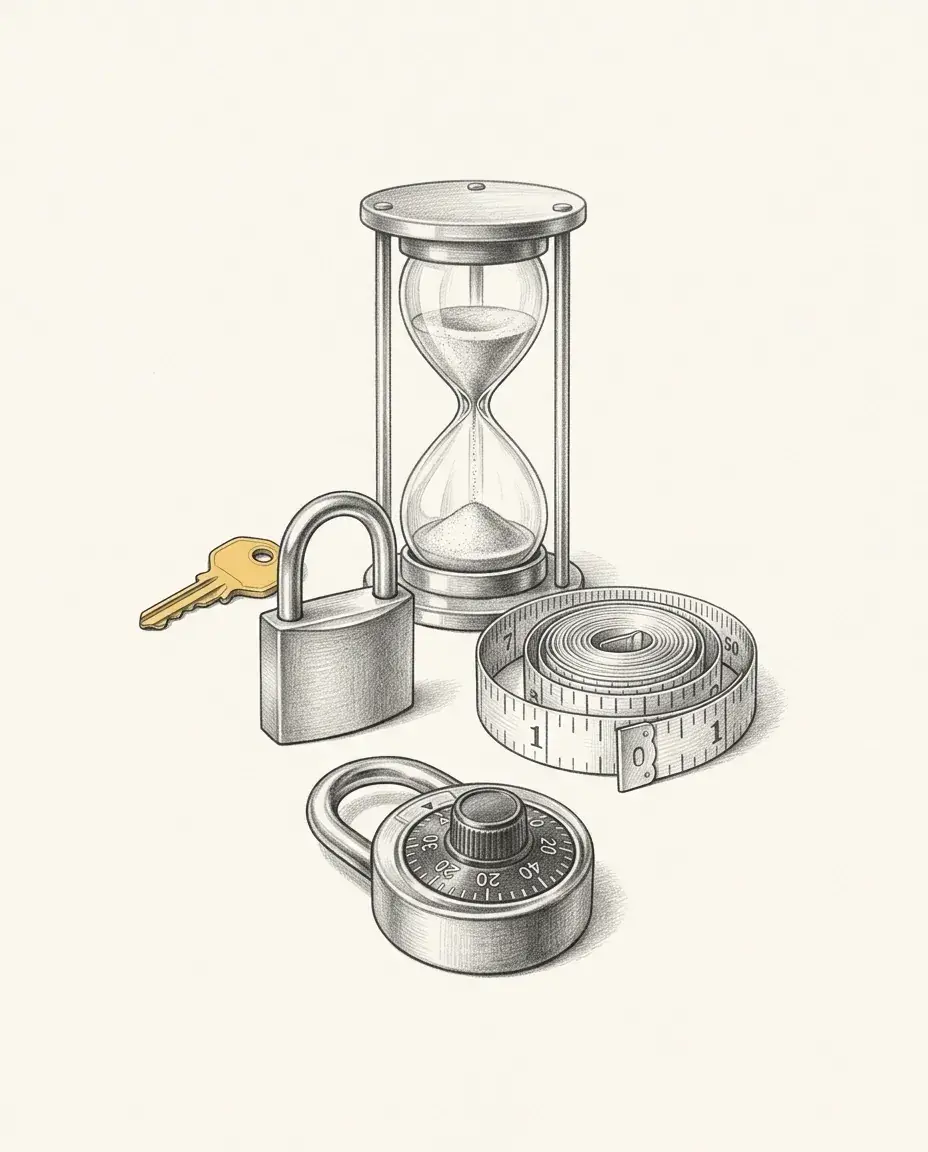
Overview
Chastity play, also called enforced chastity or orgasm control, is a consensual power-exchange practice in which one partner voluntarily surrenders control over their own sexual release to another. It frequently involves a wearable chastity device that physically prevents stimulation, paired with a dominant partner, the "key-holder," who governs if and when orgasm is permitted. As a negotiated dynamic between consenting adults it is regarded as a normal variant of erotic behaviour and a form of orgasm control, not a paraphilia or disorder. This article covers how the practice is defined, its modern subcultural lineage, how it is expressed, its psychology, and the physical and consent considerations that attach to it.
Definition & scope
Chastity play centres on the erotic charge of withheld release rather than any specific act. Three elements recur: negotiated rules about what stimulation is permitted; the optional use of a wearable device (a cage or belt); and a person who holds the symbolic or literal key. It overlaps with, but is not identical to, orgasm denial: denial can be practised with no hardware at all through "tease and denial," whereas chastity play usually foregrounds the locked device as a tangible token of surrendered control. It is not a medical diagnosis, not a fertility measure, and, in its consensual erotic form, unrelated to the coercive historical devices whose myth it borrows.
Examples
What the term covers. At its simplest, a rule and nothing else: an agreement that one partner does not orgasm before a named time, kept by honesty rather than hardware. More often it involves a wearable cage or belt and a physical key held by the other partner, worn for a session of a few hours, across a weekend, or over weeks with scheduled removals for washing. Arrangements are frequently conducted at a distance, the key-holder granting or refusing permission by message; they are frequently ritualised, with the controlled partner asking permission, reporting compliance, or being allowed a session that stops deliberately short of release.
What the term does not cover. Orgasm denial and tease and denial are the broader practices chastity play sits inside, and neither requires a device or a key-holder. Edging is the technique of approaching release and stopping short, a ruined orgasm is one that is permitted but deliberately spoiled, and a forced orgasm is the inverse dynamic, release compelled rather than withheld. Collaring is a different token of the same kind of commitment. Religious or personal celibacy shares the word and none of the erotic frame, and the coercive belts of popular legend are the object's disputed ancestry rather than this practice's.
How the word is used. Community vocabulary out of modern BDSM rather than clinical language: "key-holder", "keyholding", "locked", "caged" and "enforced chastity" all come from that milieu, and none appears in the DSM-5-TR or the ICD-11. "Enforced" is a scene word and reads misleadingly outside one, since the enforcement is agreed in advance and can be withdrawn by the controlled partner at any moment. That revocability is the whole distinction between the practice and the historical object it takes its name from.
History & origins
From restraint devices to myth
Devices and customs meant to restrict sexual activity are old and varied, but the lurid popular image of knights locking partners into iron belts during the Crusades is largely a later fiction. According to the Wikipedia survey of the chastity belt, there is no credible evidence that such belts existed before the 15th century: the earliest clear reference appears in Konrad Kyeser's Bellifortis (c. 1405), and many "medieval" museum specimens are now recognised as 19th-century forgeries. Real, widespread manufacture of restraint devices belongs to the 1800s, when Western medicine wrongly pathologised masturbation and marketed anti-onanism appliances. Modern chastity play therefore inherits the object but not the coercive medieval myth.
A modern BDSM dynamic
Chastity play as a consensual erotic dynamic belongs to the modern BDSM tradition rather than to clinical sexology. Its governing ethic, "safe, sane and consensual" (SSC), was drafted in 1983 by david stein together with Martin Berkenwald and Bob Gillespie for a statement of purpose for New York's Gay Male S/M Activists (GMSMA), and published in the group's founding document in August 1983. Stein credited an earlier "safe and sane" usage by Tony DeBlase in Chicago's Inferno 10 (1981) as a probable prompt. The later "risk-aware consensual kink" (RACK) framing, proposed by Gary Switch on a TES-Friends discussion list in November 1999, refined SSC by acknowledging that no kink is perfectly "safe." The community vocabulary (enforced chastity, orgasm denial, tease and denial, key-holding) comes from this milieu; the precise coinage of these specific phrases is not well documented.
Clinical positioning
Sexologists treat the underlying drive, eroticised restraint and the heightening of desire through delay, descriptively rather than diagnostically. Contemporary manuals such as the DSM-5-TR and ICD-11 classify consensual, non-distressing power exchange as ordinary sexual behaviour, not pathology, mirroring the broader 20th-to-21st-century shift from pathologising to depathologising consensual kink. See also the closely related orgasm denial and dominance and submission entries.
In practice
Chastity play is expressed through negotiated rules about permitted activity, the optional use of a wearable device, and an agreed arrangement in which one partner holds the key. Periods of denial may last hours, days, or much longer by agreement, and the dynamic is frequently combined with tease-and-denial, dominance and submission, and aftercare. Open communication, hygiene checks, and the freedom to end the arrangement at any time are standard. It is non-explicit at the level of dynamic: the eroticism lies in the control and anticipation, not in any particular act.
Psychology
What is the appeal of chastity play?
The appeal is commonly linked to the intensification of desire that accompanies delay, to the eroticism of surrendering or holding control, and to the relational intimacy of entrusting one's release to another. For the controlled partner, denial can heighten anticipation, focus, and a sense of devotion; for the key-holder it offers a clear, ongoing expression of dominance and care. Because rigorous research targets the broader BDSM/power-exchange umbrella rather than chastity play specifically, the evidence base for these proposed mechanisms is largely descriptive and drawn from community accounts.
Prevalence & culture
Chastity and orgasm-control themes sit within the very common BDSM/power-exchange fantasy space: in Lehmiller's Tell Me What You Want (2018) survey of 4,175 Americans, BDSM-themed fantasies were near-universal, providing the umbrella under which orgasm control falls, though chastity play is not itemised separately. The practice has a visible, organised presence in BDSM communities and online forums and is supported by an active market in wearable devices. Mainstream cultural visibility is modest but growing alongside broader coverage of kink, and the dynamic is widely catalogued in lay guides such as Glamour's A–Z of kinks.
Safety, consent & law
Is wearing a chastity device safe?
A correctly fitted device worn with attention to hygiene is generally tolerated, but the physical risks are real and they rise with the length of wear. Fit is the main variable: a ring that is too tight compresses tissue and restricts blood flow, while one that is too loose chafes and lets the device shift and pinch. Prolonged or ill-fitting wear can cause skin irritation, chafing, pressure sores, trapped moisture and secondary infection, impaired circulation, and reversible nerve numbness or tingling. Erections during sleep are a common source of pain and disrupted rest in the early weeks, and are the usual way a wearer discovers the device is the wrong size. Hygiene is not optional: the skin under and around the device needs regular cleaning and thorough drying, and most wearers remove the device periodically rather than relying on rinsing it in place. Pain, numbness, swelling, discolouration, discharge or any break in the skin means removing it immediately and, if the change does not resolve, seeking medical advice, since circulatory compromise is time-sensitive. Devices integrated with a piercing add the risks of the piercing to those of the device. The controlled partner must always be able to remove the device in an emergency, which means an accessible spare key or a cutting tool, and never a lock only another person can open. As with all power exchange, the practice depends on genuine, informed, ongoing consent under the SSC/RACK ethic, clearly negotiated limits, and an unconditional right to stop. It is legal between consenting adults in private. Where chastity is layered with surrendered-control fantasies it overlaps with consensual non-consent, which makes explicit pre-negotiation especially important.
Common questions
What does a key-holder actually do?
The key-holder sets and enforces the rules of the arrangement: what stimulation is permitted, how long the denial lasts, and whether and when release is granted. In practice the role involves as much attention as authority, since it also covers checking in on comfort and hygiene, deciding when a device should come off, and handling aftercare. The key may be literal or entirely symbolic, and long-distance arrangements often work by message alone.
Is chastity play the same as orgasm denial?
No. Orgasm denial is the wider practice of withholding release, and it can be done with nothing but an agreement, as in tease and denial. Chastity play is the version that foregrounds a locked device and a key-holder, turning the surrendered control into a physical object. All chastity play is a form of denial; most denial is not chastity play.
Does chastity play mean no sex at all?
Usually not. What is controlled is one partner's orgasm, not the couple's sex life, and most arrangements permit a good deal: ordinary partnered sex in which only the wearer is restricted, teasing sessions the wearer is not allowed to finish, or periods where the device comes off under supervision. The specific rules are negotiated rather than standard, and the range between arrangements is enormous.
How long do people stay locked?
Anything from a few hours to weeks or months, by agreement, with short sessions of a day or two by far the commonest starting point. Long arrangements are limited less by willpower than by the body: hygiene, fit and skin condition set the practical ceiling, which is why extended periods are normally punctuated by scheduled removals for washing and inspection rather than being continuous.
What happens if the chastity key is lost?
It is a foreseeable problem, and a responsible arrangement plans for it before the device goes on. Most devices ship with more than one key; a spare should be somewhere the wearer can reach without asking permission, and many couples keep a sealed emergency key for exactly this. Failing that, plastic devices can be cut off and metal ones removed with bolt cutters. If circulation is affected, that is an emergency-room matter and not a cause for embarrassment.
Is chastity play only for men?
No, though the visible market and most online discussion revolve around cage-style devices for people with penises. Belt-style devices exist for other anatomies, and the underlying dynamic, one partner controlling another's release, requires no hardware at all. Denial arrangements are practised by people of any gender and any anatomy, with the device being the optional part rather than the definition.
Is chastity play a sign of a psychological problem?
No. Contemporary manuals treat consensual power exchange between adults as ordinary sexual behaviour, and chastity play is listed as a paraphilia or disorder in neither the DSM-5-TR nor the ICD-11. As with any interest, the questions a clinician would actually ask are whether it causes the person marked distress or impairment, and whether everyone involved consents.
- Orgasm Denial54/100Power, Roles & ScenariosA power-exchange dynamic in which one partner controls another's access to orgasm or genital stimulation through teasing and edging. Repeated denial and symbolic or physical chastity are also used, with a "keyholder" granting or withholding release.54
- Dominance and Submission92/100Power, Roles & ScenariosA consensual erotic dynamic in which one partner takes a dominant role and the other a submissive role, exchanging power within agreed limits. It is one of the most widespread elements of BDSM and of human sexual fantasy.92
- Consensual Non-Consent64/100Power, Roles & ScenariosA negotiated power-exchange scenario in which adults agree in advance to enact a scene of simulated non-consent. The fiction of resistance or being overpowered is staged while real, ongoing consent underlies the whole encounter. Categorically distinct from actual assault.64
- Mommy Domme / MDLB54/100Power, Roles & ScenariosA consensual adult power-exchange dynamic in which a dominant partner takes a nurturing, maternal "Mommy" role over a submissive "little." The emphasis is care, structure and affection over pain. MDLB denotes the Mommy Dom/Little Boy pairing; MDLG its girl counterpart.54
- Pet Play54/100Power, Roles & ScenariosConsensual role-play in which an adult adopts the mindset, mannerisms, and headspace of an animal, most often a puppy, kitten, or pony. It frequently takes place within a handler or caretaker dynamic. A playful power-exchange and immersion practice that involves no real animals.54
- Dere Archetypes53/100Power, Roles & ScenariosDere archetypes are a family of anime and manga character-personality types named with the suffix '-dere', from deredere, 'lovestruck'. Tsundere, kuudere, dandere and deredere are among them. As an interest it is a preference for one of these fictional personality patterns.53
Plain-English term. "Chastity" derives from Latin *castitas* ("purity, abstinence"), here repurposed for consensual erotic restraint. The associated kink vocabulary (enforced chastity, orgasm control, denial, key-holding) are modern BDSM-community coinages rather than clinical Greek/Latin -philia terms.
power exchange · orgasm control · dominance and submission
Prevalence is computed from the entry's cited population estimate. Rows marked ESTare indicative editorial estimates scored against a fixed anchor rubric, not measured quantities. Method & anchors: methodology.
Common · ≈ 1 in 20
- 01Orgasm control, WikipediaDefinition of orgasm control / enforced chastity, key-holding, denial, and its place within consensual BDSM power exchange.
- 02Safe, sane and consensual, WikipediaThe SSC consent-ethics framework of modern BDSM; coined 1983 by david stein, Martin Berkenwald and Bob Gillespie for GMSMA; the later RACK refinement.
- 03The history of SSC vs RACK, History of the Dominatrix (Anne O Nomis)SSC published in GMSMA's August 1983 statement of purpose; Tony DeBlase's 1981 'safe and sane' usage in Inferno 10 as a precursor; RACK proposed by Gary Switch on the TES-Friends list on 25 November 1999.
- 04Chastity belt, WikipediaHistorical context that medieval chastity-belt narratives are largely myth or later invention (no credible pre-15th-century evidence; Kyeser's Bellifortis c.1405; 19th-century forgeries; 1800s anti-masturbation devices).
- 05Chastity belt (BDSM), WikipediaModern consensual chastity devices (cages, belts) and the key-holder dynamic of surrendering control over one's own sexual release within BDSM.
- 06Erotic sexual denial, WikipediaDefinitions of orgasm denial, tease-and-denial, enforced chastity and the role of devices and key-holding in extended denial.
- 07Lehmiller (2018), Tell Me What You Want, survey of 4,175 AmericansSituates orgasm-control/chastity within the near-universal BDSM/power-exchange fantasy umbrella.
- 08An A–Z of Kinks and Fetishes, GlamourLay-guide cataloguing of chastity and orgasm-control dynamics in popular kink coverage.