Pet Play
Added 21 Jun 2026 · Updated 22 Aug 2026
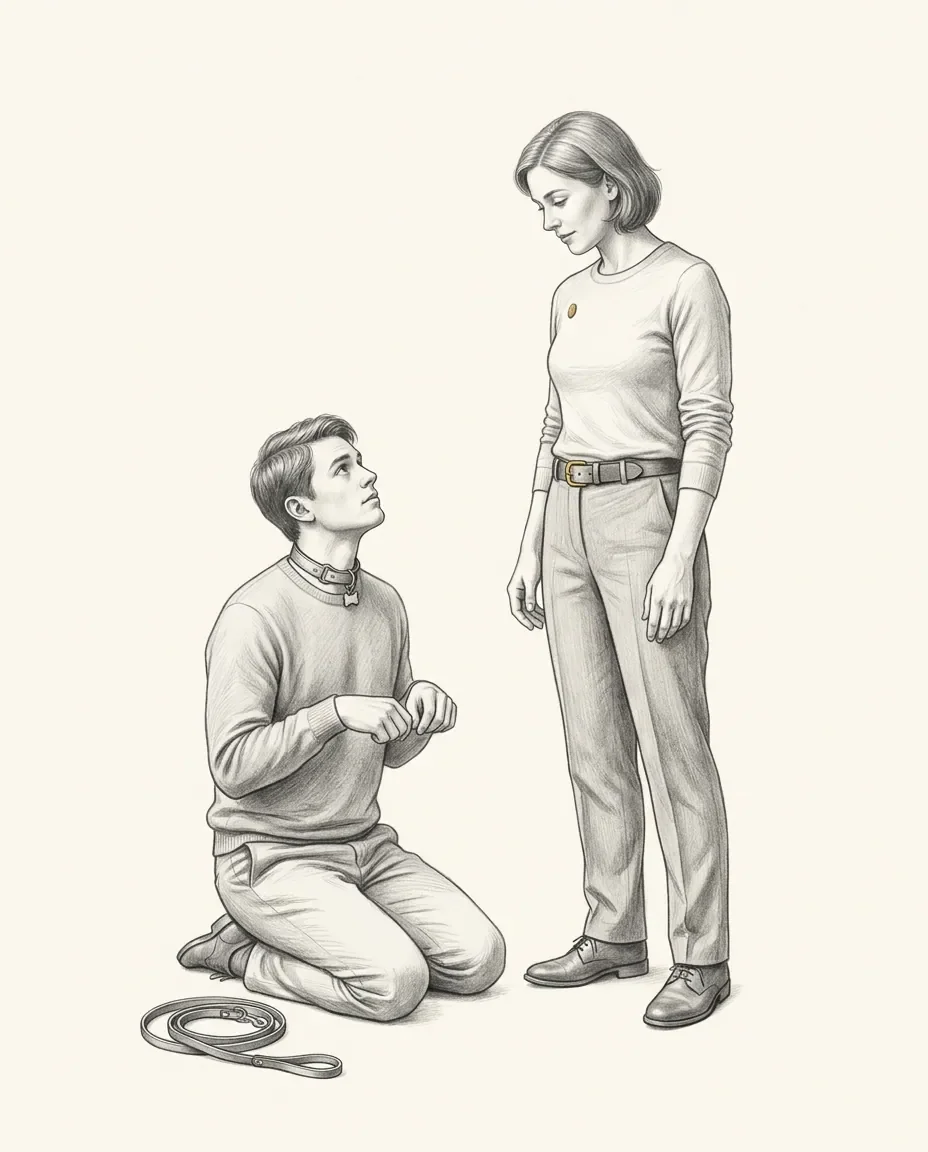
Consensual role-play in which an adult adopts the mindset, mannerisms, and headspace of an animal, most often a puppy, kitten, or pony. It frequently takes place within a handler or caretaker dynamic. A playful power-exchange and immersion practice that involves no real animals.
- Prevalence
- Common
- Category
- Power, Roles & Scenarios
- Domain
- Sexual interest
- Confidence
- Medium confidence
- Status
- A consensual role-play activity and normative variation, not a paraphilia or disorder; distinct from any interest in real animals.
- Also known as
- petplay, anthropomorphic role-play, puppy play, pup play, kitten play, pony play, human pet, animal role-play, cowification, cattle play
- Added
- 21 Jun 2026
- Updated
- 22 Aug 2026
Featured in
Overview
Pet-play is a form of consensual role-play in which an adult adopts the persona, behaviours, and mental "headspace" of an animal (most commonly a puppy, kitten, or pony) frequently paired with a "handler," "owner," or "trainer." It blends animal-themed character work with elements of power exchange and immersive play, and is a recognised activity within the BDSM and kink world. It involves only human role-play and no real animals, which sharply distinguishes it from zoophilia. This article covers its documented lineage, how it is practised, the psychology of its appeal, and what survey research reveals about who takes part.
Definition & scope
Pet-play is an umbrella for several animal personas. The most common is puppy or pup play, followed by kitten play and the older, more athletic tradition of pony play. What unites them is the adoption of an animal role and mindset rather than any specific act: a participant may wear themed gear, communicate non-verbally, and behave in character within a caretaker relationship. It is not the same as the furry fandom (which centres on anthropomorphic animal characters and art) though the two overlap socially, and it is emphatically not an interest in real animals. The activity can be sexual, purely playful, or a mix, and many participants describe the appeal as the headspace itself rather than anything erotic.
Examples
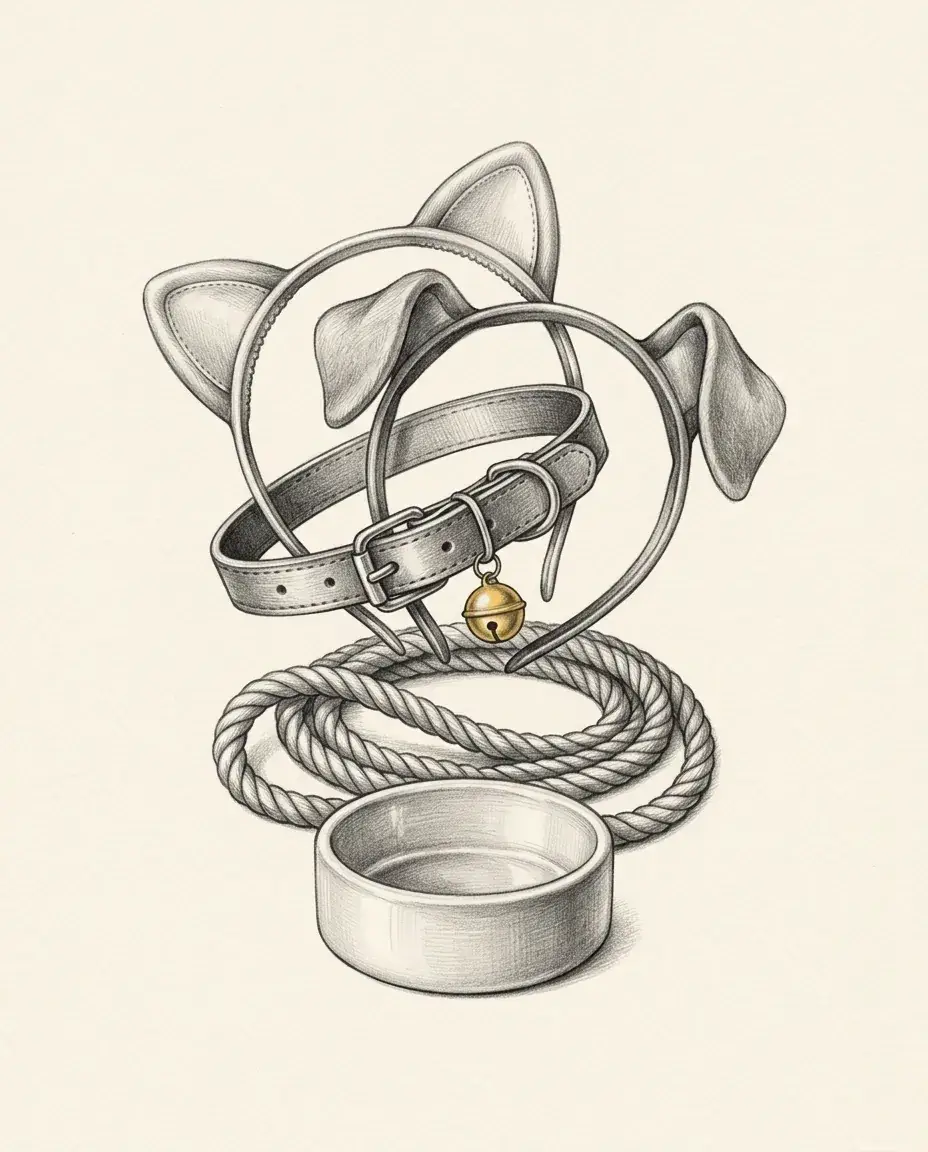
What the term covers. Puppy or pup play is the most common form: an adult adopts a dog-like manner, largely non-verbal, playful, responsive to a handler's cues and to training or fetch games. Kitten play trades that eagerness for aloofness, curiosity and being petted on the pet's own terms, while pony play is the athletic branch, built around posture, harness, gait work and cart or riding routines. Rarer personas run to cows (the hucow dynamic), foxes and wolves. Gear (ears, a tail, a collar, a hood, padded mitts) is common but optional; the persona and the headspace are what define the practice, and plenty of participants use none of it.
What the term does not cover. Pet-play involves humans only, and has nothing to do with zoophilia or bestiality, which concern real animals and are a wholly separate subject. It is not the furry fandom or fursuiting, which centre on anthropomorphic characters, art and costume rather than on an animal headspace, though the two scenes overlap socially. It is not therianthropy or being otherkin, which are identity claims rather than play. And it is distinct from age play and littlespace, which regress toward a younger human role rather than an animal one.
How the word is used. "Pet play" and "petplay" are community vernacular and interchangeable in writing; animal role-play is the more formal umbrella. "Pup" names both the role and the person filling it: "he is a pup, she is his handler" is an ordinary sentence in the scene. Neither term is a diagnosis: the family surfaces in reference works only descriptively, among the consensual variations catalogued in the list of paraphilias, and the academic literature, which begins only in 2017, writes "pup play" rather than the umbrella.
History & origins
Cultural & subcultural roots
The symbolic use of animal imagery in human power dynamics is ancient, but pet-play as a distinct, self-aware practice is a modern outgrowth of the twentieth-century BDSM and leather communities.
- 1946–1959: among the earliest published images of animal role-play (especially pony play) are those in fetish artist John Willie's Bizarre magazine, per Wikipedia's article on pony play. Equestrian-themed erotic role-play thus has the longest documented lineage of the pet-play family.
- Post-war era: puppy or "pup" play traces most plausibly to the "dog" or "dog-slave" role within post-war gay leather and BDSM subculture, where a submissive partner would be collared, leashed, and trained in a dog-like manner.
- Late 1990s: "dog headspace" workshops began appearing in San Francisco around 1997, and UK pups began organising alongside the existing pony-play scene, marking pup play's emergence as a recognisable practice in its own right.
- 2000s: online forums and later platforms such as FetLife let handlers and pups organise into clubs, "packs," competitions, and events, driving rapid growth.
The precise coinage of the umbrella term "pet-play" is not well documented; it appears to have crystallised as community shorthand rather than as a clinical label.
Clinical lineage
Pet-play sits almost entirely outside the diagnostic literature. The broad category of animal role-play is catalogued among consensual variations on Wikipedia's List of paraphilias, but no edition of the DSM or ICD treats pet-play as a disorder: it is a benign leisure practice, not a pathology. Its clinical interest is recent and empirical rather than diagnostic: pup play was first studied academically only in the 2010s.
- 2017: Wignall & McCormack's An Exploratory Study of a New Kink Activity: "Pup Play" (Archives of Sexual Behavior, 46:801–811) became the first peer-reviewed study of the practice, based on 30 interviews with gay and bisexual men in the UK. It found pup play consists mainly of mimicking and adopting the role of a dog, serves both sexual satisfaction and relaxation, and found no evidence for it being a form of zoophilia.
- 2022: Wignall, McCormack, Cook & Jaspal's community survey of 733 participants broadened the picture (see Prevalence & culture).
In practice
Pet-play is expressed through behaviour and mindset rather than any single act: mannerisms, play, training games, and a relaxed, largely non-verbal headspace, sometimes accompanied by themed gear such as ears, tails, hoods, or masks. Pony play in particular has an athletic, performance-oriented tradition involving harness, gait, and cart work. The activity may be lightly sexual, primarily about emotional release and connection, or entirely non-sexual for participants who value the headspace itself, the survey evidence shows participants spread across that whole spectrum.
Psychology
The appeal is often linked to setting down human responsibility and entering a simpler, instinctive mental state, the comfort of being cared for, and the trust built within a handler relationship. For the person in the handler role, the draw can lie in nurturing, structure, and gentle authority: overlapping with the dynamics of dominance and submission and, in lifestyle forms, master/slave relationships. The 2022 survey found that 84% of respondents felt pup play improved their mental health, and nearly half had a diagnosed mental-health condition, suggesting the headspace functions for many as restorative play. It overlaps socially with the furry community for some people, though the two are distinct, and it is regarded as a normative variation rather than a pathology.
Prevalence & culture
How common is pet play?
Pet-play is a minority interest, but pup play especially has gained visibility through established clubs, competitions, and large online communities. FetLife groups dedicated to puppy, pony, and kitten play number in the tens of thousands of members, used here as a community-size proxy. The largest dataset to date, the 2022 community survey of 733 people, found the population skews male (about 79%) and predominantly gay, lesbian, or bisexual, with most respondents aged 18–30; roughly 72% identified as pups, about 10% as handlers, and around 18% as switches. Nearly half the sample had a diagnosed mental-health condition, and about two-thirds reported attending public pup-play events, marking it as a socially organised scene rather than a solitary one. Engagement was rated on average as "equally social and sexual," confirming that pet-play is not a uniformly sexual activity. Mainstream awareness has grown through documentaries such as Secret Life of the Human Pups and lifestyle coverage like Glamour's A–Z of kinks that frame it as a recognised kink.
Safety, consent & law
Pet-play among consenting adults is legal and harmless, and is firmly distinct from any interest involving real animals, which is illegal and unrelated. Responsible practice follows ordinary kink principles: negotiation, ongoing consent, agreed non-verbal safe signals (since speech may be limited in role), comfort and safety with any gear such as hoods or harnesses, and aftercare to ease the return from headspace.
Common questions
Is pet play sexual?
It can be, and often is not. The practice spans a full range: for some participants it is folded into sexual play, for others it is entirely about the headspace (play, companionship, and switching off human responsibility), and the largest survey to date found the average participant placing their engagement midway between the social and the sexual. Assuming pet play is inherently erotic misreads a hobby that people organise clubs, competitions and public events around.
Is pet play the same as zoophilia?
No, and the two share nothing beyond the word "animal." Pet play is role-play between consenting adults; no animal is present, involved, or represented as a partner. Zoophilia is a sexual interest in real animals, which cannot consent, and the acts it describes fall under bestiality, a criminal offence in most jurisdictions. When Wignall and McCormack interviewed thirty pup-play participants in 2017 they looked specifically for a connection and found no evidence of one.
What is the difference between pet play and the furry fandom?
They overlap socially but answer different impulses. The furry fandom is built around anthropomorphic animal characters (art, writing, conventions, an invented persona that talks and wears clothes), and fursuiting is its costume side. Pet play is about dropping into a non-verbal animal mindset, usually within a handler relationship. Many people do both, but a fursuiter performing a character is not in pup headspace, and a pup in headspace usually has no character to perform.
What does a handler do in pet play?
The handler, sometimes called an owner or trainer, holds the human end of the dynamic: setting structure, giving cues, running training or play games, watching for signs of overheating, strain or distress, and steering the return to ordinary headspace afterwards. The appeal on that side is usually described as nurturing and gentle authority rather than harshness, and it overlaps with ordinary dominance and submission dynamics. A handler may be a partner, a friend, or a scene-only counterpart.
What is pup space?
"Pup space" is the community name for the mental state at the centre of the practice: simplified, instinctive and largely non-verbal, with adult worries and responsibilities set aside. Participants generally describe it as restorative rather than erotic. It resembles the absorbed states reported elsewhere in kink, such as subspace, and like those it can leave a person foggy or emotionally raw on the way out, which is what aftercare is for.
Do you need gear to try pet play?
No. Ears, a tail, a collar, a hood, mitts and knee pads are common and many people enjoy them, but none of it is required: the practice is defined by the persona and the headspace, not the equipment. Plenty of participants begin with nothing more than an agreed dynamic and a pet name. Gear tends to arrive later, as a way of deepening immersion or signalling a role at events, and pony play is the branch where equipment matters most.
Is pet play safe?
Physically it is low-risk, with caveats attached to gear and to crawling. Hoods and masks restrict sight, hearing and airflow, so they need checking and a way to remove them quickly; time on hands and knees is hard on wrists, knees and neck, and pads and breaks help; collars and harnesses should never be tight enough to constrict. Because speech is limited in role, an agreed non-verbal safe signal (dropping a toy, a set number of taps) does the work a safeword would.
From the blog
- Dominance85/100Power, Roles & ScenariosTaking the leading, controlling role in a consensual power-exchange dynamic. One of the two halves of dominance and submission (D/s) within BDSM, in which a person directs the scene, sets the rules, and guides a willing partner who has agreed to yield control.85
- Submission90/100Power, Roles & ScenariosTaking the yielding, following role in a consensual power-exchange dynamic. One of the two halves of dominance and submission (D/s), in which a person cedes control to a trusted partner under negotiated limits.90
- Master/Slave Dynamic58/100Power, Roles & ScenariosAn intensive, often ongoing form of consensual power exchange in which one adult (master or mistress) holds broad authority over another (slave). The arrangement runs inside a negotiated, ownership-styled framework. A structured, high-commitment expression of dominance and submission.58
- Chastity Play54/100Power, Roles & ScenariosChastity play is a consensual power-exchange practice in which one partner surrenders control over their own sexual release, often via a wearable device. That control passes to a partner ('key-holder') who governs if and when orgasm is permitted. A form of orgasm control, not a paraphilia.54
- Mommy Domme / MDLB54/100Power, Roles & ScenariosA consensual adult power-exchange dynamic in which a dominant partner takes a nurturing, maternal "Mommy" role over a submissive "little." The emphasis is care, structure and affection over pain. MDLB denotes the Mommy Dom/Little Boy pairing; MDLG its girl counterpart.54
- Orgasm Denial54/100Power, Roles & ScenariosA power-exchange dynamic in which one partner controls another's access to orgasm or genital stimulation through teasing and edging. Repeated denial and symbolic or physical chastity are also used, with a "keyholder" granting or withholding release.54
A plain-English compound: "pet" (a domesticated companion animal) plus "play" (role-play), describing consensual human role-play in an animal persona. No classical -philia derivation.
animal role-play · power exchange · headspace play
Prevalence is computed from the entry's cited population estimate. Rows marked ESTare indicative editorial estimates scored against a fixed anchor rubric, not measured quantities. Method & anchors: methodology.
Common · ≈ 1 in 20
- 01List of paraphilias, Wikipediadefinition/existence of animal role-play within BDSM
- 02FetLife, kink community group sizes (community-size proxy)community-size proxy: sizeable puppy/pony/kitten play groups
- 03An A–Z of Kinks and Fetishes, Glamourmainstream lay framing of pet play as a known kink
- 04Pony play, Wikipediahistorical lineage: John Willie's Bizarre magazine (1946-1959) as earliest published animal role-play imagery
- 05Wignall & McCormack (2017), An Exploratory Study of a New Kink Activity: 'Pup Play', Archives of Sexual Behavior 46:801-811first peer-reviewed study of pup play; 30 interviews with UK gay/bisexual men; sexual + relaxation motivation; no evidence of zoophilia
- 06Wignall, McCormack, Cook & Jaspal (2022), Findings From a Community Survey of Individuals Who Engage in Pup Play, Archives of Sexual Behaviorlargest survey (n=733): demographics (~79% male, mostly LGB, 18-30), pup/handler/switch split, 'equally social and sexual', 84% reporting improved mental health