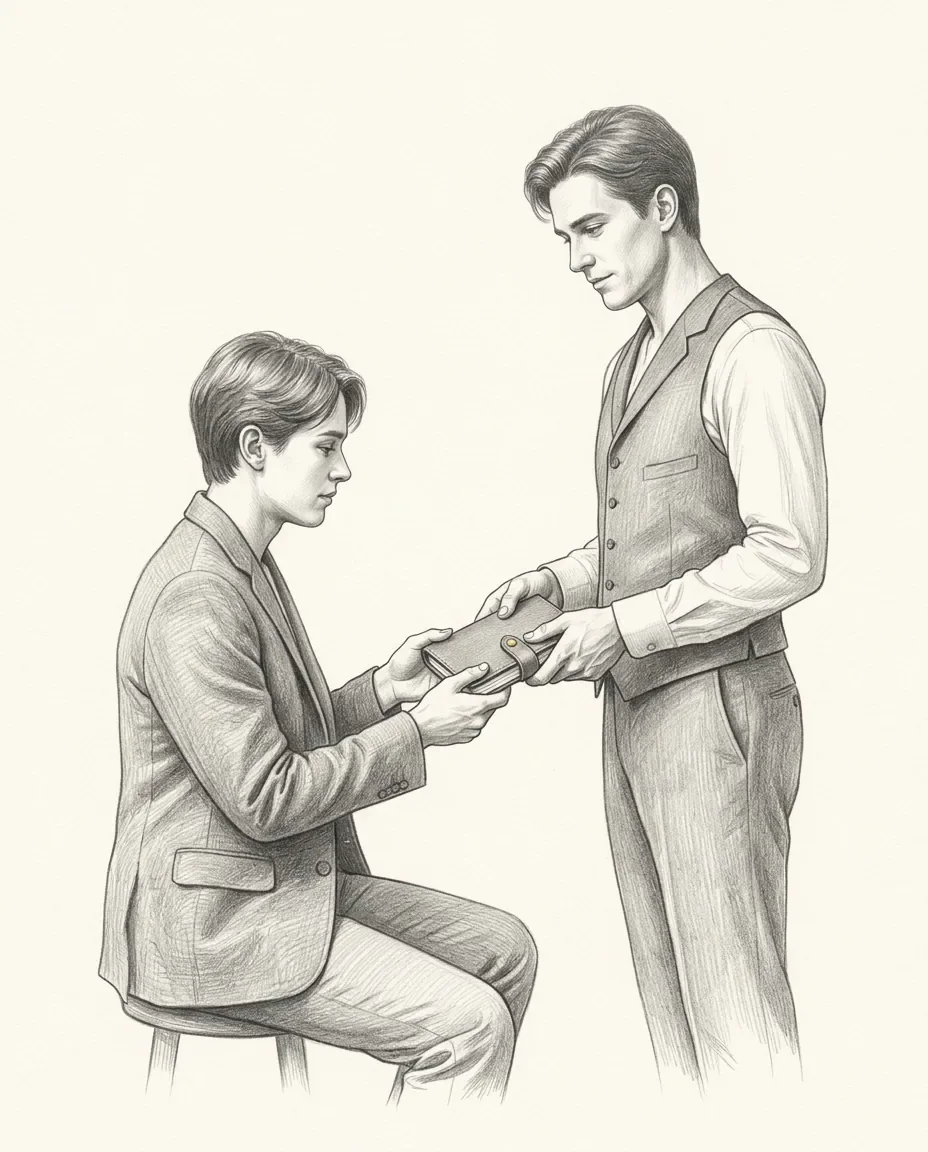
Switching
Added 21 Jun 2026 · Updated 22 Aug 2026
A person who enjoys both the dominant and submissive roles in consensual power exchange, rather than identifying with only one. A switch may move between leading and yielding across partners, scenes, relationship phases, or moods.
- Prevalence
- Very common
- Category
- Power, Roles & Scenarios
- Domain
- Sexual interest
- Confidence
- Medium confidence
- Status
- A normative variation of sexual interest and a role label, not a paraphilia or disorder.
- Also known as
- switch, versatile, role fluidity, role versatility, role reversal
- Added
- 21 Jun 2026
- Updated
- 22 Aug 2026
Featured in
Overview
Switching describes the inclination to occupy both sides of a consensual power-exchange dynamic. A person who switches (a "switch") finds satisfaction in taking control at some times and yielding it at others, rather than holding a fixed dominant or submissive identity. It sits within the broader dominance-and-submission (D/s) and BDSM landscape as a recognised stance toward role flexibility, and it is a normative variation of sexual interest rather than a paraphilia or disorder. This article traces where the term came from, how the underlying phenomenon was first observed, how switching is practised and understood, and how common it is.
Examples
Switching is a disposition rather than an activity, so it is easiest to recognise by the patterns it produces and by the labels it gets mistaken for.
What the term covers. A person who leads one scene and yields the next with the same partner; someone who is consistently dominant with one partner and submissive with another; a rope enthusiast who works as a rigger on some evenings and is the one being tied on others; a couple who reverse their usual arrangement for a night by prior agreement. A deliberate handover partway through a single encounter is the least common pattern, but a recognised one.
What the term does not cover. A service top is not switching: doing the physical work at a bottom's direction is a fixed role rather than a fluid one. Nor is brat play, where the resistance happens inside submission instead of crossing to the other side. Being new to kink and unsure which role suits is not switching either: the word describes a settled taste for both, not the absence of a preference. And a switch is not a diluted dominant or a lapsed submissive; each role is held whole, one at a time.
How the word is used. "Switch" is community vocabulary, working as a noun ("she's a switch"), as a verb, and as a profile field on kink platforms. It appears in neither DSM-5-TR nor ICD-11, neither of which names consensual role identities at all. In gay male usage "versatile" carries a related but distinct meaning, about physical position rather than about who holds authority.
History & origins
Clinical lineage
The phenomenon behind switching is far older than the word. Nineteenth- and early-twentieth-century sexology already isolated the paired impulses now grouped under dominance and submission, and noticed that they often live in the same person. Richard von Krafft-Ebing's Psychopathia Sexualis (1886) named "sadism" and "masochism" as opposed but complementary patterns, and Havelock Ellis's Studies in the Psychology of Sex discussed how the two frequently co-occur in one individual. Sigmund Freud's Three Essays on the Theory of Sexuality (1905) went further, treating sadism and masochism as two faces of a single drive that can reverse into its opposite. The recognition that a person can be drawn to both poles is therefore long-standing; "switch" is simply the contemporary self-label for it.
- 1886: Krafft-Ebing pairs sadism and masochism as clinical opposites in Psychopathia Sexualis.
- early 1900s: Ellis and Freud each note that the dominant and submissive impulses commonly inhabit the same individual.
- 1980 onward: the DSM and ICD lineage progressively narrows the diagnoses to cases involving distress, harm, or non-consent, so that consensual role play, whether fixed or fluid, is treated as a normative variation, not a disorder.
Cultural & subcultural evolution
The word "switch" itself is community-coined slang from modern BDSM subculture rather than a clinical coinage, and its precise first use is not well documented. The paired role vocabulary of top and bottom emerged in the gay leather culture of the 1950s and the bondage and sadomasochism scenes of the 1960s, replacing vaguer earlier slang such as "active" and "passive"; the switch label, for those who alternate, arose in parallel within these circles and was at first often conflated with "versatile" in gay contexts.
- 1950s–1960s: top/bottom terminology crystallises in leather and SM subcultures; "switch" appears alongside it as the term for those who move between roles.
- 1971: The Eulenspiegel Society, founded in New York by Pat Bond and Terry Kolb as the first U.S. SM organisation open to all orientations, helps disseminate this role vocabulary through its newsletters and events.
- 1990s–2000s: the label becomes a firmly established standard self-description on community platforms, in personal ads, and in the academic literature on kink.
As the Wikipedia entry on top, bottom and switch makes explicit, the vocabulary distinguishes the psychological axis (dominant/submissive, who holds authority) from the physical axis (top/bottom, who applies or receives stimulation): a top "is not necessarily a dominant," and a switch is defined as someone who "participates in BDSM activities sometimes as a top and other times as a bottom or sometimes as a dominant and other times as a submissive", moving freely along either axis.
In practice
Switching may vary by partner, by scene, by phase of a relationship, or simply by mood. Some switches alternate deliberately within a single encounter; others lean predominantly one way while remaining open to the other. The defining feature is versatility rather than a strictly balanced split. Whatever the pattern, which role a switch takes in a given encounter is normally negotiated in advance with the partner, the same way any dominance or submission arrangement would be, including in more total dynamics such as master/slave play. The usual failure mode is assumption rather than disagreement: a partner who has led the last several encounters can be presumed to be leading the next one, which is why switches tend to name the role for a given scene out loud even inside long-standing relationships.
Psychology
Psychologically, switching is usually framed as responsiveness to context and partner chemistry, and as access to the rewards of both roles: the agency, control, and caretaking of dominance, and the release, surrender, and trust of submission. The mixed-methods study of role fluidity by Katherine Martinez (2018), published in the Journal of Homosexuality (65(10):1299–1324) and drawing on 202 survey respondents and 25 interviews, found that men in her sample tended to identify as dominant, master, top, or sadist and women as submissive, slave, bottom, or masochist, while it was specifically women and queer or pansexual individuals who disrupted that binary through switch identities, offering, in her framing, the possibility of transforming fixed dominant/submissive categories rather than staying inside them. Practitioners frequently describe firsthand experience of both sides as deepening empathy, communication, and technical skill. As with D/s generally, the evidence base for any single causal mechanism is thin, and most accounts emphasise learned preference, context-sensitivity, and the symbolic appeal of power exchange rather than a fixed underlying trait.
Prevalence & culture
How common is switching?
Switches are a sizeable minority within kink, typically the third-largest single role identity after the two poles. In Martinez's (2018) sample of 202 BDSM practitioners, 22.3% identified as a switch, against 41.1% who identified as submissive, slave, or bottom and 28.2% as dominant, master, or sadist. "Switch" is likewise a standard self-label on dedicated platforms such as FetLife and in community surveys, even if it is claimed somewhat less often than a purely dominant or submissive identity.
The population it draws from is large. In the survey behind Lehmiller's Tell Me What You Want (2018), dominance-and-submission fantasies were near-universal: only about 4% of women and 7% of men reported never having a BDSM fantasy, with roughly 65% fantasising about receiving and 60% about inflicting consensual pain. Lay reference guides such as Glamour's A–Z of kinks list "switch" as one of the core BDSM role identities, reflecting how routine the term has become in mainstream coverage of kink.
Safety, consent & law
Switching among consenting adults is legal and benign. The same responsible-practice principles apply as in any power exchange: clear negotiation of who holds which role in a given scene, ongoing affirmative consent, agreed safewords, and aftercare. Because a switch may change roles mid-relationship or even mid-scene, communicating role expectations explicitly is especially important so that both partners know who is leading and who is yielding at any moment.
Common questions
Is being a switch the same as being versatile?
Not quite, though the two get used interchangeably. In gay male usage "versatile" usually describes physical position (whether someone penetrates, receives, or both), while "switch" describes the authority axis, whether a person leads or yields. Early leather circles conflated them and casual use still does. Someone can be versatile in position and consistently dominant in role, or the reverse.
Can you call yourself a switch if you lean mostly submissive?
Yes. The label marks versatility, not a balanced split. Plenty of switches spend most of their time in one role and take the other occasionally, with a particular partner, or only in certain kinds of scene. Some describe themselves as a submissive-leaning or dominant-leaning switch precisely to signal the tilt. Nothing in the term requires a fifty-fifty distribution, and nobody measures it.
How do you know if you're a switch?
There is no test and no threshold to cross. The usual signal is that both roles appeal on their own terms (that leading is rewarding in itself and so is yielding) rather than one being tolerated for a partner's sake. Curiosity about the other side is common in people who never switch, so the practical difference is whether the appeal survives actually trying it. Most people settle on the label only after some experience of both.
Do switches swap roles with the same partner?
Sometimes, but not necessarily. Some alternate with one partner across scenes or even within a single encounter; others are reliably dominant with one person and submissive with another and never mix the two. Which pattern applies is a matter of chemistry and negotiation rather than a rule attached to the label, and partners normally settle it explicitly beforehand rather than discovering it mid-scene.
Can a switch be in a 24/7 or master/slave dynamic?
It can work, but it takes deliberate structure. Arrangements such as master/slave or total power exchange rest on a standing asymmetry, so a switch in one of them usually holds a fixed role there and switches elsewhere, or the pair define specific occasions when the usual order is set aside. What fails is an unspoken assumption that the hierarchy is renegotiable at will.
Is switching a paraphilia, or a sign of indecision?
Neither. It is a role preference rather than a diagnosis: neither DSM-5-TR nor ICD-11 mentions it, and consensual power exchange between adults is not pathologised in either manual. The "can't make up their mind" reading is a community stereotype rather than a research finding, and nothing in the literature on kink roles treats fluidity as instability. The label describes a taste held with as much conviction as any fixed role.
Can two switches be in a relationship together?
Yes, and it is a common pairing. Two switches may trade roles between scenes, alternate by mood, or find that each of them reliably takes one side with this particular person. The practical demand is the same as in any power exchange (being explicit about who is leading before play starts), but the arrangement removes the mismatch in which one partner wants a turn the other cannot offer.
From the blog
Definitions5 min read
What a switch is, and how switching works
What is a switch in BDSM? A person who takes both dominant and submissive roles, estimated at 12 percent of adults, with survey shares and history.

How common6 min read
Do men and women have different kinks, and by how much
Do men and women have different kinks? Bondage appeals to 29.5% of men and 29.2% of women, threesomes to 34.1% and 11.1%. Where the surveys find a gap.

Relationships8 min read
How to tell a partner about a kink, and how partners respond
How to tell a partner about a kink: 71% who shared a favourite fantasy got a positive response, and only 28% who never shared expected one.

Definitions8 min read
What BDSM stands for, and what it covers
What does BDSM stand for? Bondage and discipline, dominance and submission, sadism and masochism: what each pair means, how common it is, where the lines are.
- Dominance85/100Power, Roles & ScenariosTaking the leading, controlling role in a consensual power-exchange dynamic. One of the two halves of dominance and submission (D/s) within BDSM, in which a person directs the scene, sets the rules, and guides a willing partner who has agreed to yield control.85
- Submission90/100Power, Roles & ScenariosTaking the yielding, following role in a consensual power-exchange dynamic. One of the two halves of dominance and submission (D/s), in which a person cedes control to a trusted partner under negotiated limits.90
- Master/Slave Dynamic58/100Power, Roles & ScenariosAn intensive, often ongoing form of consensual power exchange in which one adult (master or mistress) holds broad authority over another (slave). The arrangement runs inside a negotiated, ownership-styled framework. A structured, high-commitment expression of dominance and submission.58
- Discipline65/100Power, Roles & ScenariosThe rules-and-consequences half of BDSM: a dominant sets expectations, a submissive agrees to follow them, and pre-negotiated punishments or rewards follow. It is about behaviour and structure rather than sensation, which is what separates it from sadomasochism even when the two use the same implements.65
- Consensual Non-Consent64/100Power, Roles & ScenariosA negotiated power-exchange scenario in which adults agree in advance to enact a scene of simulated non-consent. The fiction of resistance or being overpowered is staged while real, ongoing consent underlies the whole encounter. Categorically distinct from actual assault.64
- Cuckolding66/100Troilism · Power, Roles & ScenariosA consensual erotic interest, sometimes termed troilism, in which a person is aroused by their committed partner's intimacy with someone else. The arousal can come from watching, knowing about, or imagining it. It ranges from humiliation play to affirming compersion.66
From the English verb "switch" (to change or exchange), used as modern BDSM-community slang for a person who alternates between dominant and submissive roles; not a Greek/Latin clinical coinage.
power exchange · role fluidity
Prevalence is computed from the entry's cited population estimate. Rows marked ESTare indicative editorial estimates scored against a fixed anchor rubric, not measured quantities. Method & anchors: methodology.
Very common · ≈ 1 in 7
- 01Lehmiller (2018), Tell Me What You Want, survey of 4,175 AmericansBDSM/dominance-submission fantasies are near-universal, supplying the population from which switches draw
- 02FetLife, kink community group sizes (community-size proxy)community-size proxy showing 'switch' as a major self-reported role alongside dominant and submissive
- 03An A–Z of Kinks and Fetishes, Glamourlay framing of switch as a recognized BDSM role identity
- 04Havelock Ellis, Studies in the Psychology of Sexearly sexological observation that dominant (sadistic) and submissive (masochistic) impulses frequently co-occur in the same individual
- 05Top, bottom, switch, Wikipediadefinition of a switch as moving between top/bottom and dominant/submissive; distinction between the psychological (dominant/submissive) and physical (top/bottom) axes; emergence of top/bottom/switch terminology in 1950s leather and 1960s SM subcultures
- 06The Eulenspiegel Society, Wikipedia1971 New York founding by Pat Bond and Terry Kolb of the first US SM organisation open to all orientations, which helped disseminate dominant/submissive/top/bottom/switch role vocabulary
- 07Krafft-Ebing, Psychopathia Sexualis (1886), Wikipedia1886 naming of sadism and masochism as opposed but complementary patterns, the clinical root of the dominant/submissive pairing a switch occupies on both sides
- 08Sigmund Freud, Three Essays on the Theory of Sexuality (1905), Wikipedia1905 treatment of sadism and masochism as two faces of a single drive that can reverse into its opposite, prefiguring the switch concept
- 09Martinez, K. (2018), BDSM role fluidity: switches within dominant/submissive binaries, Journal of Homosexuality 65(10):1299-1324mixed-methods study (202 survey + 25 interview) reporting BDSM identity shares (41.1% submissive/slave/bottom, 28.2% dominant/master/sadist, 22.3% switch) and finding that women and queer/pansexual individuals disrupt the dominant/submissive binary through switch identities
- 10DSM-5-TR, Paraphilic Disorders (American Psychiatric Association, 2022)diagnostic lineage that progressively narrowed the diagnoses to cases of distress, harm, or non-consent, leaving consensual role play (fixed or fluid) a normative variation
- 11ICD-11, Paraphilic disorders (World Health Organization)WHO classification reserving paraphilic diagnoses for harm/non-consent, so consensual switching is not a disorder