Plangonology
Added 7 Sep 2026
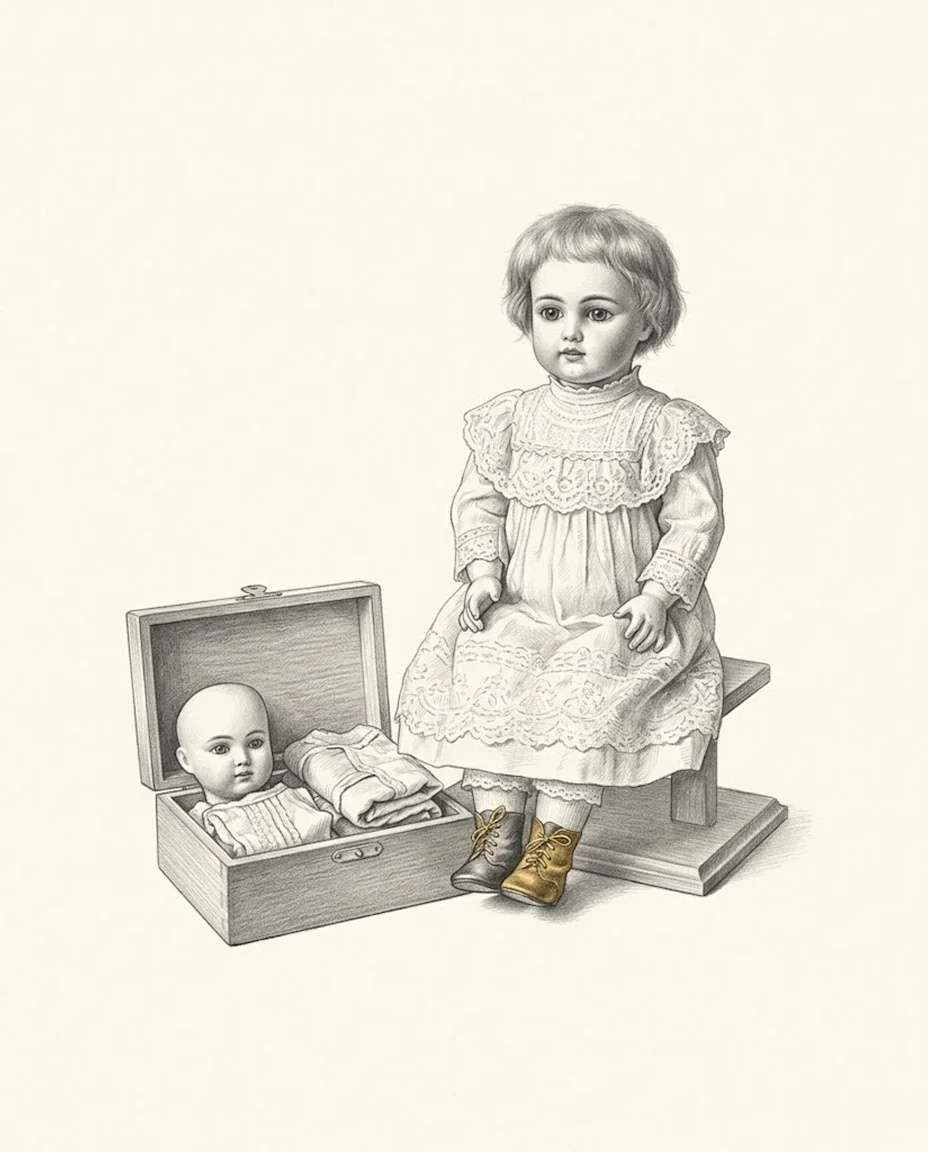
The collecting of dolls as objects, from nineteenth-century bisque to Barbie and ball-jointed dolls. The work is identifying makers and moulds, grading condition, restoring and displaying. A mainstream non-sexual hobby with its own societies and shows.
- Prevalence
- Common
- Category
- Non-Sexual Fetishism
- Domain
- Non-sexual interest
- Confidence
- Low confidence
- Status
- A mainstream hobby that no diagnostic manual names. Acquisition that displaces daily life overlaps with compulsive buying or hoarding disorder, which are different conditions.
- Also known as
- doll collecting, plangonologist, antique doll collecting, fashion doll collecting, Barbie collecting
- Added
- 7 Sep 2026
Featured in
Overview
Plangonology is the collecting of dolls: the assembling, study and keeping of dolls as objects, from the bisque-headed French and German dolls of the nineteenth century to Barbie, ball-jointed dolls and artist dolls. The word is the hobby's own coinage and lives mostly in society names and price guides; most collectors say "doll collecting". The interest is non-sexual and belongs with the other acquisitive hobbies in this catalog, where fetish keeps its older sense of an object credited with a power beyond its making.
Definition & scope
A plangonologist collects dolls for what they are as objects: the maker, the mould, the material, the costume and the condition. The field divides by period and material. Antique dolls, made before about 1930, are wood, wax, papier-mâché, china and bisque; vintage dolls, from roughly 1930 to 1980, are composition, hard plastic and early vinyl; modern collectibles are vinyl fashion dolls, resin ball-jointed dolls and one-of-a-kind artist dolls. Collectors specialise by maker (Jumeau, Kestner, Madame Alexander), by line (Barbie, Blythe, American Girl), by type (character dolls, automata, dollhouse dolls) or by the many variants of a single doll. Scope runs from a shelf of childhood survivors to museum-grade cabinets with provenance files.
Examples
What the term covers. Hunting a particular mould number at a doll show; keeping a 1959 Barbie in her original box; commissioning an artist doll; restoring a bisque head with a hairline crack and recording the repair; cataloguing costumes, wigs and sleep eyes by maker; collecting one factory's dolls across its whole run; and the ball-jointed doll hobby, in which owners buy resin bodies and faces and then paint, wig and dress them.
What the term does not cover. Dollification is a sexual role-play in which a person is treated as a doll, and the robot and doll fetish is a sexual attraction to doll-like figures; neither has anything to do with keeping dolls on a shelf. Antiquing overlaps in the shops and fairs, and a doll collector is often an antiquer too, but the antiquer's object is the whole past and the plangonologist's is one kind of thing. Collecting in general and its neighbours coin and stamp collecting and deltiology share the drive and differ in the object. Compulsive hoarding is a named disorder; a large, catalogued, displayed collection is a hobby whatever its size.
How the word is used. Plangonology and plangonologist appear in society names, price guides and dictionaries, and seldom in conversation; collectors talk about dolls, makers and moulds. The "fetish" in this entry's category is the everyday sense, an intense attachment to a class of object, with no sexual meaning. No diagnostic manual names doll collecting; the only clinical neighbour is hoarding disorder, which describes a different problem.
History & origins
Bisque and the factories (1840s to 1930)
The collectible doll is a product of nineteenth-century industry. Pierre-François Jumeau founded his Paris firm in 1842, and by the 1870s French bisque dolls from Jumeau, Bru and Steiner were luxury goods with glass eyes, kid bodies and couture wardrobes. German factories in Thuringia, Kestner, Simon & Halbig and Armand Marseille among them, made bisque heads in the millions and undercut the French by 1900. Kämmer & Reinhardt's character dolls of 1909, modelled on the faces of real children, are the pieces the antique market prizes most. Composition and, after 1945, hard plastic and vinyl ended bisque production, which is why a pre-1930 bisque doll is "antique" in the hobby's vocabulary.
The hobby organises (1937 onward)
Collecting the dolls, as distinct from playing with them, organised in the twentieth century. The United Federation of Doll Clubs was founded in the United States in 1937 and still runs the annual convention, the magazine and the accreditation of doll museums. The Colemans' The Collector's Encyclopedia of Dolls (1968) gave the field its reference work.
Barbie and the modern collectible (1959 onward)
Mattel launched Barbie on 9 March 1959 at the New York Toy Fair, and the doll became the twentieth century's most collected; Mattel puts lifetime sales above a billion dolls. Mattel began issuing dolls made for collectors, with certificates and tiered editions, in the 1980s, and the boxed 1959 "Number One" Barbie is the hobby's best-known trophy. Blythe (Kenner, 1972), American Girl (1986) and, from 1999, the resin ball-jointed dolls of Volks followed. Barbie entered the National Toy Hall of Fame at The Strong in Rochester in 1998.
In practice
Collectors buy at doll shows, auctions, estate sales and online, and the specialist shows are where most antique dolls change hands. The work after buying is identification (the maker's mark on the back of a bisque head, the mould number, the body type), condition grading, conservation (cleaning, restringing, re-wigging, storing away from light and damp) and documentation. Display matters to most: cabinets, stands and period furniture. Ball-jointed doll owners photograph, dress and repaint their dolls and share the results, which makes that corner of the hobby a craft as much as a collection.
Psychology
The motives are the collector's usual ones with a specific inflection. Dolls are figures of people, so a collection carries memory, period and character in a way a coin does not, and many collectors begin with a childhood doll or the doll a parent kept. Completeness (every variant of a line), rarity (a factory's short run), craft (the modelling of an antique face, a hand-sewn costume) and the pleasure of arranging a display do the rest.
Prevalence & culture
No survey counts doll collectors, and this entry's figure is an estimate. The United Federation of Doll Clubs is among the largest hobby federations in its field, doll shows run in most large cities, and the ball-jointed doll and reborn communities online are sizeable, which places the committed hobby at a few percent of adults at most and the casual keeping of a childhood doll far higher. The catalog files it beside coin and stamp collecting and postcards, at the lower end of the collecting group.
Safety, consent & law
The hobby is legal and harmless. The practical risks are the antique trade's: reproduction bisque heads sold as originals, repainted faces, married bodies and heads, and forged marks, so provenance and a trusted dealer matter. Old dolls can carry lead paint and flammable celluloid, a handling and storage question. The hobby raises no consent or legal concern of its own; the line to watch is the one every collecting entry draws, between a catalogued collection and compulsive shopping or hoarding.
Common questions
What is a doll collector called?
A plangonologist, from the Greek plangon, a wax doll. The word appears in dictionaries and society names and almost never in conversation, where people say doll collector. The United Federation of Doll Clubs, founded in 1937, is the hobby's largest organisation in the United States and uses the plain term.
Is doll collecting a fetish?
No, in the sexual sense. This catalog files it under non-sexual fetishism, where fetish keeps its older meaning of an intense attachment to a class of object, the same sense used of watch or record collectors. The sexual interests that involve dolls, dollification and the robot and doll fetish, are separate entries with nothing in common with the hobby.
What makes an antique doll valuable?
Maker, mould, condition and originality. A marked bisque head from Jumeau, Bru or Kämmer & Reinhardt with its original body, wig, eyes and costume commands the most; hairline cracks, repaints and replaced parts cut value sharply. Rarity of the mould and documented provenance matter next. The Bisque doll article on Wikipedia covers the makers the market prizes.
How much is a 1959 Barbie worth?
It depends on condition, and no single figure holds. The boxed "Number One" Barbie of 1959 is the hobby's best-known trophy and sells at auction for sums that vary by an order of magnitude with box, hair and paint. Later dolls from the same years are worth far less. Mattel's collector editions from the 1980s onward were made to be kept and rarely gain much.
What is a ball-jointed doll?
A resin doll with elastic-strung ball-and-socket joints, sold blank or lightly finished so the owner paints the face, chooses eyes and a wig and dresses it. The modern form began with Volks in Japan in 1999. Collectors treat the dolls as a craft and a character as much as an object, and photograph and customise them for online communities.
When does collecting dolls become hoarding?
When the collection stops being a collection. A catalogued, displayed, cared-for set of dolls is a hobby at any size. Hoarding disorder, named in the DSM-5-TR, is about acquiring and keeping in a way that overwhelms living space and causes distress, and compulsive shopping is buying that displaces everything else. Both are conditions with treatment, and neither is the hobby.
- Collecting57/100Non-Sexual FetishismA strong, non-sexual drive to acquire, organize, and complete sets of objects: from stamps and coins to figures, records, and memorabilia. It is a widespread hobby and behavioral pattern, not a clinical disorder, and is distinct from hoarding.57
- Antiquing53/100Non-Sexual FetishismA non-sexual hobby of shopping for, sourcing, identifying, and collecting antiques: old furniture, decorative objects, and everyday artifacts. They are valued for age, craftsmanship, and history. It centers on the hunt, connoisseurship, and the tactile appeal of aged material.53
- Coin & Stamp Collecting38/100Non-Sexual FetishismA non-sexual, focused interest in acquiring, organizing, and studying coins, banknotes, and postage stamps (numismatics and philately). It centers on heritage, completeness, and the tactile and historical appeal of small physical artifacts.38
- Deltiology (Postcard Collecting)31/100Deltiology · Non-Sexual FetishismDeltiology is the collecting and study of postcards, one of the largest and oldest collecting hobbies by participation. Collectors pursue postcards for their images, history, and the traces of the people and places they document.31
- Dollification23/100Identity & TransformationA role-play and transformation kink in which one partner, the "doll", is styled, posed and treated as a lifelike human doll by a partner, the "maker". Costume, makeup, restrictive material or a doll-like persona create it. The charge comes from performing as a doll, not from attraction to an actual inanimate object.23
- Handbag Fetish38/100Non-Sexual FetishismA non-sexual, intense interest in acquiring and curating designer handbags, prized for craftsmanship, brand prestige, and status. It blends collecting, consumer culture, and identity signaling rather than any clinical condition.38
From Greek plangon, a wax doll, plus -logy; a hobbyist coinage of the twentieth century recorded in dictionaries as the study or collecting of dolls, with plangonologist for the collector.
collecting · dolls · antiques · toy collecting
Prevalence is computed from the entry's cited population estimate. Rows marked ESTare indicative editorial estimates scored against a fixed anchor rubric, not measured quantities. Method & anchors: methodology.
Common · ≈ 1 in 20
- 01Bisque doll, WikipediaFrench and German bisque doll industry from the 1840s to 1930, the makers named, and the antique/vintage boundary
- 02Barbie, Wikipedialaunch on 9 March 1959 at the New York Toy Fair, lifetime sales above a billion, collector editions from the 1980s
- 03United Federation of Doll Clubsthe federation founded in 1937, its convention, magazine and museum accreditation
- 04plangonology, Wiktionarythe word's definition and its Greek root plangon, a wax doll
- 05Barbie, National Toy Hall of Fame, The StrongBarbie's 1998 induction into the National Toy Hall of Fame