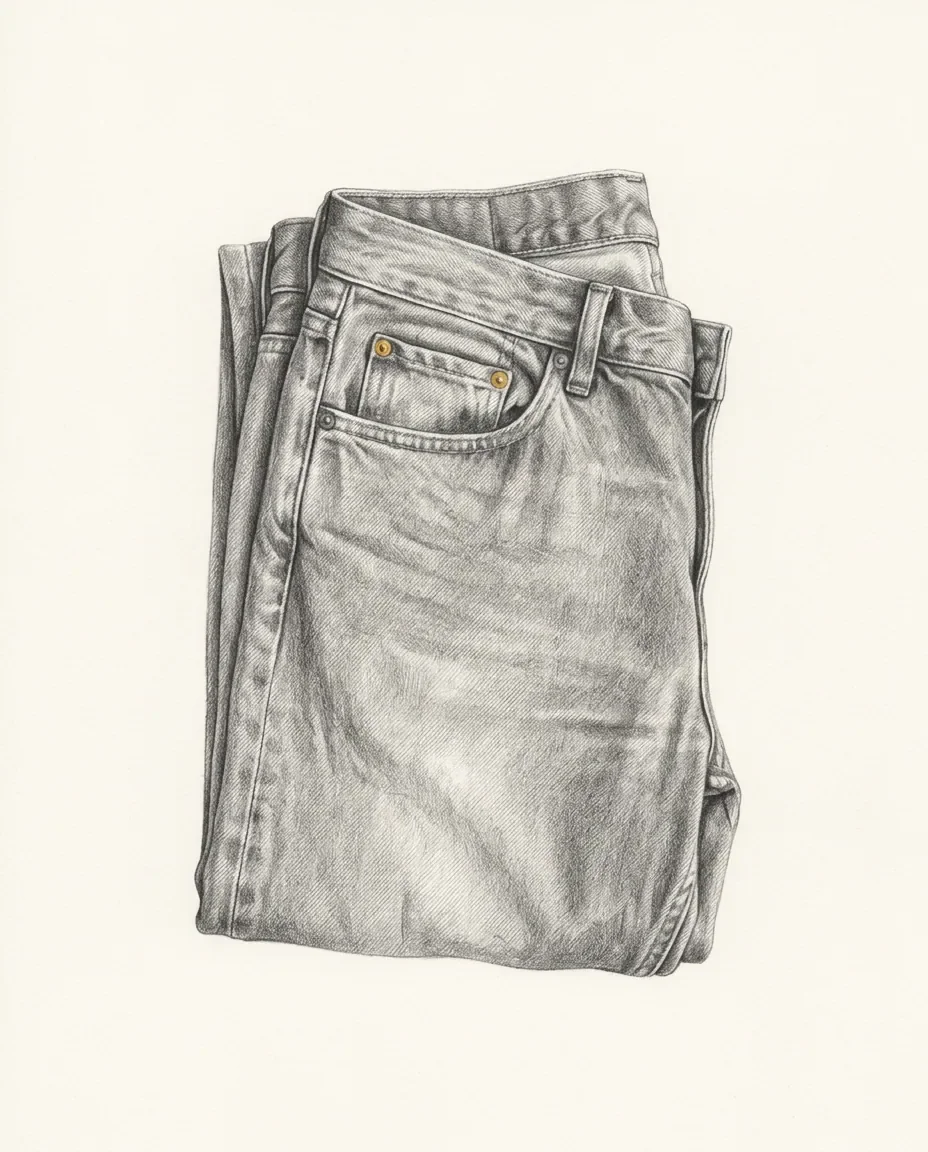
Denim Fetish
Denim Fetishism
Added 21 Jun 2026 · Updated 22 Aug 2026
An erotic or aesthetic interest centred on denim garments, most often jeans, but also jackets, skirts and overalls. They are valued for their coarse texture, body-shaping fit, scent, and rugged, casual associations. It is a common-variation material and clothing fetish, not a clinical disorder.
- Prevalence
- Rare
- Category
- Objects & Materials
- Clinical term
- Denim Fetishism
- Domain
- Sexual interest
- Confidence
- Low confidence
- Status
- Common material/clothing fetish; a normal variation, not a disorder unless it causes distress or impairment.
- Also known as
- denim fetishism, jeans fetish, denim
- Added
- 21 Jun 2026
- Updated
- 22 Aug 2026
Overview
Denim fetishism is a material- and clothing-focused interest in which denim items (most often jeans, but also jackets, skirts, dungarees and shorts) become a strong source of arousal, comfort, or aesthetic fixation. The appeal can rest on the fabric's coarse cotton-twill weave and stiffness, the way a well-fitted pair of jeans shapes the body, the look and feel of worn-in fading and distressing, the scent of worn denim, or the broader cultural image of denim as rugged, youthful and everyday. This article surveys how the interest is understood clinically and culturally; it is descriptive and non-explicit, and concerns a normal variation among consenting adults.
Examples
What the term covers. Jeans, first and above all: a particular cut, wash, degree of fade or distressing, and the way a well-fitted pair shapes the body. Beyond them, jackets, skirts, dungarees and shorts; the stiffness and coarse twill of the fabric against skin; the smell and softened feel of a long-worn pair; collecting particular brands, cuts or vintages; and a preference for a partner staying dressed, which overlaps with clothed sex. The interest may be directed at what a partner wears, at what the person wears themselves, or at the garment on its own.
What the term does not cover. It is not the glossy second-skin family (latex, rubber and spandex) whose appeal runs through shine, tightness and enclosure; denim is matte, coarse and entirely ordinary, and the ordinariness is much of the point. It is not leather, the other rugged material, which carries subcultural and BDSM associations denim does not. It is not the uniform fetish, where the charge comes from an assigned role rather than from a fabric. And it is not texture fixation, a non-erotic sensory response to materials.
How the word is used. Plain descriptive vernacular. "Denim fetish" and "jeans fetish" are used interchangeably; there is no Greek-derived clinical coinage for it, and no diagnostic manual names a material at all: DSM-5-TR and ICD-11 describe fetishistic disorder generically and only where marked distress or impairment is present. Inside kink spaces "denim" works as a dress code and a group label rather than as a diagnosis, which is roughly how "leather" is used in the same rooms.
History & origins
Clinical lineage
Clinical interest in clothing- and material-directed attraction long predates denim's emergence as a fashion icon. The framework for understanding fetishism toward fabrics and garments was laid out by Richard von Krafft-Ebing in Psychopathia Sexualis (1886), whose case-study taxonomy first systematised attraction to materials and objects. It was elaborated by Havelock Ellis in his Studies in the Psychology of Sex and by Sigmund Freud in his Three Essays on the Theory of Sexuality (1905), who framed such interests as products of early association and displacement. Modern diagnostic manuals, the DSM-5-TR and the WHO's ICD-11, treat a material fetish as clinically significant only when it causes marked distress or impairment, so an ordinary denim preference falls outside the diagnostic threshold entirely.
Cultural & subcultural evolution
Denim as a distinct erotic focus is a far more recent, culturally driven phenomenon, inseparable from the fabric's own social history. Denim is a sturdy cotton twill whose name is, per Wikipedia's account of the fabric, a contraction of the French serge de Nîmes ('serge from Nîmes'). The rivet-reinforced blue jean was created in 1873 by Jacob W. Davis, a Nevada tailor, who partnered with the San Francisco dry-goods wholesaler Levi Strauss & Co. to patent and mass-produce it as durable workwear.
The garment's charge came from the screen. Through the first half of the twentieth century jeans read as the clothing of miners, cowboys and labourers, honest and unglamorous. That changed sharply in the 1950s:
- 1953: Marlon Brando wore jeans as the leather-jacketed biker in The Wild One, recasting denim as dangerous and sexual rather than merely practical.
- 1955: James Dean's turn in Rebel Without a Cause fixed the jeans-and-white-t-shirt look as the uniform of teenage defiance, per the cultural history of jeans.
- late 1950s onward: some American schools, cinemas and restaurants banned denim, which only sharpened its association with youth, freedom and nonconformity; by the late 1960s jeans had spread worldwide as mainstream fashion.
This mid-century charge (rugged, youthful, sexualised, working-class-authentic) gave denim the symbolic weight that any modern garment fetish draws upon. There is no dedicated clinical literature isolating denim, and the precise coinage of the phrase "denim fetish" is not well documented; it is best understood as a contemporary subtype within the long-established study of material fetishism.
In practice, how the interest is typically expressed
Expression is typically benign and varied. It may include a strong preference for partners wearing tight, faded or distressed jeans; enjoyment of the look, sound and feel of the fabric against skin; pleasure in the scent of worn denim; collecting particular cuts, washes, or brands; or incorporating denim garments into intimate settings. For most people the interest functions as a heightened preference layered onto otherwise conventional attraction rather than a sole requirement for arousal, the hallmark distinction between a common variation and a clinically relevant fetish.
Psychology
Denim fetishism fits the well-described general models of fetish formation, though none has been tested on denim specifically. Associative-learning accounts hold that a neutral material becomes linked to arousal through repeated pairing with a formative attraction. Symbolic accounts emphasise the cultural meanings denim carries (rebellion, working-class authenticity, casual sexuality and youth) which can be eroticised in their own right. A heightened sensitivity to texture and scent also plays a role for some individuals, aligning denim with other tactile materials such as leather. The evidence base specific to denim is essentially absent, so these mechanisms are reasoned by analogy from the broader fetishism literature rather than demonstrated.
Prevalence & culture
Denim is rarely studied on its own. In the largest relative-prevalence dataset, Scorolli and colleagues' 2007 analysis of online fetish-community membership, fabric and textile fetishes form only a small share of object fetishes, sitting well below headline materials such as rubber, leather and latex; the figures are carried in summary form on the Wikipedia sexual-fetishism article. Dedicated denim and jeans communities exist online and on platforms such as FetLife but are modest in size. Because denim is a near-universal garment, many people carry mild associations with it (a particular fit, a worn-in pair) without ever identifying those feelings as a fetish, which complicates any attempt to estimate true prevalence.
Variations & related interests
Denim fetishism sits within a family of material and clothing interests and frequently overlaps with the appeal of other worn fabrics and garments: notably leather, lingerie, and the structured, identity-laden look of uniforms. What unites them is an eroticisation of how a material looks, feels, smells and shapes the body, rather than the body alone.
Safety, consent & law
There are no inherent safety, consent, or legal concerns. The interest involves ordinary clothing and consenting adults, so only the standard norms of mutual consent, honest communication and privacy apply.
Common questions
Is a denim fetish normal?
Yes, on any reasonable reading. It is one of the more ordinary material interests and it clears no diagnostic bar: DSM-5-TR and ICD-11 treat an interest in a fabric as clinically relevant only where it causes the person marked distress or impairment. Denim is also a near-universal garment, so a great many people carry mild associations with a particular fit or a worn-in pair without ever giving them a name.
What is the difference between liking how a partner looks in jeans and a denim fetish?
Mostly degree, and it is a gradient rather than a line. A preference sits on top of an otherwise conventional attraction and can be set aside without much cost; a fetish in the clinical sense means the material is doing the essential work, and arousal is difficult without it. Most people who describe themselves as having a denim fetish are at the preference end, where nothing requires attention.
How is a denim fetish different from a latex or leather fetish?
Different textures carry different meanings. Latex and rubber work through shine, tightness and full enclosure, a second skin. Leather carries decades of subcultural and BDSM association. Denim has neither: it is matte, stiff, opaque and completely everyday, and its appeal usually runs through fit, wear and the fabric's image of rugged, casual authenticity. The dedicated communities are correspondingly much smaller.
Can a denim fetish be about wearing the jeans yourself?
Yes. Material interests point in both directions. Plenty of people describe the sensation of stiff, heavy twill against their own skin, or the settled feel of one particular pair, as the main draw rather than the sight of someone else in them. Others care only about what a partner wears, and some about the garment on its own, off the body entirely. All three are recognised variants of the same material-focused pattern.
Is a jeans fetish the same as a denim fetish?
In everyday use, yes: jeans dominate the category so completely that the two phrases are interchangeable. The wider term is slightly broader: jackets, skirts, dungarees and shorts belong to it too, and for some people the appeal really is the fabric rather than any one garment. Community groups and retailers tend to use "denim" as the umbrella and "jeans" when the trousers specifically are the point.
- Leather Fetish65/100Leather fetishism · Objects & MaterialsAn erotic attraction to leather as a material: its look, smell, creak, shine, and feel when worn. It overlaps strongly with BDSM gear and is bound up with a recognised, organised leather subculture with its own bars, codes, and titles.65
- Lingerie Fetish70/100Clothing & GarmentsAn erotic interest in lingerie and intimate apparel in which the garments themselves, their fabrics, and their styling become a focus of arousal. Bras, briefs, stockings, corsets and slips are typical. One of the most common and mainstream garment-related interests.70
- Uniform Fetish60/100Uniform Fetishism · Clothing & GarmentsAn erotic interest in uniforms and the authority, role, or status they signal: military, police, medical, school, or service dress. A common clothing-and-role fetish rather than a clinical disorder.60
- Vacuum Bed / Encasement Fetish27/100Objects & MaterialsAn interest in being sealed inside an airtight latex envelope from which the air is pumped out, shrink-wrapping and immobilising the body. It sits within total-enclosure fetishism and is a higher-risk form of bondage and sensory deprivation.27
- Robot Fetish26/100Technosexuality · Objects & MaterialsRobot fetishism, also called technosexuality or ASFR, is an erotic attraction to robots and androids, or to people behaving as artificial beings. It commonly centres on mechanical movement, control, and the blurred line between human and machine.26
- Balloon Fetish29/100Globophilia · Objects & MaterialsAn erotic or playful fixation on balloons: their look, feel, smell, sound, inflation, and sometimes their popping. Enthusiasts call themselves looners; it is a benign novelty-object fetish related to latex and inflatable interests.29
From the fabric name 'denim', an English contraction of the French serge de Nîmes ('serge from Nîmes'), a sturdy cotton twill once associated with that city; 'denim fetish' is a plain descriptive compound naming the material, with no clinical -philia coinage.
natural fibers · rugged textiles · tactile
Prevalence is computed from the entry's cited population estimate. Rows marked ESTare indicative editorial estimates scored against a fixed anchor rubric, not measured quantities. Method & anchors: methodology.
Rare · ≈ 1 in 1,000
- 01Scorolli et al. (2007), Relative prevalence of different fetishes, Int. J. Impotence Research 19(4):432-437textile/material fetishes form a small share of object fetishes (relative-prevalence framing)
- 02Sexual fetishism, Wikipedia (carries the Scorolli 2007 relative-frequency table)carries the Scorolli relative-frequency table placing fabric fetishes in the low single digits
- 03FetLife, kink community group sizes (community-size proxy)small denim/jeans community group (community-size proxy)
- 04Denim, Wikipediaorigin of the fabric and name (a contraction of serge de Nîmes), the 1873 Jacob W. Davis / Levi Strauss & Co. riveted blue-jean patent, and denim's 1950s-60s shift from workwear to a youth/rebellion fashion symbol
- 05Jeans, Wikipedia1950s cinematic reframing of jeans (Marlon Brando in The Wild One, 1953; James Dean in Rebel Without a Cause, 1955) and denim's shift from workwear to a symbol of youth rebellion, including period bans in schools and public venues
- 06Psychopathia Sexualis, WikipediaKrafft-Ebing's 1886 case-study taxonomy first systematised fetishism toward materials and objects
- 07Havelock Ellis, WikipediaEllis's Studies in the Psychology of Sex elaborated the early study of material- and garment-directed attraction
- 08Three Essays on the Theory of Sexuality, WikipediaFreud (1905) framed material/garment fetishism as a product of early association and displacement
- 09DSM-5-TR, American Psychiatric Associationa material fetish is clinically significant only when it causes marked distress or impairment
- 10ICD-11, World Health Organizationmodern diagnostic framing distinguishing benign variation from a fetishistic disorder