Rubber Fetish
Rubberism
Added 21 Jun 2026 · Updated 7 Sep 2026
An erotic interest in rubber garments and gear, prized for the heavier, matte material and the look, smell, and enveloping feel it provides. A material fetish closely tied to latex and BDSM gear culture among consenting adults.
- Prevalence
- Common
- Category
- Objects & Materials
- Clinical term
- Rubberism
- Domain
- Sexual interest · Paraphilia
- Confidence
- Medium confidence
- Status
- A fetishistic interest in the DSM/ICD sense; benign and not a disorder unless it causes distress, impairment, or is required for functioning.
- Also known as
- rubber fetishism, rubberism, rubberist, latex fetish, rubber gear fetish
- Added
- 21 Jun 2026
- Updated
- 7 Sep 2026
Featured in
Overview
Rubber fetishism is a material fetish centred on rubber clothing, sheeting, and equipment, whose adherents are commonly called rubberists (and, among men, rubbermen). It overlaps heavily with latex fetishism; in practice the word "rubber" tends to signal the heavier, thicker, more matte material and a culture oriented around full gear (catsuits, hoods, masks, and BDSM-adjacent items) while "latex" often connotes the thinner, glossy fashion-facing variant. This article traces the documented history of the interest, how it is expressed, its proposed psychology, and what the limited research says about its prevalence.
Examples
Rubber is one of several fetish materials that look alike from the outside, and most of the term's precision lies in the distinctions between them.
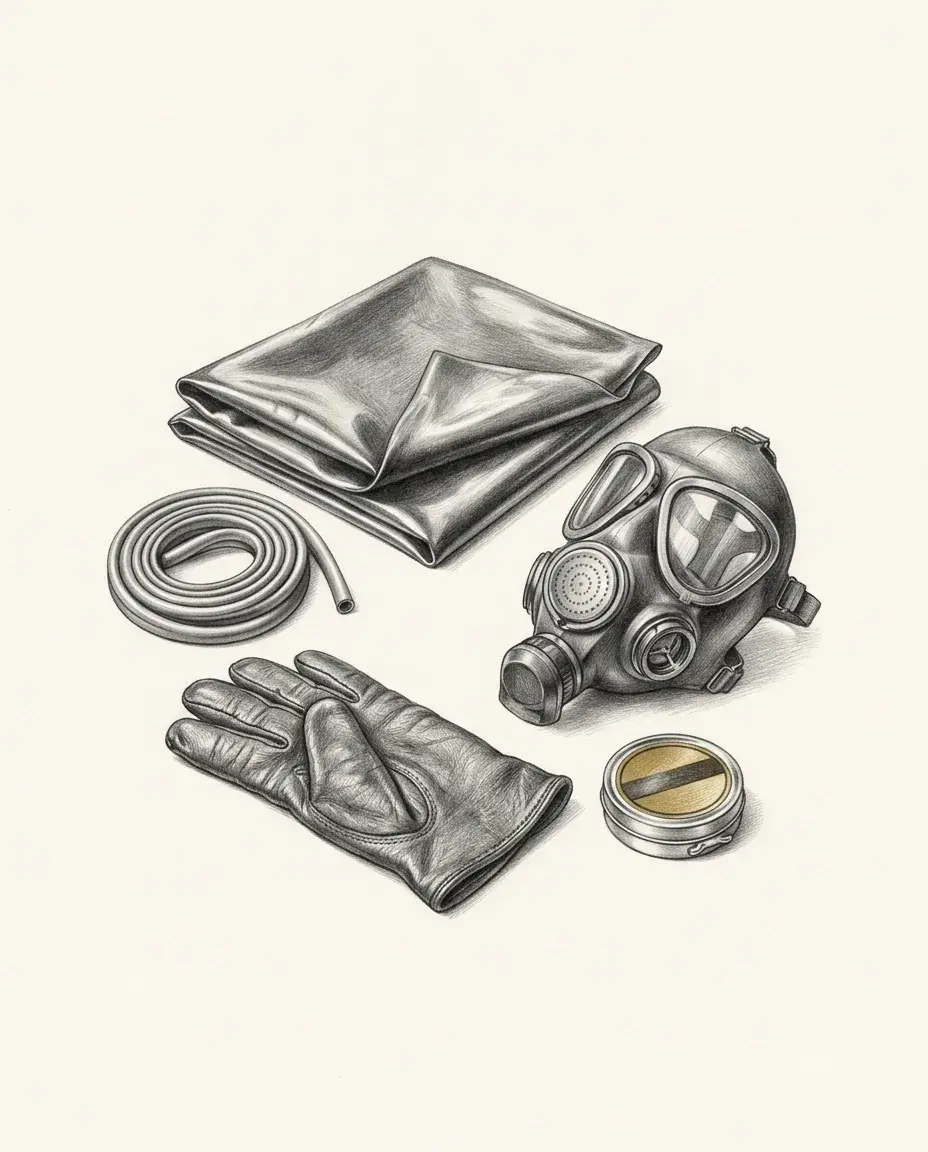
What the term covers. Heavy sheet-rubber garments and equipment: hooded catsuits, gloves, waders, aprons, masks and hoods, sheeting, and rubberised outerwear of the mackintosh type. The reported appeal works across several senses at once: the material's weight, its smell, the squeak and drag of it against itself, the way it grips and warms to the skin, and the smooth anonymous silhouette a full suit imposes. The rituals around gear are often described as part of the interest rather than chores attached to it: dressing with talc, polishing a suit to a shine, drying and storing it afterwards.
What the term does not cover. Latex fetishism is the closest neighbour, and the two overlap so heavily that many use the words interchangeably; the tendency, not a rule, is for "rubber" to name the heavier matte material and the gear culture around it and "latex" the thinner glossy fashion-facing variant. PVC and vinyl are plastics rather than rubber, shinier and cheaper, and carry none of the latex-allergy issue. Leather is a different material with its own subcultural history, and spandex or zentai suits share the encasement without the weight or smell. Raincoat fetishism overlaps at the mackintosh end but is defined by the garment. And mummification is an act of restraint that may use rubber but is defined by the immobility, not the material. Wetsuit fetish is neoprene, a foamed synthetic rubber, and the one strand of the family that comes from the water and the dive shop.
How the word is used. Rubberist and rubberman are community terms rather than clinical ones; there is no Greek-derived synonym in the manuals. Under DSM-5-TR and ICD-11 an interest of this kind is discussed as fetishism, and rises to fetishistic disorder only where it causes marked distress or impairment.
History & origins
The material comes first
Rubber fetishism is inseparable from the industrial history of the material itself. In 1824 the Scottish chemist Charles Macintosh patented a rubber-coated waterproof fabric, giving rise to the Mackintosh raincoat, which quickly acquired a fetishistic following alongside its practical use. Natural rubber only became durable and wearable in everyday garments after Charles Goodyear discovered vulcanisation in 1839 and patented it in 1844, processing that stabilised rubber for raincoats, surgical and protective wear, and eventually fashion. Mass-produced rubberised clothing in the Victorian era thus created both the object and the conditions for an erotic attachment to it.
Clinical lineage
Early sexologists recognised that clothing materials could carry an erotic charge. Richard von Krafft-Ebing's Psychopathia Sexualis (1886) and Havelock Ellis's Studies in the Psychology of Sex both documented fetishism for garments and materials, of which rubber and mackintosh fetishism are recognisably modern examples. The most concrete clinical datum comes much later: in Chalkley and Powell's review of forty-eight clinical fetishism cases (1983), drawn from a London teaching hospital's discharge register, "rubber and rubber items" were the focus in 22.9% of cases: second only to ordinary clothing (58.3%) and ahead of footwear and leather. In the modern diagnostic frame of the DSM-5-TR and ICD-11, a material preference like this is not a disorder in itself; it qualifies as fetishistic disorder only when it causes clinically significant distress or impairment.
Cultural & subcultural evolution
The interest organised itself into a distinct subculture across the twentieth century. By the 1920s–30s rubber and mackintosh play were already documented in correspondence magazines such as London Life. The British designer John Sutcliffe registered his fetish-wear label AtomAge in 1957 as a maker of weatherproofs for women pillion riders, issued his first catalogue in 1965, and in 1972 expanded it into the AtomAge magazine, which ran through 1980 and became the underground reference for leather, rubber, and vinyl wear. His studio helped shape the sleek catsuits Diana Rigg wore as Emma Peel in The Avengers, though the show used leather and PVC rather than rubber. The 1980s saw the launch of Skin Two, which chronicled the emerging fetish-club scene, alongside specialist titles such as Marquis. From the 1970s onward the look's recurrence in club, punk, and music subcultures broadened and partly normalised it, while dedicated makers, events, and codes of etiquette gave rubberists a durable shared identity, documented in Wikipedia's account of rubber and PVC fetishism.
In practice
The interest is expressed through wearing, handling, or seeing rubber suits, masks, hoods, boots, and accessories. Appeal arises from the material's weight, smell, glossy or matte surface, enveloping pressure, and the altered silhouette and full-body coverage it produces. It can be the primary focus of arousal or one element within broader fetish and dominance–submission play, and many participants emphasise the ritual of dressing, polishing, and caring for gear as part of the experience.
Psychology
Rubber fetishism is generally framed through associative learning: an early pairing of the material with sexual arousal, the mechanism Chalkley and Powell and later case-based researchers most often invoke for material fetishes. Beyond conditioning, commonly cited themes include the "second skin" quality of a close-fitting suit, sensory containment and enclosure, and the way full coverage can obscure individual identity and transform the body's outline. As with material fetishes generally, the evidence base is thin and largely clinical or qualitative, and the interest is regarded as a benign variation of sexual preference rather than a sign of pathology.
Prevalence & culture
Rubber sits alongside leather and latex as a recognised pillar of fetish-gear scenes, with established communities, commercial makers, and dedicated events. Population research situates it within object/material fetishes, a relatively small slice of the overall fetish distribution mapped by Scorolli et al. (2007), whose large online sample found garments and footwear far more common than whole-body materials. Broader general-population surveys such as Joyal and Carpentier (2017) report that interest in fetishistic objects and materials is widespread, with rubber a minor sub-category within it, while Holvoet et al.'s "Fifty Shades of Belgian Gray" (2017) found latex among the fetishes endorsed by a representative sample and noted the high overall prevalence argues against stigmatising such interests. Community proxies such as FetLife groups suggest a modest but durable following, narrower than the broader, fashion-driven latex audience. Visibility in fashion editorial, club culture, and music imagery far exceeds the size of the core fetish community.
Safety, consent & law
Rubber fetishism between adults is consensual and legal. Sensible precautions concern latex and additive allergies, heat retention and dehydration in full suits, and the safe use of any restrictive hoods or enclosures, where airway and circulation must never be compromised. It is considered a benign variation rather than a disorder, reaching clinical significance only if it causes distress, impairment, or becomes strictly required for sexual functioning.
Common questions
What is the difference between a rubber fetish and a latex fetish?
Mostly weight, finish and culture rather than chemistry, since latex is a rubber. In scene usage “rubber” tends to mean the heavier, thicker, often matte material and the full-gear tradition of catsuits, hoods and masks, while latex more often signals the thin, glossy, fashion-facing version. Many people use the two words interchangeably and belong to both communities, so the distinction is a tendency, not a boundary.
Is a rubber fetish a paraphilia or a disorder?
It is a fetishistic interest in the technical sense, because arousal attaches to a material rather than to a partner as such. That is not a diagnosis. Under DSM-5-TR and ICD-11 it becomes fetishistic disorder only where it causes marked distress or impairment, or where sexual functioning depends on it entirely, thresholds most people with the interest never approach.
How common is a rubber fetish?
There is no clean population figure. The most cited datum is clinical rather than general: Chalkley and Powell's 1983 review of forty-eight fetishism cases from a London teaching hospital found rubber and rubber items were the focus in 22.9% of them, second only to ordinary clothing. A clinical series overstates prevalence in the wider public, where representative surveys such as Holvoet et al.'s 2017 Belgian sample find latex endorsed by a small minority.
Do you have to be into BDSM to have a rubber fetish?
No. The interest is in the material and what it does to the senses and the silhouette, and plenty of people pursue it purely as clothing: at fetish clubs, in photography, or privately at home. The overlap with dominance and submission is real and historically close, since much of the gear came from the same makers, but it is an association rather than a requirement.
Is wearing a rubber catsuit safe?
With care, yes. Three concerns are genuine: latex allergy, which ranges from a rash to a serious reaction and is a reason to test a small area first; heat, since a sealed suit stops sweat evaporating and can cause overheating and dehydration on a long wear; and anything covering the face, where the airway and circulation must never be restricted. Hoods and full enclosure border on breath play and should not be worn alone.
Is PVC the same as latex or rubber?
No. PVC and vinyl are synthetic plastics finished to a high-gloss wet look, whereas latex and rubber come from the sap of the rubber tree and behave quite differently: heavier, stretchier, warmer against the skin, and carrying a distinctive smell. PVC is also cheaper, more durable, and safe for people with a latex allergy, which is part of why it has a following of its own.
How do you look after rubber gear?
Rinse it after wear to remove sweat, which degrades the material, dry it thoroughly on both sides before storing, and keep it out of direct sunlight and heat. Prolonged contact with metals such as copper and brass stains latex permanently, so buckles and coins are best kept away from it. Suits are usually stored flat or loosely hung rather than folded under pressure.
- Latex Fetish62/100Latex fetishism · Objects & MaterialsAn erotic interest in latex garments and their tight, glossy, second-skin qualities. A common material fetish involving the look, feel, sound, smell, and enveloping sensation of clinging latex on consenting adults.62
- Leather Fetish65/100Leather fetishism · Objects & MaterialsAn erotic attraction to leather as a material: its look, smell, creak, shine, and feel when worn. It overlaps strongly with BDSM gear and is bound up with a recognised, organised leather subculture with its own bars, codes, and titles.65
- Nylon Fetish43/100Nylon Fetishism · Objects & MaterialsAn erotic attraction to nylon as a material: the sheer, smooth, faintly glossy synthetic fabric used in hosiery, stockings, tights, and other slick garments. It is a textile-material preference rather than a clinically defined paraphilia.43
- PVC Fetish42/100Objects & MaterialsAn erotic attraction to shiny PVC and vinyl clothing, prized for its high-gloss "wet look", smooth slick surface, and tight, body-hugging fit. A common, accessible cousin of latex and leather fetishism.42
- Food Fetish37/100Sitophilia · Objects & MaterialsAn erotic interest in food and eating, in which edible items, their taste and texture, or the act of food contact become a focus of arousal. Often expressed as playful, messy, sensory-led intimacy between consenting partners; its messy variant is known as sploshing.37
- Gas Mask Fetish37/100Objects & MaterialsAn erotic interest in gas masks and respirators, valued for the rubber enclosure of the face, anonymity, and altered breathing. An uncommon object fetish tied to rubber/latex culture and breath play, carrying real physical risk when airflow is restricted.37
From "rubber," the elastic material named in the 18th century for its early use rubbing out ("rubbing") pencil marks; "rubberism," "rubberist," and "rubberman" are community-derived labels rather than formal clinical terms. The related word "latex" derives from Latin latex, "liquid" or "fluid," referring to the milky sap of the rubber tree.
synthetic materials · tight-fitting materials · BDSM-adjacent gear
Prevalence is computed from the entry's cited population estimate. Rows marked ESTare indicative editorial estimates scored against a fixed anchor rubric, not measured quantities. Method & anchors: methodology.
Common · ≈ 1 in 20
- 01Scorolli et al. (2007), Relative prevalence of different fetishes, Int. J. Impotence Research 19(4):432-437relative-prevalence context: rubber/latex falls within object/material fetishes, a small slice of the fetish distribution
- 02Sexual fetishism, Wikipedia (carries the Scorolli 2007 relative-frequency table)rubber/latex listed as a recognized material fetish; carries the Scorolli relative-frequency table
- 03Joyal & Carpentier (2017), The Prevalence of Paraphilic Interests and Behaviors in the General Population, J. Sex Research 54(2):161-171general-population context: fetishism for objects/materials ~44% interest, of which rubber is a minor sub-category
- 04FetLife, kink community group sizes (community-size proxy)community-size proxy: rubber/latex is a sizeable but niche FetLife interest group
- 05Rubber and PVC fetishism, Wikipediahistory of rubberism, the rubberist/rubberman subculture, London Life, Skin Two and specialist magazines, and relation to latex fetishism
- 06AtomAge, WikipediaJohn Sutcliffe's AtomAge label (registered 1957), first catalogue 1965, and the AtomAge fetish magazine (1972-1980) as the underground reference for leather, rubber and vinyl wear; connection to Diana Rigg's Emma Peel catsuits in The Avengers
- 07Chalkley & Powell (1983), The Clinical Description of Forty-Eight Cases of Sexual Fetishism, British Journal of Psychiatry 142:292-295clinical-series datum: 'rubber and rubber items' were the fetish focus in 22.9% of 48 clinical fetishism cases, second only to clothing
- 08Holvoet et al. (2017), Fifty Shades of Belgian Gray: The Prevalence of BDSM-Related Fantasies and Activities in the General Population, J. Sexual Medicine 14(9):1152-1159representative Belgian survey (N=1,027) included latex among endorsed fetishes; high overall prevalence argues against stigmatisation
- 09Mackintosh, WikipediaCharles Macintosh's 1824 rubberised waterproof fabric and the Mackintosh raincoat that drew a fetishistic following
- 10Charles Goodyear, Wikipediavulcanisation discovered 1839, patented 1844, the process that made wearable rubber garments possible
- 11Psychopathia Sexualis, WikipediaKrafft-Ebing's 1886 documentation of fetishism for clothing and materials, the early clinical lineage of material fetishes
- 12DSM-5-TR, American Psychiatric Associationmodern diagnostic frame: a material preference is fetishistic disorder only with distress or impairment
- 13ICD-11, World Health Organizationmodern diagnostic frame for paraphilic disorders, requiring distress or harm for a diagnosis