Zentai
Added 26 Jun 2026 · Updated 22 Aug 2026
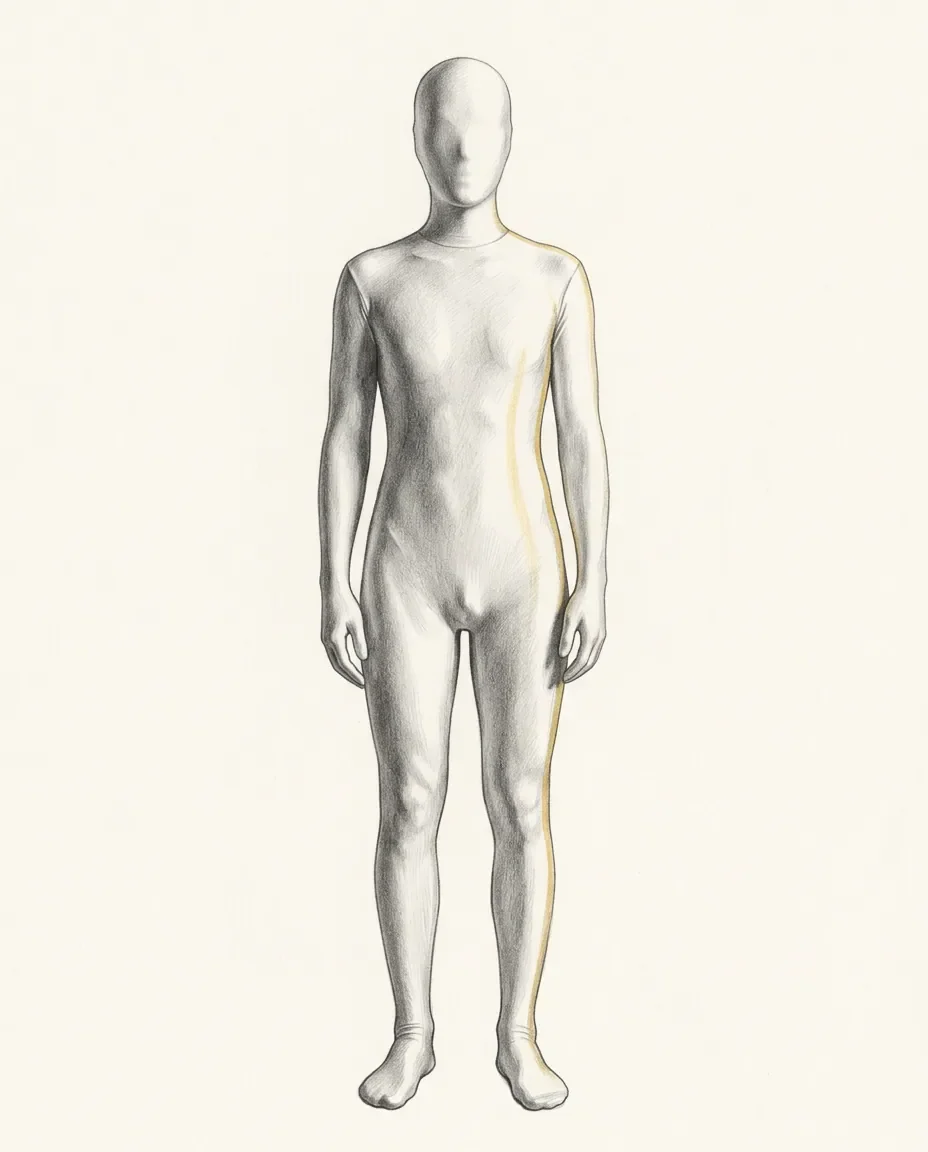
Zentai is a seamless skin-tight suit, usually nylon-spandex, that covers the entire body including the face and hands. The name is Japanese, from zenshin taitsu, "full-body tights". Wearing or being attracted to zentai centres on smooth full-body encasement and the anonymity it creates.
- Prevalence
- Rare
- Category
- Clothing & Garments
- Domain
- Sexual interest
- Confidence
- Low confidence
- Status
- Not a recognised paraphilia; a benign garment and encasement interest, a normal variation absent distress or impairment.
- Also known as
- 全身タイツ, full-body suit, seamless encasement, zentai suit
- Added
- 26 Jun 2026
- Updated
- 22 Aug 2026
Featured in

Overview
Zentai (from Japanese zenshin taitsu, 全身タイツ, "full-body tights") is a seamless skin-tight garment, typically a nylon-spandex blend, that covers the entire body including the face, hands and feet. As an interest it covers both wearing the suit and being drawn to it, and its defining feature is total smooth encasement and the anonymity that erasing the face produces. This article covers what distinguishes zentai from related spandex interests, its origins, how it is worn, and the psychology of facelessness.
Definition & scope
A zentai differs from an ordinary catsuit or bodysuit in one key respect: it has no openings. The face is covered, so the wearer becomes a smooth, featureless figure. That single detail separates the zentai interest from general spandex, latex or rubber fetishism, where the appeal is usually the tight material on a recognisable person. With zentai, the depersonalisation is the point: the suit hides identity and turns the wearer into an anonymous, abstract human form. The sensory side (the second-skin compression, the muffled, filtered perception through fabric, the uniform texture against the whole body) reinforces that shift.
Examples
What the term covers. A single-colour suit worn alone at home for the compression and the anonymity; the same garment worn to a costume party, a stadium or a dance piece with no erotic content whatsoever; suits layered two deep, or worn under a costume as a base layer; a hood-only or open-eye variant for wearers who want to breathe and see more easily; and negotiated scenes that combine the suit with bondage or restricted vision. The suit is the constant; almost everything about the reason for wearing it varies.
What it does not cover. Mask fetishism and female masking localise the transformation to the head, and kigurumi masking adds a hard anime mask and, with it, a specific character to become. Mummification and the vacuum bed share the enclosed feeling but immobilise the body, where a zentai leaves the wearer free to move, and the vacuum bed carries real asphyxiation risk that a zentai does not. Sensory deprivation removes a sense deliberately; a zentai only dims perception as a side-effect of covering it. Cosplay and fursuiting put an identity on, while the zentai interest is usually about taking one off.
How the word is used. Zentai is a Japanese loanword, standard in English in both the enthusiast community and the costume trade, where the same garment is often sold as a morphsuit or party suit. It names the object and, by extension, the interest in it. Neither term is clinical: no garment interest is named in DSM-5-TR or ICD-11, which reach for fetishistic disorder only where there is distress, impairment or a non-consenting person.
History & origins
The garment and its name are Japanese in origin, and the English-language record is candid that the early subcultural history is thinly documented. The term contracts zenshin taitsu ("full-body tights"). The suits sit at the meeting point of theatrical costume, sportswear and fetish wear, and several distinct uses grew up in parallel:
- Performance and stagecraft: featureless full-body suits have long served dance and theatre, and chroma-key (green-screen) suits use the same construction so a performer can be edited out of footage.
- Sports fandom: zentai-clad fans became a recognisable spectacle, the best-known being the Green Men, two Vancouver Canucks supporters who first appeared in green full-body suits at Rogers Arena in December 2009, drew international attention during the Canucks' 2011 playoff run, and were inducted into ESPN's Hall of Fans in 2012.
- Commercial boom: branded party suits such as Morphsuits popularised the look in the late 2000s and early 2010s, with the maker reporting roughly 10,000 units shipped to Canada alone in 2010, alongside RootSuit, Superfan Suit and Bodysocks.
- Fetish subculture: in parallel, a smaller community formed around zentai specifically for the encasement and anonymity experience, overlapping with spandex, rubber and bondage scenes.
Psychology
Why does anonymity appeal?
For many wearers the draw is freedom through facelessness: with identity hidden, self-consciousness drops and the person can act, pose or simply exist as an abstract figure without being individually seen. The suit can function as a mask for the whole body, which links zentai to deindividuation and to play around losing or shedding the self. For others the core is sensory: even, total compression and the smooth uniform texture create a contained, soothing or arousing full-body sensation. The two motives often combine. As with most material and encasement interests, the evidence base is observational and community-derived rather than experimental.
Prevalence & culture
How common is a zentai interest?
There are no prevalence figures specific to the zentai interest, so any estimate carries low confidence. The broad category it belongs to is common: Joyal & Carpentier (2017) found material and fabric-related interests to be widespread in the general population, but a zentai-specific attraction is far rarer than that umbrella. Cultural visibility, by contrast, is unusually high for so niche an interest, because the look crossed into the mainstream through party suits, sports fandom and music videos.
Safety, consent & law
The interest is benign and legal, and involves no risk to anyone else: the suit is worn by, and on, a consenting adult. The practical cautions are ordinary garment ones. Full coverage limits vision, hearing and ventilation, so heat build-up and reduced situational awareness are the real concerns, and both matter more in a crowd, near traffic or in water than at home.
Public-order rules occasionally bite. France's ban on face covering in public can apply to a hooded zentai and carries a fine of up to €150, and some sports venues, including Major League Baseball, bar full-face suits and costume hoods for security reasons. A covered face is also easily misread by police or bystanders, which is a practical risk rather than a legal one.
Common questions
Are zentai suits sexual?
Usually not. The great majority of zentai worn in public is costume: party suits, sports-crowd stunts, stage and dance work, chroma-key filming. A smaller community wears them specifically for the encasement and the anonymity, and for those wearers the interest is a material and identity one. The garment is identical either way; what differs is the reason for putting it on.
Can you see, hear and breathe in a zentai suit?
Yes, but all three are degraded. The knit is thin enough to see light and shapes through and to pass air, and wearers describe vision as workable but flattened, with peripheral awareness and hearing noticeably muffled. Heat is the more practical problem, since the suit covers the entire skin surface and traps it. Suits are also made with open eyes or an open mouth for people who want to wear one for longer stretches.
What is the difference between a zentai and a morphsuit?
Branding, mostly. Morphsuits is a commercial line of party zentai, and its several rivals sell the same nylon-spandex garment for the same purpose. "Zentai" is the older and broader word, standard in the enthusiast community and used for full-coverage suits generally, while "morphsuit" tends to signal the costume-shop context of stag parties, stadium crowds and novelty prints.
Is it legal to wear a zentai suit in public?
In most places it is ordinary clothing, but the covered face is the complication. Several countries restrict face coverings in public space, and many stadiums, banks and transport systems set their own rules about obscured faces; enforcement varies and is rarely aimed at costume. The more immediate risk is being misread: a faceless figure draws police and public attention in a way the same person in a t-shirt does not.
Is a zentai interest a paraphilia or a disorder?
No. It is named in neither DSM-5-TR nor ICD-11, and no garment interest is a disorder in itself. Fetishistic disorder requires that an interest cause the person marked distress or impairment, or that it involve someone who has not consented, and wearing a suit alone or with a willing partner meets neither condition. The research literature on it is close to non-existent, which reflects research attention rather than risk.
What are zentai suits made of, and do they have to fit exactly?
Almost always a nylon-spandex or polyester-spandex knit with four-way stretch, in matte, shiny or velvet finishes. Fit matters more than in ordinary clothing, because the effect depends on the fabric lying smooth over the whole body, so suits are commonly made to measure from height, weight and limb lengths. Too large and the suit wrinkles and loses the seamless look; too small and the seams take the strain.
- Spandex Fetish36/100Objects & MaterialsAn erotic attraction to spandex and similar stretch fabrics (Lycra, elastane), focused on their tight, second-skin fit and smooth, glossy surface. It is a benign synthetic-material interest rather than a clinically defined paraphilia.36
- Rubber Fetish56/100Rubberism · Objects & MaterialsAn erotic interest in rubber garments and gear, prized for the heavier, matte material and the look, smell, and enveloping feel it provides. A material fetish closely tied to latex and BDSM gear culture among consenting adults.56
- Latex Fetish62/100Latex fetishism · Objects & MaterialsAn erotic interest in latex garments and their tight, glossy, second-skin qualities. A common material fetish involving the look, feel, sound, smell, and enveloping sensation of clinging latex on consenting adults.62
- Mask Fetish37/100Mask Fetishism · Clothing & GarmentsAn erotic interest in masks, hoods, and other face coverings, often tied to themes of anonymity, transformation, and concealed or altered identity. It is an uncommon clothing-and-material fetish rather than a clinical disorder.37
- Female Masking17/100Identity & TransformationFemale masking is the practice of wearing a lifelike full-head silicone or latex mask to present as a woman or as an idealized doll-like figure. A matching body suit is usually worn with it. It centres on transformation, embodiment and total concealment of the wearer's own identity.17
- Mummification45/100Sensation & PainMummification is a form of consensual bondage in which a person's body is wrapped or encased in materials such as plastic film, tape, or bandages. The wrapping often runs head to foot, restricting movement and heightening sensory experience. It is a recognised BDSM practice, not a clinical paraphilia.45
From Japanese 全身タイツ (zenshin taitsu), "full-body tights": 全身 (zenshin, "whole body") + タイツ (taitsu, a loanword from English "tights"). "Zentai" is a contraction of zenshin taitsu.
full-body encasement · spandex & lycra · anonymity & depersonalisation
Prevalence is computed from the entry's cited population estimate. Rows marked ESTare indicative editorial estimates scored against a fixed anchor rubric, not measured quantities. Method & anchors: methodology.
Rare · ≈ 1 in 1,000
- 01Zentai, Wikipediadefinition, zenshin taitsu etymology, nylon-spandex construction, anonymity/depersonalisation, Green Men and Morphsuits cultural history with 2010 shipping figure, chroma-key use, and France's face-covering ban
- 02Joyal & Carpentier (2017), The Prevalence of Paraphilic Interests and Behaviors in the General Population, Journal of Sex Research 54(2):161-171general-population prevalence of material/fabric interests as the broad umbrella this niche encasement interest sits far below
- 03Sexual fetishism, Wikipediaclassification of garment and material fetishism and the distinction between material appeal and identity-concealing encasement
- 04The Green Men, Wikipediathe Green Men Vancouver Canucks fans: first appearance at Rogers Arena in December 2009, international attention during the 2011 playoffs, and induction into ESPN's Hall of Fans in 2012