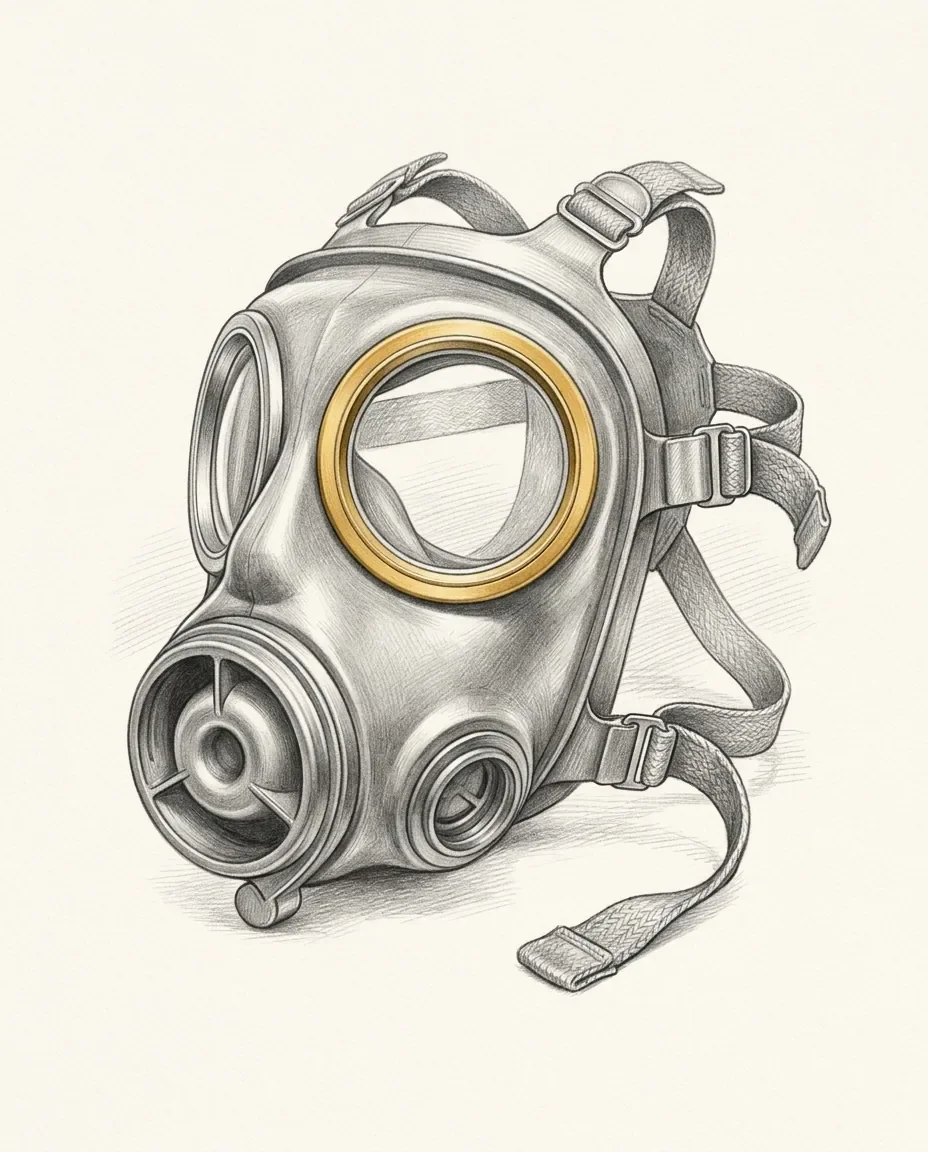
Gas Mask Fetish
Added 22 Jun 2026 · Updated 22 Aug 2026
An erotic interest in gas masks and respirators, valued for the rubber enclosure of the face, anonymity, and altered breathing. An uncommon object fetish tied to rubber/latex culture and breath play, carrying real physical risk when airflow is restricted.
- Prevalence
- Uncommon
- Category
- Objects & Materials
- Domain
- Sexual interest · Paraphilia
- Confidence
- Low confidence
- Status
- A fetishistic interest in the DSM-5-TR/ICD-11 sense; benign and not a disorder unless it causes distress, impairment, or significant risk of injury. ICD-11 flags such interests when associated with risk of injury or death.
- Also known as
- gas mask fetishism, respirator fetish, gasmask kink, breathing mask fetish
- Added
- 22 Jun 2026
- Updated
- 22 Aug 2026
Featured in
Overview
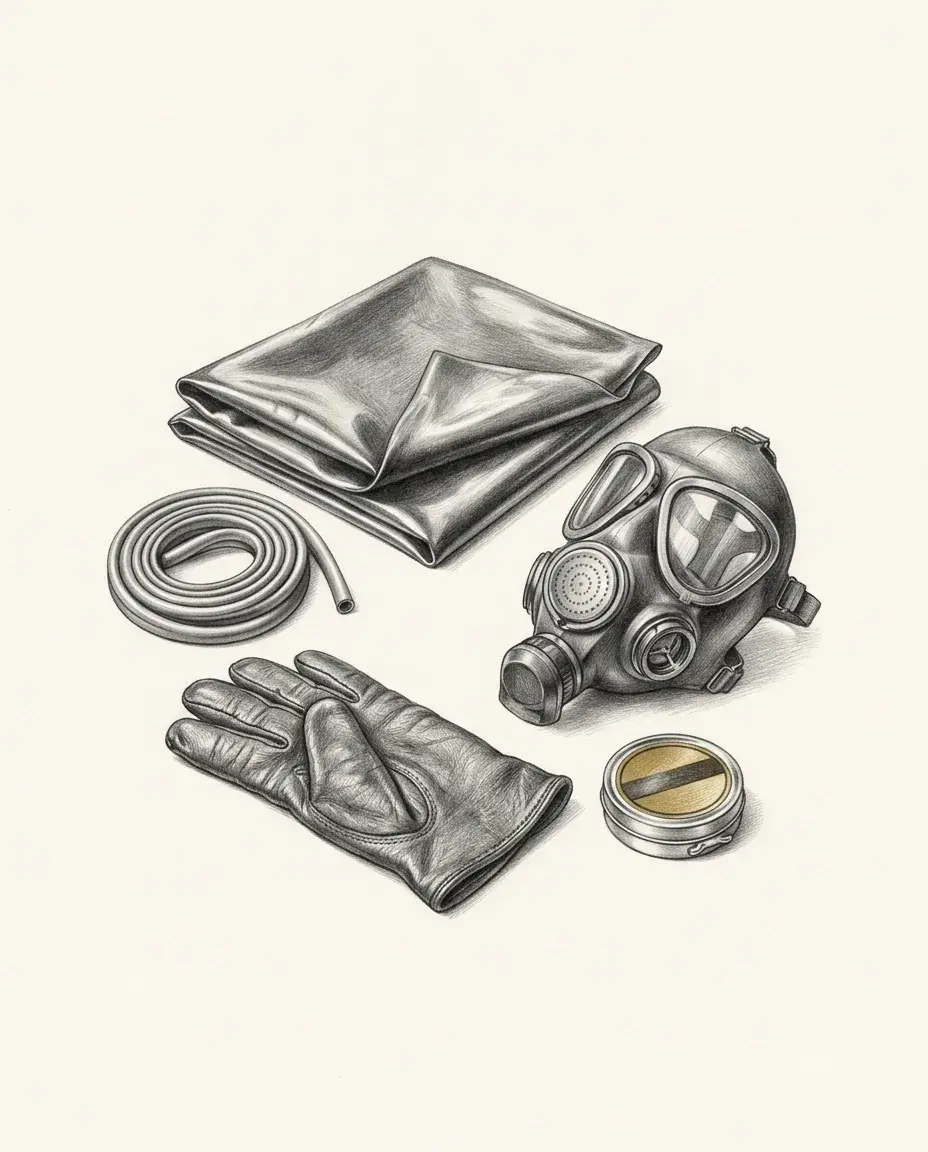
Gas mask fetishism is an erotic interest in which arousal is tied to gas masks, respirators, and similar full-face breathing apparatus. The appeal typically combines the rubber or latex material, the concealment and anonymity of the covered face, the militaristic aesthetic, and the sensation of filtered or restricted breathing. Among consenting adults it is a benign object fetish rather than a disorder, but it sits at the boundary of breath play and so carries genuine physical risk when used to restrict airflow. This article traces the mask from a battlefield invention to a kink-culture object and frames its safety profile clearly.
Examples
What the term covers. Wearing a mask, or looking at images of one worn, for the sealed rubber enclosure of the head, the narrowed field of vision, the muffled sound and the hollow noise of one's own breathing through a filter. The apparatus is usually worn alongside other gear rather than alone (latex or rubber garments, uniform or military dress), and surplus masks are frequently collected as objects in their own right, photographed and displayed as much as used.
What the term does not cover. A general mask fetish covers any face covering and turns on anonymity and transformation; the gas mask adds the industrial-military form and the altered breathing, which is what makes it a separate interest. Breath play reverses the emphasis: there the restriction is the point and the apparatus incidental, and erotic asphyxiation narrows it further to arousal from oxygen restriction itself, often practised alone. Sensory deprivation removes sight or hearing with no breathing element at all, mummification and zentai encase the whole body, and claustrophilia attaches to enclosed spaces rather than to worn equipment.
How the word is used. Entirely community vernacular: "gas mask fetish", "respirator kink", "rubber breathplay". Sexology never coined a distinct term for it and treats it simply as a form of object fetishism, so it reaches DSM-5-TR and ICD-11 only through the general fetishism criteria. That is also where ICD-11's caveat about interests carrying a significant risk of injury or death becomes the relevant part of the entry.
History & origins
Unlike most fetish objects, the gas mask has a precise twentieth-century birth, and its erotic afterlife is entirely bound up with the rise of rubber culture.
A battlefield invention
The modern gas mask was engineered in response to chemical warfare in the First World War.
- 22 April 1915: the German army released chlorine gas at the Second Battle of Ypres, the first large-scale poison-gas attack, creating an urgent need for respiratory protection.
- May–June 1915: Cluny Macpherson's chemical-absorbing fabric hood, presented to the British War Office, became the British Smoke Hood; the same year the Russian chemist Nikolay Zelinsky devised an effective activated-charcoal filter.
- 1916: the Small Box Respirator, with a filter canister joined to the mask by a hose, became standard issue and set the template for the rubber-and-canister look that fetish culture later adopted.
After the wars, vast quantities of gas masks entered civilian life as cheap military surplus, putting the object within easy reach of enthusiasts.
Into rubber and fetish culture
The mask's erotic meaning was absorbed from the broader rubber and latex subculture.
- 1920s–1930s: rubber and latex play were already documented by enthusiasts writing in publications such as London Life.
- 1957 onward: British designer John Sutcliffe began making weatherproof rubber clothing for motorcyclists that crossed into fetish wear; his catalogue grew into the magazine AtomAge (founded 1972, ending 1980), which became a central document of the rubber, leather and vinyl scene.
- 1980s: Skin Two magazine chronicled the emergence of the fetish-club scene, in which rubber gear, including gas masks, featured prominently.
Wikipedia's overview of rubber and PVC fetishism lists gas masks among the garments of interest to enthusiasts, valued for the protective-industrial aesthetic. No clinician ever coined a distinct diagnostic term for the interest; it circulates through community usage rather than formal nomenclature, classed in the broader literature simply as a form of object fetishism.
In practice
The interest is expressed through wearing or viewing gas masks, frequently alongside latex, rubber, or uniform attire. Common elements include:
- the sealed rubber enclosure of the head and the muffling of sound and vision
- the changed soundscape and the resistance of breathing through a filter or hose
- pairing with breath play, in which airflow is briefly and deliberately altered or restricted
For some it is a standalone focus; for many it sits within broader mask, rubber, or BDSM interests rather than existing in isolation. It overlaps with, but is not identical to, a general mask fetish (the gas mask adds the industrial-military look and the breathing element) or with hood and enclosure interests, where the draw is total covering rather than the specific apparatus.
Psychology
The appeal is usually traced to several overlapping threads: the symbolic charge of the mask (anonymity, transformation, authority, danger, the uncanny erasure of the human face), the sensory shift of altered breathing and narrowed perception, and associative learning that links the apparatus with arousal through repeated pairing. Concealing the face can lower self-consciousness and support identity shift or power exchange, which is part of why masks recur across many kinks. As with most object fetishes, the evidence base is thin and largely qualitative; no single mechanism is established, and accounts tend to combine symbolic and learning explanations.
Prevalence & culture
How common is gas mask fetishism?
It is uncommon. No survey isolates gas mask fetishism, so its rarity is inferred. Scorolli and colleagues' 2007 analysis of online fetish communities found object- and material-directed interests to be a comparatively small share of the overall fetish landscape, within which a specific item like the gas mask is a minor sub-category. The interest is nested mainly within rubber, latex, and mask communities and is especially visible in parts of the gay leather and rubber scenes; dedicated community groups exist but are niche relative to mainstream object fetishes. It enjoys broad cultural familiarity through war imagery, photography and film, but attracts little dedicated research.
Safety, consent & law
The object itself is legal and the interest is benign among consenting adults, though wearing a concealing mask in some public settings may be locally restricted. The serious caveat is breathing. A gas mask can restrict or block airflow, risking hypoxia, loss of consciousness, and, rarely, cardiac complications or death; this is why ICD-11 notes that otherwise benign fetishistic interests rise to clinical concern when they carry a significant risk of injury or death. The danger is not hypothetical: a 1995 forensic case report by Howard documented a fatal asphyxiation involving a modified gas mask. Harm-reduction principles shared with erotic asphyxiation apply: informed consent, never restricting breath while alone, constant in-person monitoring, instant mask removal, and never using filters of unknown contents or sealed/modified setups. Restricting another person's breathing also carries serious legal liability if harm results.
Common questions
Why do people find gas masks arousing?
Several threads usually run together: the symbolism of the covered face (anonymity, transformation, authority, a hint of danger), the tactile and olfactory pull of rubber, and the sensory shift of hearing your own breathing while sight and sound narrow. Concealing the face also lowers self-consciousness, which is part of why masks recur across so many interests. The evidence base is thin and largely descriptive, and no single mechanism is established.
Is it safe to wear a gas mask during sex?
Not inherently, and that is what separates this from most object fetishes. A sealed mask controls what you breathe, so a blocked, modified or unsuitable filter can cause hypoxia and loss of consciousness quickly, and arousal makes people slower to notice it happening. The mask has to come off instantly and without help, someone sober should be present, and no one should wear one alone.
What is the difference between a gas mask fetish and breath play?
Where the interest sits. A gas mask fetish attaches to the object (the rubber, the shape, the concealment), and many enthusiasts wear one with airflow completely unobstructed. Breath play attaches to the restriction of breathing itself, whatever produces it. The two overlap when a mask is used to alter airflow, and that is precisely the point at which the physical risk stops being theoretical.
Is a gas mask fetish a paraphilia?
In the technical sense, yes: it is a fetishistic interest, meaning an erotic focus on an object, and both DSM-5-TR and ICD-11 use "paraphilia" for an atypical focus rather than for a pathology. It is not a disorder. It becomes clinically relevant only where it causes the person distress or impairment, involves someone who has not consented, or (the ICD-11 caveat that matters most here) carries a significant risk of injury or death.
What should you do if someone passes out wearing one?
Treat it as an emergency. Get the mask off immediately, put the person on their side with the airway clear, and call emergency services rather than waiting to see whether they come round. Losing consciousness means the brain was deprived of oxygen. The risk is documented, not hypothetical: a 1995 forensic case report described a fatal asphyxiation involving a modified gas mask.
Is it legal to wear a gas mask in public?
Sometimes not. The masks themselves are legal to own and buy almost everywhere, but a number of jurisdictions restrict covering the face in public places or at public gatherings, and the rules differ sharply between countries and even cities. Nothing about the interest requires a public setting, so in practice it belongs to private, consensual contexts among adults.
Why did gas masks end up in fetish culture at all?
Two accidents of history. The mask was engineered for chemical warfare from 1915 onward, and after the wars enormous quantities reached civilians as cheap military surplus, so a striking object became easy to obtain. It then landed in a rubber-and-latex subculture already forming around rubber wear and weatherproof clothing, documented from the 1920s through AtomAge and later Skin Two, which absorbed the gas mask as one more piece of rubber gear.
From the blog
- Rubber Fetish56/100Rubberism · Objects & MaterialsAn erotic interest in rubber garments and gear, prized for the heavier, matte material and the look, smell, and enveloping feel it provides. A material fetish closely tied to latex and BDSM gear culture among consenting adults.56
- Latex Fetish62/100Latex fetishism · Objects & MaterialsAn erotic interest in latex garments and their tight, glossy, second-skin qualities. A common material fetish involving the look, feel, sound, smell, and enveloping sensation of clinging latex on consenting adults.62
- Mask Fetish37/100Mask Fetishism · Clothing & GarmentsAn erotic interest in masks, hoods, and other face coverings, often tied to themes of anonymity, transformation, and concealed or altered identity. It is an uncommon clothing-and-material fetish rather than a clinical disorder.37
- Breath Play52/100Asphyxiophilia · Sensation & PainA sexual interest in restricting breathing or blood/oxygen flow to heighten arousal, ranging from light, negotiated partnered breath control. At its far end it includes solitary erotic asphyxiation. Clinically recognised as a specifier of sexual masochism and carrying a serious risk of accidental death.52
- Erotic Asphyxiation30/100Asphyxiophilia · Clinical ParaphiliasAsphyxiophilia is a paraphilic interest in which sexual arousal is heightened by restricting breathing or blood flow to the brain. Neck pressure and suffocation are two examples. Practiced alone it is termed autoerotic asphyxiation; it is among the most lethal of documented paraphilias.30
- Food Fetish37/100Sitophilia · Objects & MaterialsAn erotic interest in food and eating, in which edible items, their taste and texture, or the act of food contact become a focus of arousal. Often expressed as playful, messy, sensory-led intimacy between consenting partners; its messy variant is known as sploshing.37
A plain descriptive compound: "gas mask" names the protective respirator designed to filter poison gas, plus the directional "-fetish" (from Portuguese feitiço, "charm, sorcery"). There is no coined Greek- or Latin-derived clinical term for it.
rubber and latex objects · face coverings · breath-restriction apparatus
Prevalence is computed from the entry's cited population estimate. Rows marked ESTare indicative editorial estimates scored against a fixed anchor rubric, not measured quantities. Method & anchors: methodology.
Uncommon · ≈ 1 in 100
- 01Rubber and PVC fetishism, Wikipediagas masks listed among garments of interest to rubber/latex enthusiasts; subculture history (London Life 1920s-30s, John Sutcliffe, AtomAge, Skin Two)
- 02List of paraphilias, Wikipediaplacement of object/apparatus-directed interests within the fetishism family
- 03Scorolli et al. (2007), Relative prevalence of different fetishes, Int. J. Impotence Research 19(4):432-437relative-frequency anchor: gas masks are a minor sub-category within object/material fetishes, keeping prevalence low
- 04Howard JD (1995), Suffocation from use of modified gas mask, Am J Forensic Med Pathol 16(2)documented fatal asphyxiation from a modified gas mask, basis for the physical-risk safety framing
- 05ICD-11, Paraphilic disorders (World Health Organization)clinical framing: object fetishism rises to a disorder only with distress, impairment, or significant risk of injury or death
- 06FetLife, kink community group sizes (community-size proxy)community-size proxy: gas mask / rubber breathplay groups exist but are niche relative to mainstream object fetishes
- 07Gas mask, Wikipediaorigin of the modern gas mask in WWI chemical warfare (Second Battle of Ypres, 22 April 1915; British Smoke Hood 1915; Small Box Respirator 1916) and later military-surplus availability
- 08John Sutcliffe (designer), WikipediaJohn Sutcliffe began rubber fetish-wear in 1957; his AtomAge magazine (1972-1980) documented the rubber/leather/vinyl scene