Raincoat Fetish
Added 26 Jul 2026 · Updated 22 Aug 2026
An erotic attraction to rainwear (rubberized or PVC macs, capes, sou'westers and waders) for their waterproof sheen or matte texture. The sound of the material adds to it, as does the tension between a garment's plain practicality and its covert erotic charge.
- Prevalence
- Rare
- Category
- Clothing & Garments
- Domain
- Sexual interest · Paraphilia
- Confidence
- Low confidence
- Status
- Not a distinct clinical entity; treated under the general fetishistic-disorder framework in DSM-5-TR/ICD-11, which applies only where the interest causes significant distress, impairment, or harm.
- Also known as
- mac fetish, rainwear fetishism, mackintosh fetish, plastic mac fetish, wet-weather fetish
- Added
- 26 Jul 2026
- Updated
- 22 Aug 2026
Featured in
Overview
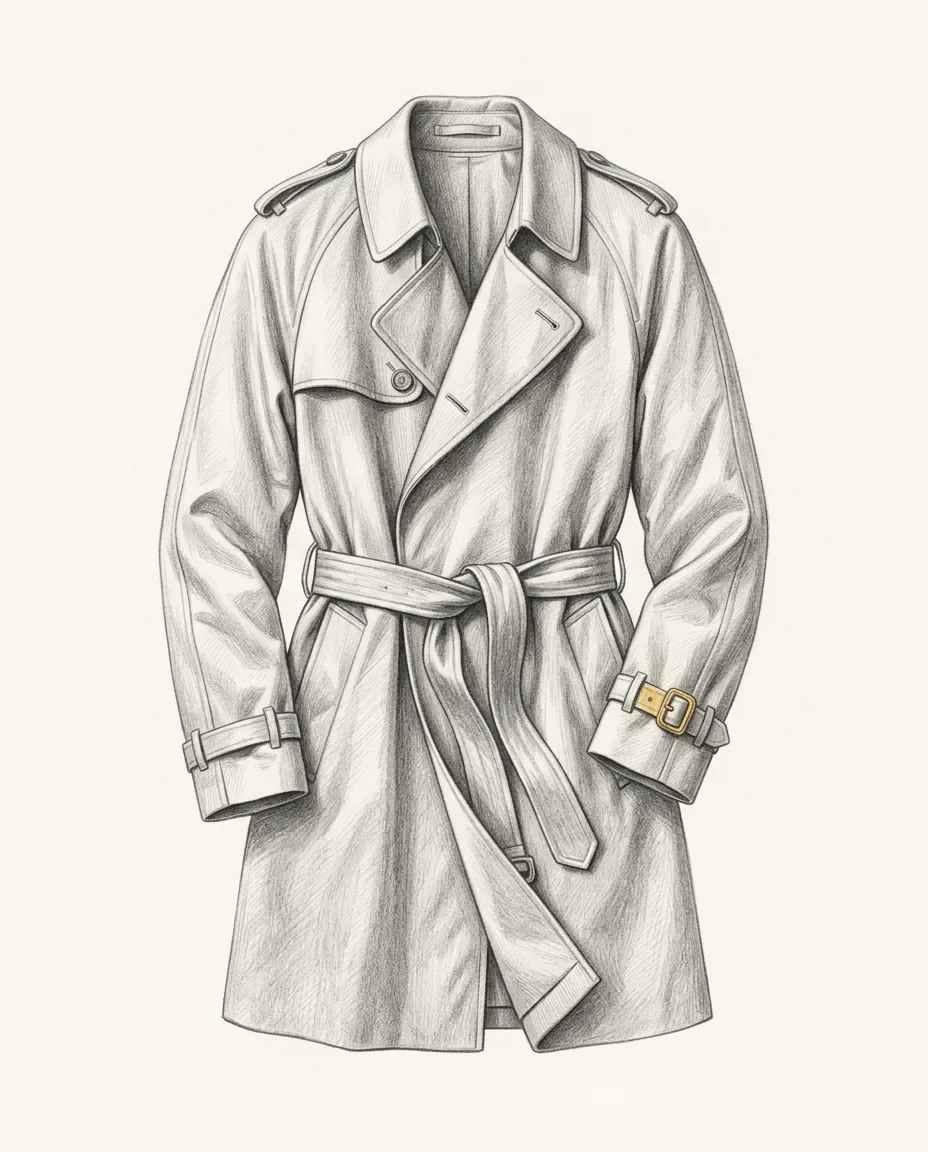
Raincoat fetish (rainwear fetishism, or "mac fetish" in British slang) is an attraction to waterproof outerwear (the classic rubberized mackintosh, PVC macs and capes, sou'westers and waders) prized for a glossy or matte waterproof surface, the crinkle or swish of the material in motion, and often the sight of a partner dressed against the weather. It sits alongside PVC fetishism and rubber fetishism, sharing the same synthetic, second-skin materials, but it has its own distinct history: the British mackintosh coat carried a documented erotic following almost from the moment it was invented, decades before rubber or vinyl became fetish-club staples in their own right. This article traces that history, from a Glasgow chemist's patent to the underground magazines that gave the interest a public voice.
Definition & scope
The interest covers a range of wet-weather garments: the traditional rubberized-cotton mackintosh, transparent or opaque PVC raincoats and capes, oilskins, sou'westers and rubber waders, worn either by the person with the interest or observed on a partner. The appeal draws on several overlapping qualities: the coat's waterproof sheen or "wet look," its stiffness or cling against the body, the audible rustle it makes when moving, and a contrast some enthusiasts describe between the garment's everyday, unremarkable function and its private erotic meaning. Because rainwear is made from the same rubberized cloth, PVC or vinyl used elsewhere in fetish clothing, the practice overlaps closely with the broader shiny- and second-skin-material fetishes, while remaining a recognisable interest in its own right, organised around a specific, everyday garment rather than a material alone.
Examples
What the term covers. The range is narrow and entirely ordinary: rubberized-cotton mackintoshes, transparent and opaque PVC macs and capes, oilskins, sou'westers, rubber waders and the wellington boots that go with them, worn by the person with the interest or watched on a partner. What varies is which property carries the charge. For some it is visual: the wet-look shine of PVC, or the dull matte of heavy rubberized cloth. For others it is audible: the crinkle and swish of a coat in motion. For a third group it is situational rather than material at all: rain itself, being caught out in it, or a partner arriving soaked and wrapped against the weather.
What the term does not cover. PVC, rubber and latex fetishism are material-first: the appeal follows the substance into catsuits, hoods and sheeting. Rainwear fetishism is garment-first, which is why a waxed-cotton oilskin still counts and a latex dress does not. A boot fetish shares the wellington but is footwear-focused; a uniform fetish turns on the role a garment signals rather than on the fabric; nylon and spandex are sibling synthetic-material interests without the waterproofing. And despite the name, it is close to the reverse of wet and messy play, where the point is to get soaked and dirty; the rainwear interest is in staying dry inside something impermeable.
How the word is used. The vocabulary is community vocabulary, not clinical: "mac fetish" in British usage, "rainwear fetishism" in the marketplaces and forums, and "rubberist" (a word already circulating in the readers' letters of London Life between the wars) for the wider material scene it sits inside. None of it is a diagnosis: neither DSM-5-TR nor ICD-11 names rainwear, which falls under the general fetishistic-disorder framing that applies only where an interest causes significant distress, impairment or harm.
History & origins
An accidental fetish object
The garment itself predates any fetish framing. The Scottish chemist Charles Macintosh (1766–1843) patented a method of cementing two layers of cloth together with rubber dissolved in coal-tar naphtha, and the first coats went on sale under his name in 1824. Early rubberized macs were stiff, smelly and prone to melting in hot weather; in 1843, Thomas Hancock's vulcanisation process, patented the same year Macintosh died, fixed most of these faults and let the rubberized coat become a durable, mass-market garment. According to Wikipedia's account of rubber and PVC fetishism, although the coat was designed purely for practical weatherproofing, "it found a fetishistic following" almost as soon as it appeared, and rubberized garments were briefly fashionable among wealthy Victorians in the 1850s before falling out of ordinary public wear by the 1890s, a decline that, if anything, pushed the material further into a specialist, semi-private interest rather than erasing it.
Print culture and the fetish underground
The interest surfaces in print from the 1920s. London Life, a general-interest British weekly published from 1923 to 1960, carried an active readers'-letters section that, alongside tight-lacing, discussed "rubberism" and related material interests; it dropped this content after 1941 but is credited with connecting fetish-minded readers across the English-speaking world and with inspiring the artist John Willie to found his own fetish magazine, Bizarre. The post-war rubber and PVC scene coalesced around the designer John Sutcliffe, whose fetish-clothing business AtomAge began trading from a 1965 catalogue and launched a magazine of the same name in 1972, running until 1980 and later described as "the underground bible of leather, rubber and vinyl fetish wear" of 1970s Britain; a 2010 retrospective, Dressing for Pleasure: The Best of AtomAge 1972–1980, was published by FUEL. Wider visual exposure came through the glossy latex and PVC catsuits worn on the 1960s British television series The Avengers, and through the 1980s–90s club scene and its dedicated magazines (Skin Two, Marquis, Rubberist, Dressing for Pleasure), which documented and helped consolidate the whole shiny-material community that rainwear sits within.
Clinical framing
Raincoat fetishism has never been catalogued as a distinct clinical entity. Like other object- and material-based interests, it falls under the general fetishistic disorder category in the DSM-5-TR and the corresponding entry in the ICD-11: a diagnosis reserved for cases causing significant distress, impairment, or harm to others, not for the interest itself, which the literature treats as a benign, common-enough variation within the wider family of clothing and material fetishes.
In practice
The interest is expressed through owning, wearing or watching a partner wear vintage or new mackintoshes, PVC or rubber raincoats and capes, oilskins and waders, sometimes paired with wellington boots or a matching hood. Some enthusiasts favour the classic matte, heavy rubberized mac; others prefer glossy PVC for its wet-look shine, tracking closely with PVC fetishism and rubber fetishism. A subset of the interest centres less on the material than on situation: being caught in the rain, or a partner arriving soaked and wrapped in rainwear, which draws it toward broader clothing and role-based fetishes rather than a fixed material alone.
Psychology
As with other garment fetishes, an early, repeated pairing of the sight, sound or feel of rainwear with arousal is the most commonly proposed mechanism, a classical-conditioning account shared across material fetishes. Enthusiasts frequently point to the tension between the coat's plain, protective, everyday purpose and its private erotic charge, an ordinary object made covertly significant. The dynamic belongs to the broader psychology of fetishism rather than to any interest in the body itself: rainwear is an object fetish, not a partialism, which names a focus on a specific non-genital body part.
Prevalence & culture
No study has measured rainwear fetishism as its own category; it is folded into the wider literature on object and material fetishism. Joyal & Carpentier (2017) found that a substantial minority of a general-population sample reported some fetishistic interest in objects or materials, of which rainwear is a narrow slice, and Scorolli et al.'s (2007) survey of online fetish communities found clothing interests concentrated in leg- and buttock-wear, footwear and underwear, well ahead of the smaller whole-body-wear category that rainwear belongs to. The interest is sustained today by dedicated online marketplaces, hobbyist forums and photo-sharing groups, considerably smaller in scale than the general rubber, PVC or leather fetish communities they overlap with.
Safety, consent & law
Between consenting adults, raincoat fetishism carries no legal restriction and, like PVC fetishism, no clinical risk. The practical cautions are the ones that attach to any impermeable garment worn for pleasure rather than for weather: rubberized and PVC clothing does not breathe, so heat builds and sweat has nowhere to go, and long wear in a warm room can bring on overheating and fluid loss faster than it feels like it should, particularly in a full-length coat worn with a hood. Natural-rubber items are a latex-allergy risk for a minority of people, and a tight collar or cuff can chafe or restrict circulation. None of this is specific to the interest; it is simply what impermeable material does.
Common questions
What is the difference between a raincoat fetish and a PVC or rubber fetish?
The difference is what the interest is anchored to. PVC, rubber and latex fetishism follow the material wherever it turns up: catsuits, hoods, sheeting. A raincoat fetish is anchored to a garment and its purpose, which is why a waxed-cotton oilskin or a canvas cape can carry the same charge as a glossy PVC mac. In practice the two overlap constantly, because most rainwear is made of exactly those materials.
Why is it called a "mac fetish"?
"Mac" is the British shortening of "mackintosh," the rubberized waterproof coat named after Charles Macintosh, the Glasgow chemist whose 1823 patent for cementing cloth with rubber made it possible; the first coats went on sale in 1824. Because "mac" became the everyday British word for a raincoat, "mac fetish" is simply the local phrasing for the same interest more often called a rainwear or raincoat fetish elsewhere.
Is a raincoat fetish a paraphilia or a disorder?
Neither manual treats it as a diagnosis. Rainwear has never been catalogued as a distinct clinical entity; it falls under the general fetishistic-disorder heading in DSM-5-TR, which requires significant distress, impairment or harm to others before anything is diagnosed, and ICD-11 applies the same threshold. An enjoyed interest that harms nobody does not meet it.
Why would a raincoat be arousing?
The standard account is classical conditioning: an early, repeated pairing of the sight, sound or feel of rainwear with arousal, which is the same explanation offered for garment fetishes generally. Enthusiasts themselves tend to describe something more specific: the appeal of an object that is aggressively ordinary in public and privately charged, plus the sensory package of shine, cling, weight and the rustle the material makes when someone moves.
How common is a raincoat fetish?
Rare, and never measured directly. No study isolates rainwear; it is folded into research on object and material fetishism. Joyal & Carpentier (2017) found that a substantial minority of a general-population sample reported some fetishistic interest in objects or materials, but rainwear is a narrow slice of that, and Scorolli et al. (2007) found clothing interest concentrated in footwear and underwear, well ahead of the whole-body-garment category rainwear belongs to.
Is it safe to wear PVC or rubber rainwear for long periods?
Within limits. The material is impermeable by design, so body heat and sweat have nowhere to go; long wear in a warm room can bring on overheating and dehydration faster than it feels like it should, especially in a full-length hooded coat. Natural rubber is also a latex-allergy risk for some people. Breaks, drinking water, a looser fit and a cool room deal with almost all of it.
- PVC Fetish42/100Objects & MaterialsAn erotic attraction to shiny PVC and vinyl clothing, prized for its high-gloss "wet look", smooth slick surface, and tight, body-hugging fit. A common, accessible cousin of latex and leather fetishism.42
- Rubber Fetish56/100Rubberism · Objects & MaterialsAn erotic interest in rubber garments and gear, prized for the heavier, matte material and the look, smell, and enveloping feel it provides. A material fetish closely tied to latex and BDSM gear culture among consenting adults.56
- Latex Fetish62/100Latex fetishism · Objects & MaterialsAn erotic interest in latex garments and their tight, glossy, second-skin qualities. A common material fetish involving the look, feel, sound, smell, and enveloping sensation of clinging latex on consenting adults.62
- Fetishism64/100Fetishistic Disorder · Clinical ParaphiliasA DSM-5-TR paraphilic disorder defined by recurrent, intense arousal from nonliving objects or a strong focus on non-genital body parts. The body-part form is partialism, and the arousal must cause clinically significant distress or impairment. An object or body-part preference without distress is not a disorder.64
- Partialism46/100Partialism · Clinical ParaphiliasThe clinical term for an exclusive or near-exclusive sexual focus on a specific, usually non-genital body part: feet, hands, hair, legs, the navel. It is the umbrella concept under which interests such as foot or hand attraction are formally classified.46
- Nun Fetish26/100Clothing & GarmentsAn erotic interest centred on religious dress, most often the nun's habit and veil, valued for its modest silhouette and ritual symbolism. Themes of forbidden allure are part of the draw. A niche costume and role-play fetish, not a clinical disorder.26
"Mackintosh" (colloquially shortened to "mac" in British usage) derives from the surname of Charles Macintosh, the Glasgow chemist whose 1823 patent for rubberized waterproof cloth gave the coat its name; "raincoat" is a plain nineteenth-century English compound of "rain" and "coat."
rainwear · waterproof materials · vintage fashion · material fetish
Prevalence is computed from the entry's cited population estimate. Rows marked ESTare indicative editorial estimates scored against a fixed anchor rubric, not measured quantities. Method & anchors: methodology.
Rare · ≈ 1 in 1,000
- 01Rubber and PVC fetishism, WikipediaCharles Macintosh's 1824 coat found a fetishistic following almost immediately; 1850s fashionability among the wealthy and its decline from ordinary public wear by the 1890s; the wider AtomAge/Skin Two/Marquis/Rubberist club-era timeline and The Avengers' role in visual exposure.
- 02Charles Macintosh, WikipediaCharles Macintosh's dates (1766-1843) and his 1823 patent for rubberized waterproof cloth.
- 03Mackintosh (raincoat), Wikipedia1824 first coats sold; Thomas Hancock's 1843 vulcanisation process that fixed the early garment's smell and stiffness.
- 04London Life (fetish magazine), Wikipedia1923-1960 publication dates; readers'-letters coverage of rubberism and related material interests; its influence on John Willie's Bizarre magazine.
- 05AtomAge, WikipediaJohn Sutcliffe's AtomAge business and magazine (1965 catalogue; 1972-1980 magazine run); its description as the 'underground bible' of 1970s British rubber/vinyl/leather fetish wear; the 2010 Dressing for Pleasure retrospective.
- 06Joyal & Carpentier (2017), The Prevalence of Paraphilic Interests and Behaviors in the General Population, J. Sex Research 54(2):161-171General-population rate of fetishistic interest in objects/materials, of which rainwear is a narrow slice.
- 07Scorolli et al. (2007), Relative prevalence of different fetishes, Int. J. Impotence Research 19(4):432-437Relative-frequency data showing clothing-fetish interest concentrated in leg/buttock wear, footwear and underwear well ahead of the smaller whole-body-wear category rainwear belongs to.
- 08DSM-5-TR, Paraphilic Disorders (American Psychiatric Association, 2022)Fetishistic disorder is diagnosed only with distress, impairment or harm; the interest itself is not pathologised.
- 09ICD-11, Paraphilic disorders (World Health Organization)Corresponding ICD-11 framing of consensual object/material fetishism as non-disordered absent distress or harm.