Nylon Fetish
Nylon Fetishism
Added 21 Jun 2026 · Updated 22 Aug 2026
An erotic attraction to nylon as a material: the sheer, smooth, faintly glossy synthetic fabric used in hosiery, stockings, tights, and other slick garments. It is a textile-material preference rather than a clinically defined paraphilia.
- Prevalence
- Common
- Category
- Objects & Materials
- Clinical term
- Nylon Fetishism
- Domain
- Sexual interest
- Confidence
- Medium confidence
- Status
- Synthetic-material sensory interest; not a recognized paraphilia. Benign common-spectrum preference.
- Also known as
- sheer-fabric fetish, hosiery-material fetish, stocking-material fetish
- Added
- 21 Jun 2026
- Updated
- 22 Aug 2026
Featured in
Overview
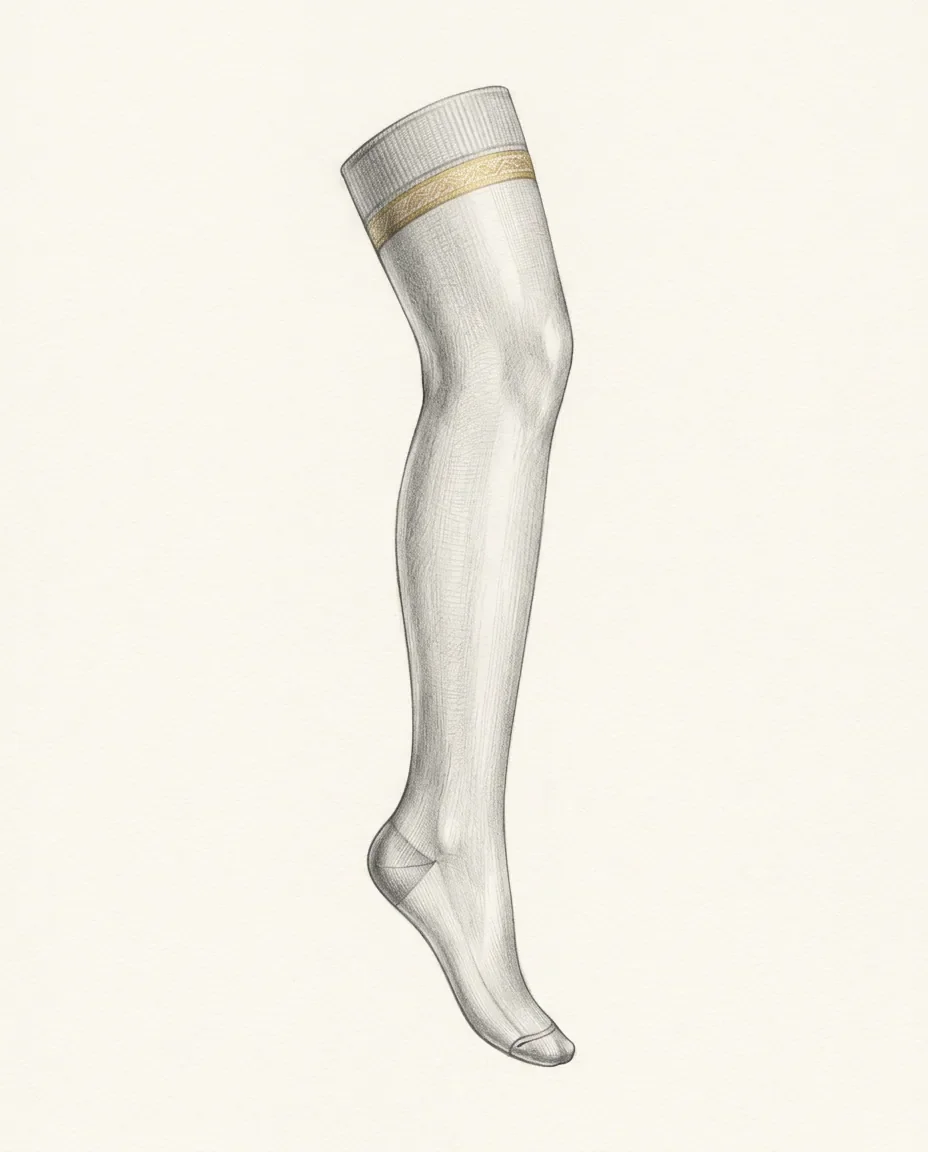
Nylon fetishism is an erotic attraction to nylon as a material, most often encountered in sheer hosiery (stockings, tights, and pantyhose) but extending to other smooth synthetic garments such as nylon sportswear, slips, and lingerie. The appeal centres on the fabric's fine translucent weave, its faint sheen under light, the dry rustle it makes in motion, and the slick sensation of nylon gliding over skin. It is best understood as a benign material preference on the everyday spectrum of clothing and material fetishes rather than a clinically defined disorder.
Examples
What the term covers. Sheer hosiery in fine deniers, and the opaque tights and pantyhose cut from the same fibre; nylon slips, blouses and lingerie; and the entirely non-hosiery side of the material (shell jackets, windbreakers, sportswear), which is where a nylon interest separates most clearly from a legwear one. The appeal is the sensory package the fibre carries: translucent weave, faint sheen, the dry rustle of nylon moving against nylon, the slick glide of it over skin. It may be expressed by wearing the material, by handling it, or by seeing a partner in it.
What the term does not cover. Stocking fetishism and pantyhose fetishism are garment interests (the two-piece stocking and the one-piece waist-to-toe tight), and the distinction is a real one: a nylon enthusiast is often indifferent to which garment carries the fabric, while a stocking enthusiast may be perfectly content with silk or lace. Lingerie fetishism is the umbrella above all of them, and the garter belt is hardware rather than cloth. Other materials are not substitutes: silk and satin are the soft counterparts, lace is openwork, and spandex, PVC and latex are the synthetics that stretch or shine instead. A leg or foot fetish is anatomy rather than fabric, and socks sit at the far end of the same wardrobe.
How the word is used. Plain retail and community English, with "hosiery fetish" and "nylon fetish" traded almost interchangeably, partly because "nylons" is itself an everyday synonym for stockings, which keeps material and garment permanently blurred. It is not a diagnosis: no manual names a fabric, and DSM-5-TR and ICD-11 recognise only a general fetishistic interest, and only as a disorder where distress or impairment is present.
History & origins
Unusually for an erotic interest, this one has a firm birthdate, because the fabric itself was an industrial invention rather than a natural fibre.
Birth of the fabric
- 1927–1935: Research chemist Wallace Hume Carothers led a polymer programme at DuPont that first synthesised the polyamide later called nylon 66 on 28 February 1935, a discovery the American Chemical Society commemorates as a National Historic Chemical Landmark.
- 27 October 1938: DuPont publicly announced nylon at the Herald Tribune's "Forum on Current Problems" in New York, after securing the patent in September 1938.
- 1939: Nylon stockings were showcased at the 1939 New York World's Fair under the "World of Tomorrow" theme; a limited first public sale in Wilmington, Delaware on 24 October 1939 reportedly cleared 4,000 pairs in three hours.
- 15 May 1940: "N-Day," the national release, triggered a buying frenzy in which nearly 800,000 pairs sold on the first day; some 64 million pairs sold in the first year.
- From February 1942: Wartime rationing diverted nylon to parachutes, tents, and cordage, making stockings a scarce luxury and cementing their association with glamour, modernity, and desirability, a cultural charge that long outlasted the shortage.
Clinical lineage of material fetishism
The broader idea that a fabric can become a focus of erotic interest is much older than nylon. Richard von Krafft-Ebing catalogued garment and fabric fixations in Psychopathia Sexualis (1886), and Alfred Binet had named "erotic fetishism" in his 1887 essay Le fétichisme dans l'amour. Nylon, by contrast, is a twentieth-century newcomer: its eroticization grew out of mid-century fashion advertising and pin-up imagery, not the older clinical archive. "Nylon fetish" is a plain descriptive label with no formal coinage on record, and it is not separately listed in the DSM-5-TR or ICD-11; both fold such interests under the general heading of fetishistic interest, which is only a disorder when it causes distress or impairment.
In practice
The interest is typically expressed by wearing or handling hosiery and nylon garments, or by seeing a partner wearing them. Many enthusiasts emphasise specific sensory qualities: the visual sheen, the tactile glide, the sound of nylon on nylon. Because the fabric is so closely tied to legwear, the interest frequently overlaps with leg and foot attraction, though dedicated nylon enthusiasts often stress that it is the material, not the body part beneath, that carries the charge. It sits alongside other smooth-textile interests such as silk and satin, differing mainly in nylon's synthetic origin and characteristic sheen.
Psychology
Like other material fetishes, nylon attraction is usually framed through sensory conditioning and associative learning: a distinctive tactile-visual cue becomes paired with arousal and is reinforced over time. The decades-long cultural eroticization of stockings supplies a ready-made association, which helps explain how a synthetic fibre barely a century old became a recognisable erotic focus. As with most benign fetishes, the empirical literature specific to nylon is thin, and these mechanisms are inferred from the general fetishism research rather than tested directly on this niche.
Prevalence & culture
Nylon and hosiery enjoy outsized visibility through fashion, advertising, and pin-up traditions, which keeps the material culturally salient. In Scorolli and colleagues' 2007 analysis of online fetish communities, legwear such as stockings made up roughly a third of clothing-related fetishes, the single largest garment category, though that figure covers hosiery broadly rather than the nylon material in isolation. More generally, Joyal and Carpentier (2017) found that interest in fabric and object fetishism is common in the wider population, with nylon as one small, specific niche within it. Online hosiery and nylon communities are sizeable relative to other single-fabric interests, though still modest beside leather or latex, and dedicated formal research remains limited.
Safety, consent & law
The interest is consensual and legal and carries no particular safety concerns. It involves ordinary garments worn or handled between consenting adults, with no inherent physical, legal, or ethical risk.
Common questions
What is the difference between a nylon fetish and a stocking fetish?
One is a material, the other a garment. A stocking fetish is about the legwear (its cut, its seam, the hold-up band, the moment of putting it on) and can be satisfied by silk or lace as readily as by nylon. A nylon fetish follows the fibre wherever it goes, including into jackets, sportswear and lingerie that have nothing to do with legs. Most people's interest in practice sits somewhere between the two.
Is a nylon fetish a disorder?
No. Neither DSM-5-TR nor ICD-11 names any fabric; both file material interests under a general fetishistic heading that becomes a disorder only where the interest causes real distress or impairment, or involves someone who has not consented. Wearing, handling or admiring hosiery between consenting adults meets none of that, and the interest carries no physical or legal risk of its own.
Why did nylon in particular become erotically charged?
Because of how it arrived. Nylon stockings went on national sale in the United States on 15 May 1940 ("N-Day") and sold close to 800,000 pairs in a single day, then all but vanished when wartime rationing diverted the fibre to parachutes and cordage from February 1942. Scarcity, novelty and a decade of advertising and pin-up imagery fixed the material to glamour and desirability long before anyone called it a fetish.
Is a nylon fetish the same as a foot or leg fetish?
No, though they travel together, since hosiery is worn on precisely the parts of the body those interests concern. The useful test is whether the fabric still appeals away from the leg: on a sleeve, a slip, a jacket. If it does, the interest is in the material; if it does not, the legwear is a costume for an underlying leg or foot interest.
Does having a nylon fetish mean wearing hosiery yourself?
Not necessarily. The interest sits on either side of the garment: some people are drawn to wearing nylon, some to seeing or touching it on a partner, and many to both. Wearing hosiery is not in itself cross-dressing either, which concerns gendered presentation as a whole rather than the appeal of one fabric.
How common is a nylon fetish?
Common as a family, uncertain as a specific. In Scorolli and colleagues' 2007 survey of online fetish communities, legwear was the single largest clothing category at roughly a third of garment-related preferences, though that counts hosiery broadly rather than the fibre in isolation, and Joyal and Carpentier (2017) found object and material interests to be common in the general population. No study isolates nylon itself.
From the blog
How common7 min read
Shoes, heels, socks and stockings: when the fetish is what covers the foot
A shoe fetish centres on footwear, not the foot. Heels, boots, socks, stockings and pantyhose: what the surveys count and where each ranks on the index.
Origins7 min read
Why do people have kinks? Where the evidence runs out
Why do people have kinks? What conditioning, excitation transfer and the trauma story each explain, and the point where the evidence stops.
- Silk Fetish34/100Objects & MaterialsAn erotic attraction to silk, centred on its smooth, soft, cool tactile feel and luminous drape. It is a soft-textile material interest within the broad family of fabric fetishisms rather than a separately defined clinical paraphilia.34
- Satin Fetish31/100Objects & MaterialsAn erotic attraction to satin centred on its smooth, slippery feel and characteristic sheen, a benign soft-textile material interest. It is not a clinically defined paraphilia, and it overlaps closely with silk and other shiny-fabric preferences.31
- Spandex Fetish36/100Objects & MaterialsAn erotic attraction to spandex and similar stretch fabrics (Lycra, elastane), focused on their tight, second-skin fit and smooth, glossy surface. It is a benign synthetic-material interest rather than a clinically defined paraphilia.36
- PVC Fetish42/100Objects & MaterialsAn erotic attraction to shiny PVC and vinyl clothing, prized for its high-gloss "wet look", smooth slick surface, and tight, body-hugging fit. A common, accessible cousin of latex and leather fetishism.42
- Food Fetish37/100Sitophilia · Objects & MaterialsAn erotic interest in food and eating, in which edible items, their taste and texture, or the act of food contact become a focus of arousal. Often expressed as playful, messy, sensory-led intimacy between consenting partners; its messy variant is known as sploshing.37
- Gas Mask Fetish37/100Objects & MaterialsAn erotic interest in gas masks and respirators, valued for the rubber enclosure of the face, anonymity, and altered breathing. An uncommon object fetish tied to rubber/latex culture and breath play, carrying real physical risk when airflow is restricted.37
A plain descriptive English compound: "nylon" (a coined trade name introduced by DuPont in 1938 for the synthetic polyamide fibre) plus "fetish," from French fétiche and Portuguese feitiço, "charm, sorcery," from Latin facticius, "artificial, made by art."
synthetic materials · sheer fabrics · tactile
Prevalence is computed from the entry's cited population estimate. Rows marked ESTare indicative editorial estimates scored against a fixed anchor rubric, not measured quantities. Method & anchors: methodology.
Common · ≈ 1 in 20
- 01Scorolli et al. (2007), Relative prevalence of different fetishes, Int. J. Impotence Research 19(4):432-437material/clothing fetish data; legwear and hosiery materials feature among clothing fetishes (stockings ~33% of clothing fetishes)
- 02Sexual fetishism, Wikipedia (carries the Scorolli 2007 relative-frequency table)carries the Scorolli relative-frequency table covering fabric/material fetishes
- 03Joyal & Carpentier (2017), The Prevalence of Paraphilic Interests and Behaviors in the General Population, J. Sex Research 54(2):161-171general-population interest in object/material fetishism (~44%), of which nylon is a small niche subset
- 04Nylon, Wikipediahistory of the fabric: synthesised by Wallace Carothers at DuPont (nylon 66, 28 Feb 1935), publicly announced 27 Oct 1938, stockings shown at the 1939 NY World's Fair and nationally released 15 May 1940 ('N-Day'), diverted to parachutes/tents under wartime rationing from Feb 1942
- 05Wallace Carothers and the Development of Nylon, American Chemical Society National Historic Chemical Landmarkauthoritative confirmation that nylon 66 was first synthesised on 28 February 1935 by Wallace Hume Carothers at DuPont's Experimental Station, and that ~800,000 pairs of stockings sold on N-Day (15 May 1940)
- 06Psychopathia Sexualis, WikipediaKrafft-Ebing's 1886 cataloguing of garment and fabric fixations as part of the clinical lineage of material fetishism
- 07Richard von Krafft-Ebing, WikipediaKrafft-Ebing as the author who documented fabric/garment fetishes in early sexology
- 08Alfred Binet, WikipediaBinet's 1887 essay 'Le fétichisme dans l'amour' naming erotic fetishism
- 09DSM-5-TR, Paraphilic Disorders (American Psychiatric Association, 2022)material/fabric interest is not separately listed; fetishistic interest is a disorder only with distress or impairment
- 10ICD-11, Paraphilic disorders (World Health Organization)ICD-11 does not separately list nylon/material fetishism among paraphilic disorders