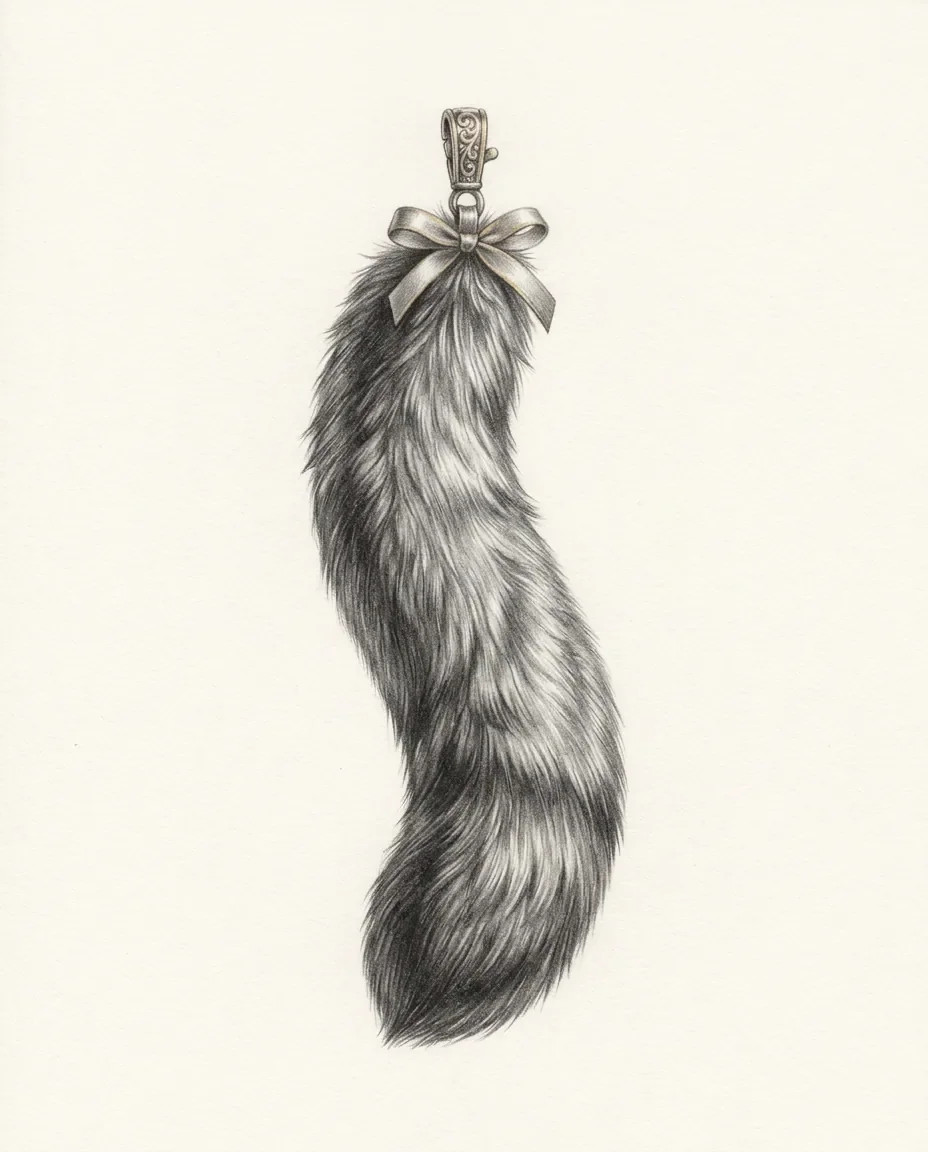
Tail Fetish
Caudaphilia
Added 27 Jun 2026 · Updated 22 Aug 2026
Tail partialism is an erotic interest centred on tails, most often worn or costume tails rather than anatomical ones. Clinically termed caudaphilia, it is a rare, benign interest that overlaps heavily with furry, pet-play and pony-play.
- Prevalence
- Rare
- Category
- Body Parts & Partialism
- Clinical term
- Caudaphilia
- Domain
- Sexual interest · Paraphilia
- Confidence
- Low confidence
- Status
- Partialism; a benign paraphilic variation, not a disorder absent distress or impairment.
- Also known as
- caudaphilia, tail partialism
- Added
- 27 Jun 2026
- Updated
- 22 Aug 2026
Overview
Tail fetishism, listed clinically as caudaphilia, is a partialism in which a tail becomes a primary focus of erotic attraction. Because humans have no tail, the interest is distinctive among partialisms: rather than an anatomical feature, it attaches to worn or imagined tails, meaning costume and fursuit tails, animal-style accessories, or the tails of anthropomorphic and fantasy figures. As Wikipedia's article on partialism records, the tail (caudaphilia) is one of the named foci of body-part interest. This article covers the terminology, the interest's place between partialism and fantasy role-play subcultures, how it is typically expressed, and why dedicated evidence on it is close to absent.
Definition & scope
A tail fetish centres on the tail as an object of attraction, whether admired on a fictional character or worn as a costume piece. It differs from a purely anatomical partialism because there is no biological tail to fixate on: the appeal is inseparable from fantasy, transformation, and animal-persona role-play, and it sits close to pet play and the wider furry fandom. Worn tails range from clip-on and belt tails to the plush appendages built into fursuits, and interest may focus on their look, their movement, their softness, or their meaning within a character.
Examples
The interest is unusual among partialisms in that its object does not exist on the human body, so almost everything it covers is worn, drawn or imagined.
What the term covers. Clip-on and belt-mounted costume tails; the large plush tails built into fursuits; tails as part of a pet play outfit; and the tails of anthropomorphic or fantasy characters in illustration, animation and games. Attention may settle on the look of a tail, its weight and movement, the softness of the fur, or its meaning as the visible marker of an animal persona.
What the term does not cover. The furry fandom is a much larger creative fandom, mostly non-sexual, in which tails are simply part of a costume; animal role-play and its forms such as kitten play and pony play are role-play dynamics in which a tail is one prop among many; therianthropy is a non-sexual identity, not an attraction; a transformation fetish concerns the process of a body changing rather than any finished feature; and a plushie fetish attaches to soft toys as objects. None of this involves real animals, and nothing in this interest does: the tail is a manufactured or drawn object.
How the word is used. "Tail fetish" is community vernacular. Caudaphilia, from Latin cauda plus -philia, is a regularly formed coinage carried in reference tables of partialisms rather than a diagnosis; it appears in neither DSM-5-TR nor ICD-11. In everyday use inside furry and pet-play spaces the interest is rarely named at all: people simply talk about liking tails.
History & origins
A fantasy partialism
Tails carry symbolic weight across mythology and folklore, from mermaids and satyrs to the many animal-human hybrids of world mythology, and that long imaginative tradition is the cultural backdrop against which a modern tail interest sits. As a named erotic focus, however, tail interest has almost no independent documentary record, and its clinical lineage is inherited from the broader category that contains it.
- 1886: Richard von Krafft-Ebing's Psychopathia Sexualis begins the systematic clinical cataloguing of erotic interest directed at specific bodily features and objects, the seed of the modern concept of partialism.
- 20th century: partialism, the channelling of sexual interest onto a specific non-genital body part, is consolidated as a clinical term. It was a named paraphilia (not otherwise specified) in DSM-IV before being merged into fetishistic disorder in DSM-5.
- 1980s onward: the rise of furry fandom and of animal-themed pet play gives tail interest a concrete, community-based home, where worn tails are a standard part of costume and persona.
- DSM-5 / DSM-5-TR: partialism is treated as a form of fetishistic interest and is a disorder only where it causes the individual clinically significant distress or functional impairment.
The label caudaphilia is a regularly-formed coinage from Latin cauda ("tail") plus Greek -philia ("love of"). No single author is documented as having coined it, and its precise first use is not well attested.
In practice
Unlike anatomical partialisms, tail interest is overwhelmingly expressed through worn objects and role-play. Common forms include wearing or appreciating costume and fursuit tails, animal-style tail accessories, and the tails of anthropomorphic characters in art and media. Because of this, the interest overlaps strongly with furry fandom, pet play, kitten play, and pony play, and with the wider appeal of anthropomorphic and transformation fantasy. For many, the tail is one element of a fuller animal-persona experience rather than an isolated focus.
Psychology
Like other partialisms, tail attraction is generally explained through associative learning, here combined with the imaginative and identity dimensions of animal and fantasy role-play. The tail can act as a symbol of an animal persona, a marker of playfulness or transformation, and a tactile costume element, and any of these can anchor an erotic association. Because the interest is tied to fantasy and subculture rather than to a fixed anatomical feature, individual meaning varies widely. There is essentially no research treating tail interest as a discrete category, so understanding is inferred from the broader partialism and role-play literature, and the evidence base is thin.
Prevalence & culture
How common is a tail fetish?
It is rare as a named interest, and no population study measures it. Tail partialism nonetheless has unusually concrete cultural visibility for a partialism because of its home in furry and pet-play communities, where worn tails are commonplace. The best comparative anchor for body-part interest generally is Scorolli et al. (2007), an analysis of 381 online fetish groups in which body parts made up about a third of preferences, feet dominated that category at roughly 47%, and rarer or fantasy-linked foci trailed far behind. No survey isolates a tail-specific prevalence, so any figure here is an estimate rather than a measured rate, drawn more from the size of the adjacent role-play communities than from any dedicated study.
Safety, consent & law
The interest is benign. It involves consenting adults and worn costume items or fantasy, and raises no safety or legal concerns beyond mutual consent and ordinary care with any worn accessories.
Common questions
Is a tail fetish the same as being a furry?
No. The furry fandom is a large creative fandom built around anthropomorphic animal characters, art and costume, and the great majority of participation in it is not sexual. A tail fetish is a specific erotic focus. The two overlap because furry spaces are where worn tails are most visible, but plenty of furries have no such interest and plenty of people drawn to tails have no involvement in the fandom.
Does a tail fetish have anything to do with real animals?
No. The object of interest is a manufactured or drawn tail: a costume piece, a fursuit component, or a character in artwork. Interest in real animals is a different matter entirely, is not what this term describes, and involves a being that cannot consent. Confusing the two is the most common misreading of the term.
What kinds of tails are involved?
Most often clip-on or belt-mounted costume tails, the plush tails sewn into fursuits, and tails sold as part of pet play or pony play gear. Beyond worn objects, the interest often extends to depicted tails: those of anthropomorphic and fantasy characters in illustration, animation and games, where movement and expressiveness matter as much as appearance.
Is caudaphilia a recognised diagnosis?
No. It is a regularly formed compound of Latin cauda, meaning tail, and the Greek -philia, and it is carried in reference lists of partialisms. It is not a diagnostic category in DSM-5-TR or ICD-11, no author is documented as having coined it, and no clinician uses it as a label for a patient.
Is a tail fetish a disorder?
No. Under DSM-5-TR a focus on a non-genital feature falls under fetishistic disorder only where it causes the person clinically significant distress or functional impairment, and ICD-11 similarly reserves paraphilic-disorder status for patterns involving distress or a non-consenting person. A benign interest in worn costume tails meets neither condition.
Do you have to be into pet play to have a tail fetish?
No, though the two travel together often enough that they are frequently conflated. Pet play is a role-play dynamic involving a persona and usually a handler; a tail interest can exist entirely without it, expressed through artwork, costume or simple appreciation of the object. For many people the tail is one element of a fuller animal-persona experience rather than the whole of it.
Is wearing a tail safe?
Costume tails that clip to a belt or harness raise nothing beyond ordinary care: check the fastening, and wash fur that sits against skin. Tails designed to be worn internally are sex toys and carry the usual considerations: a non-porous body-safe material, thorough cleaning between uses, adequate lubrication, and a base wide enough that the item cannot be drawn inside the body.
- Furry Fandom54/100Identity & TransformationMembership in the furry fandom, the community organised around anthropomorphic animal characters that blend human and animal traits. It spans fan art, writing, costuming and conventions and centres on creating a character, a fursona. Most participation is social and creative; an erotic dimension is optional for some.54
- Pet Play54/100Power, Roles & ScenariosConsensual role-play in which an adult adopts the mindset, mannerisms, and headspace of an animal, most often a puppy, kitten, or pony. It frequently takes place within a handler or caretaker dynamic. A playful power-exchange and immersion practice that involves no real animals.54
- Kitten Play42/100Identity & TransformationA consensual adult role-play in which a person adopts the persona, mannerisms, and relaxed headspace of a kitten or cat. A partner often acts as owner or caretaker within a gentle power-exchange dynamic. It is symbolic human role-play with no connection to real animals.42
- Pony Play34/100Power, Roles & ScenariosA consensual adult role-play in which one partner adopts the persona, posture, and movement of a horse while another acts as handler, trainer, or rider. It is a specialized branch of animal role-play emphasizing equestrian tack and trained behaviour.34
- Nail Fetish24/100Onychophilia · Body Parts & PartialismAn erotic interest centered on fingernails or toenails, particularly their length, shape, color, or adornment. The nails themselves are the primary focus of attraction.24
- Teeth Fetish24/100Odontophilia · Body Parts & PartialismOdontophilia is a partialism in which the teeth are a focal point of erotic interest. Attention may center on the appearance, shape, or arrangement of teeth, including features such as gaps, fangs, or braces.24
From Latin cauda ("tail") plus Greek -philia ("love of"); a modern clinical-style coinage whose precise first use is not well documented.
fantasy anatomy · role-play crossover
Prevalence is computed from the entry's cited population estimate. Rows marked ESTare indicative editorial estimates scored against a fixed anchor rubric, not measured quantities. Method & anchors: methodology.
Rare · ≈ 1 in 1,000
- 01Partialism, Wikipedia (Types table: Caudaphilia / tail fetish)lists caudaphilia (tail fetish) as a recognised partialism toward the tail
- 02List of paraphilias, Wikipediadefinition/existence of partialism toward specific non-genital body parts and worn features
- 03Scorolli et al. (2007), Relative prevalence of different fetishes, Int. J. Impotence Research 19(4):432-437relative-frequency table where feet dominate (47%) and fantasy-linked foci sit far down the tail, supporting a low estimate
- 04Sexual fetishism, Wikipedia (carries the Scorolli 2007 relative-frequency table)partialism context and DSM framing; minor body-part/worn-feature foci
- 05Krafft-Ebing, Psychopathia Sexualis (1886)1886 origin of the partialism framework cataloguing attraction to specific body features and objects