Nail Fetish
Onychophilia
Added 21 Jun 2026 · Updated 22 Aug 2026
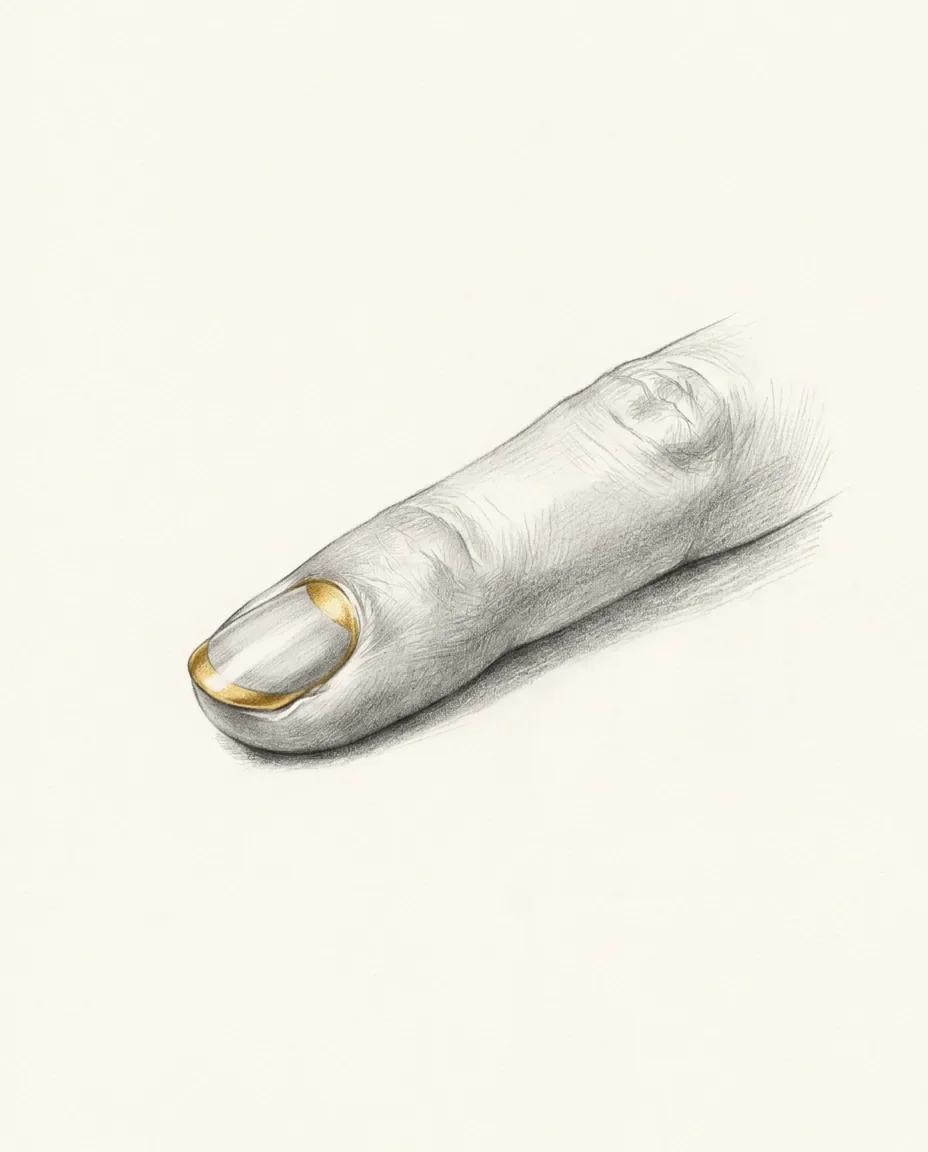
An erotic interest centered on fingernails or toenails, particularly their length, shape, color, or adornment. The nails themselves are the primary focus of attraction.
- Prevalence
- Uncommon
- Category
- Body Parts & Partialism
- Clinical term
- Onychophilia
- Domain
- Sexual interest · Paraphilia
- Confidence
- Low confidence
- Status
- A partialism; considered a paraphilia only when it causes distress, impairment, or harm. Otherwise a benign preference.
- Also known as
- Nail Partialism (Onychophilia), onychophilia, fingernail fetish, long nails fetish, nail partialism
- Added
- 21 Jun 2026
- Updated
- 22 Aug 2026
Overview
Nail fetishism, sometimes labelled onychophilia, is a partialism in which fingernails or toenails are a central source of erotic interest, usually as an extension of broader hand and foot appreciation. Attention may settle on long natural or artificial nails, particular shapes, glossy polish, intricate nail art, or the look, sound and light tactile feel of nails drawn across skin. A partialism treats one body part as the primary object of attraction rather than a secondary feature; here that part is the nail. This article covers how the interest is named, how it is typically expressed, and how uncommon and lightly documented it is.
Definition & scope
Nail interest is aesthetic and sensory: the appeal of a well-kept, shaped, polished or decorated nail, and sometimes the sensation of nails against skin. It should not be confused with onychophagia (nail-biting) or onychotillomania (compulsive nail-picking), which are body-focused repetitive behaviours studied in dermatology and psychiatry, not erotic interests, even though all three words share the Greek root for "nail". Because humans rarely eroticise nails in isolation, the interest is most often described as one facet of hand fetishism (clinically cheirophilia), within which Wikipedia's article on hand fetishism explicitly names nails as a focus.
Examples
Because the nail is a small feature of a much larger body part, the interest is easiest to locate by what falls inside and outside it.
What the term covers. Attention to nail length (long natural nails, or sculpted acrylic and gel extensions); to shape, whether square, oval, almond or stiletto; to finish, from bare buffed keratin through high-gloss polish to detailed nail art; and to the sensory register of nails, the click of them against a hard surface or their light drag across skin. Short, immaculately kept nails hold the same appeal for some people as long ones. The common thread is that the nail is the thing being looked at, rather than the hand or foot carrying it.
What the term does not cover. A hand fetish is the broader partialism this interest usually sits inside, taking in fingers, veins and gesture as well as nails; a foot fetish, or the narrower toe fetish, treats toenails the same way. A glove fetish concerns worn handwear and generally hides the nail altogether. Scratching is an act rather than an appearance: what is sought there is the sensation the nail delivers, not its look. And nail-biting and nail-picking, despite sharing the Greek root, are clinical repetitive behaviours with no erotic content at all.
How the word is used. "Nail fetish" is everyday vernacular, common in beauty-adjacent online spaces as much as in kink ones. Onychophilia is a glossary coinage rather than a diagnostic term: neither word appears in DSM-5-TR or ICD-11, where an interest of this kind is considered only under fetishistic disorder, and only where it causes distress or impairment.
History & origins
Clinical lineage
The broad concept of partialism, erotic focus on a single body part, was formalised in late-nineteenth-century sexology. Richard von Krafft-Ebing's Psychopathia Sexualis (1886) catalogued how desire could attach to isolated features of the body, and Havelock Ellis's Studies in the Psychology of Sex (issued from 1897) treated the same phenomenon of erotic symbolism, where a part stands in for the whole person.
- 1886: Krafft-Ebing documents fetishism and the erotic over-valuation of body parts in Psychopathia Sexualis, the foundational clinical frame for all later partialisms.
- 1897 onward: Ellis treats partial attractions as a normal-range variation of erotic symbolism rather than inherent pathology.
- DSM-IV to DSM-5: partialism was a named paraphilia (not otherwise specified) in DSM-IV, then merged into fetishistic disorder in DSM-5, so an intense focus on a non-genital part counts as a disorder only when it causes distress, impairment, or harm. Mere preference is not pathologised.
The word onychophilia combines the Greek onyx / onychos ("nail" or "claw": the same root behind onyx the stone) with -philia ("love of"). It is a regularly-formed coinage that appears in fetish glossaries rather than in the standard clinical catalogues: it is absent from Wikipedia's list of paraphilias, and its precise first use is not well documented.
Cultural & subcultural evolution
Decorated and elongated nails have signalled status, leisure and femininity across many societies for millennia: from ancient kohl-and-henna grooming to the long, sculpted nails of imperial Chinese elites, which advertised freedom from manual labour. The spread of commercial manicures, acrylic and gel extensions from the late twentieth century, and the rise of nail art as a creative medium gave the aesthetic a large contemporary stage. Within grooming and kink communities the interest overlaps heavily with hand and foot appreciation, and circulates through niche forums, fashion-adjacent imagery and dedicated nail-art content.
In practice
The interest is usually expressed, non-explicitly, through:
- admiration of well-manicured hands and feet, and of nail length, shape, polish and art;
- appreciation of the visual styling and the light tactile sensation of nails drawn gently across skin between consenting partners;
- collecting or curating imagery of elaborate manicures.
It frequently sits alongside hand and foot partialism and broader grooming, fashion and self-care aesthetics, and rarely exists on its own.
Psychology
Like other partialisms, nail interest is generally understood as a blend of aesthetic preference and associative learning, in which the look or feel of nails becomes paired with arousal. The cultural coding of long, decorated nails as markers of femininity, status or meticulous self-care can reinforce the appeal. The evidence base specific to nails is thin: there is no dedicated empirical literature, so these mechanisms are extrapolated from the broader study of partialism rather than demonstrated for nails in particular. In the great majority of cases it is a focused taste, not a sign of dysfunction.
Is a nail fetish normal?
Yes, for practical purposes. A preference for well-kept nails is a benign aesthetic taste. It becomes a clinical concern only in the rare case where the focus causes the person significant distress or impairment, the threshold that DSM-5 sets for fetishistic disorder.
Prevalence & culture
Nail-specific interest is uncommon, with modest, dispersed online communities and very little dedicated research. It sits far below foot fetishism: in Scorolli et al. (2007), a large analysis of 381 online fetish groups, body parts accounted for about a third of all preferences, feet dominated that category at around 47%, and nails appear only among the study's explicitly "less popular" body-part foci (alongside navels, legs, body hair and the mouth). Wikipedia's hand-fetishism article, drawing on the same Bologna analysis, likewise treats nail interest as an extension of hand fetishism. General-population surveys such as Joyal & Carpentier (2017) confirm that body-part fetishism is common in aggregate but do not isolate a nail-specific figure, so the prevalence estimate carried in this entry is a rough, low-confidence inference.
Safety, consent & law
Shared by consenting adults, the interest is benign and raises no legal concern. The only practical considerations are ordinary ones of hygiene and care: long or sculpted nails can scratch, and need maintenance to stay clean. As with any partialism, mutual consent and comfortable negotiation are all that is required.
Common questions
Is a nail fetish the same as a hand fetish?
Not quite, though the two are hard to separate in practice. A hand fetish takes in the whole hand (fingers, knuckles, veins, gesture) with nails as one feature among several. A nail fetish narrows the focus to the nail itself, which is why it is usually described as an extension of hand interest rather than a category of its own. The same relationship holds for toenails and foot interest.
Is onychophilia a real clinical term?
Only in a loose sense. It is a regularly built compound of the Greek onyx, meaning nail or claw, and -philia, and it circulates in fetish glossaries. It does not appear in DSM-5-TR, in ICD-11, or in Wikipedia's list of paraphilias, and no clinician diagnoses it. Treat it as a descriptive label rather than a diagnosis.
What do people with a nail fetish actually notice?
Usually some combination of length, shape, finish and sound: long natural or sculpted nails, a particular silhouette such as almond or stiletto, glossy polish or detailed nail art, and the light tactile trace of nails moving across skin. Preferences are highly specific and vary widely: some people are drawn to elaborate extensions, others to short, immaculately kept, unpolished nails.
Is a nail fetish connected to nail biting?
No, beyond a shared Greek root. Onychophagia (nail-biting) and onychotillomania (compulsive nail-picking) are body-focused repetitive behaviours studied in dermatology and psychiatry; they concern damage a person does to their own nails, involve no erotic element, and are treated in an entirely different literature from partialism.
How common is a nail fetish?
Uncommon, and not measured directly by any survey. In the large analysis of 381 online fetish groups by Scorolli and colleagues (2007), body parts made up about a third of all preferences and feet dominated that category at roughly 47%; nails appear only among the study's explicitly less popular body-part foci. The prevalence figure carried here is therefore an inference rather than a measurement.
Are long or sculpted nails a safety concern with a partner?
They can be, and the concerns are ordinary rather than exotic. Long or pointed nails scratch skin easily, and any break in the skin is a route for infection; extensions can catch, snap or lift, and the space beneath a long nail is harder to clean. Filed, smooth edges and clean hands cover most of it, and anything involving contact with mucous membranes calls for particular care.
- Toe Fetish56/100Toe Partialism · Body Parts & PartialismA focused erotic interest specifically in the toes: a narrower subset of foot partialism. The toes' shape, length, arrangement, adornment such as painted nails or toe rings, or related contact are a primary source of attraction.56
- Back Fetish23/100Dorsal Partialism · Body Parts & PartialismA focused erotic interest in the back and shoulders, where this dorsal region of the torso is a primary source of attraction rather than the body as a whole. It is generally a benign aesthetic preference, best understood as a form of partialism.23
- Tail Fetish24/100Caudaphilia · Body Parts & PartialismTail partialism is an erotic interest centred on tails, most often worn or costume tails rather than anatomical ones. Clinically termed caudaphilia, it is a rare, benign interest that overlaps heavily with furry, pet-play and pony-play.24
- Teeth Fetish24/100Odontophilia · Body Parts & PartialismOdontophilia is a partialism in which the teeth are a focal point of erotic interest. Attention may center on the appearance, shape, or arrangement of teeth, including features such as gaps, fangs, or braces.24
- Eye Fetish26/100Oculophilia · Body Parts & PartialismA focused erotic interest in the eyes: their colour, shape, gaze, or framing features such as lashes and makeup. It is an uncommon facial-feature partialism with limited dedicated study.26
- Morphophilia22/100Morphophilia · Body Parts & PartialismA clinical term for sexual interest organized around a particular overall body shape or size rather than around a single body part. Slender, athletic, or heavyset builds are typical examples. It is a thinly documented catalog entry more than a described clinical syndrome.22
From Greek onyx / onychos (ὄνυξ, "nail" or "claw", the same root as onyx the stone) + -philia ("love of"), literally "love of nails". A regularly-formed coinage found in fetish glossaries rather than the standard clinical catalogues; its exact first use is not well documented.
extremities · hands and feet
Prevalence is computed from the entry's cited population estimate. Rows marked ESTare indicative editorial estimates scored against a fixed anchor rubric, not measured quantities. Method & anchors: methodology.
Uncommon · ≈ 1 in 100
- 01List of paraphilias, Wikipediareference catalogue of partialisms toward specific non-genital body parts; onychophilia is not listed, supporting the note that the term is poorly documented in standard clinical catalogues
- 02Partialism, Wikipediapartialism was a separate paraphilia (NOS) in DSM-IV and was merged into fetishistic disorder in DSM-5, diagnosed only with significant distress or impairment
- 03Hand fetishism, Wikipediaclinical term cheirophilia; explicitly names nails as a focus of hand fetishism and, citing the 2007 Bologna analysis, treats nail interest as an extension of hand fetishism
- 04Nail-Associated Body-Focused Repetitive Behaviors (habit-tic deformity, onychophagia, onychotillomania), NCBI/PMCdistinguishes nail-biting/picking body-focused repetitive behaviours from erotic nail interest despite the shared onych- root
- 05Scorolli et al. (2007), Relative prevalence of different fetishes, Int. J. Impotence Research 19(4):432-437relative prevalence anchor: body parts ~33% of preferences, feet dominate that category (~47%), and nails appear only among the explicitly less-popular body-part foci
- 06Sexual fetishism, Wikipedia (carries the Scorolli 2007 relative-frequency table)carries the Scorolli body-part frequency table placing nails among the minor extremity partialisms
- 07Richard von Krafft-Ebing, Psychopathia Sexualis (1886)early formalisation of partialism, erotic focus on a single body part, in foundational sexology
- 08Studies in the Psychology of Sex, Wikipedia (Havelock Ellis)Ellis frames partial/symbolic attractions as normal-range erotic variation rather than inherent pathology
- 09Onyx, Etymology, Origin & Meaning (Etymonline)Greek onyx / onychos = nail or claw, the root of onychophilia and onyx the stone
- 10Joyal & Carpentier (2017), The Prevalence of Paraphilic Interests and Behaviors in the General Population, J. Sex Research 54(2):161-171confirms body-part fetishism is common in aggregate but does not isolate a nail-specific figure