Arch Fetish
Added 27 Jun 2026 · Updated 22 Aug 2026
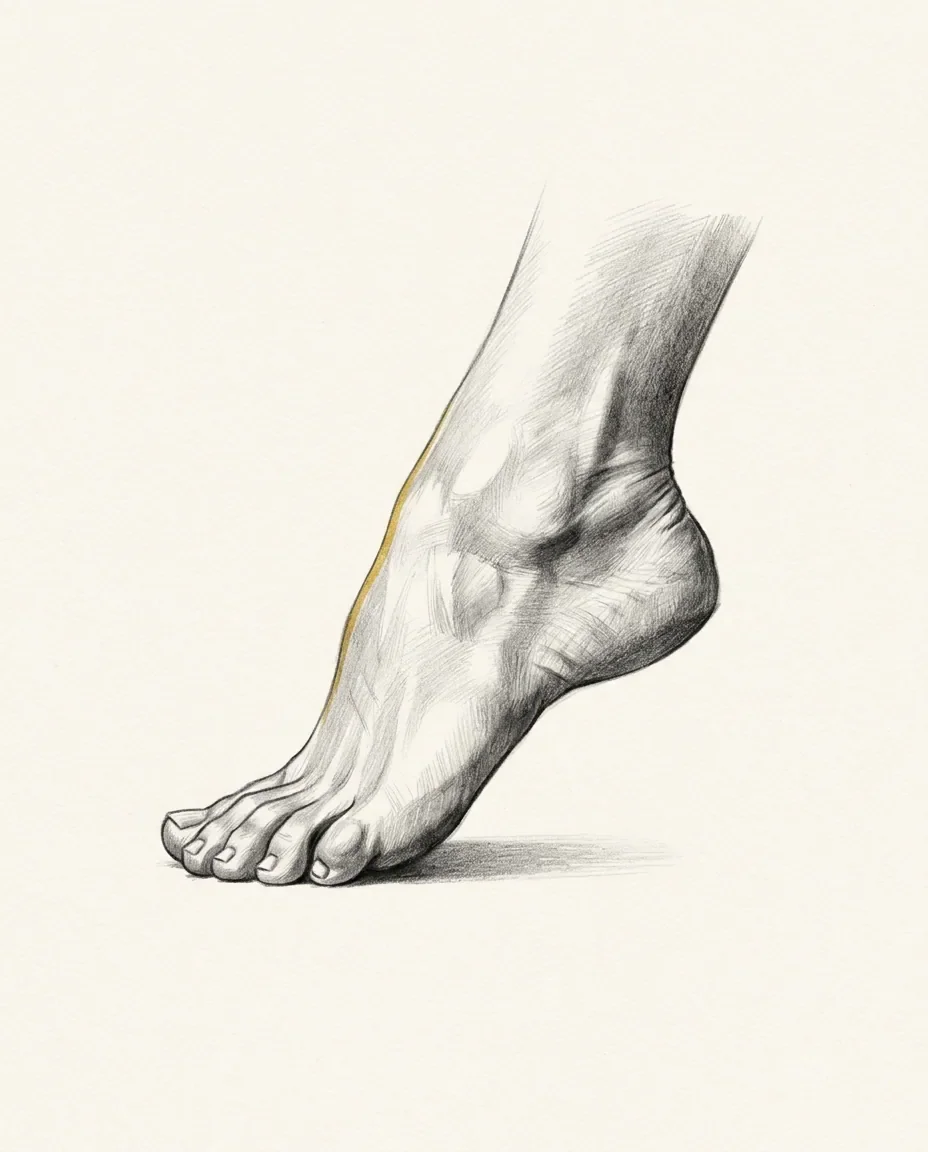
An erotic focus on the curved instep or arch of the foot, often with a preference for high arches. A narrower expression of foot partialism that overlaps closely with sole and general foot interest.
- Prevalence
- Common
- Category
- Body Parts & Partialism
- Domain
- Sexual interest · Paraphilia
- Confidence
- Low confidence
- Status
- A partialism within the foot-fetish spectrum; classified as a paraphilia only if it causes distress, impairment, or harm.
- Also known as
- foot arch fetish, high arch interest
- Added
- 27 Jun 2026
- Updated
- 22 Aug 2026
Featured in
Overview
Arch fetishism is an erotic interest concentrated on the curved instep of the foot (the bony bridge that rises between the heel and the ball), frequently expressed as a preference for a high, pronounced arch. It is a narrower expression of the much broader foot fetish (clinically podophilia), and it overlaps heavily with attention to the sole and with general foot appreciation. As a focus on a specific, non-genital body feature, it belongs to the family of partialism. This article situates the arch within the documented history of foot eroticism, the proposed mechanisms behind it, and what reliable prevalence data exist.
Definition & scope
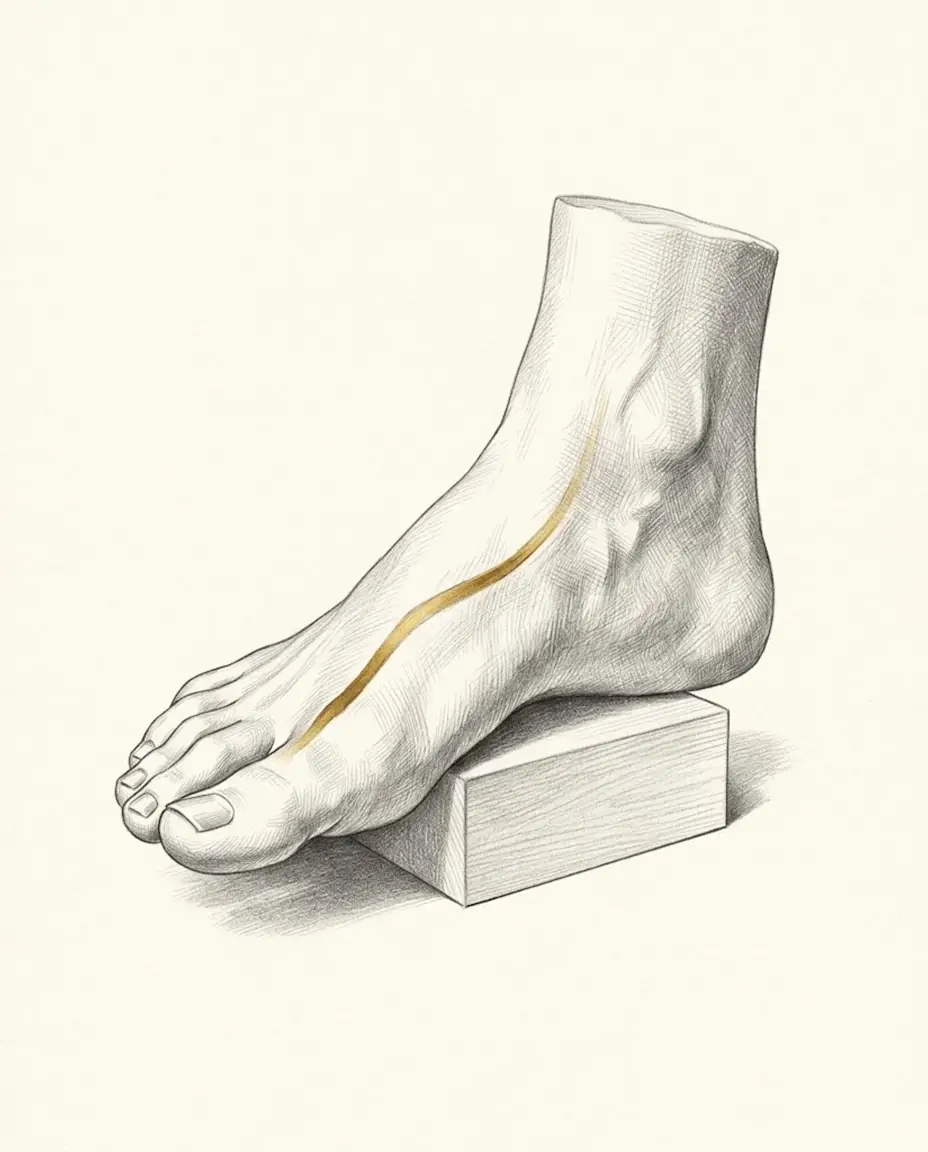
The arch is the longitudinal curve formed by the tarsal and metatarsal bones and the tendons of the instep. In arch-focused interest, this curve, its height, the shape it makes when the foot points or flexes, and the way it deepens when a foot is arched in a heel or en pointe, is the central object of attraction. Enthusiasts often distinguish a high, pronounced arch (the most commonly named preference) from flatter or lower insteps, and some describe the appeal in terms of the taut, sculpted line the arch produces when the foot is fully pointed. The interest rarely exists in isolation: it typically sits alongside an appreciation of the sole, the toes, and the overall line of the foot, which is why dedicated arch-only research is essentially absent and the topic is documented as a sub-preference within foot partialism rather than a distinct diagnosis. It is a preference for a feature, not a separate paraphilia.
Examples
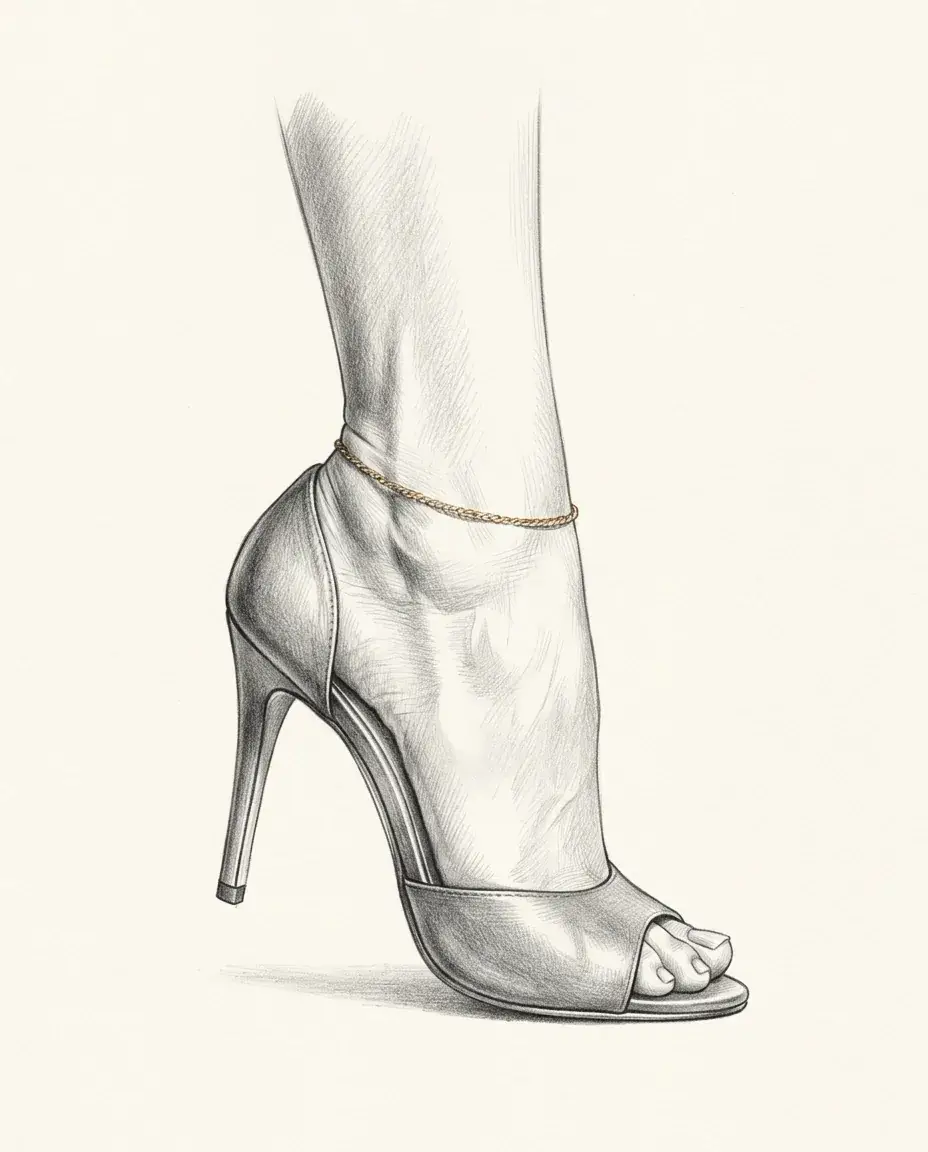
What the term covers. The height and line of the instep: the curve as it reads in profile, how deep it becomes when the foot is pointed or held en pointe, and how it changes as the foot flexes. In practice that means appreciative looking, touching or massaging the instep, photography framed to catch the curve, and an eye for the geometry a heel or a pointe shoe imposes on the foot. Because the arch is a shape rather than a surface, it registers through hosiery or an open shoe as readily as on a bare foot; the silhouette survives the covering, which is much of what separates this preference from its neighbours.
What the term does not cover. The sole is the underside as a surface, with its own texture and scent; the toes are a separate focus again; and a barefoot interest is defined against footwear, where an arch interest is largely indifferent to it. High heels and shoes are objects rather than features, and shoeplay is a behaviour. Acts done with feet (a footjob, foot worship, trampling) may be motivated by the preference but do not define it, and the leg fetish begins above the ankle.
How the word is used. "Arch fetish" is community vernacular with no clinical coinage of its own. The formal class is partialism, which DSM-5-TR handles within fetishistic disorder and ICD-11 treats similarly, in both cases only where there is distress, impairment or a non-consenting person. Neither manual names the arch, and no survey isolates it: it is a preference described from the inside, by people who already use "foot fetish" for the wider interest.
History & origins
The arch in foot-binding
The single most striking historical eroticisation of the arch comes from the Chinese practice of foot-binding. From roughly the tenth century, binding reshaped the foot to shorten its length and compress the heel toward the toes, deliberately producing an exaggerated arched bulge on the instep and a deep crevice beneath it. As historians of the practice note, this engineered arch and crevice were considered among the most intensely erotic features of the bound "lotus foot," and a small, highly arched foot became a marker of refinement and desirability (see the Smithsonian account and Wikipedia on foot binding). The practice was formally banned in 1912. It is the clearest pre-clinical evidence that the arch specifically, not merely the foot in general, has long carried erotic charge.
Clinical lineage
Foot-focused eroticism entered the medical literature with the foundational sexology of the late nineteenth century. Richard von Krafft-Ebing's Psychopathia Sexualis (1886) catalogued foot- and shoe-focused fetishism and framed such fixations as childhood erotic associations that persist into adulthood. The following year, in 1887, the French psychologist Alfred Binet introduced the term fetishism in its erotic sense, giving the phenomenon its enduring name. Havelock Ellis discussed foot and shoe symbolism in his Studies in the Psychology of Sex (1936), and mid-century sexologist John Money folded foot interest into his "lovemap" theory of acquired arousal templates. None of these writers singled out the arch as a separate category; it is treated throughout as one facet of foot interest, which is why this entry's history is grounded in the broader podophilia record.
Across the twentieth century the clinical reading shifted from a sign of pathology toward a benign variation. Under the DSM-5-TR and ICD-11, a fetishistic interest is a disorder only when it causes marked distress, functional impairment, or involves a non-consenting person.
The neuroscience thread
In Phantoms in the Brain (1998), neuroscientist V. S. Ramachandran popularised the hypothesis that, on the brain's somatosensory map, the representation of the foot lies adjacent to that of the genitals, so cross-activation might predispose people to eroticise feet. The idea is elegant but contested: a body-mapping survey of roughly 800 participants reported in Cortex (2013) found feet low in erogenous intensity and no clustering between somatosensory-adjacent sites, undercutting the simple cross-wiring account.
Cultural & subcultural evolution
Outside the clinic, the high arch has been aestheticised for centuries through dance and footwear. Classical ballet trains the foot toward a deep, extended arch, and the pointe shoe exists to display that line at its extreme, so the arched instep reads culturally as a mark of grace and discipline. High-heeled footwear works on the same geometry, forcing the foot into a pronounced arch and lengthening its visual line, which is one reason high heels and arch appreciation so often travel together. These traditions kept the instep in view as an object of beauty long before any online community named a dedicated "arch" preference, and today the term circulates mainly within foot fetish subcultures rather than in medical writing.
In practice
Among consenting adults, expression is usually mild and woven into ordinary intimacy:
- appreciative looking at, touching, or massaging the instep, especially when the foot is pointed or arched;
- enjoyment of the arch's silhouette as accentuated by high heels, ballet flats, or a pointed (en pointe) position;
- photography or collection of imagery emphasising the curve of the instep;
- overlap with sole- and toe-focused contact such as massage or barefoot appreciation.
Many people who notice a preference for high arches never label it a "fetish"; it functions for most as an aesthetic preference rather than a precondition for arousal.
Psychology
No single mechanism is established. Alongside the contested cortical-adjacency hypothesis, mainstream accounts emphasise associative learning (a body feature repeatedly paired with arousal can, through conditioning, become a focus of attraction in its own right) and the long-standing cultural eroticisation of feet. The specific pull toward high arches is often read in aesthetic terms: a pronounced arch lengthens the visual line of the foot and is widely treated as a marker of gracefulness, echoing the refinement once projected onto the bound foot. The evidence base for any single causal account remains thin and debated.
Prevalence & culture
How common is arch fetishism?
There is no dedicated prevalence figure for arch-focused interest specifically; it is a slice of the much larger foot-fetish population, so estimates here are calibrated down from the foot anchor to roughly the low single digits. Feet are by a wide margin the most common body-part fetish. In the large internet survey by Scorolli and colleagues (2007), which analysed 381 fetish discussion groups with roughly 5,000 participants, feet and objects associated with feet were the single most preferred target, accounting for about 47% of body-part-focused preferences; the table is widely reproduced, including on Wikipedia's sexual fetishism article. The arch nonetheless enjoys real cultural visibility through the aesthetics of ballet, pointe work, and high-heeled footwear, all of which foreground the curve of the instep.
Safety, consent & law
Between consenting adults, arch-focused interest is a benign variation of sexual interest with no inherent legal concern. The only practical considerations are ordinary foot hygiene and the same clear, explicit consent that any intimate activity requires.
Common questions
Can you have an arch fetish without a foot fetish?
Rarely, and the two are hard to separate in practice. An arch preference almost always sits inside a broader appreciation of feet (the sole, the toes, the overall line), and people who describe it usually identify with a foot fetish first and name the arch as the part they notice most. There is no research on an arch-only interest, partly because there is little sign of a population that has one.
What counts as a high arch?
The arch is the longitudinal curve formed by the bones and tendons of the instep, running from the heel to the ball of the foot. A high arch stands well clear of the ground and makes a pronounced bow in profile; a low one sits closer to flat. It is ordinary anatomical variation rather than a grade of anything, and arch height differs between people much as height or hand size does.
Does an arch fetish only apply to bare feet?
No, and this is one of the things that distinguishes it. Because the appeal is the shape of the instep rather than the skin, the curve reads through tights, a sandal strap or the vamp of a heel (arguably more sharply, since footwear can exaggerate it). That sets the preference apart from a barefoot fetish, which is specifically about the foot being unshod.
Why do ballet and high heels come up so often here?
Both put the foot into an extreme arch and then display it. Pointe work trains the instep toward maximum extension and the pointe shoe exists to show that line; a high heel forces the same geometry by raising the rear of the foot. Neither tradition was built for erotic purposes, but both have kept the arched instep in public view as an emblem of grace, which is why the two interests travel together.
Is an arch fetish a paraphilia or a disorder?
It is a partialism (a focus on a specific non-genital body part), which the diagnostic manuals treat as a disorder only when it causes the person marked distress, impairs their functioning, or involves someone who has not consented. Noticing and enjoying a particular foot shape meets none of those conditions on its own, and neither DSM-5-TR nor ICD-11 mentions arches at all.
Is an arch fetish the same as a sole fetish?
No, though they overlap so heavily that many people have both. A sole fetish is about the underside of the foot as a surface: its texture, its lines, sometimes its scent. An arch interest is about the curve of the instep as a form, which can be appreciated from the side, in silhouette, without the sole being visible at all.
Is there any research on arch fetishism specifically?
None that isolates it. The prevalence and psychology literature treats foot interest as a single object and does not break it down by which part of the foot holds the attention, so everything specific to arches (how many people have the preference, why high ones in particular) comes from community description rather than from study. Any figure quoted for arches alone, including the estimate on this page, is scaled down from the broader foot data.
From the blog
- Foot Fetish83/100Podophilia · Body Parts & PartialismA focused erotic interest in feet (their shape, soles, toes, arches, or grooming) as a primary source of attraction. Within partialism (erotic focus on a non-genital body part) it is the example people report most, by a wide margin.83
- Sole Fetish53/100Body Parts & PartialismSole fetishism is an erotic focus on the underside of the foot, the sole, and especially on its texture and softness. The wrinkles and flex-lines that appear when the foot bends are a particular draw. A narrower form of foot partialism tied to the popular "wrinkled soles" search term.53
- Barefoot Fetish57/100Body Parts & PartialismAn erotic interest focused specifically on bare, unshod feet rather than feet in shoes or hosiery. A narrower expression of foot partialism, it centres on naked soles and toes, the contrast between clean and dirty feet, and the sight of bare feet in everyday or public settings.57
- Hand Fetish48/100Quirofilia · Body Parts & PartialismA focused erotic interest in hands: their shape, fingers, nails, veins, or expressive gestures. A recognised partialism, less common than foot interest but consistently reported alongside it.48
- Muscle Worship45/100Sthenolagnia · Body Parts & PartialismAn erotic interest in muscular physique and displays of physical strength, encompassing admiration of developed musculature. For some, arousal is tied to demonstrations of power and the hands-on appreciation of a partner's muscles.45
- Lip Fetish43/100Labia Oris Partialism · Body Parts & PartialismLip and mouth partialism is a pronounced erotic focus on the lips and mouth, typically centering on lip fullness, shape, color, and movement. Associated cues such as lipstick, glossy lips, or kissing are often part of it. A benign, mainstream-adjacent variation.43
"Arch" is plain English, from Latin arcus ("a bow, curved structure"), used anatomically for the curved instep of the foot; "arch fetish" is a descriptive compound rather than a clinical coinage, sitting within the partialism family of foot interest (clinically podophilia, from Greek pous / podos, "foot").
lower body · extremities · subset of foot partialism
Prevalence is computed from the entry's cited population estimate. Rows marked ESTare indicative editorial estimates scored against a fixed anchor rubric, not measured quantities. Method & anchors: methodology.
Common · ≈ 1 in 20
- 01Scorolli et al. (2007), Relative prevalence of different fetishes, Int. J. Impotence Research 19(4):432-437prevalence anchor (feet 47% of body-part fetishes; the arch is a narrower subset scaled down from this figure)
- 02Sexual fetishism, Wikipedia (carries the Scorolli 2007 relative-frequency table; Binet 1887 coinage)carries the Scorolli relative-frequency table placing feet at the top of body-part fetishes; Alfred Binet's 1887 coinage of the erotic sense of 'fetishism'
- 03Foot fetishism, Wikipediahistory of foot fetishism (Havelock Ellis 1936, John Money's lovemap), the Ramachandran 1998 cortical-adjacency hypothesis
- 04Foot binding, Wikipediafoot-binding reshaped the foot to produce an arched instep bulge and a crevice considered highly erotic; banned 1912
- 05Why Footbinding Persisted in China for a Millennium, Smithsonian Magazinethe engineered arch and instep of the bound 'lotus foot' as a marker of refinement and erotic desirability
- 06Krafft-Ebing, Psychopathia Sexualis (1886), Wikipedia1886 cataloguing of foot/shoe fetishism and the childhood-association framing
- 07Turnbull et al. (2013), Reports of intimate touch: Erogenous zones and somatosensory cortical organization, Cortex 49(10)~800-participant body-mapping survey finding feet low in erogenous intensity, challenging the cortical-adjacency hypothesis
- 08DSM-5-TR, Paraphilic Disorders (American Psychiatric Association, 2022)fetishistic interest is a disorder only with distress, impairment, or non-consent
- 09ICD-11, Paraphilic disorders (World Health Organization)fetishistic interest is a disorder only with distress, impairment, or non-consent