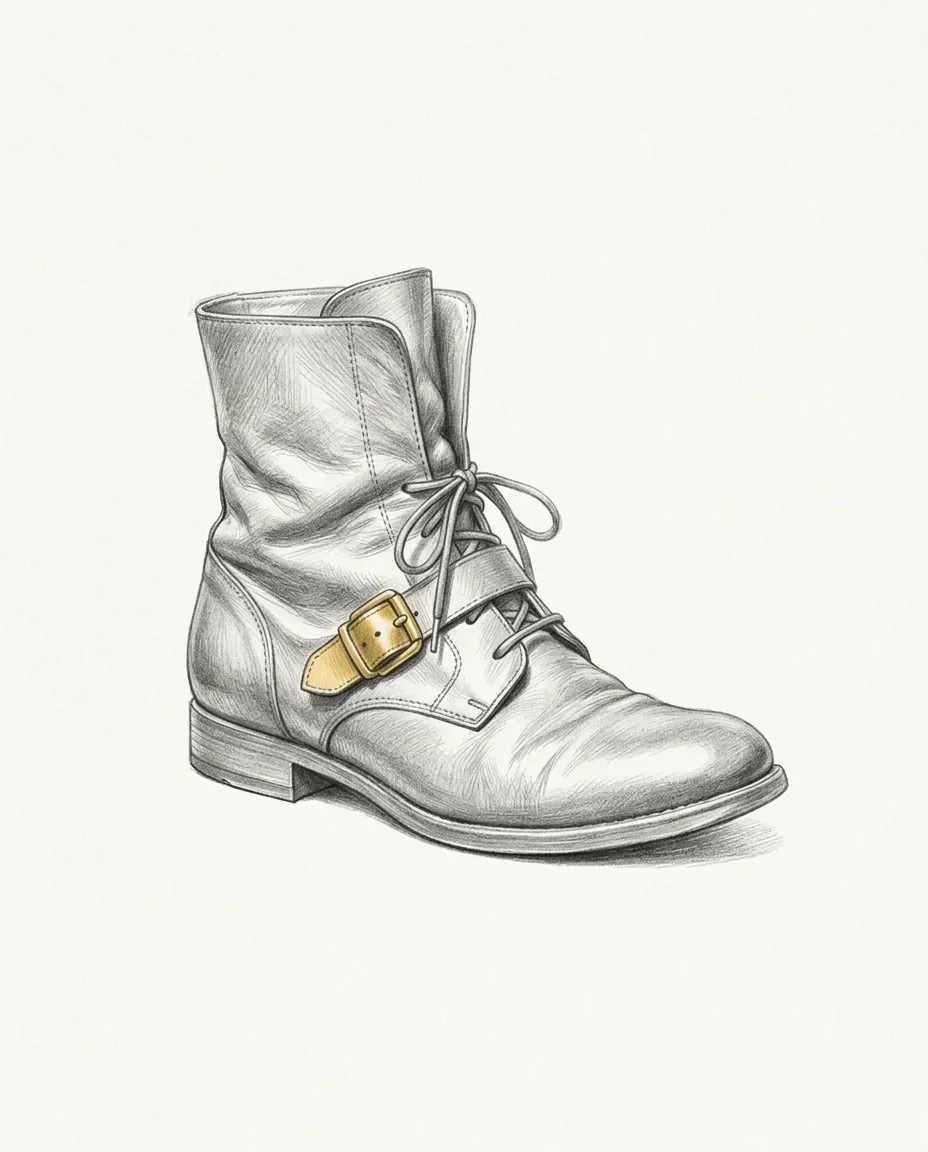
Boot Fetish
Added 21 Jun 2026 · Updated 7 Sep 2026
A sexual interest in boots, from knee-high and thigh-high fashion styles through riding, work, combat, and military boots. They are valued for their silhouette, materials, and connotations of authority. It overlaps with shoe, leather, and uniform fetishism.
- Prevalence
- Common
- Category
- Clothing & Garments
- Domain
- Sexual interest
- Confidence
- Medium confidence
- Status
- Benign variation of sexual interest; not a disorder absent distress, impairment, or non-consent.
- Also known as
- boot fetishism, knee-high boot kink, bootblacking-adjacent, footwear fetishism, boot worship, boot licking
- Added
- 21 Jun 2026
- Updated
- 7 Sep 2026
Featured in
Overview
Boot fetishism is an erotic interest in boots as a distinct class of footwear, spanning knee-high and thigh-high fashion boots, riding and equestrian boots, combat and military boots, and heavy work boots. It belongs to the wider family of shoe fetishism but is usually set apart by its associations with materials such as leather and with themes of authority, discipline, and uniform. Clinically it is a benign variation of sexual interest, not a disorder, absent distress, impairment, or non-consent. This article traces its documented history, how the interest is expressed, the psychology proposed to explain it, and its place in research and subculture.
Definition & scope
What sets boot fetishism apart from a general shoe fetish is the boot's coverage, structure, and cultural loading: the shaft that climbs the leg, the heavy sole, and the material (most often leather) carry meanings that a slipper or sandal does not. The interest is usually anchored to a boot style, and different styles carry different charges:
- Fashion boots (knee-high, thigh-high, heeled): prized for silhouette, leg coverage, and glamour, and closely tied to high-heel and stocking interest.
- Riding and equestrian boots: polished leather and an association with control and discipline.
- Combat and military boots: authority, uniform, and regimentation.
- Heavy work boots: labour, ruggedness, and masculinity, central to a distinct gay male boot culture.
It is separable from, though it often coexists with, an interest in the foot itself; a boot fetishist may care little for the bare foot and everything for the boot as object and image.
Examples
What the term covers. Wearing boots, wanting a partner in them, and the acquisition and upkeep of a collection; the sound of a heel on a hard floor and the creak and smell of leather. Where the interest becomes a scene rather than an aesthetic, it takes the form of boot worship (kneeling, kissing, polishing) inside a dominance-and-submission frame, one of the clearest cases of worship play directed at an object rather than a body. The service ritual of bootblacking sits at the formal end of that, with its own etiquette and its own contests.
What the term does not cover. Shoe fetishism is the parent category, and boots are set apart from it by the shaft, the weight and the uniformed associations rather than by anything sexological; a high-heel interest follows the heel across every kind of shoe. Leather follows the material across every garment, and a boot need not be leather to carry the charge. A uniform interest is about the office a garment signals, and a foot fetish is about the body inside; plenty of boot enthusiasts care little for the bare foot. Trampling and crush interest use the boot as an instrument of pressure. And sneaker collecting is a non-sexual subculture that simply happens to be about footwear. Ballet boot fetish is the extreme of the heel: a boot that holds the foot fully en pointe, valued as much for what it prevents as for how it looks.
How the word is used. "Boot fetish", "boot worship" and "boot licking" are community vernacular; the older clinical umbrella for footwear interest is retifism, which is not boot-specific and is barely used today. Neither term appears in DSM-5-TR or ICD-11, which recognise fetishistic disorder only where distress, impairment or harm is present. "Bootlicking" also carries a much commoner political sense (servility) that travels quite independently of the erotic practice.
History & origins
Clinical lineage
The study of footwear-focused attraction is older than the word fetishism in its modern sexual sense. The term was popularised by Richard von Krafft-Ebing in Psychopathia Sexualis (1886), who catalogued cases of erotic fixation on shoes and boots, and was given its specific sexological meaning by the French psychologist Alfred Binet in his 1887 essay Le fétichisme dans l'amour. The two framed it differently: Krafft-Ebing treated such fixations as pathological, while Binet argued that fetishism was an ordinary psychological mechanism by which objects become erotically charged through association.
- 1868: Émile Zola's novel Thérèse Raquin contains one of the earliest literary descriptions of boots as a fetishistic object; the published diaries of the Victorian servant Hannah Cullwick record a real, lived version of the same.
- 1886–1887: Krafft-Ebing and Binet bring footwear fixation into clinical and psychological literature.
- 1905: Sigmund Freud's Three Essays on the Theory of Sexuality makes the foot-and-shoe fetish a central illustration of his theory of sexual development.
- 1915: Hermine Hug-Hellmuth publishes what is often cited as the first dedicated scientific case study of female boot fetishism (republished in English in 1990).
- 1960s: The behaviourist Stanley Rachman ran laboratory conditioning experiments using boots, reporting that arousal could be classically conditioned to footwear images; later scholars questioned the result, noting boots were already fashionable at the time.
Throughout this lineage the interest was never singled out as its own disorder. Modern psychiatry follows the DSM-5-TR and ICD-11 in distinguishing a benign fetishistic interest from a fetishistic disorder, which additionally requires distress, impairment, or harm, a distinction that has steadily de-pathologised consensual kink.
Cultural & subcultural evolution
Boots carried strong symbolic charge long before sexology named the interest, through the nineteenth- and twentieth-century iconography of cavalry, military, and equestrian dress. In the early twentieth century, boot worship became a recognisable practice within sadomasochistic and leather circles, and through the century boots (in leather, latex, and PVC) became standard regalia of BDSM aesthetics. A distinct gay male boot subculture developed around men's work and combat boots, complete with the boot-care ritual of bootblacking and competitive bootblack contests, in which polishing another person's boots can itself carry erotic and service-oriented meaning. This heritage is why boot interest so often overlaps with leather and uniform themes and with dominance-and-submission dynamics.
In practice
The interest is expressed in many non-explicit ways: attraction to the silhouette and coverage of tall boots, the look, feel, smell, and sound of leather, the cultural connotations of specific boot types (riding, combat, work), collecting, and incorporating boots into consensual adult play. For some, ritual boot care such as polishing or bootblacking is itself the central erotic act, blending service, attention, and the symbolism of authority.
Psychology
No single mechanism fully explains boot fetishism, and the evidence base is thin and contested. Two threads recur. The first is associative learning, the classical-conditioning model tested by Rachman in the 1960s, in which a neutral object becomes arousing through pairing; critics note that exposure alone poorly predicts who develops a fetish. The second is symbolic meaning: boots are culturally coded for strength, discipline, and uniformed authority, so the interest plausibly draws on those connotations rather than the object alone. More recent work, such as Hsu and Bailey (2019), emphasises developmental and individual-difference factors over simple environmental conditioning. The overlap with leather fetishism and power dynamics is consistent with the symbolic account.
Prevalence & culture
How common is boot fetishism?
Footwear is one of the most commonly fetishised object categories, and boots are a prominent subtype within it. In the large online-community survey by Scorolli and colleagues (2007), which sampled at least 5,000 members of 381 fetish discussion groups, footwear (shoes and boots) accounted for about 32% of interest in objects associated with the body, close behind objects worn on the legs and buttocks (33%). Most surveys fold boots into broader footwear and leather categories rather than counting them separately, so any boot-specific figure is approximate.
| Study | Year | Population | Finding |
|---|---|---|---|
| Scorolli et al. | 2007 | ~5,000 online fetish-group members | Footwear ≈ 32% of body-associated-object interest; boots a leading subtype |
| Joyal & Carpentier | 2017 | 1,040 Quebec adults | Fetishistic interests common enough to be statistically unremarkable |
Boots are prominent in fashion, music subcultures, and popular depictions of power, giving the interest moderate mainstream visibility. Communities for boot interest are well represented on platforms like FetLife, particularly within leather and BDSM subcultures.
Safety, consent & law
Practised privately or with consenting adults, boot fetishism poses no inherent safety, consent, or legal concerns. As with any kink, ordinary expectations of consent, negotiation, and discretion apply; where boot play is folded into dominance-and-submission scenes, the usual norms of BDSM negotiation and safewords govern. The one physical caution worth stating is that boots are heavy and hard: where play extends to standing on a partner or striking with a boot, the cautions that apply to trampling and impact play apply here too, because rigid soles and narrow heels concentrate a great deal of force on a small area, and the head, torso and joints are not safe targets.
Common questions
What is boot worship?
The reverent form of the interest: kneeling to a partner's boots, kissing or licking them, or cleaning and polishing them as an act of service, usually inside an agreed dominance-and-submission dynamic. The boot stands in for the authority of the person wearing it, which is why the practice reads as devotion rather than as attention to an object. Its most formalised version is bootblacking, a genuine craft with its own community and contests.
What is the difference between a boot fetish and a shoe fetish?
Boots are a subtype, but a well-defined one. What sets them apart is coverage and connotation: a shaft that climbs the leg, a heavy sole, and an inherited iconography of military, police and equestrian dress that a sandal does not carry. Someone drawn to shoes in general may care nothing for boots, and many boot enthusiasts have no interest in other footwear at all.
Do you need a foot fetish to have a boot fetish?
No, and the two are often entirely separate. A foot fetish is a partialism, an attraction to the body part, whereas a boot fetish attaches to an object: its material, its shape and what it signifies. Many people with a strong boot interest have no particular feeling about bare feet, and the reverse holds too. The pairing is common, but nothing about either requires the other.
Does a boot fetish have to involve leather?
No. Leather dominates because of the boot's history in military, equestrian and leather-scene dress, and because of how it smells, creaks and wears, but rubber, latex, PVC and fabric boots all sustain the interest. Where the material rather than the garment is doing the work, the more accurate term is a leather, rubber or PVC fetish, which follows the substance across jackets, gloves and everything else.
Why do military and combat boots feature so heavily?
Because of what they signal rather than how they look. Combat and work boots carry meanings of authority, regimentation, discipline and physical labour, and those readings map neatly onto dominance-and-submission themes. That symbolic account also explains why the interest clusters with uniform and leather interest, and why a distinct gay male subculture grew up specifically around men's work and combat boots.
Is "bootlicking" the same thing as a boot fetish?
Usually not. In ordinary English a bootlicker is a servile flatterer, and the word carries no sexual sense at all. Within kink, boot licking is a literal act of submission and part of boot worship. The two coincide because both draw on the same image of lowering oneself to another person's feet, but almost every everyday use of the term is the political insult rather than the practice.
Is a boot fetish a disorder?
No. Both DSM-5-TR and ICD-11 distinguish a fetishistic interest from a fetishistic disorder, and the second requires clinically significant distress, impairment, or harm to someone who has not consented. A person who enjoys boots, collects them and involves them in consensual sex meets none of that. Footwear interest has appeared in the clinical literature since the 1880s without ever being singled out as a diagnosis of its own.
From the blog
- Shoe Fetish65/100Retifism · Clothing & GarmentsA sexual interest in shoes as objects of attraction or arousal, valued for their style, material, and associations rather than the wearer. Clinically termed retifism, it is among the most frequently documented garment fetishes in survey and case literature.65
- High Heel Fetish56/100Altocalciphilia · Clothing & GarmentsA focused sexual interest in high-heeled shoes (stilettos, pumps, platforms) and the height, posture, and leg line they create. It is a common, generally harmless subtype of shoe fetishism.56
- Stocking Fetish57/100Clothing & GarmentsA sexual interest in stockings and hosiery, centered on sheer or textured legwear, seams, garters and the look and feel of nylon and silk. It is among the most common garment and material fetishes.57
- Pantyhose Fetish52/100Garment fetishism (hosiery/legwear subtype) · Clothing & GarmentsA sexual interest in pantyhose and tights, sheer or opaque one-piece nylon legwear, focused on its full-leg coverage, smooth encasing texture, and look. A common close relative of stocking fetishism and one of the more historically recent garment interests.52
- Panty Fetish54/100Garment fetishism (underwear subtype) · Clothing & GarmentsAn erotic interest in underpants, panties or knickers, valued for their fabric, cut, intimate associations, and sometimes the scent of a worn pair. A common intimate-apparel fetish, not a disorder when it involves consenting adults and one's own or freely given items.54
- Sock Fetish50/100Clothing & GarmentsA sexual interest in socks, in their look, feel, scent, or association with the feet, treated as a benign relative of foot fetishism. It overlaps with hosiery and scent (olfactophilic) interests.50
A plain-English compound: "boot" (footwear, via Old French *bote*) plus "fetish." "Fetish" derives from French *fétiche*, from Portuguese *feitiço* ("charm, sorcery"); the sexual sense was popularised by Krafft-Ebing (1886) and given its psychological meaning by Alfred Binet's *Le fétichisme dans l'amour* (1887).
footwear · boots · garment fetishism
Prevalence is computed from the entry's cited population estimate. Rows marked ESTare indicative editorial estimates scored against a fixed anchor rubric, not measured quantities. Method & anchors: methodology.
Common · ≈ 1 in 20
- 01Scorolli et al. (2007), Relative prevalence of different fetishes, Int. J. Impotence Research 19(4):432-437prevalence anchor: footwear is ~32% of clothing/garment fetishes, with boots a prominent subtype
- 02Sexual fetishism, Wikipedia (carries the Scorolli 2007 relative-frequency table)carries the Scorolli clothing-fetish relative-prevalence table including footwear
- 03An A–Z of Kinks and Fetishes, Glamourmainstream/lay framing of boot fetishism as a recognized common kink
- 04Shoe fetishism, Wikipediahistory of footwear fetishism, including Binet's 1887 coinage of sexual 'fétichisme' and Krafft-Ebing/Freud lineage
- 05Boot fetishism, Wikipediadocumented boot-fetish history: Zola's Thérèse Raquin (1868), Hannah Cullwick's diaries, Hug-Hellmuth's 1915 case study, Rachman's 1960s conditioning experiments, and the leather/BDSM bootblacking subculture
- 06Psychopathia Sexualis, WikipediaKrafft-Ebing's 1886 cataloguing of footwear/boot fixation among sexual variations
- 07Three Essays on the Theory of Sexuality, WikipediaFreud's 1905 use of the foot-and-shoe fetish as a central example
- 08Hsu & Bailey (2019), The 'Sex' question in feet/objects fetish development, PubMeddevelopmental and individual-difference account of fetish development over simple environmental conditioning
- 09Joyal & Carpentier (2017), The Prevalence of Paraphilic Interests and Behaviors in the General Population, J. Sex Research 54(2):161-171general-population context: fetishistic interests are common enough to be statistically unremarkable
- 10DSM-5-TR, Paraphilic Disorders (American Psychiatric Association, 2022)the interest-versus-disorder distinction that keeps benign fetishism non-pathological
- 11ICD-11, Paraphilic disorders (World Health Organization)ICD-11 framing requiring distress/harm for a paraphilic disorder diagnosis
- 12FetLife, kink community group sizes (community-size proxy)community presence for boot interest within leather and BDSM subcultures