Corset Fetish
Added 21 Jun 2026 · Updated 22 Aug 2026
An erotic interest in corsets and structured foundation garments, focused on the dramatic hourglass shaping and the firm bodily compression they produce. Tightlacing (wearing a tightly laced corset, often to gradually reduce the waist) is a closely related expression. It is a clothing fetish, not a clinical disorder.
- Prevalence
- Uncommon
- Category
- Clothing & Garments
- Domain
- Sexual interest
- Confidence
- Low confidence
- Status
- Clothing fetish overlapping with restriction interests; a normal variation, not a disorder unless it causes distress or impairment.
- Also known as
- Corset Fetishism & Tightlacing, tightlacing, waist-training kink, waist training
- Added
- 21 Jun 2026
- Updated
- 22 Aug 2026
Featured in
Overview
Corset fetishism is an erotic interest in which arousal attaches to corsets and structured foundation garments, both for how they look and for the firm, shaping pressure they exert on the torso. The appeal may rest on the exaggerated hourglass silhouette, the steady sensation of compression and support, the boned and laced construction, and the dense historical and fashion connotations the garment carries. It sits within the broader family of clothing fetishism and overlaps with interests in bodily restriction. Its most intensive expression, tightlacing, is the practice of wearing a very tightly laced corset to shrink and reshape the waist. This article traces the garment's lineage, how the interest is typically expressed, the proposed psychology, its prevalence, and the genuine physical-safety considerations that set tightlacing apart from most benign garment kinks.
Definition & scope
Corset fetishism describes arousal centred on the corset itself, not merely on the wearer. Three strands run through it, and different enthusiasts weight them differently: the visual appeal of the cinched, hourglass figure; the tactile and proprioceptive experience of firm, all-over compression on the torso; and the symbolic and historical charge the garment carries. It shades into an interest in restriction and posture where the emphasis falls on being firmly held, and into pure clothing admiration where the emphasis is the object's look and craft. Tightlacing and "waist training" name the disciplined, progressive form of wear, and they are where the interest crosses from purely aesthetic into a practice with real physical stakes.
Examples
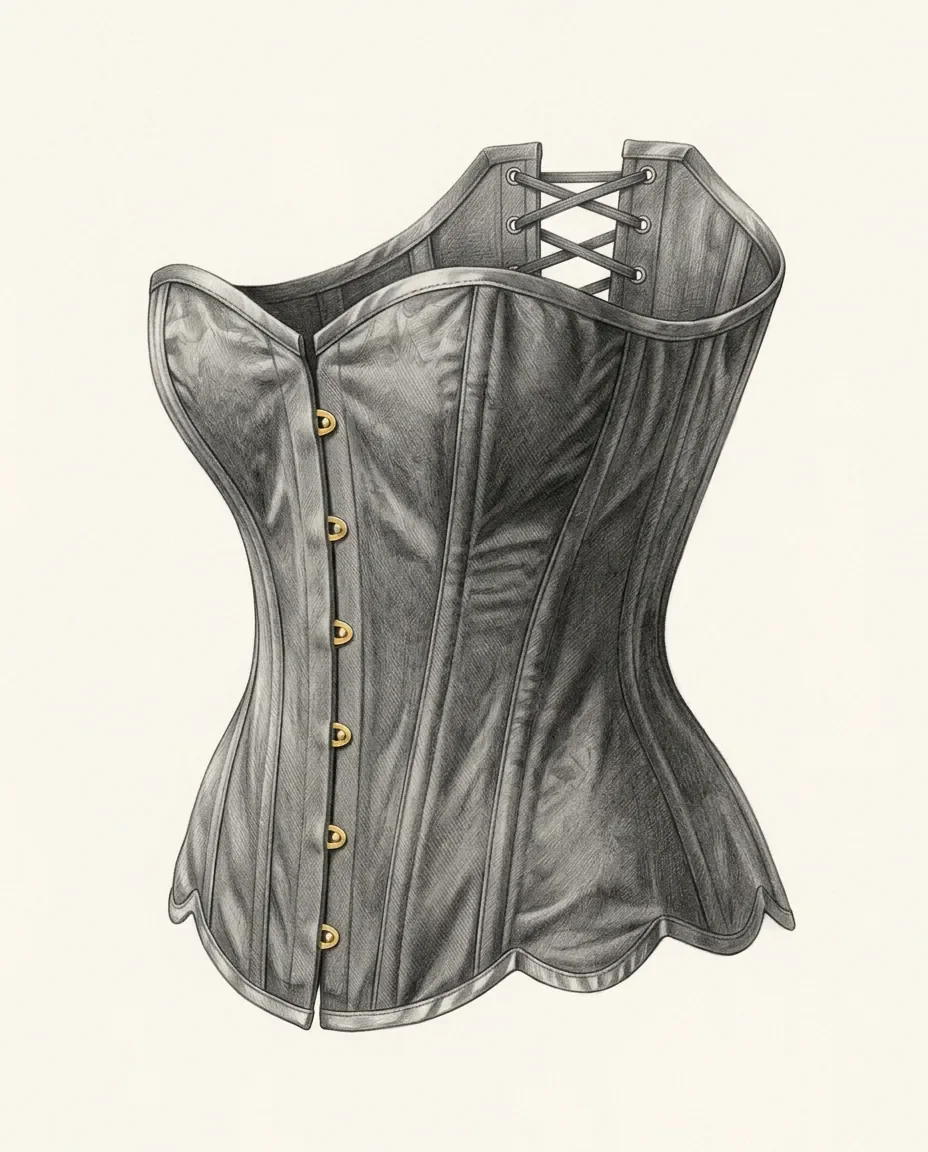
What the term covers. Wearing a boned, laced corset for the way it holds the torso, and finding that pressure itself erotic; being drawn to the cinched silhouette on a partner; the craft object (panelled cloth, spiral steel bones, a front busk, cord threaded through metal eyelets) admired as much as worn; corsetry as visible outerwear in burlesque, goth and alternative fashion; and tightlacing, the disciplined form in which the laced waist is reduced progressively over weeks and months. Overbust and underbust garments both belong here, as do purely aesthetic interests in which nobody laces anything at all.
What the term does not cover. A general taste for lingerie, lace, satin or a garter belt is about intimate garments and their materials, where corsetry is about structure and compression. Latex and leather share the second-skin tightness but not the boning and the lacing. Being restrained by someone else is bondage or vincilagnia; being wholly encased is mummification or a vacuum bed; enjoying enclosure as such is claustrophilia. A corset is self-worn and removable at will, which is the distinction that matters. Wearing one to present as another gender is cross-dressing, whatever the garment. And although severe lacing restricts breathing, that is a hazard rather than the object: deliberate restriction of breath is breath play.
How the word is used. The vocabulary here is plain English throughout. Tightlacing is a nineteenth-century descriptive term, waist training a twenty-first-century marketing one, and "corset fetish" ordinary speech; none is a clinical coinage. DSM-5-TR and ICD-11 name fetishistic interests of this kind only as disorders, and only where they cause distress or impairment.
History & origins
The garment's own history
The corset descends from a long European lineage of stiffened bodices known as "bodies" or "stays." According to the history of corsets, these emerged in sixteenth-century Europe, initially producing a conical, flattened-bust shape, stiffened with whalebone and a rigid front busk of wood or ivory. The eighteenth century favoured the inverted-cone silhouette and an upright, shoulders-back posture.
- 1790s: The modern sense of "corset" as a stiff, supporting and constricting undergarment becomes established in English.
- 1827: The metal eyelet is introduced, and steel boning follows. Together they let a corset be laced far tighter without the garment tearing, the technical precondition for the tightlacing that follows.
- Late 1820s–1830s: Tightlacing begins in earnest, and the exaggerated small waist becomes a fashion ideal. The front-opening split busk lets a woman lace and unlace without a servant's help, widening the practice beyond the wealthy.
- 1850s–1860s: The corset becomes a charged object of medical and moral debate. The dress-reform movement campaigns against tightlacing; physicians link lifelong wear to deformity and difficult births (see the Royal College of Surgeons' account, which notes a deformed rib cage from the late nineteenth century preserved in the Hunterian Museum).
- 1880s: The dress historian David Kunzle estimates a typical corseted waist of about 21 inches (53 cm) against an uncorseted 27 inches (69 cm), a reduction of roughly six inches for the fashionable woman, per the Tightlacing record. The "wasp waist" is the period ideal, not the everyday norm.
- 1900s–1920s: The Edwardian S-bend gives way to longer-line garments; rubberised elastic (from around 1911) lets the girdle and brassiere supplant the corset, a shift accelerated by post-WWI shortages and changing aesthetics.
- 1960s onward: Corsets survive chiefly in fetish, burlesque, goth and alternative-fashion subcultures as outerwear, with periodic mainstream revivals of corset-inspired tops that usually lack real boning.
The tightlacing tradition and its record-holders
A dedicated tightlacing subculture carried the practice through the twentieth century, sustained by enthusiast correspondence and, later, by online communities. Its best-known figures reached extremes far beyond fashionable Victorian lacing. Ethel Granger reduced her waist to about 13 inches (33 cm) and held a Guinness record for the smallest, and the American tightlacer Cathie Jung reached roughly 15 inches (38 cm) by 2006. Kunzle argued that for some enthusiasts the practice carried a genuine erotic charge, one thread of the moral outrage it provoked, and many practitioner testimonials describe a distinctive numb or tingling bodily sensation. The twenty-first-century "waist training" trend, promoted through celebrity endorsement and cheap elastic "waist trainers," revived the vocabulary for a mass audience, though most such products bear little resemblance to a real boned, laced corset.
Clinical lineage
The erotic fascination with tight lacing appears in the correspondence pages of period magazines and in the era's clinical literature. Richard von Krafft-Ebing's Psychopathia Sexualis (1886) introduced fetishism into the medical lexicon and described arousal fixed on garments and materials (boots, fur, fabrics), establishing the broader category within which corsetry sits. Havelock Ellis, in his Studies in the Psychology of Sex, later treated clothing and constriction among the things that can become objects of erotic interest. Modern frameworks classify consensual fetishism as a disorder only when it causes distress or impairment: the DSM-5-TR and ICD-11 both reflect this depathologising shift. The terms tightlacing and waist training are plain-English descriptors, not clinical coinages, and their precise first attestation is not well documented.
In practice
The interest is expressed through wearing or viewing corsets, through tightlacing (the gradual, progressive reduction of the laced waist over weeks and months) and through the enveloping, restrictive feeling the garment provides. For some the focus is the visual transformation of the figure; for others it is the constant, contained pressure on the torso, an emphasis that overlaps with broader interests in restriction and bondage. The aesthetic and tactile pleasures of structured materials connect it closely to latex and leather interests, while its association with intimate foundation wear links it to lingerie.
Psychology
The interest is usually framed as a blend of associative learning, arousal becoming conditioned to a distinctive garment, and the symbolic charge corsets carry around femininity, discipline, and an idealised body shape. Additional appeal comes from bodily transformation and the proprioceptive sense of being firmly held or contained, which is why the interest so often sits alongside a taste for restriction. The garment's strong presence in historical costume, burlesque and alternative fashion both reinforces and transmits the interest across generations. As with most specific clothing fetishes, the dedicated research base is thin, and much of the explanatory account is inferred from the general literature on fetishism rather than from corset-specific study.
Prevalence & culture
Corsets enjoy high mainstream visibility through period costume, fashion editorials and burlesque, while dedicated tightlacing and waist-training communities are smaller and more specialised. The interest is studied mainly as one strand of clothing fetishism rather than as a topic in its own right: Scorolli et al. (2007), analysing online fetish communities, found garments worn on the torso to be a defined but modest fraction of clothing-fetish interest, with corsetry falling within it. Broader surveys such as Joyal & Carpentier (2017) place fetishistic interest in objects and materials among the more common, non-atypical patterns in the general population, situating garment kinks like corsetry well within the ordinary range of human sexuality.
Safety, consent & law
Corset fetishism among consenting adults is benign and legal. Tightlacing, however, warrants genuine physical caution beyond the typical garment kink. Sustained, severe lacing compresses the lower rib cage and diaphragm, reducing lung expansion and tolerance for exertion; prolonged practice can displace abdominal organs, contribute to digestive complaints, and, over years, deform the rib cage, as the Hunterian specimen and the historical medical record attest (per the Royal College of Surgeons and contemporary clinical commentary). Gradual conditioning, correct fit, moderate reduction, and removing the garment for sleep and heavy exertion are the relevant harm-reduction considerations.
Common questions
Is a corset fetish a disorder?
No. Modern diagnostic frameworks treat a consensual fetishistic interest as a disorder only where it causes the person distress or impairment, or involves someone who has not consented, and an erotic interest in corsets meets neither test. The caution attached to this entry is physical rather than psychiatric: sustained, severe tightlacing carries documented health effects that most garment interests simply do not.
Can wearing a corset damage your body?
Sustained, severe lacing can. It compresses the lower rib cage and the diaphragm, which limits lung expansion and reduces tolerance for exertion, and over long periods it can displace abdominal organs and contribute to digestive complaints. The Royal College of Surgeons points to a rib cage deformed by lifelong corsetry, preserved in the Hunterian Museum, as physical evidence of the extreme case. Occasional, moderate wear in a correctly fitted garment is a different proposition from years of progressive tightlacing.
Does waist training permanently change your waist?
Only through sustained, extreme practice, and then by moving the body rather than reducing it: the lower ribs shift and soft tissue redistributes. Cleveland Clinic commentary is clear that the elastic waist trainers sold for the purpose do not deliver lasting change in body shape, only temporary shaping that disappears when the garment comes off. The historic tightlacers who did achieve permanent reductions, such as Ethel Granger at around 13 inches, did so over decades of near-continuous wear.
What is the difference between a corset fetish and a lingerie fetish?
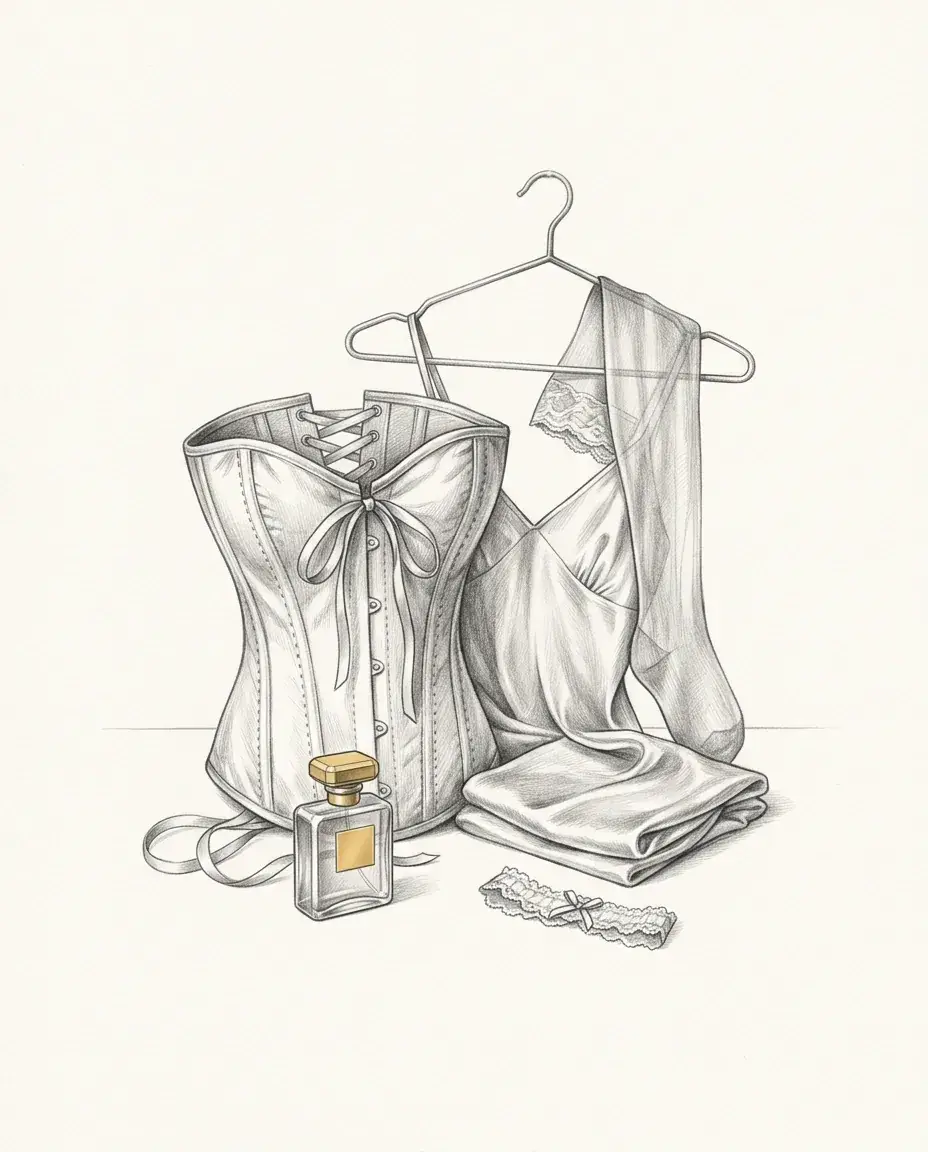
Lingerie interest is led by fabric, cut and the suggestion of intimacy: silk, lace, straps, what is concealed and what is revealed. Corset interest is led by structure: boning, lacing and the firm compression they produce. The two overlap constantly, since a corset is also underwear, but they come apart under a simple test: take away the shaping and the pressure, and a corset enthusiast has lost the thing they came for.
Is tightlacing the same as bondage?
No, although the sensations rhyme. Bondage means being restrained by, and usually for, another person, and the restraint itself is what gets negotiated. A corset is put on by the wearer, worn in public as readily as in private, and can be unlaced at will. What the two share is proprioceptive (firm, containing pressure), which is why people drawn to one often report an interest in the other.
Were the Victorians right that corsets were dangerous?
Partly. The dress-reform campaigns of the 1850s and 1860s mixed real medical observation with moral alarm, and the period's more lurid claims did not survive scrutiny. The anatomical record did: sustained tightlacing demonstrably deformed rib cages. The dress historian David Kunzle's estimate that a fashionable 1880s waist ran to about 21 inches against 27 uncorseted also suggests that everyday practice was less extreme than the wasp-waist ideal implies.
How common is corset fetishism?
No study measures it directly. Scorolli et al. (2007), analysing online fetish communities, found garments worn on the torso to be a defined but modest fraction of clothing-fetish interest, with corsetry inside it, while Joyal and Carpentier (2017) place fetishistic interest in objects and materials among the more common patterns in the general population. Corsets have far more mainstream visibility, through costume drama and fashion, than the dedicated tightlacing community has members.
- Lingerie Fetish70/100Clothing & GarmentsAn erotic interest in lingerie and intimate apparel in which the garments themselves, their fabrics, and their styling become a focus of arousal. Bras, briefs, stockings, corsets and slips are typical. One of the most common and mainstream garment-related interests.70
- Latex Fetish62/100Latex fetishism · Objects & MaterialsAn erotic interest in latex garments and their tight, glossy, second-skin qualities. A common material fetish involving the look, feel, sound, smell, and enveloping sensation of clinging latex on consenting adults.62
- Leather Fetish65/100Leather fetishism · Objects & MaterialsAn erotic attraction to leather as a material: its look, smell, creak, shine, and feel when worn. It overlaps strongly with BDSM gear and is bound up with a recognised, organised leather subculture with its own bars, codes, and titles.65
- Seamed Stocking Fetish40/100Clothing & GarmentsAn erotic interest in stockings with a visible seam up the back of the leg, the fully fashioned style of the 1940s and 1950s and its reproductions. A narrowing of the stocking fetish to the seam, the Cuban heel and the period they belong to.40
- Swimsuit Fetish40/100Clothing & GarmentsAn erotic interest in swimwear valued for its tight stretch-fabric fit, smooth synthetic sheen, and revealing cut. Bikinis, one-piece suits and competitive racing suits are the usual focus. It is a common garment and material fetish, not a clinical disorder.40
- Zentai38/100Clothing & GarmentsZentai is a seamless skin-tight suit, usually nylon-spandex, that covers the entire body including the face and hands. The name is Japanese, from zenshin taitsu, "full-body tights". Wearing or being attracted to zentai centres on smooth full-body encasement and the anonymity it creates.38
From Old French "cors" (body) plus the diminutive suffix, giving "corset" (a small, close-fitting body garment) ultimately from Latin "corpus" (body); the modern "stiff supporting undergarment" sense dates to the 1790s. "Tightlacing" and "waist training" are descriptive modern English compounds, not clinical coinages.
foundation garments · body shaping · restriction
Prevalence is computed from the entry's cited population estimate. Rows marked ESTare indicative editorial estimates scored against a fixed anchor rubric, not measured quantities. Method & anchors: methodology.
Uncommon · ≈ 1 in 100
- 01Scorolli et al. (2007), Relative prevalence of different fetishes, Int. J. Impotence Research 19(4):432-437corsets/tightlacing fall within clothing fetishes, a defined but smaller fraction of garment-related fetish interest
- 02Sexual fetishism, Wikipedia (carries the Scorolli 2007 relative-frequency table)lists garments/foundation wear among material and clothing fetish objects
- 03An A–Z of Kinks and Fetishes, Glamourlay framing of corsetry and tightlacing as a clothing-restriction kink
- 04Corset, Wikipediahistory of stays and corsetry from the 16th century through Victorian/Edwardian tightlacing and modern waist training
- 05History of corsets, Wikipedia16th-century stays and busk; 1830s shift to steel boning, metal clasps and eyelets; 1840s-1850s tightlacing; split front busk; dress-reform controversy; Edwardian S-bend and early-20th-century decline
- 06Tightlacing, Wikipedia1827 steel eyelet and late-1820s/1830s emergence of tightlacing; wasp-waist ideal; David Kunzle's 1880s ~21 in corseted vs ~27 in uncorseted waist estimate; record tightlacers Ethel Granger (~13 in) and Cathie Jung (~15 in, 2006); the erotic dimension of the practice and the modern waist-training revival
- 07Clothing fetish, Wikipediacorsetry sits within the broader category of clothing fetishism, including garment-centred arousal documented by early sexologists
- 08Psychopathia Sexualis, WikipediaKrafft-Ebing's 1886 work introduced 'fetishism' and described arousal fixed on garments and materials, founding the category within which corset fetishism sits
- 09Studies in the Psychology of Sex, WikipediaHavelock Ellis discussed clothing and constriction among objects of erotic interest
- 10Joyal & Carpentier (2017), The Prevalence of Paraphilic Interests and Behaviors in the General Population, J. Sex Research 54(2):161-171fetishistic interest in objects and materials is among the more common, non-atypical patterns in the general population, situating garment kinks within the ordinary range
- 11DSM-5-TR, Paraphilic Disorders (American Psychiatric Association, 2022)consensual fetishism is classified as a disorder only when it causes distress or impairment
- 12ICD-11, Paraphilic disorders (World Health Organization)depathologising of consensual non-coercive interests in modern diagnostic frameworks
- 13The dangers of tight lacing: the effects of the corset, Royal College of Surgeons of Englanddocumented health effects of tightlacing: restricted breathing and faintness, organ compression, rib-cage deformation (Hunterian Museum specimen), and the historical Victorian medical debate
- 14Do Waist Trainers Work?, Cleveland Cliniccontemporary clinical commentary on the breathing, organ-displacement and digestive risks of sustained waist training / tightlacing