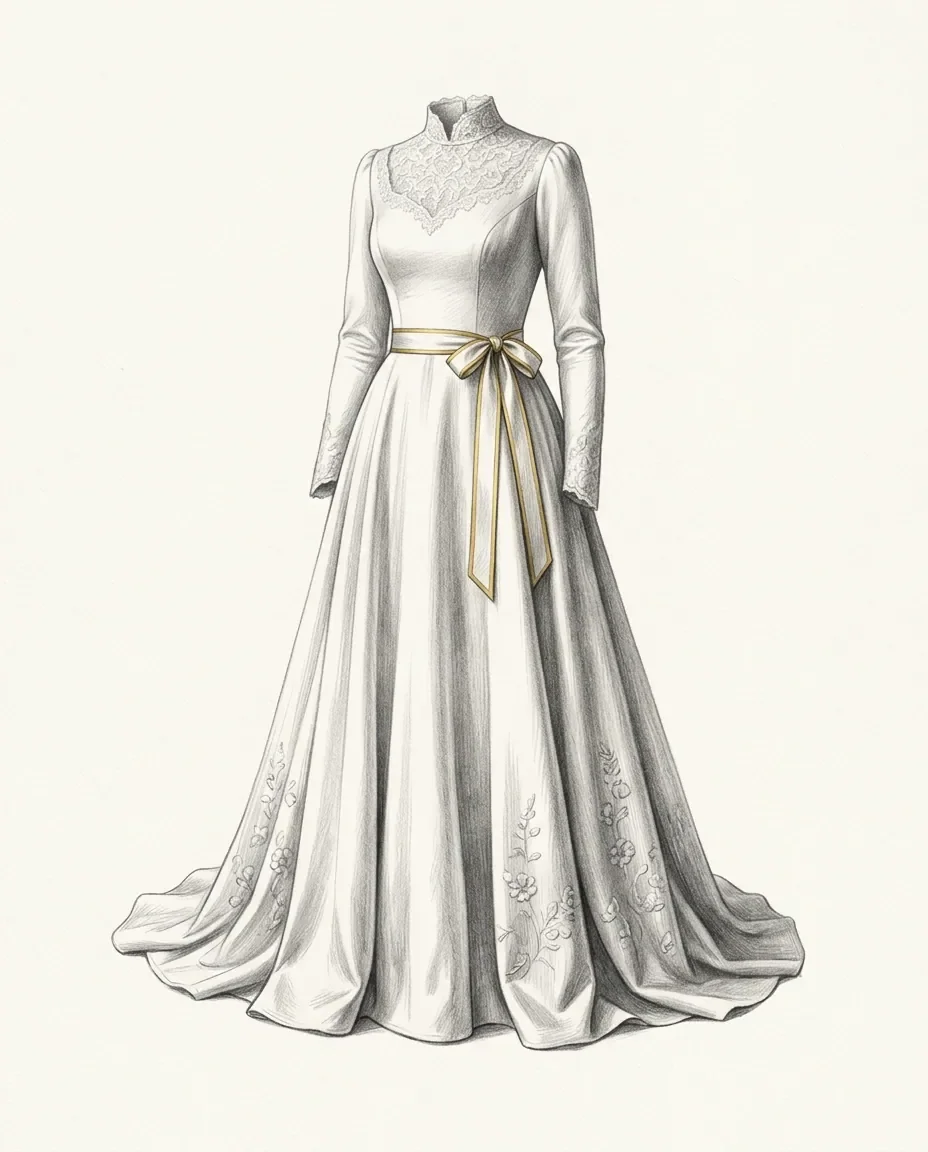
Wedding Dress Fetish
Added 21 Jun 2026 · Updated 22 Aug 2026
An erotic interest centered on wedding dresses, bridal veils, and related ceremonial attire, valued for their romantic symbolism. Their fabrics and ritual associations are part of the appeal. It is a niche clothing and costume fetish, not a clinical disorder.
- Prevalence
- Rare
- Category
- Clothing & Garments
- Domain
- Sexual interest
- Confidence
- Low confidence
- Status
- Niche clothing/costume fetish; a normal variation, not a disorder unless it causes distress or impairment.
- Also known as
- Bridalwear & Veil Fetishism, bridal kink, veil fetish, bridal fetishism, veil fetishism, bridalwear fetish
- Added
- 21 Jun 2026
- Updated
- 22 Aug 2026
Overview
Bridalwear and veil fetishism is a clothing- and costume-focused erotic interest in which the wedding dress, the bridal veil, and related ceremonial attire become a notable source of arousal or fixation. The appeal can rest on the garments' luxurious fabrics (satin, silk, lace, and tulle) on the dense romantic and ritual symbolism of marriage, or on the charged contrast between the gown's purity imagery and an erotic reading of it. This article traces the interest's roots in the history of the white wedding, its place within clinical models of garment fetishism, and how it is typically expressed.
Examples
What the term covers. A partner in a gown, veil and train, and the wish to see them that way with no wedding attached; a focus narrowed to a single element (the veil, the corseted bodice, the weight of tulle, the train dragging behind) rather than the outfit as a whole; collecting, photographing or handling gowns; and consensual role-play built around a ceremony, the vows, or the moment the veil is lifted. Where the pull is chiefly tactile it overlaps with satin, silk and lace interests and with corsetry; where it is chiefly symbolic, the ritual does the work and the fabric is almost incidental.
What the term does not cover. Finding weddings romantic is not a fetish, and the label describes a reliable erotic charge rather than an appreciation. Neighbouring costume interests aim at different signals: a uniform fetish at authority and role, a maid or schoolgirl-uniform interest at service or a specific scripted scene, and a nun fetish at religious dress, the closest relative of the three, since it shares both the veil and the purity imagery. Lingerie is worn under the costume rather than as it, and cross-dressing is about who is wearing the garment rather than about the garment.
How the word is used. "Wedding dress fetish", "bridal kink" and "bridalwear fetishism" are all plain descriptive English. There is no Greek or Latin clinical term for this one and no manual names it: DSM-5-TR reaches a garment interest only through fetishistic disorder, and only where it causes genuine distress or impairment.
History & origins
There is no single documented coiner of the phrase "wedding dress fetish." Like most occasion-specific garment interests, it is a descriptive label rather than a formal diagnosis, and its lineage runs through two intertwined histories: the clinical study of fetishism as it applies to clothing, and the cultural invention of the white bridal costume itself.
Clinical lineage
Garment-focused desire entered sexology in the late nineteenth century. Richard von Krafft-Ebing's Psychopathia Sexualis (1886) catalogued the eroticisation of specific materials and articles of dress as a recurring theme among his case studies, and Havelock Ellis's Studies in the Psychology of Sex (published 1897–1928) discussed the erotic pull of fabric, texture, and clothing at length. These early frameworks established that an article of attire, rather than a person, can carry sexual significance, the conceptual seed beneath every modern uniform, costume and garment kink.
- 1886: Krafft-Ebing documents garment- and material-focused desire in Psychopathia Sexualis.
- 1897–1928: Havelock Ellis explores the eroticism of dress and material across his multi-volume Studies.
- 2013 / 2022: the DSM-5 and its 2022 text revision, the DSM-5-TR, together with the ICD-11 (in force from 2022), treat a clothing interest as fetishistic disorder only where it causes the person clinically significant distress or functional impairment; otherwise it is regarded as a benign sexual variation, not a disorder.
The invention of the white bridal costume
The wedding dress as a recognisable erotic object is comparatively modern. The white gown was not the historic norm: pre-Victorian brides married in many colours. Queen Victoria's 1840 wedding to Prince Albert, for which she wore a white gown trimmed with Honiton lace, was illustrated and published widely and is credited with fixing white as the aspirational bridal colour across the Western world. The same wedding revived the bridal veil, which had fallen out of British and North American fashion in the seventeenth and eighteenth centuries; in the Victorian era veil weight, length, and quality became markers of a bride's social standing, and face-covering veils became common only in the second half of the nineteenth century.
The veil's older symbolism deepens the costume's erotic charge. The Roman bridal veil, the deep-yellow flammeum, was meant to shield the bride from harm, and in Western Christian use the white veil came to signify modesty and chastity, while the groom's lifting of it after the vows reads as a ritual of revelation. This braid of purity, concealment, and reveal, established long before any fetish framework, is precisely the symbolic material a bridalwear interest draws upon.
In practice
Expression is typically mild and benign: a preference for a partner wearing bridal attire, enjoyment of the texture and drape of satin, lace, or tulle, collecting or photographing gowns and veils, or incorporating the costume into consensual role-play around weddings, ceremony, and commitment. For most people it functions as a heightened preference that enriches arousal rather than a sole requirement for it.
Psychology
What causes a wedding dress fetish?
There is no single established cause, and the interest fits standard models of fetish formation rather than any dedicated theory. Associative learning can link bridalwear to emotionally saturated romantic scenes (real weddings, films, or media) so that the garment later carries arousal on its own. Layered over this is symbolic meaning: the wedding dress is one of culture's densest signs of devotion, transition, idealised femininity, and the threshold of a sanctioned sexual relationship, and the veil adds a concealment-and-reveal dynamic that some find especially compelling. As with most niche garment interests, the dedicated empirical evidence base for bridalwear fetishism specifically is thin; these are reasoned extensions of general fetish theory rather than findings from studies of this interest in isolation.
Prevalence & culture
How common is a wedding dress fetish?
It is rare and rarely studied on its own, sitting in the niche range of costume-linked clothing interests. The broad category it belongs to is itself a minority of all fetishes: in Scorolli et al.'s (2007) analysis of fetish-community group memberships, objects associated with the body dominated, with garment-linked interests forming a smaller share: placing an occasion-specific subtype like bridalwear well below one percent. Modest online communities exist, frequently overlapping with formalwear, satin, and lingerie interests and with uniform and costume fetishism more generally. The interest's cultural visibility is buoyed by the universal prominence of weddings themselves, so faint romantic-aesthetic associations with the gown are widespread even where no fetish is present. Mainstream kink coverage such as Glamour's A–Z of kinks situates occasion-wear interests within ordinary, non-pathological sexual variety.
Safety, consent & law
There are no inherent safety, consent, or legal concerns: the interest involves ordinary ceremonial clothing worn by consenting adults. Standard norms of mutual consent, communication, and privacy apply.
Common questions
Is a wedding dress fetish a disorder?
No. A garment interest counts as fetishistic disorder in DSM-5-TR only where it causes the person clinically significant distress or interferes with their functioning, and ICD-11 applies the same threshold. A preference for bridalwear that someone enjoys, and that a partner is happy to indulge, meets none of that. It is a niche taste in clothing, which is how both manuals have treated garment interests since 2013.
Is it about the dress or about the wedding?
Both exist, and they behave differently. A material-led interest tracks satin, lace and tulle and is satisfied by any garment with the right feel and drape. A symbol-led one needs the wedding meanings (devotion, transition, a sanctioned threshold), and a plain white gown with no ceremony attached does very little for it. Most people report some mixture. Which side dominates is the practical question, because it decides whether the costume alone is enough or the scenario matters.
Is a veil fetish the same thing?
It is usually treated as part of the same interest, and often as its sharpest point. The veil carries a concealment-and-reveal dynamic the gown does not: it hides a face, and lifting it after the vows is a small staged unveiling. Historically it also carried protective and modesty meanings, from the Roman flammeum to the white Christian veil. Some people are drawn to the veil alone and are indifferent to the dress.
Does having this interest mean someone wants to get married?
Not necessarily, and conflating the two causes needless worry. The interest attaches to a costume and its imagery; a wish to marry attaches to a relationship. People with no interest in marrying enjoy bridalwear scenes, and people who very much want to marry have no particular feeling about the outfit. Where a partner reads the gown as a proposal rather than a costume, that is a conversation worth having early.
How is a wedding dress fetish different from a uniform or maid fetish?
By what the costume announces. A uniform fetish draws on authority, rank and role; a maid fetish on service and a well-worn scripted dynamic. Bridalwear announces devotion, ceremony and a threshold being crossed, and it is conventionally worn once, by one person, on the most heavily staged day of ordinary life. That singularity is a good part of the charge, and the other costumes do not have it.
Is wanting to wear a wedding dress yourself the same interest?
It overlaps without being identical. Wanting to see a partner in one is an interest in the garment on someone else; wanting to wear one sits closer to cross-dressing and costume interests, where the charge comes from the transformation and from how the wearer feels inside it. Plenty of people report both. The distinction matters mainly because the two lead to quite different scenes.
- Uniform Fetish60/100Uniform Fetishism · Clothing & GarmentsAn erotic interest in uniforms and the authority, role, or status they signal: military, police, medical, school, or service dress. A common clothing-and-role fetish rather than a clinical disorder.60
- Lingerie Fetish70/100Clothing & GarmentsAn erotic interest in lingerie and intimate apparel in which the garments themselves, their fabrics, and their styling become a focus of arousal. Bras, briefs, stockings, corsets and slips are typical. One of the most common and mainstream garment-related interests.70
- Nun Fetish26/100Clothing & GarmentsAn erotic interest centred on religious dress, most often the nun's habit and veil, valued for its modest silhouette and ritual symbolism. Themes of forbidden allure are part of the draw. A niche costume and role-play fetish, not a clinical disorder.26
- Raincoat Fetish25/100Clothing & GarmentsAn erotic attraction to rainwear (rubberized or PVC macs, capes, sou'westers and waders) for their waterproof sheen or matte texture. The sound of the material adds to it, as does the tension between a garment's plain practicality and its covert erotic charge.25
- Apron Fetish20/100Apron Fetishism · Clothing & GarmentsAn erotic interest centered on aprons, including kitchen, household, and glossy PVC styles, valued for their domestic symbolism, texture, and coverage. It is a niche clothing fetish, not a clinical disorder.20
- Tie Fetish26/100Clothing & GarmentsAn erotic interest centered on neckties, dress collars, and the surrounding shirt-and-tie formalwear, valued for their look and constriction. Their authoritative associations are part of the draw. It is a niche clothing fetish, not a clinical disorder.26
"Wedding dress fetish" is plain descriptive English. "Fetish" derives from the Portuguese feitiço ("charm, sorcery"), via French fétiche, adopted by nineteenth-century sexology to denote an object that holds erotic power.
formal occasion wear · costume play · garment fetishism
Prevalence is computed from the entry's cited population estimate. Rows marked ESTare indicative editorial estimates scored against a fixed anchor rubric, not measured quantities. Method & anchors: methodology.
Rare · ≈ 1 in 1,000
- 01Sexual fetishism, Wikipedia (carries the Scorolli 2007 relative-frequency table)garment/clothing fetishism category that bridalwear falls under
- 02Scorolli et al. (2007), Relative prevalence of different fetishes, Int. J. Impotence Research 19(4):432-437clothing fetishes are a small subset of all fetishes, so occasion-specific bridalwear sits well below 1%
- 03An A–Z of Kinks and Fetishes, Glamourlay framing of costume/occasion-wear kinks in mainstream coverage
- 04Wedding dress, WikipediaQueen Victoria's 1840 white wedding helped establish the white gown and veil as Western romantic symbols; white was not the pre-Victorian norm
- 05Veil, Wikipediahistory and symbolism of the bridal veil: Roman flammeum, Christian chastity symbolism, Victorian revival in 1840, face-covering veils common only in the later 19th century
- 06Psychopathia Sexualis, WikipediaKrafft-Ebing's 1886 cataloguing of garment- and material-focused desire as part of the clinical lineage of clothing fetishism
- 07Studies in the Psychology of Sex, WikipediaHavelock Ellis's (1897-1928) exploration of the eroticism of dress and material
- 08Fetishistic disorder, WikipediaDSM-5 / DSM-5-TR treat a garment interest as a disorder only where it causes clinically significant distress or impairment
- 09ICD-11, WHOICD-11 (in force 2022) frames consensual atypical interests as disorders only when they cause distress or harm