Foot Fetish
Podophilia
Added 21 Jun 2026 · Updated 6 Sep 2026
A focused erotic interest in feet (their shape, soles, toes, arches, or grooming) as a primary source of attraction. Within partialism (erotic focus on a non-genital body part) it is the example people report most, by a wide margin.
- Prevalence
- Very common
- Category
- Body Parts & Partialism
- Clinical term
- Podophilia
- Domain
- Sexual interest · Paraphilia
- Confidence
- High confidence
- Status
- Partialism; a common variation that the manuals treat as a disorder only when it causes distress, impairment, or non-consent.
- Also known as
- foot fetishism, podophilia, foot partialism, foot worship
- Added
- 21 Jun 2026
- Updated
- 6 Sep 2026
Featured in
Overview
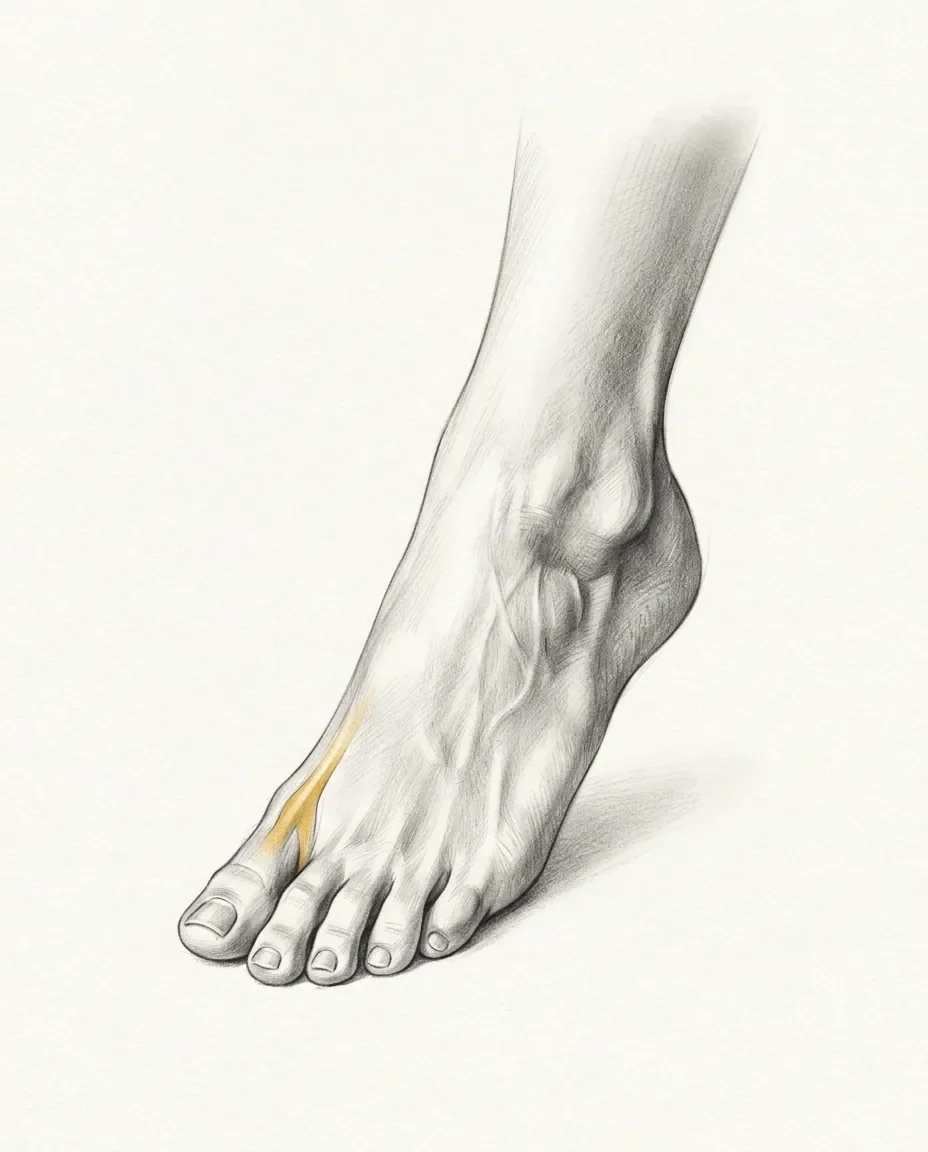
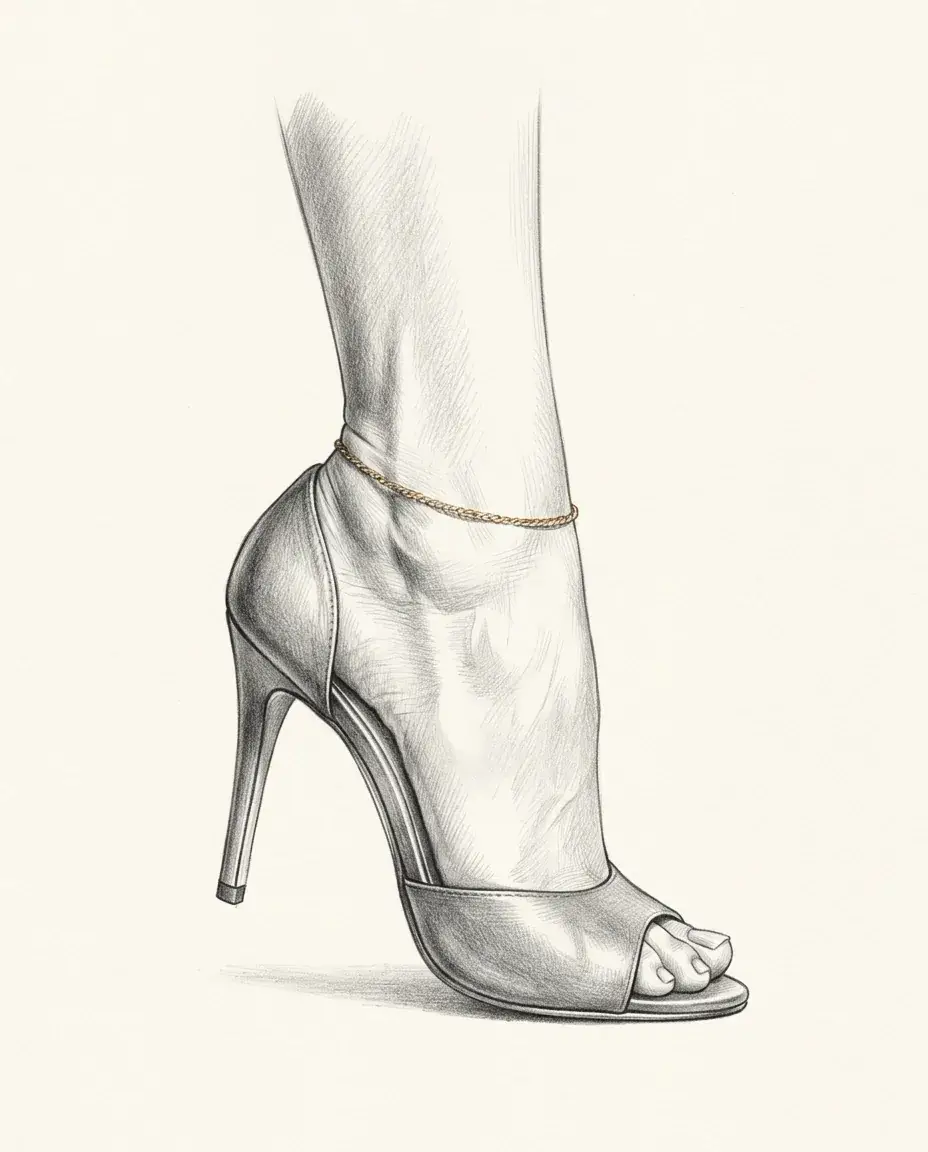
Foot fetish (clinically podophilia, and in the technical vocabulary a form of partialism) is an erotic interest centred on the feet. Attraction may attach to the shape and proportions of the foot, the soles, toes, arches or insteps, or to associated grooming and adornment such as pedicures, nail polish and anklets. It treats a non-genital body part as the principal focus of erotic attention, which places it within the class of partialism, and within that class it is the variety the literature documents most.
Examples
The word covers a wide band of intensity, from a mild aesthetic preference to a defining focus of arousal, and several neighbouring interests get mistaken for it.
What the term covers. An attraction that settles on a particular feature (the soles, the toes, the arch) or on the bare foot as such; in a minority of cases the interest extends to scent. Where it is enacted, the usual forms are the reverential attention of foot worship, the stimulation given in a footjob, and the power-inflected foot domination. The attraction itself is the constant; the term applies whether or not any of these acts follows.
What the term does not cover. Interests in shoes, high heels, boots, socks and stockings target the object rather than the body, and someone can have one without the other, though the pairing is common. Trampling uses the feet as an instrument of pressure and control, and its motive is power. The neighbouring leg fetish is a separate focus within the same class. Enjoying a foot massage says nothing either way.
How the word is used. "Foot fetish" is the everyday phrase; podophilia is its Greek-derived clinical synonym, and partialism the technical class it belongs to. DSM-5-TR handles a focus on a non-genital body part under fetishistic disorder, and ICD-11 does the same, and in both only where there is distress, impairment or a non-consenting person.
History & origins
Pre-clinical antiquity
Reverence and eroticism around feet predate any medical vocabulary. Ancient Greek erotic verse attributed to Philostratus includes pieces addressed To a Barefoot Woman and To a Barefoot Boy, and the Hindu Skanda Purana contains a passage in which the god Brahma is captivated by Parvati's feet. The cultural expression with the widest consequences was the Chinese practice of foot binding, which from roughly the tenth century onward made the bound "lotus foot" an eroticised object in classical Chinese painting and poetry; the practice was banned in 1912 and again in 1919. Some social historians link surges in foot-focused imagery to epidemics of sexually transmitted disease (gonorrhoea, later syphilis, and in the twentieth century AIDS), proposing that feet served as a "safe" erotic substitute during contagion fears. The link remains conjecture.
Clinical lineage
The interest entered the medical literature with the foundational sexology of the late nineteenth century:
- 1886: Richard von Krafft-Ebing's Psychopathia Sexualis builds a taxonomy of sexual behaviour from forensic case studies; the same work that coined sadism and masochism documents foot-focused fetishism and frames such fixations as imprinted in childhood through accidental erotic association.
- 1905 onward: Sigmund Freud, in his account of fetishism, read the foot as a symbol (in his framework, a defence against castration anxiety) and cited Chinese foot binding as a culturally amplified instance.
- 1936: Havelock Ellis's Studies in the Psychology of Sex discusses foot and shoe symbolism within his broader survey of erotic life.
- Mid-twentieth century: sexologist John Money folded foot interest into his "lovemap" theory, which reads such patterns as developmentally acquired templates of arousal.
Across the twentieth century the clinical reading moved from a Victorian sign of pathology to a common, benign variation. The current manuals codify that move: under DSM-5-TR and ICD-11, a fetishistic interest is a disorder only when it causes marked distress, functional impairment, or involves a non-consenting person. Neither manual pathologises a focus on feet on its own.
The neuroscience thread
In Phantoms in the Brain (1998), neuroscientist V. S. Ramachandran popularised a hypothesis that has been repeated ever since: in the brain's primary somatosensory map (the cortical homunculus), the representation of the foot lies adjacent to the representation of the genitals, so cross-activation between neighbouring regions might predispose people to eroticise feet. The idea remains contested. A body-mapping survey of roughly 800 participants reported in Cortex (2013) found feet rated low in erogenous intensity and no clustering between somatosensory-adjacent sites, which undercuts the cross-wiring account. The cortical-adjacency story survives as a hypothesis with no settled cause behind it.
In practice, how the interest is typically expressed
Expression is mild in most cases and woven into ordinary intimacy:
- appreciative looking, touching, holding or massaging of the feet;
- an interest in grooming and adornment (pedicures, nail polish, jewellery), which community language often calls foot worship;
- an aesthetic focus on particular features such as arches, soles or toe shape, sometimes extending to photography or to closely related footwear interests.
Many people who notice a strong preference never label it a "fetish." People report it across sexual orientations and in all gender groups, and, like most partialisms, the literature documents it most often in men.
Psychology
No single mechanism is established, and the evidence is mixed. Alongside the cortical-adjacency hypothesis above, mainstream accounts lean on learning and early-association models common to partialism generally: a body part repeatedly paired with sexual arousal can, through conditioning, become a focus of arousal in its own right. Psychodynamic readings (Freud, Money) treat the foot as a symbol within a personal arousal template. The differing schools agree on the framing: contemporary sexology treats podophilia as a benign variation of ordinary sexual interest.
Prevalence & culture
Podophilia is the partialism people report most, by a clear margin. Analysing online fetish communities, Scorolli et al. (2007) found feet accounted for about 47% of body-part fetishes, the largest single category and far ahead of the next groups. In the general population the relevant figure is smaller and depends on how the question is framed: in Justin Lehmiller's Tell Me What You Want (2018) survey of more than 4,000 Americans, roughly 1 in 7 (about 14%) reported a sexual fantasy or experience involving feet, and the interest was more common among gay and bisexual men (around 21%) than among heterosexual men (around 18%) or among lesbian and bisexual women (around 11%). A fantasy is not the same as a fetish, so the share with a defining erotic focus on feet is smaller still.
How common is foot fetishism?
It is the partialism people report most, and a foot-related fantasy is far from rare in the general population. The headline figures sit around 47% of body-part fetishes in community samples (Scorolli 2007) and roughly 14% of the wider public reporting some foot-related sexual interest (Lehmiller 2018).
These figures sit inside the broader picture from Joyal & Carpentier (2017), whose representative survey found fetishistic interest common enough (on the order of 44% reporting some interest) to count as statistically ordinary. Feet stand out within that picture for their large dedicated communities, high search demand, and strong cultural visibility; commentators cite filmmaker Quentin Tarantino's recurring foot imagery as the standard example. That visibility makes podophilia among the most studied and most public of the body-focused interests. Its relationship to clothing fetishes is close: in the same Scorolli data, footwear was one of the two largest object-fetish categories, sitting alongside foot interest itself.
Safety, consent & law
The interest is not a disorder and raises no safety or legal concern of its own. Practised between consenting adults it is benign; under DSM-5-TR and ICD-11 it would warrant clinical attention only if it caused significant distress, impairment, or involved a non-consenting person. As with any partialism, ordinary norms of consent and privacy apply.
Variations & related interests
Foot interest belongs to a family of partialisms focused on individual body parts, most closely the hand fetish and the hair fetish (trichophilia). The difference within that family is one of scale: the same associative and cultural accounts are offered for all of them, and only feet have attracted the survey attention, the dedicated communities, and the sustained public argument documented above.
Common questions
Is a foot fetish normal?
By any statistical measure, yes: it is the body-part interest people report most, and it carries no association with harm or dysfunction. Contemporary sexology treats it as a benign variation of ordinary sexual interest. The one clinical question is whether the interest causes the person real distress or interferes with their life, and for the large majority it does neither.
Is a foot fetish a paraphilia?
In the strict technical sense yes, because "paraphilia" means an erotic focus outside genital stimulation with a consenting adult partner, and a focus on feet meets that description. People often misread the word as an accusation. A paraphilia becomes a paraphilic disorder only when it causes marked distress or impairment, or involves someone who has not consented, a threshold a foot interest crosses in very few cases.
Is it a foot fetish if I just find feet attractive?
Not necessarily, and the boundary is blurry. Sexologists distinguish a preference, which adds to arousal, from a fetish proper, in which the focus is central to or required for arousal. Most people who notice that they like feet sit at the preference end and never use the word about themselves. Which label fits changes nothing in practice.
What is the difference between a foot fetish and foot worship?
One is an attraction, the other is an activity. A foot fetish is the standing erotic interest; foot worship is a practice of reverential attention directed at a partner's feet (kissing, massaging, holding, admiring), often with a devotional or power-exchange tone. Someone can have the interest and never practise it, and a person can perform foot worship for a partner's benefit without sharing the attraction at all.
How do I tell a partner I have a foot fetish?
Plainly, outside a sexual moment, and framed as something you enjoy. Naming the specific thing that appeals gives a partner something concrete to respond to, and offering a small, low-stakes version first works better than a full disclosure of intensity. Reactions vary, and the interest is common enough that most people have heard of it.
Are there hygiene concerns with foot play?
Minor and ordinary ones. Feet carry fungal infections such as athlete's foot and can transmit them through skin contact, and small cuts, cracked heels or verrucas are worth avoiding contact with until they heal. Washing beforehand handles most of it. Contact between feet and the genitals carries the same skin-to-skin transmission risks as any other genital contact.
From the blog
Mental health7 min read
Is a fetish a mental disorder? What the DSM keeps and the ICD dropped
Is a fetish a mental disorder? Not by itself: the DSM-5-TR requires distress or impairment, and the ICD-11 dropped fetishism in 2022.
How common7 min read
Shoes, heels, socks and stockings: when the fetish is what covers the foot
A shoe fetish centres on footwear, not the foot. Heels, boots, socks, stockings and pantyhose: what the surveys count and where each ranks on the index.
Origins5 min read
Can you develop a fetish later in life? What the evidence allows
Can you develop a fetish later in life? What onset studies, conditioning experiments and acquired-preference cases say about when interests form.
Origins7 min read
Why do people have kinks? Where the evidence runs out
Why do people have kinks? What conditioning, excitation transfer and the trauma story each explain, and the point where the evidence stops.
How common8 min read
Why feet are the most common fetish: the surveys, the theories and the parts
Why are feet the most common fetish? They lead every study that counted, 47% of body-part preferences and one adult in seven. The surveys, theories and ranking.
Mental health7 min read
Is my kink normal? One answer from the surveys, another from the manuals
Is my kink normal? By the surveys, yes for nearly everyone: two fantasies of 55 are rare. By the DSM-5-TR and ICD-11, a disorder needs distress or harm.
Definitions8 min read
Kink vs fetish, the difference and where the words come from
Kink is the everyday word for any unconventional sexual interest. Fetish means arousal tied to an object or body part. Where they overlap and where they part.
How common7 min read
The most common kinks, ranked by what the surveys found
The most common kinks, ranked by evidence: dominance and submission, bondage, foot fetish, roleplay and voyeurism lead 474 entries, read tier by tier.
- Hand Fetish48/100Quirofilia · Body Parts & PartialismA focused erotic interest in hands: their shape, fingers, nails, veins, or expressive gestures. A recognised partialism, less common than foot interest but consistently reported alongside it.48
- Hair Fetish52/100Trichophilia · Body Parts & PartialismA focused erotic interest in hair, most often scalp hair, attaching to its length, thickness, texture, colour or styling. It sometimes attaches to acts such as brushing, growing or cutting. Clinically termed trichophilia, it is a recognized but moderately uncommon partialism.52
- Breast Fetish68/100Mazophilia · Body Parts & PartialismMazophilia is a pronounced sexual interest centred on the breasts: their shape, size, feel and the intimacy of contact. It ranges from an extremely common aesthetic preference to a more dedicated partialism in which the breasts become the dominant focus of arousal.68
- Nipple Play62/100Body Parts & PartialismA broad and very common form of erotic intimacy centered on touching, stimulating, or focusing arousal on the nipples and surrounding chest. It ranges from ordinary gentle stimulation to negotiated sensation play with clamps or suction.62
- Butt Fetish61/100Pygophilia · Body Parts & PartialismA pronounced sexual or aesthetic attraction focused on the buttocks, clinically termed pygophilia. It ranges from a very common preference for the shape, size, and movement of the rear to a rarer, exclusive partialism.61
- Penis Fetish59/100Phallophilia · Body Parts & PartialismA pronounced sexual attraction centred on the penis: its appearance, size, shape, or symbolism. Because attraction to the penis is so widespread, it is generally an ordinary preference rather than a disorder.59
Clinical *podophilia* combines Greek *pous / podos* ("foot") with *-philia* ("love of"): "love of feet." "Partialism" denotes an erotic focus on a non-genital body part; "fetishism" derives via French *fétichisme* from Portuguese *feitiço* ("charm, sorcery"). The Greek-rooted term entered sexological usage from the late nineteenth century onward.
lower body · extremities · most-common partialism
Prevalence is computed from the entry's cited population estimate. Rows marked ESTare indicative editorial estimates scored against a fixed anchor rubric, not measured quantities. Method & anchors: methodology.
Very common · ≈ 1 in 7
- 01Scorolli et al. (2007), Relative prevalence of different fetishes, Int. J. Impotence Research 19(4):432-437prevalence anchor (feet = 47% of body-part fetishes, the most common partialism; footwear among the largest object-fetish categories)
- 02Sexual fetishism, Wikipedia (carries the Scorolli 2007 relative-frequency table)carries the Scorolli relative-frequency table showing footwear among the largest object-fetish categories
- 03Joyal & Carpentier (2017), The Prevalence of Paraphilic Interests and Behaviors in the General Population, J. Sex Research 54(2):161-171general-population fetishism interest (~44%) context placing foot fetishism within statistically ordinary range
- 04List of paraphilias, Wikipediadefinition/existence of podophilia
- 05Krafft-Ebing, Psychopathia Sexualis (1886), Wikipedia1886 foundational text; coined sadism/masochism, catalogued foot-focused fetishism and framed fixations as childhood erotic association
- 06Foot fetishism, Wikipediapre-clinical history (Philostratus, Skanda Purana, Chinese foot binding banned 1912/1919, STD-epidemic conjecture), Freud's castration-anxiety reading, Havelock Ellis 1936, John Money's lovemap, Ramachandran hypothesis, Tarantino cultural example
- 07Phantoms in the Brain (1998), V. S. Ramachandran & Sandra Blakeslee, Wikipedia1998 publication popularising the somatosensory cortical-homunculus adjacency hypothesis
- 08Turnbull et al. (2013), Reports of intimate touch: Erogenous zones and somatosensory cortical organization, Cortex 49(10)~800-participant body-mapping survey finding feet low in erogenous intensity and no clustering between somatosensory-adjacent sites, challenging the adjacency hypothesis
- 09Lehmiller (2018), Tell Me What You Want, survey of ~4,175 Americans (figures as summarised on the Foot fetishism Wikipedia article)general-population foot interest figure (~1 in 7, ~14%; ~21% gay/bisexual men, ~18% heterosexual men, ~11% lesbian/bisexual women)
- 10DSM-5-TR, Paraphilic Disorders (American Psychiatric Association, 2022)fetishistic interest is a disorder only with distress, impairment, or non-consent
- 11ICD-11, Paraphilic disorders (World Health Organization)fetishistic interest is a disorder only with distress, impairment, or non-consent