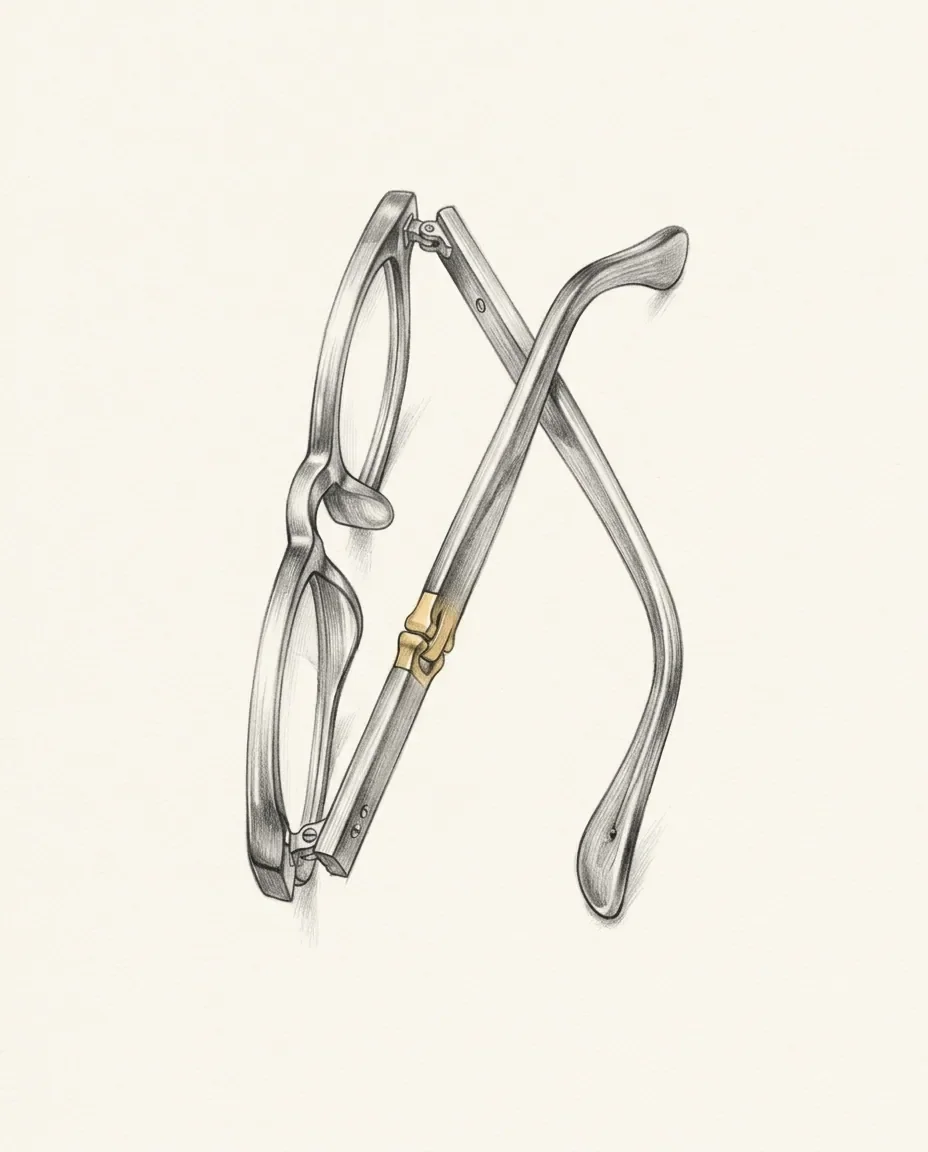
Glasses Fetish
Added 22 Jun 2026 · Updated 22 Aug 2026
A sexual or romantic attraction to people wearing eyeglasses, or to the spectacles themselves, often tied to perceptions of intelligence. Perceptions of sophistication or vulnerability are often part of it too.
- Prevalence
- Common
- Category
- Clothing & Garments
- Domain
- Sexual interest
- Confidence
- Medium confidence
- Status
- Benign aesthetic and sexual preference; not a recognized paraphilia or disorder absent distress, impairment, or non-consent.
- Also known as
- glasses fetishism, spectacle fetish, eyeglasses fetish, eyewear fetish, specs kink, meganekko (anime fandom term for a glasses-wearing character)
- Added
- 22 Jun 2026
- Updated
- 22 Aug 2026
Overview
Glasses fetishism is an erotic or romantic attraction focused on eyeglasses: on the look of a partner wearing them, on the frames as objects in their own right, or on the small rituals of putting them on, removing them, or cleaning them. Because spectacles are an everyday corrective accessory rather than an intimate garment, the interest sits at the milder, most mainstream end of clothing-and-accessory fetishism, and is widely treated as a benign aesthetic preference rather than a clinical condition. This article traces how eyewear acquired its erotic and romantic charge, how the interest is expressed, and what little the research literature says about it.
Examples
What the term covers. A stable preference for partners who wear spectacles; an eye for particular frames (heavy full-rim acetate, wire rounds, rimless, cat-eye) treated as objects worth choosing between; the small gestures that go with them, pushing frames back up the nose, folding the arms closed, breathing on a lens before cleaning it; and consensual role-play built around a studious or professorial persona, which shades into cosplay once the whole look is assembled. In Japanese fandom the same appeal attaches to the meganekko character type rather than to any real person.
What the term does not cover. An eye fetish is focused on the eyes themselves (colour, shape, gaze), where this is focused on the object in front of them, and either can exist without the other. Sapiosexuality is attraction to intelligence rather than to the accessory that signals it, and survives the discovery that the wearer is not especially bookish; a glasses fetish does not depend on that discovery either way. A mask fetish shares the idea of something worn on the face but works through concealment, which spectacles do not provide. And this is narrower than uniform or suit-and-tie fetishism, which read an entire coded outfit rather than a single corrective device.
How the word is used. "Glasses fetish" is lay vocabulary. Reference works record the interest descriptively as glasses fetishism, but it was never coined clinically and appears in neither DSM-5-TR nor ICD-11. Most people who have it do not use the word "fetish" at all: "I have a thing for people in glasses" is the ordinary phrasing, which is itself a fair indication of how mild the interest usually is.
History & origins
Clinical lineage
The sexual sense of fetishism was framed for modern sexology by the French psychologist Alfred Binet in his 1887 essay Le fétichisme dans l'amour, which borrowed the term, coined by Charles de Brosses in the eighteenth century for the religious worship of objects, and applied it to love, arguing that desire could fix on a particular body part, quality, or inanimate object first associated with early arousal. Binet's essay built on a clinical case report by Jean-Martin Charcot and Valentin Magnan (1882) and in turn shaped Richard von Krafft-Ebing's Psychopathia Sexualis (1886) and later Sigmund Freud's Three Essays on the Theory of Sexuality (1905).
These founding texts concentrated almost entirely on garments worn close to the body (shoes, gloves, underwear, hair) and eyewear was never singled out as a category. It does not appear as a named fetish in the modern clinical nosologies either: neither the DSM-5-TR nor the ICD-11 lists a spectacle-specific paraphilia, and an isolated attraction to glasses, absent distress or impairment, falls well short of the threshold for fetishistic disorder. As a result the interest has no documented clinical coinage; it is best understood as a folk-named aesthetic preference.
Cultural & subcultural evolution
Lacking a clinical pedigree, the interest entered the popular vocabulary through culture, and most visibly through Japanese fan culture. The fandom term meganekko (眼鏡っ娘, literally "glasses girl") names the endearing, bookish, glasses-wearing character archetype.
- Pre-1980: In Japan as in the West, glasses on a woman carried a faintly negative stigma, captured by the cliché that a plain woman "becomes beautiful once she takes the glasses off."
- 1980: Akira Toriyama's manga Dr. Slump and its lead character Arale Norimaki popularised the bespectacled-but-adorable type; her round frames became so iconic they lent their name to a style of "Arale glasses."
- Mid-1990s: The meganekko archetype was fully established as a recognised category in anime and manga fandom, and wearing glasses shifted from a stigma toward a fashion cue.
The same cluster of associations drives the Western "glasses are sexy" trope: and its long-running inverse, the makeover scene in which a character removes their spectacles to be "revealed" as conventionally beautiful, a convention that itself signals how strongly eyewear reads as a marker of brains over looks.
In practice
Expression is usually mild and non-explicit. Common forms include a strong, stable preference for partners who wear spectacles; aesthetic appreciation of particular frame styles, lens shapes, or rimless versus full-rim designs; collecting eyewear; or incorporating glasses into consensual role-play built around a "studious" or "librarian/professor" persona. Some people are drawn specifically to the gestures (adjusting frames, removing or replacing them, cleaning the lenses) while others respond to the way frames sit on and partly frame the eyes. Because glasses are worn in public without comment, the interest is easily satisfied within ordinary life and rarely demands any negotiated scene.
Psychology
Why are glasses seen as attractive?
Because of what they signal, not how they look on the face. The appeal is largely associative and symbolic rather than tied to a body part. Eyeglasses carry strong, well-documented cultural connotations of intelligence, competence, and seriousness, alongside a hint of vulnerability: they signal imperfect vision and draw attention to the eyes. Controlled face-perception research supports the "glasses stereotype": Leder, Forster & Gerger (2011) found that bespectacled faces were judged more intelligent and trustworthy, with full-rim frames carrying the strongest intelligence cue, while attractiveness effects depended on frame type. This blend of perceived intellect and approachability is the recurring explanation for the attraction, and it overlaps closely with sapiosexuality, the attraction to intelligence itself, and more broadly with attraction to deliberately curated dress such as a suit and tie. As with most narrow accessory interests, the formal evidence base specific to erotic attraction to glasses is thin and largely inferential.
Prevalence & culture
Glasses are an extremely common, visible accessory, which gives the interest broad low-level cultural presence even though it is rarely studied directly. Research on how spectacles shape impressions is mixed and culturally variable: Western work such as Leder and colleagues finds glasses can raise perceived intelligence and trustworthiness, whereas a Jordanian sample studied by AlRyalat et al. (2022) in Cureus rated eyeglass-wearers lower on attractiveness, confidence, and intelligence: a reminder that the "sexy glasses" association is not universal. Dedicated surveys of clothing fetishism, such as Scorolli et al. (2007), are dominated by footwear and legwear and did not isolate eyewear as a category, so any specific prevalence figure for a glasses fetish is an estimate rather than a measured value. Online, the interest sustains dedicated subreddits and fan tags rather than large standalone communities, consistent with its status as a mild, mainstream preference.
Safety, consent & law
Practised privately or with consenting adults, a glasses fetish carries no inherent safety, consent, or legal concerns. The only practical caveat is that corrective lenses are medical devices: borrowing or wearing someone else's prescription glasses for play can cause eye strain or headaches, so non-prescription or plano frames are the sensible prop. As with any kink, ordinary expectations of consent and discretion apply.
Common questions
Is having a glasses fetish normal?
Yes, in the ordinary sense of the word. An attraction to eyewear is a mild accessory preference and behaves like liking a particular hair colour or style of dress: it shapes who catches your eye without changing what you want from a relationship. It becomes a clinical matter only under the threshold that applies to every interest in this catalog: recurrent distress, genuine impairment, or acting on it with someone who has not consented. Wanting a partner to keep their glasses on meets none of those.
What does meganekko mean?
Meganekko (眼鏡っ娘) is Japanese fandom shorthand for a glasses-wearing girl character, joining megane, glasses, with a word for girl. It names an archetype (bookish, earnest, often shy) rather than a fetish, and English-speaking fans use it untranslated as a character tag. There is no equally settled term for the male equivalent, which is one reason the English "glasses fetish" reads as broader than the Japanese label it is often equated with.
What is the difference between a glasses fetish and sapiosexuality?
One responds to a signal, the other to the thing signalled. Sapiosexuality describes attraction to a person's intelligence, which requires knowing them well enough to encounter it. A glasses fetish responds to the eyewear itself and works on a stranger across a room, because spectacles carry a cultural association with intellect regardless of who is wearing them. The two overlap often enough to be confused, but they come apart the moment the wearer turns out to be nothing like the stereotype.
Is it safe to wear someone else's prescription glasses?
Not for long. Corrective lenses are medical devices ground to one person's prescription, and wearing the wrong power causes eye strain, headaches, blurred vision and, in some people, nausea and unsteadiness. None of it is lasting damage, but it makes for an uncomfortable prop and it puts an expensive pair of glasses at risk. Plano frames (non-prescription clear lenses sold as fashion eyewear) give an identical look with none of the strain, and are the sensible choice for costume or play.
Is it weird to ask a partner to keep their glasses on during sex?
No, and it is one of the more common small requests people make of each other. It is worth saying out loud rather than hinting at, because many wearers take glasses off automatically and may assume they are in the way. The caveats are physical rather than social: frames get knocked, bent and scratched, vision through a smeared lens is worse than none, and a partner who is happy to start with them on may still want them off at some point. Treat it as a preference, not a condition.
Do people with a glasses fetish like the glasses or the person wearing them?
Usually both, layered. In the common form the eyewear intensifies an attraction that is already there; the glasses are part of how someone looks rather than a substitute for them, and the same person without them is still attractive. A narrower and much rarer version treats frames as objects of interest in their own right, closer in feel to collecting than to attraction, and can attach to eyewear with no wearer involved at all.
Is there a clinical name for a glasses fetish?
No. Unlike foot or garment fetishism, eyewear was never singled out by the nineteenth-century sexologists who named most of this territory, so it has no Greek-derived coinage and no case literature behind it. Reference works list it descriptively as glasses fetishism, and no diagnostic manual contains a spectacle-specific category. The gap says something about the history of naming rather than about how common the interest is; it is far more common than plenty of interests that did get named.
- Suit and Tie Fetish33/100Clothing & GarmentsAn erotic interest centred on tailored suits, dress shirts and neckties, prized for their formality and perceived masculinity. Power symbolism and crisp tactile detail add to the appeal. It is a niche clothing fetish, not a clinical disorder.33
- Sapiosexuality56/100Identity & TransformationA self-applied identity for people who say intelligence is the trait they find most sexually or romantically attractive. Wit, knowledge and the way a mind works are what they mean, often ranked above physical appearance. Debated as an orientation versus a strong preference.56
- Skin Fetish29/100Integumentophilia · Body Parts & PartialismA focused erotic interest in human skin itself, its texture, smoothness, warmth, scent and sheen, rather than the body as a whole. The act of touching and being touched is part of it. It is generally a benign aesthetic and tactile preference.29
- Boot Fetish52/100Clothing & GarmentsA sexual interest in boots, from knee-high and thigh-high fashion styles through riding, work, combat, and military boots. They are valued for their silhouette, materials, and connotations of authority. It overlaps with shoe, leather, and uniform fetishism.52
- Lace Fetish33/100Objects & MaterialsA focused erotic interest in lace and lace-trimmed garments: their openwork pattern, sheerness, and delicate texture. The association with lingerie and intimate apparel is part of the appeal. A benign variant of material and clothing fetishism rather than a disorder.33
- Schoolgirl Uniform Fetish47/100Clothing & GarmentsAn erotic interest in school or academic uniforms (pleated skirts, blazers, neckties, and sailor-style collars) worn by consenting adults as styled costume. It is a role-coded clothing preference rather than a clinical disorder.47
Plain-English descriptive name from "glasses" (eyeglasses) plus "fetish." The fandom synonym *meganekko* is Japanese, combining *megane* (眼鏡, "glasses") with *ko/musume* (娘, "girl").
accessory fetishism · eyewear · face-focused attraction
Prevalence is computed from the entry's cited population estimate. Rows marked ESTare indicative editorial estimates scored against a fixed anchor rubric, not measured quantities. Method & anchors: methodology.
Common · ≈ 1 in 20
- 01Sexual fetishism, Wikipedia (carries the Scorolli 2007 relative-frequency table)frames clothing/accessory fetishism and Binet's 1887 sexual coinage of 'fétichisme'; eyewear not isolated as a category, so prevalence is estimated
- 02Scorolli et al. (2007), Relative prevalence of different fetishes, Int. J. Impotence Research 19(4):432-437prevalence context: clothing fetishes are dominated by legwear and footwear; eyewear was not separately measured, anchoring this as a milder/rarer accessory interest
- 03Meganekko, TV Tropesthe Japanese 'glasses girl' archetype, its post-Dr. Slump (1980) rise and mid-1990s establishment, and the intelligence/vulnerability connotations
- 04AlRyalat et al. (2022), The Effect of Wearing Eyeglasses on the Perception of Attractiveness, Confidence, and Intelligence, Cureusempirical, culturally-variable evidence on how eyeglasses shape perceived attractiveness, confidence and intelligence (Jordanian sample rated wearers lower)
- 05Glasses fetishism, Wikidata (Q3092722)establishes 'glasses fetishism' as the standard descriptive label for the interest
- 06The Origins of the Theory of Sexual Fetishism: Charcot & Magnan (1882) and Binet (1887), SpringerBinet's 1887 essay 'Le fétichisme dans l'amour' framing the sexual sense of fetishism, building on Charcot & Magnan (1882)
- 07Alfred Binet, Wikipediabiographical identification of Alfred Binet, the French psychologist who framed the sexual sense of fetishism
- 08Psychopathia Sexualis, WikipediaKrafft-Ebing's Psychopathia Sexualis (1886) as a founding sexological text in the fetishism lineage
- 09Three Essays on the Theory of Sexuality, WikipediaFreud's Three Essays (1905) extending the early clinical theory of fetishism
- 10Leder, Forster & Gerger (2011), The glasses stereotype revisited, Swiss Journal of Psychology 70(4):211-222controlled face-perception evidence that glasses-wearers are judged more intelligent and trustworthy, with frame-dependent attractiveness effects
- 11Diagnostic and Statistical Manual of Mental Disorders, 5th ed., Text Revision (DSM-5-TR), American Psychiatric AssociationDSM-5-TR does not list a spectacle-specific paraphilia; fetishistic disorder requires distress or impairment
- 12ICD-11 for Mortality and Morbidity Statistics, World Health OrganizationICD-11 does not classify an eyewear-specific paraphilic disorder