Wartenberg Wheel Play
Added 26 Jul 2026 · Updated 22 Aug 2026
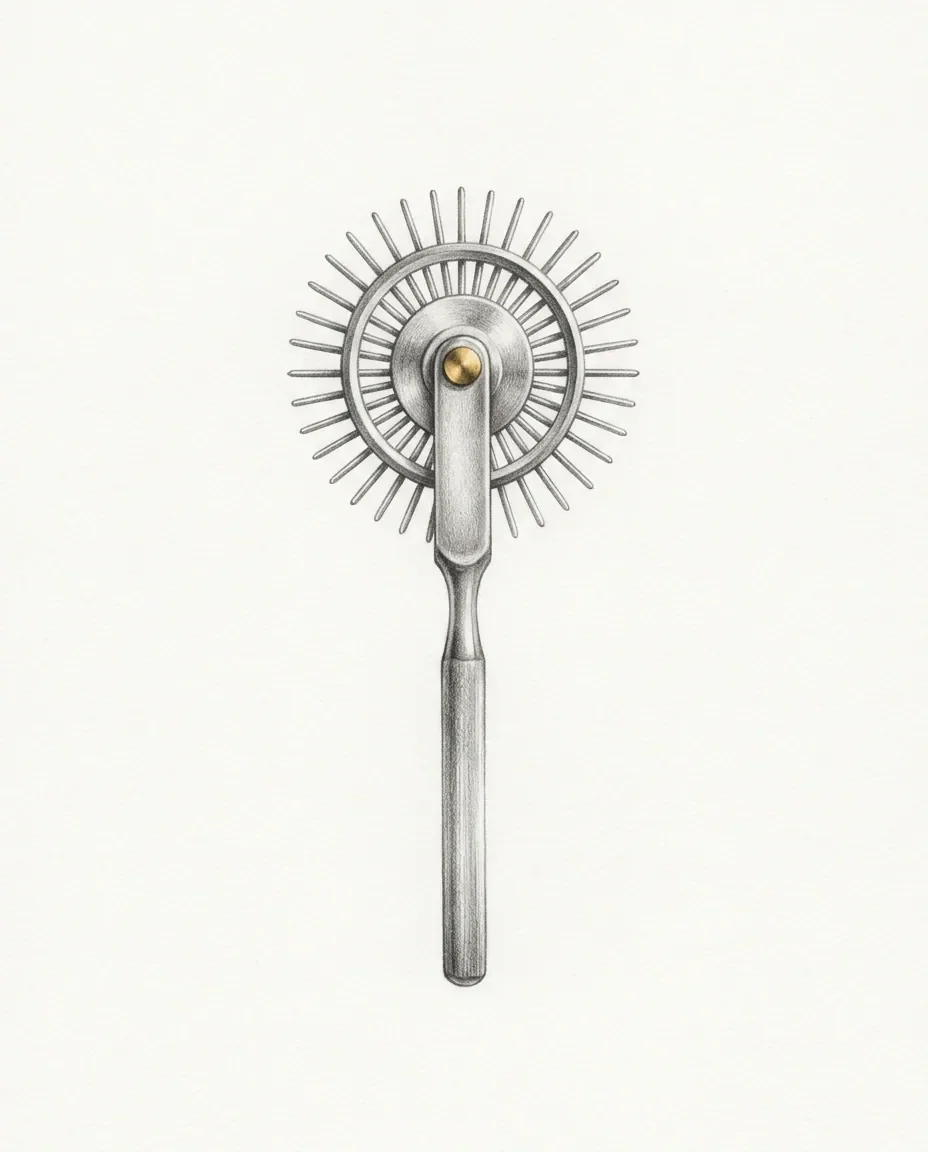
Sensation play using a Wartenberg wheel, a spiked, freely rotating pinwheel rolled across the skin to produce a prickling, tingling stimulus. The wheel was originally a neurological diagnostic instrument. It sits within broader sensation and impact-adjacent play rather than causing injury when used as intended.
- Prevalence
- Uncommon
- Category
- Sensation & Pain
- Domain
- Sexual interest
- Confidence
- Low confidence
- Status
- Not a disorder; a consensual sensation-play practice built around a repurposed clinical instrument, not classified as a paraphilia.
- Also known as
- Wartenberg pinwheel, neuro wheel, pinwheel play, spike wheel play, sensation wheel
- Added
- 26 Jul 2026
- Updated
- 22 Aug 2026
Featured in
Collection
BDSM Kinks & Dynamics
The core of BDSM: bondage, discipline, dominance, submission, sadism and masochism, each defined and ranked.
87 entries
Collection
Medical & Clinical Play
The clinic as a scene: examinations, instruments and the particular charge of clinical authority, each defined and ranked.
7 entries
Overview
Wartenberg wheel play uses a small, spiked pinwheel, an instrument built for neurological diagnosis, as a sensation-play tool: the wheel is rolled across the skin so its evenly spaced pins produce a rapid, prickling series of points of pressure, read by many as ticklish, sharp, or both depending on speed and pressure. It belongs to the broader family of sensation play and sits alongside implements such as the violet wand as a way to explore contrast and intensity on the skin without the deeper, sustained force of impact play. The tool's appeal in kink communities rests partly on its unusual double life: an object built for a doctor's exam room, repurposed for erotic sensation.
Examples
What the term covers. One tool, used many ways. A slow pass down the spine or along the inside of a forearm registers as a bright, tickling line; firmer pressure across a thigh or the sole of a foot turns sharp and tightly localised; a blindfolded partner tracking the sound and the pause before the next pass is doing the same activity with most of its content supplied by anticipation. Wheels are sold with one head or several, in stainless steel or plastic, and the number and spacing of the pins alters the sensation more than technique does. The wheel also works as a prop, brought out for its clinical look in a medical setting or doctor/nurse scene well before it touches anyone.
What the term does not cover. It is not a cutting instrument, so it is neither knife play nor needle play nor anything intended to break the skin: blood means the wheel has been pressed too hard, not that the scene has succeeded. It is not impact play, which delivers force in blows rather than rolling points, nor abrasion play, which drags a rough surface over a wider area, nor pinching and clamping, which holds steady pressure in one place. Piquerism is a clinical paraphilia centred on arousal from piercing or stabbing a person, typically without their consent, and shares nothing with a negotiated pinwheel scene beyond a loose visual resemblance.
How the word is used. "Wartenberg wheel," "pinwheel" and "neuro wheel" are used interchangeably; retailers and kink educators favour the eponym, while clinicians who still keep one call it a pinwheel. It names an instrument, not a condition: neither DSM-5-TR nor ICD-11 contains any entry for it.
History & origins
A borrowed instrument, not a purpose-built toy
The device now sold as a "Wartenberg wheel" or "Wartenberg pinwheel" was designed to test cutaneous sensitivity, the ability of skin to register a light, sharp stimulus, as part of a standard neurological exam: a clinician rolls the wheel along a patient's limb or torso to map areas of numbness or altered sensation (Wikipedia). It takes its name from the neurologist Robert Wartenberg (1887–1956), born in Grodno in the then-Russian Empire, who built his early career in Germany, heading neurology at the University of Freiburg in the early 1930s before Nazi racial laws forced him to leave the country in 1935–36. He resettled in the United States and became a clinical professor of neurology at UCSF from 1952, helped found the American Academy of Neurology, and published more than 150 papers and four books over his career (Wikipedia).
An eponym, not an invention
Wartenberg himself was explicit that he did not invent the wheel: by his own account, it was already in wide use among neurologists in Europe when he practiced in Germany, and his contribution was to champion the instrument in the United States, where he called it "an indispensable part of the outfit for everyday neurologic practice" (Wikipedia). The tool became linked with his name in American medicine largely through that advocacy rather than through any patent or first design credited to him.
From the exam room to the sensation-play scene
Clinical use of the wheel has declined since the later 20th century, in large part because a shared metal instrument passed between patients raised sterilization and infection-control concerns that disposable modern testing methods avoid (Wikipedia). Around the same period, independent of any clinical decision, kink and BDSM communities and sex-toy retailers began marketing the same design as a sensation implement, often under its clinical name, prized for the same evenly spaced, sharp-but-shallow pin pattern that made it useful for testing nerves. Educational and retail sources aimed at practitioners now describe it as one of the more accessible "beginner-friendly" sensation toys precisely because it produces a broad range of sensation from ticklish to sharp without breaking the skin when used with ordinary care (Kink Checklist).
In practice
A wheel is rolled or dragged along the skin, most often the back, chest, thighs, or soles of the feet, in single passes or repeated patterns; light pressure and a fast pass tend to register as ticklish, while more pressure and a slow, deliberate pass shifts the sensation toward sharper and more localized. It is frequently used in contrast with other tools, such as heat or ice as in temperature play, a feather, or a violet wand, to heighten the difference between sensations, and it appears in scenes framed around a clinical or medical setting precisely because the instrument itself looks the part. This is a non-explicit overview rather than an instructional guide.
Psychology
As with sensation play more broadly, the draw is usually described in terms of anticipation, sensory focus, and the psychological effect of a partner controlling an unfamiliar or slightly alarming-looking object with precision; the wheel's clinical appearance can itself heighten a scene's tension before it ever touches skin. These dynamics mirror the wider literature on BDSM participants, which finds no support for the idea that an interest in sensation or pain play reflects abuse history or sexual dysfunction, describing it instead as a benign variation in interest (Richters et al., 2008).
Prevalence & culture
There is no dedicated prevalence survey for pinwheel play specifically; it sits within the broader category of sensation and impact-adjacent kink, where general population surveys find roughly a fifth to a quarter of adults report at least some masochistic or sadistic behavior or fantasy (Joyal & Carpentier, 2017). The wheel is widely and openly sold by kink retailers and general marketplaces alike, and dedicated guides on kink-education sites treat it as a common "starter" sensation implement, which points to broad but largely unmeasured community familiarity (Kink Checklist).
Safety, consent & law
Used as intended, the wheel is considered low-risk relative to sharper implements: its pins are designed to register pressure without puncturing intact skin. Risk rises with excess pressure, repeated passes over the same spot, or use on compromised skin, any of which can break the surface and draw blood or clear fluid, at which point play should stop and the area should be cleaned. Because the wheel contacts skin directly, practitioners are advised to wash it before use and sterilize metal wheels with alcohol or a disinfectant wipe between partners and between sessions, echoing the same infection-control logic that pushed the tool out of shared clinical use. The activity is legal between consenting adults in essentially all jurisdictions; ordinary BDSM consent practice, negotiated limits and a clear stop signal, applies as it does to any sensation or impact-adjacent play.
Common questions
Is a Wartenberg wheel a good first sensation toy?
It is one of the most commonly recommended, for practical reasons: it is inexpensive, needs no power or consumables, produces a wide range of sensation from ticklish to sharp with nothing but a change in pressure, and does not break skin when used with ordinary care. What it still requires is the same negotiation, stop signal and hygiene as any other implement, and a partner who has been shown what it is beforehand.
Where should you not use a Wartenberg wheel?
Away from the face and eyes, and off any skin that is broken, sunburnt, freshly shaved, irritated, or tattooed and still healing. Moles, varicose veins and the throat are generally avoided too. Areas where a person has reduced sensation (from neuropathy, diabetes or nerve damage) deserve particular caution, because the receiving partner cannot reliably report how hard the pressure is. The same applies to anyone who has been drinking.
How do you clean a Wartenberg wheel, and can it be shared?
Wash it with soap and water, then wipe a stainless-steel wheel with isopropyl alcohol or a disinfectant wipe before and after each use. Plastic wheels tolerate less and are best treated as single-person items. Sharing a cleaned steel wheel between partners is reasonable where no skin has been broken; once the surface has been broken at any point, treat the wheel as contaminated and do not pass it on.
Does it leave marks?
Usually a faint line of red dots or a pink track that fades on its own, because the pins press the skin rather than cutting it. Firmer pressure, repeated passes along the same line, or thin skin can leave scratches or marks that last longer, and pinpoint bleeding means the pressure was too high. If the skin does break, stop, clean the area, and let it heal before using the wheel there again.
What is the difference between a Wartenberg wheel and a violet wand?
The stimulus. A wheel is purely mechanical: rolling points of pressure the receiver can feel travelling in a line. A violet wand is electrical, a repurposed early-twentieth-century electrotherapy unit producing a high-frequency, low-current spark felt as heat and prickle. The two are often used in the same scene for contrast, but one needs no power supply and the other carries electrical contraindications, including implanted medical devices.
Are Wartenberg wheels legal to buy and own?
Yes. They are sold openly both as medical instruments and as sensation toys, are not classified as weapons in ordinary use, and carry no purchase restrictions beyond the age gates that apply to adult retailers generally. Using one on a consenting adult is lawful; using one on someone who has not agreed to it is assault, exactly as it would be with any other object.
- Sensation Play45/100Sensation & PainAn interest in heightened, varied skin sensations created with soft, textured, or lightly stimulating implements. Feathers, fur, silk, brushes, ice, or pinwheels are typical, often combined with anticipation and the contrast between soothing and prickling touch. It is a common, gentle form of erotic play.45
- Temperature Play49/100Sensation & PainConsensual sensation play that uses warmth and cold, such as ice, chilled or warmed objects, and contrasting temperatures, to heighten skin sensation. It is a gentle, accessible branch of BDSM sensation play centered on thermal contrast.49
- Violet Wand Play29/100Sensation & PainViolet wand play uses a repurposed early-20th-century electrotherapy device to send a spark through glass or metal electrodes onto the skin. The spark is low-current, high-frequency and high-voltage, producing a tingling, prickling, or crackling sensation.29
- Medical Setting Kink50/100Settings & SituationsAn erotic interest in the imagery, props, and atmosphere of medical or clinical settings, enacted consensually between adults. Examination rooms, white coats, instruments, and the doctor-patient dynamic are typical. Arousal comes from the setting's blend of authority, vulnerability, care, and ritual.50
- Pinching and Clamping45/100Sensation & PainA consensual sensation-play interest in steady, focused pressure applied to the skin or sensitive areas, by the fingers or by implements. Clamps and clothespins are typical. The appeal lies in the slow build of controlled pressure and the vivid rush of sensation when it is released.45
- Fear Play33/100Sensation & PainA consensual BDSM practice that deliberately evokes controlled fear, startle, or adrenaline within a negotiated scene to heighten arousal. It draws on the body's fight-or-flight response. A niche, psychologically intense form of edge play.33
Named for the neurologist Robert Wartenberg (1887–1956), who did not invent the instrument but championed its use in American neurology after encountering it already in wide clinical use in Germany.
sensation play · pinwheel · medical instrument · tactile
Prevalence is computed from the entry's cited population estimate. Rows marked ESTare indicative editorial estimates scored against a fixed anchor rubric, not measured quantities. Method & anchors: methodology.
Uncommon · ≈ 1 in 100
- 01Wartenberg wheel, WikipediaClinical description, original neurological diagnostic purpose, decline in clinical use, and its adoption as a sensation-play/BDSM implement.
- 02Robert Wartenberg, WikipediaBiography of Robert Wartenberg (1887-1956): career in Freiburg, forced emigration in 1935-36, UCSF appointment, and founding role in the American Academy of Neurology.
- 03Wartenberg Pinwheels, Safety Guide for Couples, Kink ChecklistPractitioner-facing description of the wheel as a common sensation-play implement and its safety guidance.
- 04Joyal & Carpentier (2017), The Prevalence of Paraphilic Interests and Behaviors in the General Population, J. Sex Research 54(2):161-171General-population rates of masochistic/sadistic behavior and interest, used as context for sensation/impact-adjacent play prevalence.
- 05Richters et al. (2008), Demographic and Psychosocial Features of Participants in BDSM: Data from a National Survey, J. Sexual Medicine 5(7):1660-1668Finding that BDSM/sensation-play interest is not linked to abuse history or sexual dysfunction.
- 06DSM-5-TR, Paraphilic Disorders (American Psychiatric Association, 2022)Consensual sensation/impact-adjacent play is not a paraphilic disorder absent distress, impairment or non-consent.